Energy in simple harmonic motion · Énergie dans le mouvement harmonique simple
| English | Français |
|---|---|
| equilibrium/ˌiːkwɪˈlɪbrɪəm/ | équilibre |
| damping/ˈdæmpɪŋ/ | amortissement |
Where the energy goes at the top of a swing
- At the highest point of a swing you are, for an instant, completely still. Your kinetic energy is exactly zero.
- A moment later you are moving faster than at any other point in the arc. Nothing pushed you; the energy was never gone.
- It was in the potential store, and it came straight back out. An oscillation is that exchange, repeated for as long as friction allows.
- This lesson is the energy of an oscillator: how it swaps, why the total is constant, and why the total depends on the square of the amplitude.
Où va l'énergie au sommet d'une oscillation
- Au point le plus haut d'une oscillation, vous êtes, pendant un instant, complètement immobile. Votre énergie cinétique est exactement nulle.
- Un instant plus tard, vous allez plus vite qu'à tout autre point de l'arc. Rien ne vous a poussé ; l'énergie n'a jamais disparu.
- Elle était dans le stock d'énergie potentielle, et elle est revenue directement. Une oscillation, c'est cet échange, répété aussi longtemps que le frottement le permet.
- Cette leçon porte sur l'énergie d'un oscillateur : comment elle change, pourquoi le total est constant, et pourquoi le total dépend du carré de l'amplitude.
The swap
- At the equilibrium 平衡 position the speed is greatest, so the kinetic energy is maximum and the potential energy is at its minimum.
- At the extremes the oscillator is momentarily at rest, so the kinetic energy is zero and the potential energy is at its maximum.
- In between, the two trade continuously. The exchange happens twice per full oscillation, since the oscillator passes through the centre twice.
Two curves in opposite phase, and a flat line above them
L'échange
- À la position d'équilibre 平衡 position, la vitesse est maximale, donc l'énergie cinétique est maximale et l'énergie potentielle est à son minimum.
- Aux extrémités, l'oscillateur est momentanément au repos, donc l'énergie cinétique est nulle et l'énergie potentielle est à son maximum.
- Entre les deux, les deux énergies échangent continuellement. L'échange a lieu deux fois par oscillation complète, car l'oscillateur traverse le centre deux fois.
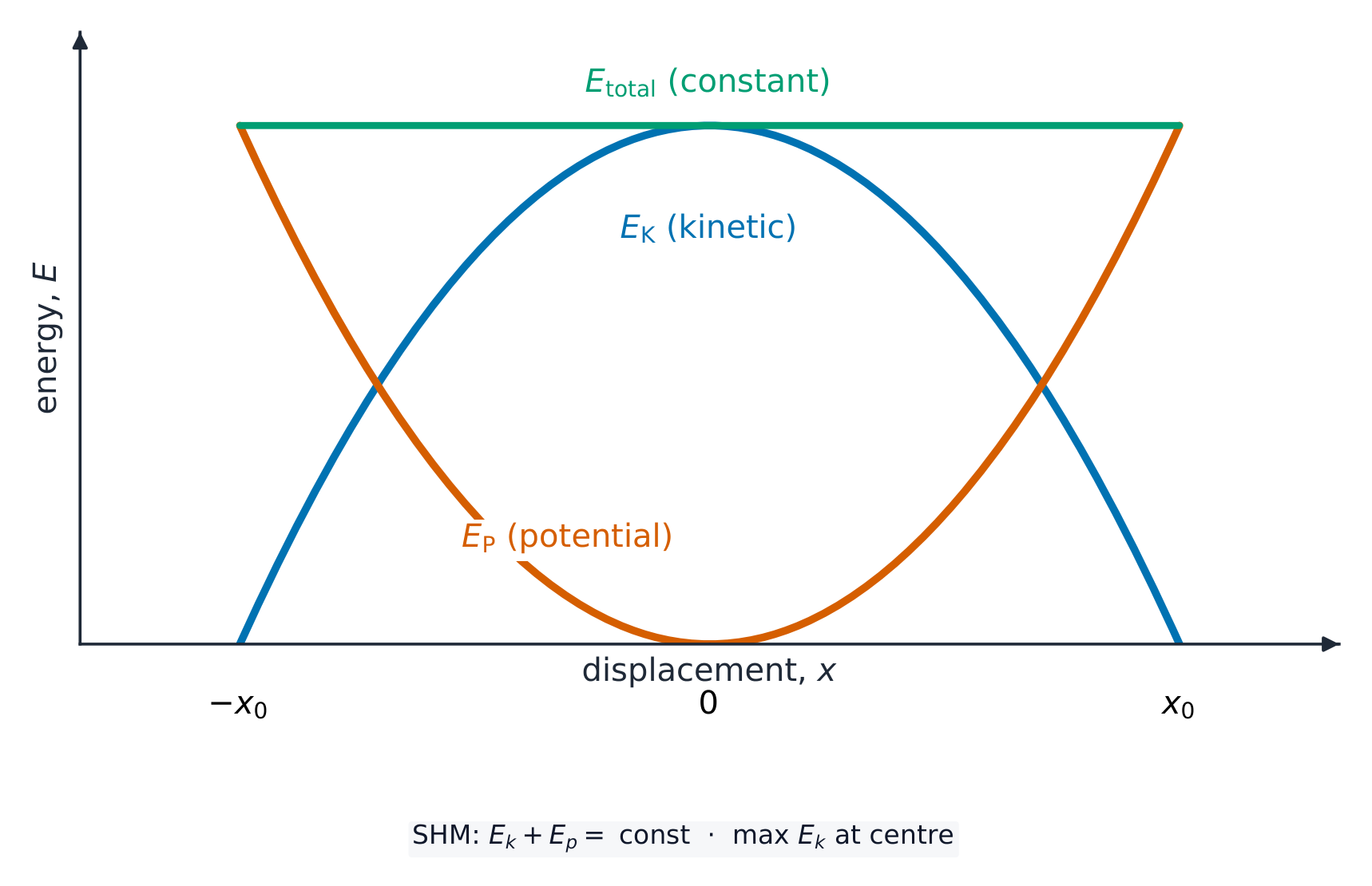
Deux courbes en opposition de phase, et une ligne plate au-dessus d'elles
The kinetic energy of an oscillator is greatest: · L'énergie cinétique d'un oscillateur est maximale :
Speed is greatest at the middle, so KE peaks there while PE is at its lowest. · La vitesse est maximale au centre, donc l'EC atteint son maximum là tandis que l'EP est au minimum.
At the extreme positions of the motion, all the energy is potential. · Aux positions extrêmes du mouvement, toute l'énergie est potentielle.
The oscillator is momentarily at rest there, so KE = 0 and all the energy is potential. · L'oscillateur est momentanément au repos là, donc EC = 0 et toute l'énergie est potentielle.
The total is constant
- With no damping 阻尼, no resistive force removing energy, the total energy stays constant. This is conservation of energy applied to the oscillator.
- The easiest place to evaluate it is at the centre, where all of it is kinetic and the speed is $\omega x_0$:
- On a graph against displacement, the kinetic energy is a downward parabola, the potential energy an upward one, and their sum is a horizontal line.
The two parabolas add to a constant at every displacement
Le total est constant
- Sans amortissement 阻尼, aucune force de résistance n'enlève de l'énergie, l'énergie totale reste constante. C'est la conservation de l'énergie appliquée à l'oscillateur.
- L'endroit le plus facile pour l'évaluer est au centre, où toute l'énergie est cinétique et la vitesse est $\omega x_0$ :
- Sur un graphique en fonction du déplacement, l'énergie cinétique est une parabole vers le bas, l'énergie potentielle une parabole vers le haut, et leur somme est une ligne horizontale.
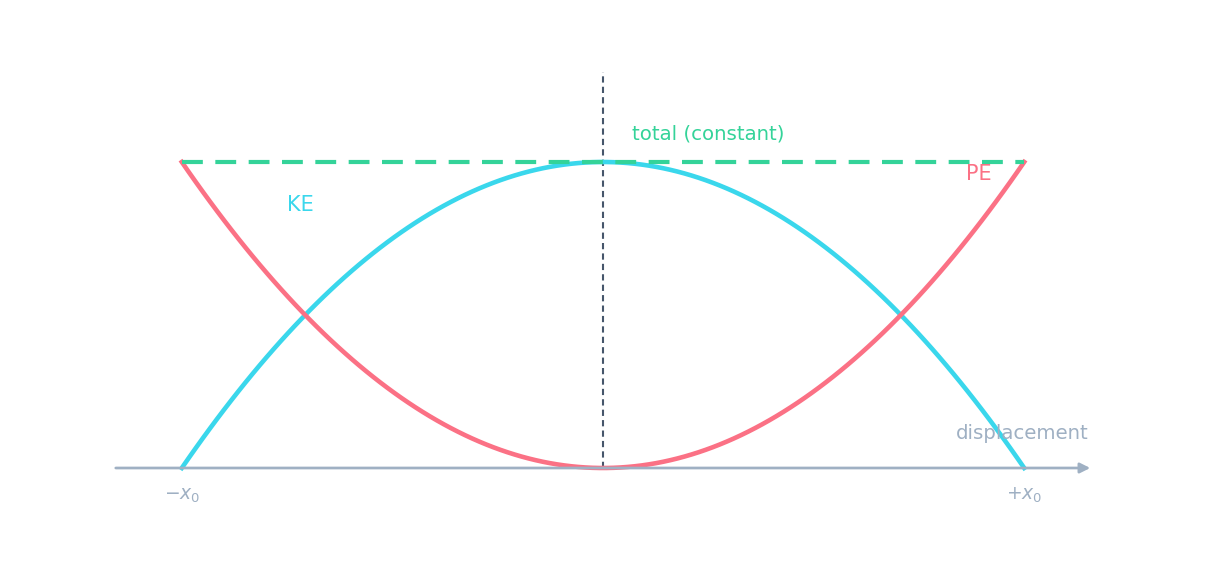
Les deux paraboles s'additionnent pour donner une constante à tout déplacement
Energy in SHM · Énergie en MHS
KE + PE = constant · EC + EP = constante
Energy trades between kinetic (fastest at the centre) and potential (max at the ends). · L'énergie alterne entre cinétique (maximale au centre) et potentielle (maximale aux extrémités).
With no damping, the total energy of an oscillator stays constant. · Sans amortissement, l'énergie totale d'un oscillateur reste constante.
Energy just swaps between KE and PE; their sum is conserved. · L'énergie alterne simplement entre EC et EP ; leur somme est conservée.
Energy and amplitude
- Because $E = \tfrac12 m\omega^2 x_0^2$, the total energy is proportional to the square of the amplitude.
- Double the amplitude and the energy is four times as large. Triple it and the energy is nine times.
- This is the relationship the exam tests most often, and answering "twice" for a doubled amplitude is the commonest error in the subtopic.
Énergie et amplitude
- Puisque $E = \tfrac12 m\omega^2 x_0^2$, l'énergie totale est proportionnelle au carré de l'amplitude.
- Doublez l'amplitude et l'énergie devient quatre fois plus grande. Triplez-la et l'énergie devient neuf fois plus grande.
- C'est la relation testée le plus souvent dans les examens, et répondre « double » pour une amplitude doublée est l'erreur la plus fréquente dans ce sous-thème.
If the amplitude doubles, the total energy of an oscillator becomes: · Si l'amplitude double, l'énergie totale d'un oscillateur devient :
$E \propto x_0^{2}$, so doubling $x_0$ gives $2^{2} = 4$ times the energy. · $E \propto x_0^{2}$, donc doubler $x_0$ donne $2^{2} = 4$ fois l'énergie.
The amplitude of an undamped oscillator is doubled. What happens to its total energy? · L'amplitude d'un oscillateur non amorti est doublée. Que se passe-t-il pour son énergie totale ?
E is proportional to the square of the amplitude, from E = m omega^2 x0^2 / 2. Answering "twice" is the commonest error in this subtopic. · E est proportionnel au carré de l'amplitude, selon E = m omega^2 x0^2 / 2. Répondre "double" est l'erreur la plus fréquente dans ce sous-domaine.
Worked example: find the total energy
- An oscillator of mass $0.20\ \text{kg}$ has angular frequency $10\ \text{rad/s}$ and amplitude $0.050\ \text{m}$. Find its total energy and its kinetic energy at a displacement of $0.030\ \text{m}$.
- Total: $E = \tfrac12 m \omega^2 x_0^2 = \tfrac12 \times 0.20 \times 10^2 \times 0.050^2 = 0.025\ \text{J}$.
- At $x = 0.030\ \text{m}$: $v = \omega\sqrt{x_0^2 - x^2} = 10\sqrt{0.050^2 - 0.030^2} = 0.40\ \text{m/s}$, so $E_{\text{k}} = \tfrac12 \times 0.20 \times 0.40^2 = 0.016\ \text{J}$.
- The potential energy there is the difference, $0.025 - 0.016 = 0.009\ \text{J}$. Using the constant total to get the second energy is quicker and safer than a separate formula.
Exemple résolu : trouver l'énergie totale
- Un oscillateur de masse $0.20\ \text{kg}$ a une pulsation $10\ \text{rad/s}$ et une amplitude $0.050\ \text{m}$. Trouvez son énergie totale et son énergie cinétique à un déplacement de $0.030\ \text{m}$.
- Total : $E = \tfrac12 m \omega^2 x_0^2 = \tfrac12 \times 0.20 \times 10^2 \times 0.050^2 = 0.025\ \text{J}$.
- À $x = 0.030\ \text{m}$ : $v = \omega\sqrt{x_0^2 - x^2} = 10\sqrt{0.050^2 - 0.030^2} = 0.40\ \text{m/s}$, donc $E_{\text{k}} = \tfrac12 \times 0.20 \times 0.40^2 = 0.016\ \text{J}$.
- L'énergie potentielle à cet endroit est la différence, $0.025 - 0.016 = 0.009\ \text{J}$. Utiliser le total constant pour obtenir la seconde énergie est plus rapide et plus sûr qu'une formule séparée.
An oscillator has $m = 0.20\ \text{kg}$, $\omega = 10\ \dfrac{\text{rad}}{\text{s}}$ and amplitude $0.10\ \text{m}$. What is its total energy? · Un oscillateur a une masse $m = 0.20\ \text{kg}$, une pulsation $\omega = 10\ \dfrac{\text{rad}}{\text{s}}$ et une amplitude $0.10\ \text{m}$. Quelle est son énergie totale ?
$E = \tfrac{1}{2}m\omega^{2}x_0^{2} = \tfrac{1}{2} \times 0.20 \times 10^{2} \times 0.10^{2} = 0.10\ \text{J}$.
An oscillator of mass 0.20 kg has omega = 10 rad/s and amplitude 0.050 m. What is its total energy, in joules? · Un oscillateur de masse 0.20 kg a une pulsation ω = 10 rad/s et une amplitude 0.050 m. Quelle est son énergie totale, en joules ?
E = m omega^2 x0^2 / 2 = 0.20 x 100 x 0.0025 / 2 = 0.025 J. Evaluating at the centre, where all the energy is kinetic, is the quickest route. · E = m ω^2 x₀^2 / 2 = 0.20 × 100 × 0.0025 / 2 = 0.025 J. L'évaluation au centre, où toute l'énergie est cinétique, est la méthode la plus rapide.
If the total energy is 0.025 J and the kinetic energy at some displacement is 0.016 J, the potential energy there is ____ J. · Si l'énergie totale est 0.025 J et l'énergie cinétique à un déplacement donné est 0.016 J, l'énergie potentielle à cet endroit est ____ J.
The total is constant, so the potential energy is simply the total minus the kinetic. That subtraction is quicker and safer than a separate formula. · Le total étant constant, l'énergie potentielle est simplement le total moins l'énergie cinétique. Cette soustraction est plus rapide et plus sûre qu'une formule séparée.
Worked example: reading the energy graphs
- Sketch how the kinetic energy, the potential energy and the total energy of an undamped oscillator vary with displacement.
- Kinetic energy: maximum at $x = 0$, falling to zero at $x = \pm x_0$, a downward parabola.
- Potential energy: zero at $x = 0$, rising to the maximum at $x = \pm x_0$, an upward parabola, and the mirror image of the first.
- Total: a horizontal line at the value of either maximum, since the two curves always add to the same amount.
- Against time instead of displacement, both curves are still parabola-shaped in energy but now oscillate at twice the frequency of the displacement, because energy peaks twice per cycle.
Exemple résolu : lire les graphiques d'énergie
- Esquissez comment l'énergie cinétique, l'énergie potentielle et l'énergie totale d'un oscillateur non amorti varient avec le déplacement.
- Énergie cinétique : maximale à $x = 0$, décroissant jusqu'à zéro à $x = \pm x_0$, une parabole vers le bas.
- Énergie potentielle : nulle à $x = 0$, croissant jusqu'au maximum à $x = \pm x_0$, une parabole vers le haut, et l'image miroir de la première.
- Total : une ligne horizontale à la valeur de l'un des maxima, puisque les deux courbes s'additionnent toujours au même montant.
- Contre le temps au lieu du déplacement, les deux courbes restent de forme parabolique en énergie mais oscillent maintenant à double fréquence du déplacement, car les pics d'énergie surviennent deux fois par cycle.
Match each energy of an undamped oscillator to its graph against displacement. · Reliez chaque forme d'énergie d'un oscillateur non amorti à son graphique en fonction du déplacement.
The two parabolas are mirror images, so they add to the same value at every displacement. That flat line is conservation of energy drawn out. · Les deux paraboles sont symétriques, donc elles s'additionnent pour donner la même valeur à tout déplacement. Cette ligne plate représente la conservation de l'énergie.
Plotted against time, the kinetic energy of an oscillator repeats at twice the frequency of the displacement. · Tracé en fonction du temps, l'énergie cinétique d'un oscillateur se répète à une fréquence double de celle du déplacement.
The oscillator passes through the centre twice per cycle, so kinetic energy peaks twice per cycle while displacement peaks once. · L'oscillateur traverse le centre deux fois par cycle, donc l'énergie cinétique atteint son maximum deux fois par cycle alors que le déplacement n'atteint son maximum qu'une fois.
Energy against time runs at double the frequency
- Plot the displacement against time and you get one cycle per period. Plot the kinetic energy against time and you get two.
- The reason is the square. Kinetic energy depends on $v^2$, and $v$ passes through its maximum magnitude twice in every cycle, once going each way.
- So both energy curves complete two maxima per oscillation, and their frequency is double that of the displacement.
- The two curves are exact mirrors of each other about the half-total line, and their sum is a horizontal line at the total energy.
- A sketch question here is marked on three things: the doubled frequency, the two curves being out of step by half their period, and the flat total.
L'énergie contre le temps a une fréquence double
- Tracez le déplacement en fonction du temps et vous obtenez un cycle par période. Tracez l'énergie cinétique en fonction du temps et vous en obtenez deux.
- La raison est le carré. L'énergie cinétique dépend de $v^2$, et $v$ passe par son amplitude maximale deux fois à chaque cycle, une fois dans chaque sens.
- Donc les deux courbes d'énergie complètent deux maxima par oscillation, et leur fréquence est double celle du déplacement.
- Les deux courbes sont des miroirs exacts l'une de l'autre autour de la ligne moitié-total, et leur somme est une ligne horizontale à l'énergie totale.
- Une question d'esquisse ici est notée sur trois points : la fréquence doublée, les deux courbes étant décalées d'un demi-période l'une par rapport à l'autre, et le total plat.
The kinetic energy of an oscillator varies at twice the frequency of its displacement. · L'énergie cinétique d'un oscillateur varie à une fréquence double de celle de son déplacement.
KE depends on v squared, and the speed reaches its maximum twice per cycle, once in each direction. The potential energy does the same, and the two sum to a flat line. · L'EC dépend de v carré, et la vitesse atteint son maximum deux fois par cycle, une fois dans chaque sens. L'énergie potentielle fait de même, et les deux s'additionnent pour former une ligne plate.
Marks that slip away
- Energy is proportional to amplitude squared. Doubling the amplitude gives four times the energy, not twice.
- Kinetic energy is maximum at the centre, potential at the ends. Do not swap them.
- Against time, the energy curves repeat at twice the frequency of the displacement, because there are two energy peaks per oscillation.
- The total is constant only when there is no damping. Say so when the question mentions resistive forces.
Pièges qui font perdre des points
- L'énergie est proportionnelle au carré de l'amplitude. Doubler l'amplitude donne quatre fois l'énergie, pas deux fois.
- L'énergie cinétique est maximale au centre, potentielle aux extrémités. Ne les inversez pas.
- Contre le temps, les courbes d'énergie se répètent à double fréquence du déplacement, car il y a deux pics d'énergie par oscillation.
- Le total est constant uniquement lorsqu'il n'y a pas d'amortissement. Dites-le quand la question mentionne des forces de résistance.
You've got it
- kinetic energy is maximum at the centre and zero at the extremes; potential energy does the opposite, and they exchange twice per cycle
- with no damping the total is constant: $E = \tfrac12 m\omega^2 x_0^2$, most easily evaluated at the centre where all of it is kinetic
- against displacement the energies are two opposite parabolas whose sum is a horizontal line
- $E \propto x_0^2$: double the amplitude, four times the energy
Vous avez compris
- l'énergie cinétique est maximale au centre et nulle aux extrémités ; l'énergie potentielle fait l'inverse, et elles échangent deux fois par cycle
- sans amortissement le total est constant : $E = \tfrac12 m\omega^2 x_0^2$, évalué le plus facilement au centre où toute l'énergie est cinétique
- contre le déplacement, les énergies sont deux paraboles opposées dont la somme est une ligne horizontale
- $E \propto x_0^2$ : doublez l'amplitude, quatre fois l'énergie