Elastic and plastic behaviour · Comportement élastique et plastique
| English | Français |
|---|---|
| elastic/ɪˈlæstɪk/ | élastique |
| plastic/ˈplæstɪk/ | plastique |
| limit of proportionality/ˈlɪmɪt ɒv prəˌpɔːʃəˈnælɪti/ | limite de proportionnalité |
| elastic limit/ɪˈlæstɪk ˈlɪmɪt/ | limite élastique |
| permanent extension/ˈpɜːmənənt ekˈstenʃn/ | allongement permanent |
The paperclip test
- Bend a paperclip a little and it springs back — elastic 弹性.
- Bend it far and it stays bent — plastic 塑性.
- The same material can do both, depending on how hard you push it.
Le test du trombone
- Pliez un trombone légèrement et il rebondit — élastique 弹性.
- Pliez-le fort et il reste plié — plastique 塑性.
- Le même matériau peut faire les deux, selon la force exercée.
Three stages of stretching
- Elastic and straight — obeys Hooke's law; returns to shape.
- Elastic but curved — past the limit of proportionality 比例极限; still returns to shape.
- Plastic — past the elastic limit 弹性极限; a permanent change is left.
A stress-strain graph, straight up to the limit of proportionality P
Trois stades d'étirement
- Élastique et droit — obéit à la loi de Hooke ; revient à la forme.
- Élastique mais courbé — après la limite de proportionnalité 比例极限 ; revient encore à la forme.
- Plastique — après la limite élastique 弹性极限 ; un changement permanent est laissé.
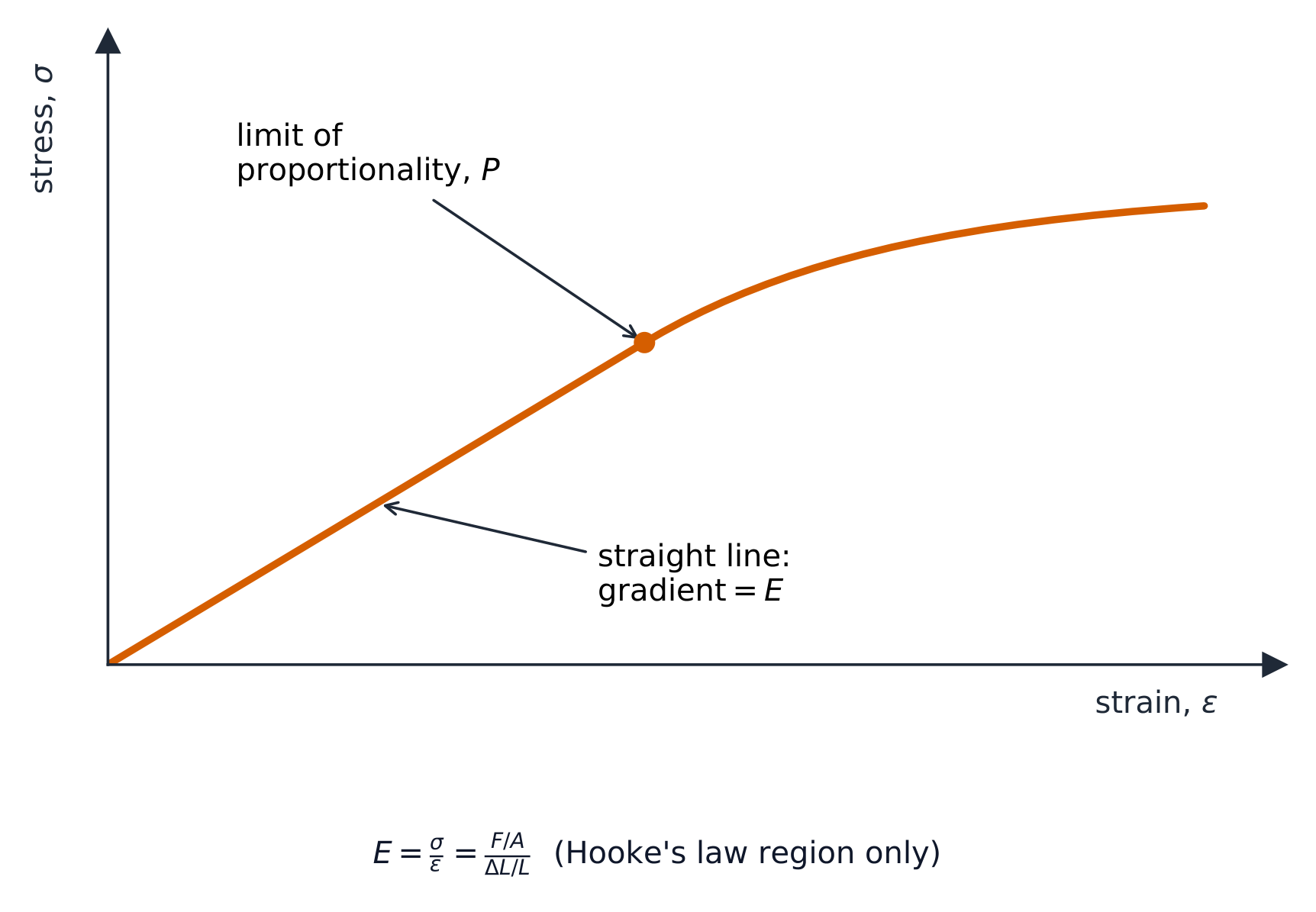
Un graphique contrainte-déformation, droit jusqu'à la limite de proportionnalité P
Hooke's law · Loi de Hooke
F = kx
Up to the limit, extension is proportional to force — the gradient is the spring constant k. · Jusqu'à la limite, l'allongement est proportionnel à la force — la pente est la constante de raideur k.
Match each stage of stretching to what happens. · Reliez chaque étape de l'étirement à ce qui se produit.
Elastic = returns to its first length on unloading; plastic = a permanent change once you pass the elastic limit. · Élastique = reprend sa longueur initiale lors du déchargement ; plastique = changement permanent une fois la limite élastique franchie.
Loading and unloading
- Stretch past the elastic limit, then remove the load.
- The unloading line is parallel to the first line but shifted — leaving a permanent extension 永久伸长.
Chargement et déchargement
- Étirez au-delà de la limite élastique, puis retirez la charge.
- La ligne de déchargement est parallèle à la première mais décalée — laissant une extension permanente 永久伸长.
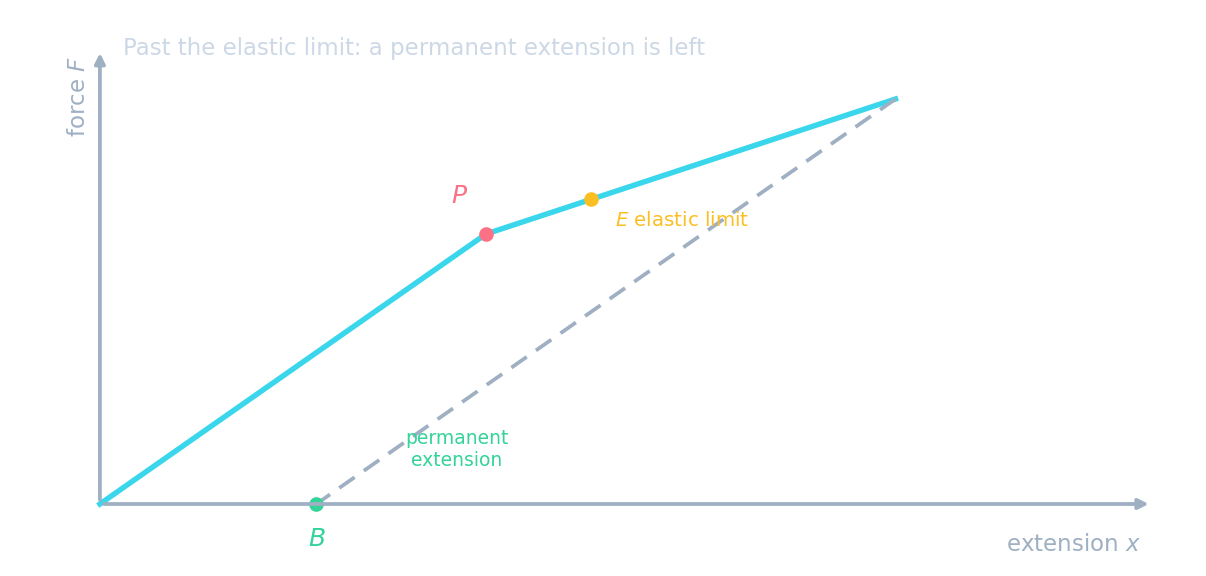
Past the elastic limit, an object returns to its original length when the load is removed. · Au-delà de la limite élastique, un objet reprend sa longueur initiale lorsque la charge est retirée.
No — in the plastic region a permanent extension stays after unloading. · Non — dans la zone plastique, une extension permanente persiste après déchargement.
Match each term to the definition the examiner marks. · Reliez chaque terme à la définition marquée par l'examinateur.
The elastic limit sits a little beyond the limit of proportionality, so a material can stop obeying Hooke's law while still being elastic. · La limite élastique se situe un peu au-delà de la limite de proportionnalité, donc un matériau peut cesser d'obéir à la loi de Hooke tout en restant élastique.
Energy = area under the graph
- The work done stretching a material is the area under its force–extension graph.
Énergie = aire sous la courbe
- Le travail effectué pour étirer un matériau est l'aire sous son graphique force-extension.
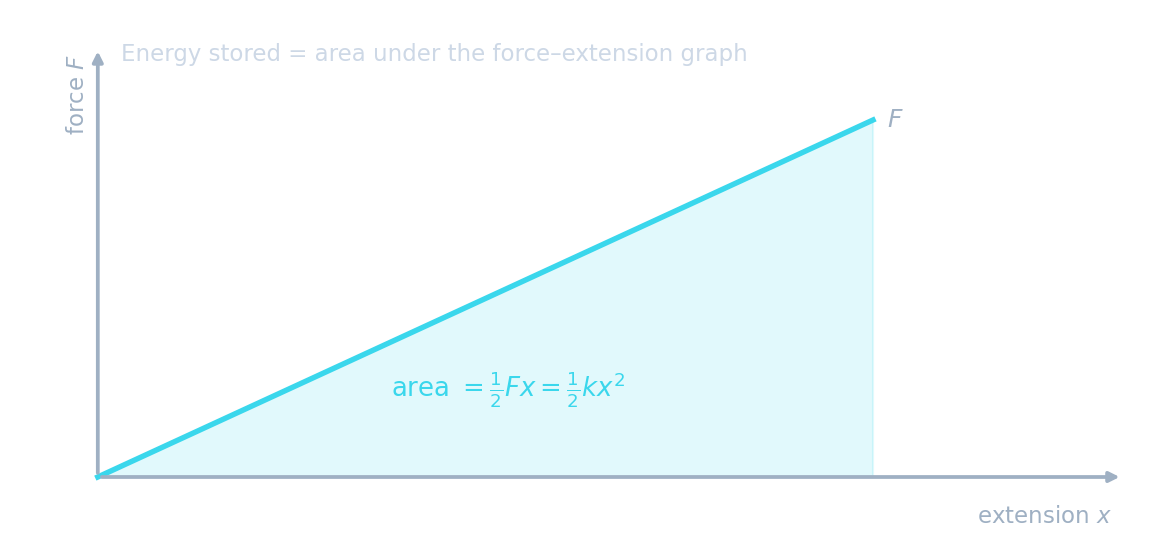
The energy stored in a stretched material equals the ____ under the force–extension graph. · L'énergie stockée dans un matériau étiré est égale à la ____ sous le graphique force-allongement.
Work done = area under the force–extension graph (a triangle for a Hooke material). · Travail = aire sous le graphique force-allongement (un triangle pour un matériau obéissant à Hooke).
Stored elastic energy
- For a Hooke's-law material the area is a triangle: $E_{\text{P}} = \tfrac{1}{2}Fx = \tfrac{1}{2}kx^{2}$.
- An equal form is $E_{\text{P}} = \dfrac{F^{2}}{2k}$.
Force-extension past the elastic limit: P and E marked, with a permanent extension B left after unloading
Énergie élastique stockée
- Pour un matériau obeyant à la loi de Hooke, l'aire est un triangle : $E_{\text{P}} = \tfrac{1}{2}Fx = \tfrac{1}{2}kx^{2}$.
- Une forme équivalente est $E_{\text{P}} = \dfrac{F^{2}}{2k}$.
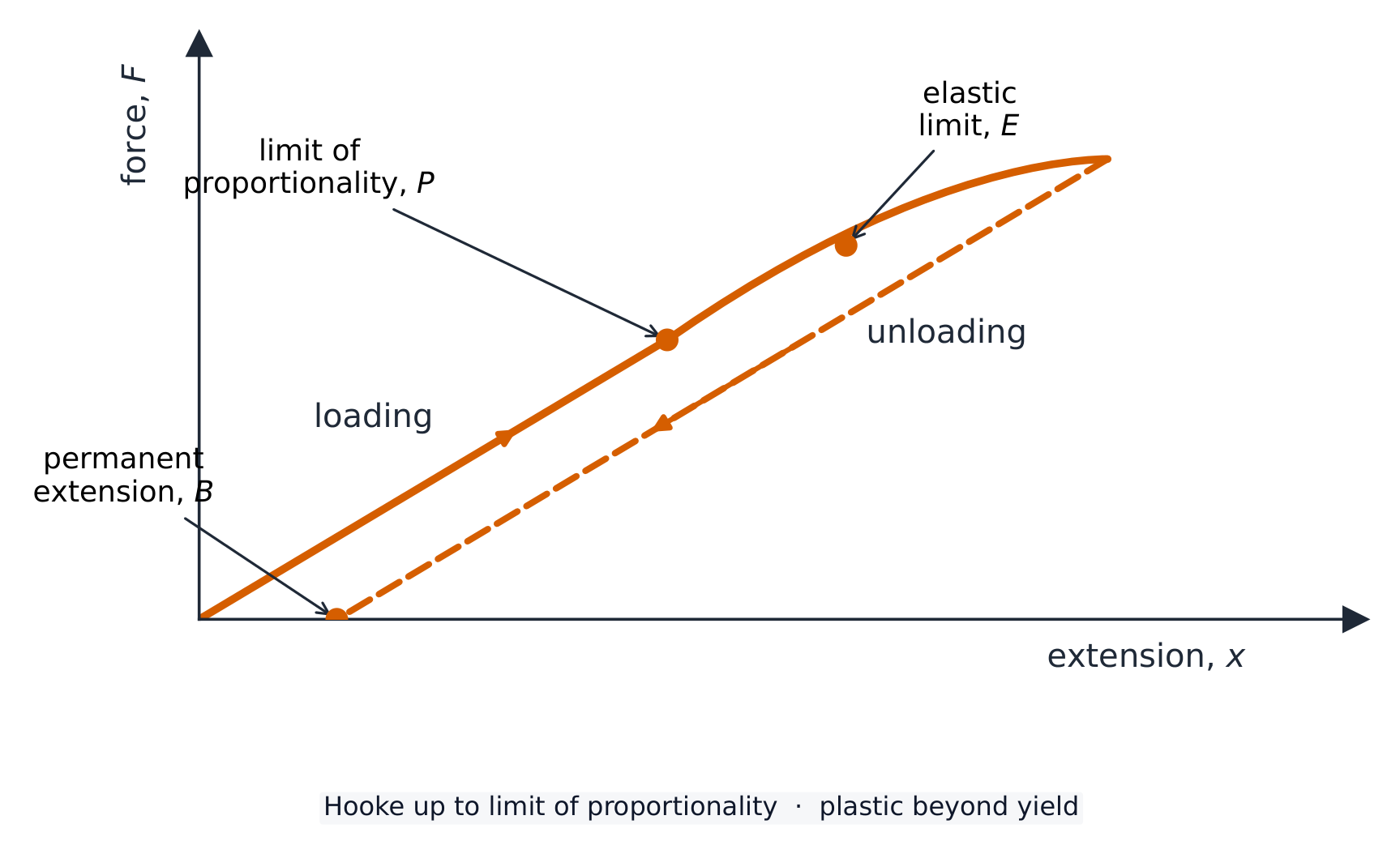
Force-extension après la limite élastique : P et E marqués, avec une extension permanente B laissée après le déchargement
A spring of constant $200\ \dfrac{\text{N}}{\text{m}}$ is stretched by $0.10\ \text{m}$. How much elastic PE is stored? · Un ressort de constante $200\ \dfrac{\text{N}}{\text{m}}$ est étiré de $0.10\ \text{m}$. Quelle énergie potentielle élastique est stockée ?
$E_{\text{P}} = \tfrac{1}{2}kx^{2} = \tfrac{1}{2} \times 200 \times 0.10^{2} = 1.0\ \text{J}$.
When it's not a straight line
- For rubber, or a spring past its limit, the graph is a curve.
- Find the area by counting squares or using trapezia — the rule is the same.
Quand ce n'est pas une ligne droite
- Pour le caoutchouc, ou un ressort après sa limite, le graphique est une courbe.
- Trouvez l'aire en comptant les cases ou en utilisant des trapèzes — la règle est la même.
Comparing and releasing
- Same force, softer spring (smaller $k$) → bigger $x$ → more energy stored.
- Released onto a mass, the elastic PE becomes kinetic energy: $\tfrac{1}{2}kx^{2} = \tfrac{1}{2}mv^{2}$.
Comparer et relâcher
- Même force, ressort plus mou (plus petit $k$) → plus grand $x$ → plus d'énergie stockée.
- Relâché sur une masse, la PE élastique devient EC : $\tfrac{1}{2}kx^{2} = \tfrac{1}{2}mv^{2}$.
Two springs are pulled with the same force. The softer spring (smaller $k$) stores: · Deux ressorts sont tirés avec la même force. Le ressort plus mou (constante $k$ plus petite) stocke :
Same $F$, smaller $k$ → larger extension $x$ → larger area $\tfrac{1}{2}Fx$, so more energy is stored. · Même $F$, plus petite $k$ → plus grand allongement $x$ → plus grande aire $\tfrac{1}{2}Fx$, donc plus d'énergie est stockée.
When a stretched spring is released onto a mass, its elastic PE becomes ____ energy. · Lorsqu'un ressort étiré est relâché sur une masse, son PE élastique devient ____ énergie.
Set · Définir $\tfrac{1}{2}kx^{2} = \tfrac{1}{2}mv^{2}$ (plus $mgh$ if it rises) to find the speed. · Poser $\tfrac{1}{2}kx^{2} = \tfrac{1}{2}mv^{2}$ (plus $mgh$ s'il monte) pour trouver la vitesse.
Worked example: energy from a graph
- A spring of spring constant $40\ \text{N/m}$ is stretched by $0.10\ \text{m}$. Find the energy stored, and the extra energy needed to stretch it to $0.20\ \text{m}$.
- Energy stored is the area under the force-extension line, a triangle: $E = \tfrac{1}{2}kx^2 = \tfrac{1}{2}(40)(0.10)^2 = 0.20\ \text{J}$.
- At $0.20\ \text{m}$: $E = \tfrac{1}{2}(40)(0.20)^2 = 0.80\ \text{J}$.
- The extra energy is the difference, $0.80 - 0.20 = 0.60\ \text{J}$, not $0.20\ \text{J}$ again.
- Energy goes as $x^2$: doubling the extension gives four times the energy, so the second half of a stretch always costs more than the first.
Exemple résolu : énergie depuis un graphique
- Un ressort de constante de raideur $40\ \text{N/m}$ est étiré de $0.10\ \text{m}$. Trouvez l'énergie emmagasinée et l'énergie supplémentaire nécessaire pour l'étirer jusqu'à $0.20\ \text{m}$.
- L'énergie emmagasinée correspond à la surface sous la droite force-allongement, un triangle : $E = \tfrac{1}{2}kx^2 = \tfrac{1}{2}(40)(0.10)^2 = 0.20\ \text{J}$.
- À $0.20\ \text{m}$ : $E = \tfrac{1}{2}(40)(0.20)^2 = 0.80\ \text{J}$.
- L'énergie supplémentaire est la différence, $0.80 - 0.20 = 0.60\ \text{J}$, et non pas $0.20\ \text{J}$ encore une fois.
- L'énergie varie comme $x^2$ : doubler l'allongement multiplie l'énergie par quatre, donc la seconde moitié d'un étirement coûte toujours plus cher que la première.
Marks that slip away
- On a force-extension graph the area is the energy and the gradient is the spring constant. Reading one for the other loses the whole question.
- Energy stored goes as $x^2$, not as $x$. The work between two extensions is the difference of two $\tfrac{1}{2}kx^2$ values.
- Elastic deformation returns to the original length when the force is removed; plastic deformation leaves a permanent extension.
- On a length-force graph only the part beyond the original length $L_0$ is extension. The area right down to the axis is not work.
- For a curved line the area must be estimated by counting squares, because $\tfrac{1}{2}kx^2$ assumes a straight line.
Pièges qui font perdre des points
- Sur un graphique force-allongement, la surface représente l'énergie et la pente représente la constante de raideur. Lire l'une pour l'autre annule toute la question.
- L'énergie emmagasinée varie comme $x^2$, et non comme $x$. Le travail effectué entre deux allongements est la différence de deux valeurs $\tfrac{1}{2}kx^2$.
- La déformation élastique revient à sa longueur initiale lorsque la force est supprimée ; la déformation plastique laisse un allongement permanent.
- Sur un graphique longueur-force, seule la partie au-delà de la longueur initiale $L_0$ correspond à un allongement. La surface descendant jusqu'à l'axe n'est pas du travail.
- Pour une courbe, la surface doit être estimée en comptant les carreaux, car $\tfrac{1}{2}kx^2$ suppose une ligne droite.
A spring of spring constant 40 N/m is stretched from 0.10 m to 0.20 m. How much extra energy does that take, in J? · Un ressort de constante de raideur 40 N/m est étiré de 0.10 m à 0.20 m. Quelle quantité d'énergie supplémentaire cela nécessite-t-il, en J ?
0.80 J minus 0.20 J = 0.60 J. Energy goes as x^2, so the second half of a stretch costs three times the first, not the same again. · 0.80 J moins 0.20 J = 0.60 J. L'énergie varie comme x^2, donc la deuxième moitié d'un étirement coûte trois fois plus que la première, et non le même montant en plus.
On a force-extension graph for a spring, which are true? Select all · tout that apply. · Sur un graphique force-allongement pour un ressort, quelles affirmations sont vraies ? Sélectionnez toutes les réponses applicables.
Half k x squared assumes a straight line, so it is simply unavailable once the graph curves. Counting squares is then the only route. · ½ k x² suppose une ligne droite, donc il est simplement inaccessible dès que le graphique s'incurve. Le comptage de carreaux est alors la seule voie.
Doubling the extension of a spring doubles the energy stored in it. · Doubler l'allongement d'un ressort double l'énergie stockée.
It quadruples it, because the energy goes as x squared. Treating stored energy as proportional to extension is one of this topic's standard errors. · Il la quadruple, car l'énergie varie comme x². Traiter l'énergie stockée comme proportionnelle à l'allongement est une erreur standard de ce sujet.
You've got it
- elastic returns to shape; plastic leaves a permanent extension (past the elastic limit)
- energy stored = area under the force–extension graph
- for a Hooke material $E_{\text{P}} = \tfrac{1}{2}kx^{2}$
Vous avez compris
- élastique revient à sa forme ; plastique laisse un allongement permanent (au-delà de la limite élastique)
- énergie emmagasinée = surface sous le graphique force–allongement
- pour un matériau de Hooke $E_{\text{P}} = \tfrac{1}{2}kx^{2}$