Motion in two directions · Mouvement en deux directions
| English | Français |
|---|---|
| vertical/ˈvɜːtɪkl/ | verticale |
| horizontal/ˌhɒrɪˈzɒntl/ | horizontale |
| parabola/pəˈræbələ/ | parabole |
| range/reɪndʒ/ | range |
| symmetric/sɪˈmetrɪk/ | symétrique |
| projectile/prəˈdʒektaɪl/ | projectile |
Drop one, throw one
- Drop a ball and throw another one sideways at the same instant.
- They hit the ground at the same time.
- The sideways motion does not change how fast it falls.
Lâcher un objet, en lancer un autre
- Lâchez une balle et lancez une autre horizontalement au même instant.
- Elles touchent le sol au même instant.
- Le mouvement horizontal ne change pas la rapidité de la chute.
Two motions, side by side
- Horizontal 水平 and vertical 竖直 motion are independent.
- Treat each direction as its own SUVAT problem, linked only by the time $t$.
A high-speed train: its motion can be shown on a distance-time graph
Deux mouvements côte à côte
- Le mouvement horizontal 水平 et vertical 竖直 sont indépendants.
- Traitez chaque direction comme un problème SUVAT à part, reliés uniquement par le temps $t$.

Un train à grande vitesse : son mouvement peut être représenté sur un graphique distance–temps
Launch a projectile · Lancer un projectile
Fire the ball, then change the angle and speed. The horizontal motion is steady while gravity pulls it down — together they trace a parabola. Find the angle for the longest range, and try the Moon. · Tirez la balle, puis changez l'angle et la vitesse. Le mouvement horizontal est régulier tandis que la gravité l'attire vers le bas — ensemble ils tracent une parabole. Trouvez l'angle pour la portée maximale, et essayez la Lune.
A horizontal throw
- Horizontal: constant velocity $u_{\text{H}}$, so $x = u_{\text{H}}t$.
- Vertical: free fall from rest, so $y = \tfrac{1}{2}gt^{2}$.
- The time to land depends only on the height, not on $u_{\text{H}}$.
Displacement–time graph of a car on a test track
Un lancer horizontal
- Horizontal : vitesse constante $u_{\text{H}}$, donc $x = u_{\text{H}}t$.
- Vertical : chute libre depuis le repos, donc $y = \tfrac{1}{2}gt^{2}$.
- Le temps de chute dépend uniquement de la hauteur, pas de $u_{\text{H}}$.

Graphique position–temps d'une voiture sur un circuit d'essai
A ball thrown horizontally and a ball dropped from the same height hit the ground at the same time (no air resistance). · Une balle lancée horizontalement et une balle lâchée de la même hauteur touchent le sol en même temps (sans résistance de l'air).
Yes — the vertical motion is the same free fall for both, and the horizontal speed does not change the fall time. · Oui — le mouvement vertical est la même chute libre pour les deux, et la vitesse horizontale ne modifie pas le temps de chute.
Launched at an angle
- Split the launch velocity: horizontal $u\cos\theta$ (stays constant), vertical $u\sin\theta$.
- The vertical part slows, stops at the top, then grows downward — tracing a parabola 抛物线.
Lancé avec un angle
- Décomposez la vitesse de lancement : horizontale $u\cos\theta$ (reste constante), verticale $u\sin\theta$.
- La composante verticale ralentit, s'arrête au sommet, puis augmente vers le bas — traçant une parabole 抛物线.

A projectile is launched at $20\ \dfrac{\text{m}}{\text{s}}$, $30^{\circ}$ above the horizontal. What is the vertical part of the launch velocity? · Un projectile est lancé à $20\ \dfrac{\text{m}}{\text{s}}$, $30^{\circ}$ au-dessus de l'horizontale. Quelle est la composante verticale de la vitesse de lancement ?
Vertical part $= u\sin\theta = 20 \times \sin 30^{\circ} = 20 \times 0.5 = 10\ \dfrac{\text{m}}{\text{s}}$. · Composante verticale $= u\sin\theta = 20 \times \sin 30^{\circ} = 20 \times 0.5 = 10\ \dfrac{\text{m}}{\text{s}}$.
At the top and the range 射程
- At the highest point $v_{\text{V}} = 0$, but $v_{\text{H}} = u\cos\theta$ is unchanged.
- Time to the top $= \dfrac{u\sin\theta}{g}$; the flight is symmetric 对称, so total time is twice that.
Projectile 抛体 launched at angle $\theta$ — horizontal and vertical motions are independent
Au sommet et la portée 射程
- Au point le plus haut $v_{\text{V}} = 0$, mais $v_{\text{H}} = u\cos\theta$ reste inchangé.
- Temps pour atteindre le sommet $= \dfrac{u\sin\theta}{g}$ ; le vol est symétrique 对称, donc le temps total est le double.
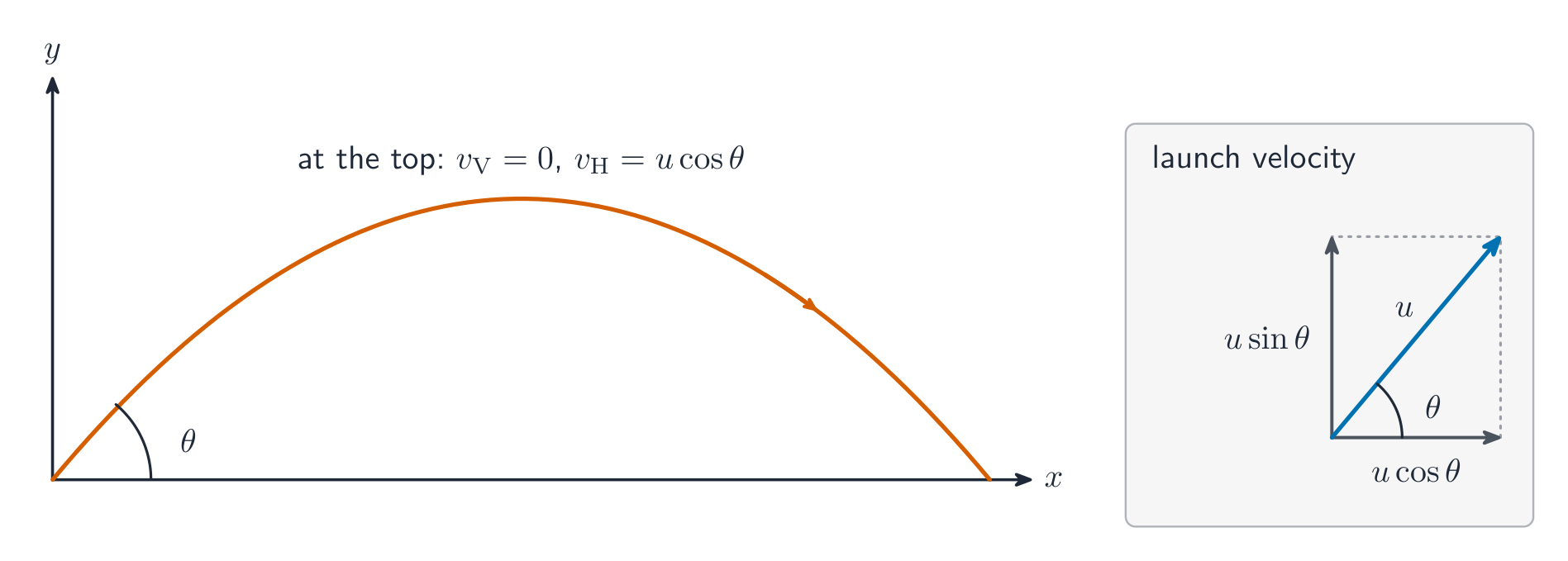
Projectile 抛体 lancé à un angle $\theta$ — les mouvements horizontal et vertical sont indépendants
Select all · tout the statements that are true for a projectile (ignore air). · Sélectionnez toutes les affirmations vraies pour un projectile (ignorer l'air).
At the top only the vertical velocity is zero — the horizontal velocity $u\cos\theta$ carries on, so the ball keeps moving. Mass does not change free fall. · Au sommet seule la vitesse verticale est nulle — la vitesse horizontale $u\cos\theta$ continue, donc la balle reste en mouvement. La masse ne change pas la chute libre.
That projectile has a vertical launch velocity of $10\ \dfrac{\text{m}}{\text{s}}$. How long does it take to reach the top? (Use $g = 9.81\ \dfrac{\text{m}}{\text{s}^2}$.) · Ce projectile a une vitesse de lancement verticale de $10\ \dfrac{\text{m}}{\text{s}}$. Combien de temps met-il pour atteindre le sommet ? (Utilisez $g = 9.81\ \dfrac{\text{m}}{\text{s}^2}$.)
Time to the top $= \dfrac{u\sin\theta}{g} = \dfrac{10}{9.81} \approx 1.0\ \text{s}$. · Temps jusqu'au sommet $= \dfrac{u\sin\theta}{g} = \dfrac{10}{9.81} \approx 1.0\ \text{s}$.
A bouncing ball
- Between bounces the velocity–time graph is a straight sloping line (constant $g$).
- Each bounce is a sudden jump: the velocity flips direction (and shrinks if energy is lost).
Une balle qui rebondit
- Entre les rebonds, le graphique vitesse–temps est une droite inclinée (accélération constante $g$).
- Chaque rebond est un saut soudain : la vitesse change de direction (et diminue si de l'énergie est perdue).
On the velocity–time graph of a bouncing ball, each bounce appears as: · Sur le graphique vitesse–temps d'une balle rebondissante, chaque rebond apparaît comme :
At a bounce the velocity flips from downward to upward almost instantly — a sudden vertical jump on the graph (smaller if energy is lost). · Lors d'un rebond, la vitesse bascule de descendant à montant presque instantanément — un saut vertical soudain sur le graphique (plus petit si de l'énergie est perdue).
Two objects meeting
- Write a displacement equation for each, using the same start time and positive direction.
- They are level again when their displacements are equal — set $s_1 = s_2$ and solve.
Deux objets se rencontrant
- Écrivez une équation de déplacement pour chacun, en utilisant le même temps de départ et la même direction positive.
- Ils sont de nouveau au même niveau lorsque leurs déplacements sont égaux — posez $s_1 = s_2$ et résolvez.
Two objects moving along the same line are level again when their ____ are equal. · Deux objets se déplaçant sur la même ligne sont alignés à nouveau lorsque leurs ____ sont égaux.
Set the two displacement equations equal ($s_1 = s_2$) and solve for the time. · Égaliser les deux équations de déplacement ($s_1 = s_2$) et résoudre pour le temps.
Worked example: thrown off a cliff
- A ball is thrown horizontally at $15\ \text{m/s}$ from a cliff $20\ \text{m}$ high. Find the time to land and how far from the base it lands. Take $g = 9.81\ \text{m/s}^2$.
- Vertical, to get the time. The initial vertical velocity is zero, so $s = \tfrac{1}{2}gt^2$ gives $20 = \tfrac{1}{2}(9.81)t^2$ and $t = 2.02\ \text{s}$.
- Horizontal, to get the range. There is no horizontal acceleration, so $x = ut = 15 \times 2.02 = 30\ \text{m}$.
- The horizontal speed plays no part in finding the time. A ball dropped from the same cliff lands at exactly the same moment.
- Time is the only quantity the two motions share, and it is always the bridge between them.
Exemple résolu : lancé depuis une falaise
- Une balle est lancée horizontalement à $15\ \text{m/s}$ depuis une falaise haute de $20\ \text{m}$. Trouvez le temps de chute et la distance horizontale parcourue. Prenez $g = 9.81\ \text{m/s}^2$.
- Vertical, pour trouver le temps. La vitesse verticale initiale est nulle, donc $s = \tfrac{1}{2}gt^2$ donne $20 = \tfrac{1}{2}(9.81)t^2$ et $t = 2.02\ \text{s}$.
- Horizontal, pour trouver la portée. Il n'y a pas d'accélération horizontale, donc $x = ut = 15 \times 2.02 = 30\ \text{m}$.
- La vitesse horizontale ne joue aucun rôle dans le calcul du temps. Une balle lâchée de la même falaise atterrit exactement au même moment.
- Le temps est la seule grandeur partagée par les deux mouvements, et c'est toujours le lien entre eux.
A ball is thrown horizontally at 15 m/s from a 20 m cliff. How long does it take to land, in seconds? (g = 9.81 m/s^2) · Une balle est lancée horizontalement à 15 m/s depuis une falaise de 20 m. Combien de temps faut-il pour toucher le sol, en secondes ? (g = 9.81 m/s^2)
Vertical only: 20 = 0.5 x 9.81 x t^2, so t = 2.02 s. The 15 m/s plays no part; a dropped ball lands at the same moment. · Uniquement vertical : 20 = 0.5 x 9.81 x t^2, donc t = 2.02 s. La vitesse de 15 m/s n'a aucune incidence ; une bille lâchée tombe au même moment.
That same ball, thrown horizontally at 15 m/s and landing after 2.02 s, lands how far from the base of the cliff, in metres? · Cette même balle, lancée horizontalement à 15 m/s et tombant après 2.02 s, atterrit à quelle distance de la base de la falaise, en mètres ?
Horizontal has no acceleration, so x = ut = 15 x 2.02 = 30 m. Time is the bridge between the two directions. · L'horizontale n'a pas d'accélération, donc x = ut = 15 × 2.02 = 30 m. Le temps est le lien entre les deux directions.
Worked example: launched at an angle
- A ball leaves the ground at $18\ \text{m/s}$ at $60°$ to the horizontal. Show that it reaches its greatest height at $t = 1.6\ \text{s}$.
- Resolve first. Vertical: $u_y = 18\sin 60° = 15.6\ \text{m/s}$. Horizontal: $u_x = 18\cos 60° = 9.0\ \text{m/s}$.
- At the top the vertical velocity is zero, so $v = u + at$ gives $0 = 15.6 - 9.81t$ and $t = 1.59 \approx 1.6\ \text{s}$.
- The horizontal velocity is still $9.0\ \text{m/s}$ at the top. The speed there is $9.0\ \text{m/s}$, not zero.
- Total time of flight is twice this, $3.2\ \text{s}$, and the range is $u_x \times 3.2 = 29\ \text{m}$.
Exemple résolu : lancé avec un angle
- Une balle quitte le sol à $18\ \text{m/s}$ à un angle $60°$ par rapport à l'horizontale. Montrez qu'elle atteint sa hauteur maximale à $t = 1.6\ \text{s}$.
- Décomposer d'abord. Vertical : $u_y = 18\sin 60° = 15.6\ \text{m/s}$. Horizontal : $u_x = 18\cos 60° = 9.0\ \text{m/s}$.
- Au sommet, la vitesse verticale est nulle, donc $v = u + at$ donne $0 = 15.6 - 9.81t$ et $t = 1.59 \approx 1.6\ \text{s}$.
- La vitesse horizontale reste $9.0\ \text{m/s}$ au sommet. La vitesse là-bas est $9.0\ \text{m/s}$, pas zéro.
- Le temps de vol total est le double, soit $3.2\ \text{s}$, et la portée est $u_x \times 3.2 = 29\ \text{m}$.
Put the method for a projectile launched at an angle in order. · Mettez la méthode pour un projectile lancé à un angle dans l'ordre.
Time is the only quantity the two directions share, which is why it is always found from the vertical motion first. · Le temps est la seule grandeur partagée par les deux directions, c'est pourquoi il est toujours trouvé d'abord via le mouvement vertical.
At the highest point of a projectile's flight, match each quantity to its value. · Au point le plus haut du vol d'un projectile, associez chaque quantité à sa valeur.
The speed at the top is the horizontal component, not zero. And the acceleration never pauses, not even for an instant at the top. · La vitesse au sommet est la composante horizontale, pas zéro. Et l'accélération ne s'arrête jamais, pas même un instant au sommet.
Marks that slip away
- Resolve before you start. Every projectile question is two one-dimensional problems sharing a value of $t$.
- The horizontal velocity is constant and takes no part in the time calculation.
- At the highest point the vertical velocity is zero, not the speed. The horizontal component is unchanged.
- A ball thrown horizontally and a ball dropped from the same height land at the same time.
- Keep the sign convention for the whole flight. With up positive, $a = -9.81\ \text{m/s}^2$ on the way down too.
Pièges qui font perdre des points
- Décomposez avant de commencer. Chaque question de projectile est deux problèmes unidimensionnels partageant une valeur de $t$.
- La vitesse horizontale est constante et n'intervient pas dans le calcul du temps.
- Au point le plus haut, la vitesse verticale est nulle, pas la vitesse scalaire. La composante horizontale est inchangée.
- Une balle lancée horizontalement et une balle lâchée de la même hauteur atterrissent au même instant.
- Conserver la convention de signe pour tout le vol. Avec l'axe vertical positif vers le haut, $a = -9.81\ \text{m/s}^2$ reste valide même lors de la descente.
A ball thrown horizontally from a cliff lands later than a ball dropped from the same cliff at the same moment. · Une balle lancée horizontalement depuis un promontoire atterrit plus tard qu'une balle lâchée du même promontoire au même instant.
They land together. The vertical motion is identical, and the horizontal velocity has no effect on it, which is the whole point of treating the two directions separately. · Elles atterrissent ensemble. Le mouvement vertical est identique, et la vitesse horizontale n'a aucun effet dessus, c'est tout l'intérêt de traiter les deux directions séparément.
You've got it
- horizontal and vertical motion are independent — share only the time $t$
- a horizontal throw lands in a time set only by its height
- resolve a launch: $u\cos\theta$ stays constant, $u\sin\theta$ behaves like a vertical throw
Vous avez compris
- Le mouvement horizontal et vertical sont indépendants — ils partagent uniquement le temps $t$
- Un lancer horizontal touche le sol en un temps déterminé uniquement par sa hauteur
- Décomposer un lancement : $u\cos\theta$ reste constant, $u\sin\theta$ se comporte comme un lancer vertical