Halogenoarenes · Halogénobenzènes
| English | Français |
|---|---|
| halogenoarene/ˈheɪləʊdʒnɔːren/ | halogénobenzène |
| aryl halide/ˈɑːrɪl ˈhælaɪd/ | halogénure d'aryle |
| nucleophilic substitution/ˌnjuːklɪəˈfɪlɪk ˌsʌbstɪˈtjuːʃn/ | substitution nucléophile |
| persistent/pəˈsɪstənt/ | persistant |
| pesticide/ˈpestɪsaɪd/ | pesticide |
| bioaccumulate/ˌbaɪəʊəˈkjuːmjʊleɪt/ | bioaccumuler |
Halogens on a ring
- A halogenoarene 卤代芳烃 (aryl halide 芳基卤) has a halogen joined to a benzene ring.
- It is made by electrophilic substitution.
- It is far less reactive than a halogenoalkane.
Halogènes sur un cycle
- Un halogénure d'aryle 卤代芳烃 (halogénure aryle 芳基卤) a un halogène lié à un cycle de benzène.
- Il est fait par substitution électrophile.
- Il est beaucoup moins réactif qu'un halogénure d'aliphatique.
Halogenoarene lab · Laboratoire des halogénobenzènes
Compare halogenoarenes with halogenoalkanes.
The C–halogen bond in a halogenoarene is less reactive than in a halogenoalkane.
The ring's delocalised electrons strengthen the bond.
Making one
- An arene reacts with $\text{Cl}_2$ or $\text{Br}_2$ using $\text{AlCl}_3$/$\text{AlBr}_3$ as catalyst — the halogen replaces a ring hydrogen.
- benzene → chlorobenzene; methylbenzene → 2- and 4-chloromethylbenzene.
Benzene + Cl₂ with an AlCl₃ catalyst → chlorobenzene, by electrophilic substitution
En faire un
- Un arome réagit avec $\text{Cl}_2$ ou $\text{Br}_2$ en utilisant $\text{AlCl}_3$/$\text{AlBr}_3$ comme catalyseur — l'halogène remplace un hydrogène du cycle.
- benzène → chlorobenzène ; méthylbenzène → 2- et 4-chlorométhylbenzène.

Benzène + Cl₂ avec un catalyseur AlCl₃ → chlorobenzène, par substitution électrophile
A halogenoarene is made by reacting an arene with a halogen and:
The halogen-carrier catalyst enables electrophilic substitution of a ring hydrogen.
Match each term to its meaning.
Each item links the term to its correct meaning.
Benzene reacts with Cl₂ using the catalyst AlCl₃ to form ____.
Electrophilic substitution replaces a ring hydrogen with chlorine.
Why it is unreactive
A halogenoalkane reacts easily by nucleophilic substitution 亲核取代 (polar C–Cl). A halogenoarene does not, for two reasons:
- a lone pair on the halogen overlaps the delocalised ring, giving the C–Cl bond partial double-bond character — shorter and stronger, so hard to break.
- the electron-rich ring repels an approaching nucleophile.
So chlorobenzene does not react with $\text{OH}^-$ under normal conditions, while chloroethane does.
Why a halogenoarene is much less reactive than a halogenoalkane
Pourquoi il est inerte
Un halogénure d'aliphatique réagit facilement par substitution nucléophile 亲核取代 (C–Cl polaire). Un halogénure d'aryle ne le fait pas, pour deux raisons :
- une paire d'électrons non liante sur l'halogène chevauche le anneau délocalisé, conférant à la liaison C–Cl un caractère partiel de double liaison — plus courte et plus forte, donc difficile à rompre.
- l'anneau riche en électrons repousse un nucléophile approchant.
Ainsi, le chlorobenzène ne réagit pas avec $\text{OH}^-$ dans des conditions normales, tandis que le chloroéthane le fait.

Pourquoi un halogénobenzène est beaucoup moins réactif qu'un halogénocétane
A halogenoarene is unreactive towards nucleophiles partly because:
The lone-pair overlap gives partial double-bond character, making C–Cl shorter and stronger.
The second reason a halogenoarene resists nucleophiles is that the ring:
The delocalised, electron-rich ring repels electron-rich nucleophiles.
Under normal conditions, with OH⁻:
The halogenoalkane (chloroethane) undergoes nucleophilic substitution; the halogenoarene (chlorobenzene) does not.
Lone-pair overlap with the ring makes the C–Cl bond in chlorobenzene easier to break.
Overlap gives partial double-bond character, so the bond is shorter and stronger.
Which is more readily hydrolysed by aqueous OH⁻ under usual laboratory conditions?
Chloroethane undergoes nucleophilic substitution. The aryl C–Cl bond is strengthened by overlap with the ring.
Useful but persistent 持久
- That same stability makes halogenoarenes useful — in pesticides 农药 (e.g. DDT), dyes and many synthesis intermediates.
- But being unreactive, they do not break down in the environment.
- So they persist and bioaccumulate 生物累积 up food chains — which is why several, including DDT, have been banned.
Many pesticides and herbicides are halogenoarenes — chlorine atoms bonded to a benzene ring.
Utiles mais persistants 持久
- Cette même stabilité rend les halogénobenzènes utiles — dans les pesticides 农药 (ex. DDT), les colorants et de nombreux intermédiaires de synthèse.
- Mais étant peu réactifs, ils ne se dégradent pas dans l'environnement.
- Ils persistent donc et bioaccumulent 生物累积 dans les chaînes alimentaires — c'est pourquoi plusieurs, dont le DDT, ont été interdits.
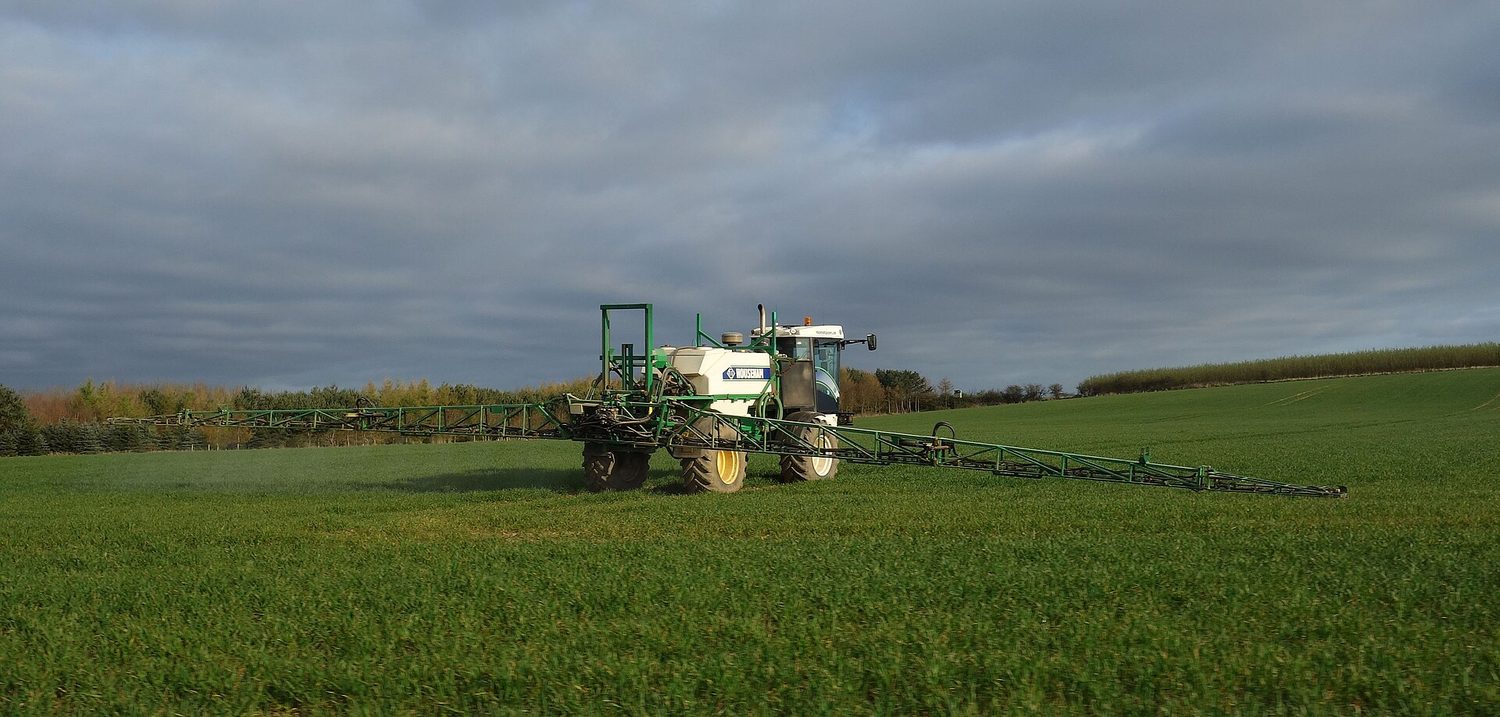
Nombreux pesticides et herbicides sont des halogénobenzènes — atomes de chlore liés à un cycle benzénique.
You've got it
- a halogenoarene is made by electrophilic substitution (arene + Cl₂/AlCl₃)
- it is unreactive to nucleophiles: the Cl lone pair strengthens the C–Cl bond, and the ring repels nucleophiles
- chlorobenzene does not react with OH⁻; chloroethane does
- that stability makes them useful (pesticides, dyes) but persistent pollutants (DDT was banned)
Vous avez compris
- un halogénobenzène est obtenu par substitution électrophile (aromatique + Cl₂/AlCl₃)
- il est inerte vis-à-vis des nucléophiles : la paire libre du Cl renforce la liaison C–Cl, et l'anneau repousse les nucléophiles
- le chlorobenzène ne réagit pas avec OH⁻ ; le chloroéthane le fait
- cette stabilité les rend utiles (pesticides, colorants) mais persistants (le DDT a été interdit)