New organic mechanisms
Introduit| English | Sens |
|---|---|
| electrophilic substitution/ɪˌlektrəʊˈfɪlɪk ˌsʌbstɪˈtjuːʃn/ | substitution électrophile |
| electrophile/ɪˌlektrəʊˈfaɪl/ | électrophile |
| delocalised/dɪˈlɒkəlaɪzd/ | délocalisé |
| nitration/naɪˈtreɪʃn/ | nitration |
| nitrobenzene/ˌnaɪtrəʊˈbenziːn/ | nitrobenzène |
Two new mechanisms
- TNT, aspirin and many dyes all start from benzene. Benzene is very stable, so it needs its own mechanism. A Level adds two: electrophilic substitution 亲电取代 (benzene) and addition–elimination (acyl chlorides and carbonyls).
- In both, the key question is the same as before: where are the electrons, and where do they go?
Electrophilic substitution is when:
Difficulté 1/5 · 100 pièces + un petit bonus lors de la première réussite aujourd'hui
Benzene reacts by electrophilic substitution, keeping its stable ring while swapping an H for the electrophile.
Benzene reacts mainly by:
Difficulté 1/5 · 100 pièces + un petit bonus lors de la première réussite aujourd'hui
Substitution keeps the stable delocalised ring intact, unlike addition which would destroy it.
Benzene undergoes electrophilic ______ rather than addition.
Difficulté 1/5 · 100 pièces + un petit bonus lors de la première réussite aujourd'hui
This preserves the stable ring.
Reduction adds hydrogen (or removes oxygen) to a molecule.
Difficulté 1/5 · 100 pièces + un petit bonus lors de la première réussite aujourd'hui
The opposite of oxidation.
Electrophilic substitution
- An electrophile 亲电试剂 replaces a hydrogen atom on a benzene ring. The delocalised 离域 ring of 6 π electrons is kept.
- Addition would destroy that ring and its extra stability, so benzene substitutes instead. Its π electrons are spread out, so it needs a strong electrophile, usually made with a catalyst.

Electrophilic substitution on benzene
Step through how benzene reacts. An electrophile swaps for a hydrogen — keeping the stable ring — instead of adding across it.
In an addition–elimination reaction:
Difficulté 1/5 · 100 pièces + un petit bonus lors de la première réussite aujourd'hui
Addition–elimination (e.g. with 2,4-DNPH or acyl chlorides) adds then eliminates a small molecule.
Match each term to its meaning.
Difficulté 2/5 · 140 pièces + un petit bonus lors de la première réussite aujourd'hui
Each item links the term to its correct meaning.
Addition–elimination
- A nucleophile first adds to a C=O carbon, then a small molecule is removed (eliminated). The C=O comes back at the end.
- Acyl chlorides lose HCl: with water they give a carboxylic acid, with an alcohol an ester, with ammonia an amide. 2,4-DNPH adds to aldehydes and ketones and loses water.

Worked example: nitration 硝化
Nitrating benzene (concentrated HNO₃ + H₂SO₄, 50 °C) — an electrophilic substitution:
- Make the electrophile: $\text{HNO}_3+2\text{H}_2\text{SO}_4\rightarrow\text{NO}_2^{\,+}+\text{H}_3\text{O}^++2\text{HSO}_4^-$.
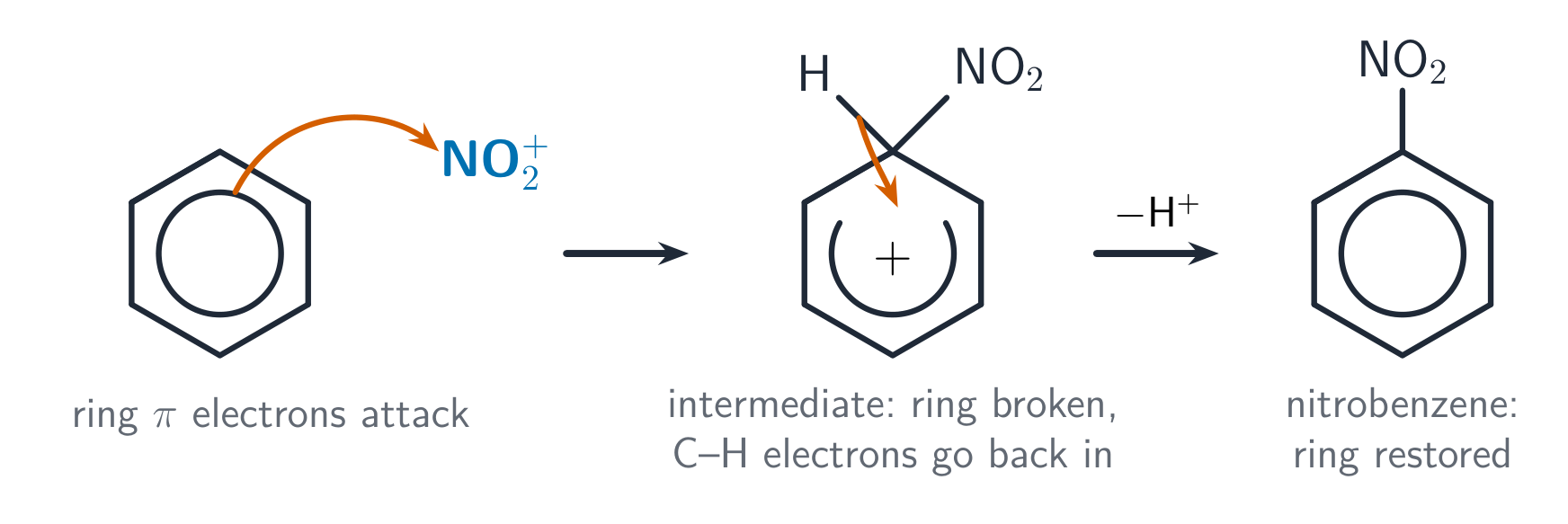
- Two π electrons from the ring attack NO₂⁺, giving an intermediate with a broken ring and a + charge. The C–H bond electrons then return to the ring as H⁺ leaves. Product: nitrobenzene 硝基苯.
The electrophile in nitration, formed from concentrated HNO₃ and H₂SO₄, is ______.
Difficulté 1/5 · 100 pièces + un petit bonus lors de la première réussite aujourd'hui
HNO₃ + 2H₂SO₄ → NO₂⁺ + H₃O⁺ + 2HSO₄⁻. NO₂⁺ is the nitronium ion.
Same pattern, different electrophile. Benzene reacts with bromine only when FeBr₃ is added. Explain the role of FeBr₃.
- Br₂ alone is not a strong enough electrophile for benzene. FeBr₃ (a halogen carrier) pulls on Br₂: $\text{Br}_2+\text{FeBr}_3\rightarrow\text{Br}^++\text{FeBr}_4^-$.
- Br⁺ attacks the ring, the intermediate loses H⁺, and H⁺ + FeBr₄⁻ → HBr + FeBr₃, so the catalyst is regenerated. Product: bromobenzene.
In the bromination of benzene, what does FeBr₃ do?
Difficulté 1/5 · 100 pièces + un petit bonus lors de la première réussite aujourd'hui
FeBr₃ polarises Br₂ to give Br⁺ + FeBr₄⁻. At the end, FeBr₄⁻ + H⁺ gives back FeBr₃ and HBr.
Addition–elimination. Ethanoyl chloride reacts with ethanol at room temperature. Name the product and the molecule eliminated.
- Ethanol's O lone pair adds to the δ+ carbon of C=O; the C=O reforms and Cl⁻ leaves, then loses H⁺: HCl is eliminated.
- $\text{CH}_3\text{COCl}+\text{C}_2\text{H}_5\text{OH}\rightarrow\text{CH}_3\text{COOC}_2\text{H}_5+\text{HCl}$: ethyl ethanoate, an ester.
Ethanoyl chloride reacts with ammonia. What are the products?
Difficulté 1/5 · 100 pièces + un petit bonus lors de la première réussite aujourd'hui
NH₃ adds to the C=O carbon, HCl is eliminated, giving the amide CH₃CONH₂. (With excess NH₃, the HCl forms NH₄Cl.)
- In the intermediate, the horseshoe is open toward the carbon that carries both H and the electrophile, and the + is drawn inside it.
- The arrow to the electrophile starts at the ring (the π electrons), not at a carbon atom.
- Benzene does substitution, not addition, even with bromine. Bromine water does not decolourise.
You've got it
- electrophilic substitution: an electrophile replaces an H on the benzene ring (how benzene reacts)
- it keeps the stable delocalised ring — benzene substitutes rather than adds
- nitration: NO₂⁺ (from HNO₃ + H₂SO₄) attacks, the intermediate loses H⁺, giving nitrobenzene; bromination uses an FeBr₃ halogen carrier
- addition–elimination: a molecule adds on, then a small molecule is removed (2,4-DNPH, acyl chlorides)