Enthalpies of solution and hydration
Introduit| English | Sens |
|---|---|
| enthalpy of solution/enˈθælpi ɒv səˈluːʃn/ | enthalpie de solution |
| enthalpy of hydration/enˈθælpi ɒv haɪˈdreɪʃn/ | enthalpie d'hydratation |
| exothermic/eɡzəˈðɜːmɪk/ | exothermique |
| lattice energy/ˈlætɪs ˈenədʒi/ | énergie réticulaire |
Dissolving, energetically
- An instant cold pack gets icy when you squeeze it: ammonium nitrate dissolving in water takes in heat. Calcium chloride dissolving gives heat out, which is how some hand warmers work.
- Whether dissolving is hot or cold depends on two enthalpy steps: pulling the lattice apart, then hydrating the ions. Together they give the enthalpy of solution 溶解焓.
Enthalpy of solution lab
deltaHsol = lattice + hydration terms
Change hydration strength and see solution enthalpy shift.
The two changes
- enthalpy of hydration 水合焓 $\Delta H_{\text{hyd}}$: change when one mole of gaseous ions is surrounded by water (exothermic 放热).
- enthalpy of solution $\Delta H_{\text{sol}}$: change when one mole of solute fully dissolves.
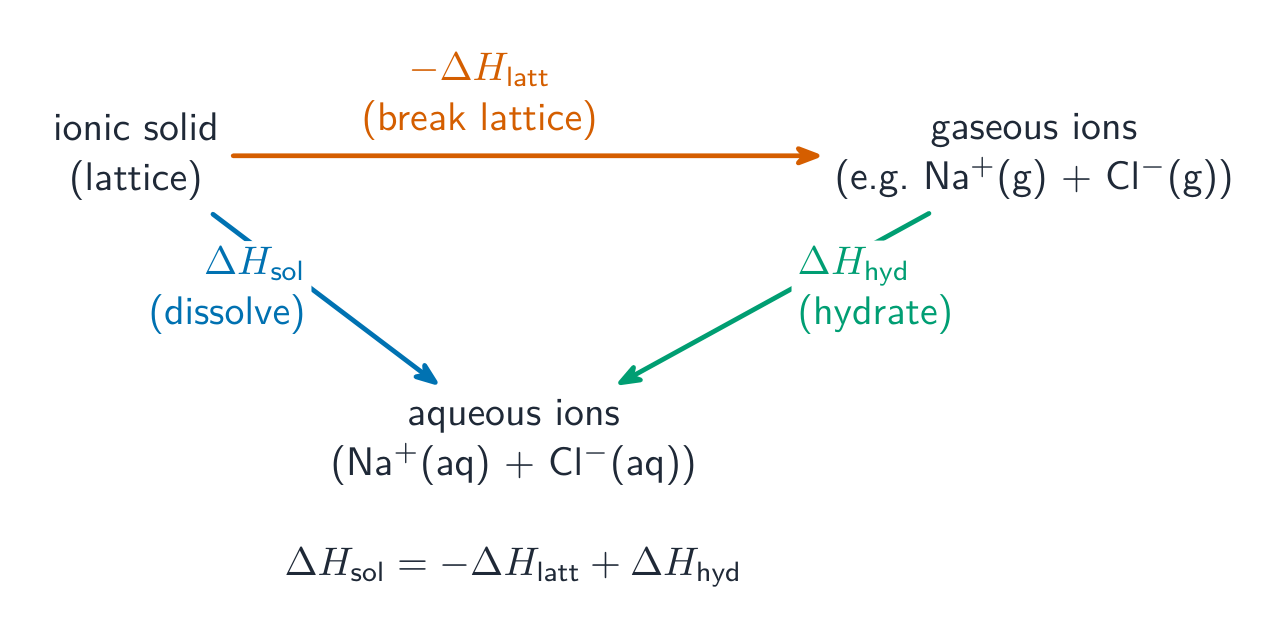
Dissolving energy cycle links lattice energy 晶格能, hydration and solution
The enthalpy change of hydration is:
Difficulté 1/5 · 100 pièces + un petit bonus lors de la première réussite aujourd'hui
Water molecules are attracted to the ions, releasing energy, so hydration is exothermic.
The enthalpy change when one mole of gaseous ions dissolves in water is the enthalpy of ______.
Difficulté 1/5 · 100 pièces + un petit bonus lors de la première réussite aujourd'hui
More negative for smaller, more highly charged ions.
The dissolving cycle
To dissolve, you first pull the lattice apart, then hydrate the ions:
- Like lattice energy, $\Delta H_{\text{hyd}}$ is more exothermic for ions of higher charge and smaller radius.
The enthalpy of solution is given by:
Difficulté 1/5 · 100 pièces + un petit bonus lors de la première réussite aujourd'hui
You reverse the lattice energy (to separate the ions) then add the hydration enthalpy.
Enthalpy of solution can be found from lattice energy and hydration enthalpies using Hess's law.
Difficulté 1/5 · 100 pièces + un petit bonus lors de la première réussite aujourd'hui
A Hess cycle links them.
Hydration enthalpy data
| Cation | $\Delta H_{\text{hyd}}$ / kJ/mol | Anion | $\Delta H_{\text{hyd}}$ / kJ/mol |
|---|---|---|---|
| Li⁺ | −519 | F⁻ | −506 |
| Na⁺ | −406 | Cl⁻ | −364 |
| K⁺ | −322 | Br⁻ | −335 |
| Mg²⁺ | −1920 | I⁻ | −293 |
| Ca²⁺ | −1650 | ||
| Ba²⁺ | −1360 |
- Smaller ions and 2+ ions attract water molecules (the δ− O or δ+ H) more strongly, so their hydration is far more exothermic: Mg²⁺ is almost five times Na⁺.
The enthalpy of hydration is more exothermic for ions with:
Difficulté 1/5 · 100 pièces + un petit bonus lors de la première réussite aujourd'hui
Higher charge and smaller radius pull the water molecules in more strongly, releasing more energy.
Which ion has the most exothermic enthalpy of hydration?
Difficulté 1/5 · 100 pièces + un petit bonus lors de la première réussite aujourd'hui
Mg²⁺ has a 2+ charge and a small radius, so it attracts water molecules most strongly (−1920 kJ/mol).
Worked example: magnesium chloride
Find $\Delta H_{\text{sol}}$ of $\text{MgCl}_2$. Data in $\dfrac{\text{kJ}}{\text{mol}}$: $\Delta H_{\text{latt}} = -2526$, $\Delta H_{\text{hyd}}(\text{Mg}^{2+}) = -1920$, $\Delta H_{\text{hyd}}(\text{Cl}^-) = -364$.
- Breaking the lattice costs $+2526$. One $\text{MgCl}_2$ gives one $\text{Mg}^{2+}$ and two $\text{Cl}^-$, so hydration gives $-1920 + 2(-364) = -2648$.
- $\Delta H_{\text{sol}} = +2526 - 2648 = -122\ \dfrac{\text{kJ}}{\text{mol}}$: dissolving is exothermic. Forgetting the 2 gives $+242$, the wrong sign.
For KCl, $\Delta H_{\text{latt}} = -711$, $\Delta H_{\text{hyd}}(\text{K}^+) = -322$ et $\Delta H_{\text{hyd}}(\text{Cl}^-) = -364\ \dfrac{\text{kJ}}{\text{mol}}$. Find $\Delta H_{\text{sol}}$ in $\dfrac{\text{kJ}}{\text{mol}}$.
Difficulté 2/5 · 140 pièces + un petit bonus lors de la première réussite aujourd'hui
$\Delta H_{\text{sol}} = +711 + (-322) + (-364) = +25\ \dfrac{\text{kJ}}{\text{mol}}$, so dissolving KCl is slightly endothermic.
Which expression gives $\Delta H_{\text{sol}}$ of $\text{CaCl}_2$?
Difficulté 1/5 · 100 pièces + un petit bonus lors de la première réussite aujourd'hui
Reverse the lattice energy to break the solid, then hydrate every ion: one $\text{Ca}^{2+}$ and two $\text{Cl}^-$.
Use the table. NaCl has $\Delta H_{\text{latt}} = -787$ kJ/mol. Find $\Delta H_{\text{sol}}$ of NaCl, in kJ/mol.
Difficulté 2/5 · 140 pièces + un petit bonus lors de la première réussite aujourd'hui
$\Delta H_{\text{sol}} = +787 + (-406) + (-364) = +17$ kJ/mol. Slightly endothermic, yet salt dissolves well because entropy increases.
Why Group 2 sulfates get less soluble
- Down Group 2 the cation grows. The large $\text{SO}_4^{2-}$ ion keeps the ion spacing almost the same, so the lattice energy becomes only a little less exothermic.
- The cation's hydration enthalpy becomes much less exothermic. So $\Delta H_{\text{sol}}$ becomes more endothermic and the sulfates become less soluble from $\text{MgSO}_4$ to $\text{BaSO}_4$.
Why does the solubility of the Group 2 sulfates fall from $\text{MgSO}_4$ à $\text{BaSO}_4$?
Difficulté 1/5 · 100 pièces + un petit bonus lors de la première réussite aujourd'hui
The big sulfate ion keeps the lattice energy nearly constant, but the larger cation is hydrated much less strongly, so $\Delta H_{\text{sol}}$ becomes more endothermic.
- In the cycle the lattice energy appears with its sign reversed: breaking the lattice is endothermic.
- Multiply each hydration enthalpy by the number of that ion in the formula (MgCl₂ has two Cl⁻).
- A positive $\Delta H_{\text{sol}}$ does not mean "insoluble": NH₄NO₃ (+26 kJ/mol) dissolves well. Entropy also matters (2401).
You've got it
- hydration $\Delta H_{\text{hyd}}$ (exothermic): gaseous ions surrounded by water
- solution $\Delta H_{\text{sol}}$: one mole of solute dissolves
- the cycle: $\Delta H_{\text{sol}} = -\Delta H_{\text{latt}} + \Delta H_{\text{hyd}}$
- $\Delta H_{\text{hyd}}$ is more exothermic for higher charge and smaller radius