Balancing redox and agents
Introduit| English | Sens |
|---|---|
| disproportionation/ˌdɪsprəˈpɔːʃəneɪʃn/ | disproportionnement |
| reducing agent/rɪˈdjuːsɪŋ ˈeɪdʒənt/ | agent réducteur |
| oxidised/ˈɒksɪdaɪzd/ | oxydé |
| reduced/rɪˈdjuːst/ | réduit |
| oxidising agent/ˈɒksɪdaɪzɪŋ ˈeɪdʒənt/ | agent oxydant |
Balancing the electron books
- In a titration, purple manganate(VII) turns colourless as it oxidises iron(II). To calculate with it, you need the balanced equation.
- Every electron lost by the reducing agent 还原剂 is gained by the oxidising agent. Use that fact to balance.
Method 1: oxidation numbers
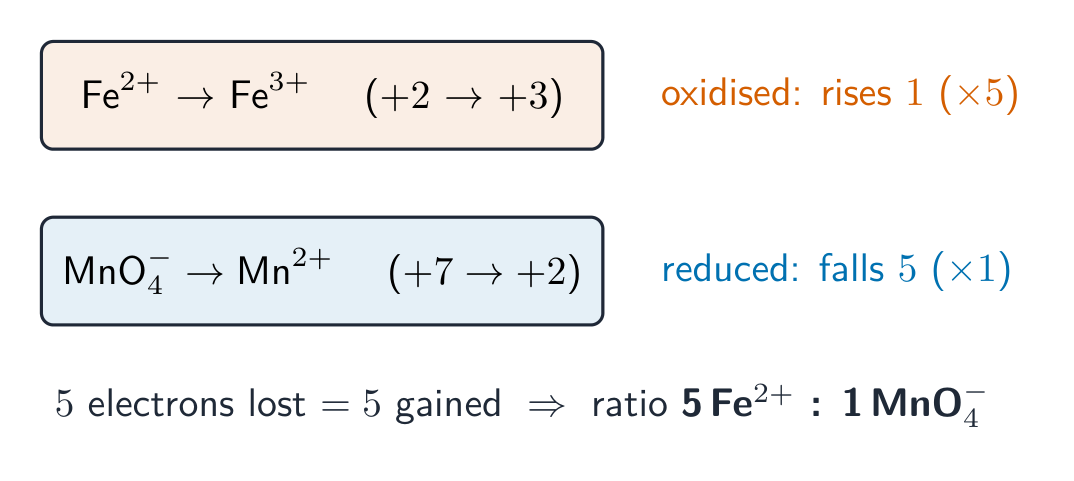
- Find the element that is oxidised 被氧化 (number rises) and the one that is reduced 被还原 (number falls).
- Make the total rise = total fall, then balance O with H₂O, H with H⁺, and check the charges.
Counting the electrons moved
Watch the electrons hand over: the oxidising agent takes them, the reducing agent gives them — balance the half-equations so the electrons cancel.
When balancing a redox equation using oxidation numbers:
Difficulté 1/5 · 100 pièces + un petit bonus lors de la première réussite aujourd'hui
Every electron lost is gained, so the total increase in oxidation number equals the total decrease.
Balance $\text{IO}_3^- + \text{I}^- + \text{H}^+ \rightarrow \text{I}_2 + \text{H}_2\text{O}$.
- I in $\text{IO}_3^-$ falls from $+5$ to $0$ (a fall of 5). I in $\text{I}^-$ rises from $-1$ to $0$ (a rise of 1). Rise = fall needs 5 $\text{I}^-$ for each $\text{IO}_3^-$.
- That gives 6 I atoms, so $3\text{I}_2$; the 3 O atoms make $3\text{H}_2\text{O}$, which needs $6\text{H}^+$. So $\text{IO}_3^- + 5\text{I}^- + 6\text{H}^+ \rightarrow 3\text{I}_2 + 3\text{H}_2\text{O}$. Check the charges: $-1 - 5 + 6 = 0$ on both sides.
Method 2: half-equations (in acid)
- Balance the main element. Add H₂O to balance O. Add H⁺ to balance H. Add e⁻ to balance the charge.
- $\text{MnO}_4^-\rightarrow\text{Mn}^{2+}$: add $4\text{H}_2\text{O}$ on the right, then $8\text{H}^+$ on the left. Charges: left $-1+8=+7$, right $+2$, so add $5\text{e}^-$ on the left:
In the half-equation $\text{Cr}_2\text{O}_7^{2-}+14\text{H}^++n\,\text{e}^-\rightarrow2\text{Cr}^{3+}+7\text{H}_2\text{O}$, what is $n$?
Difficulté 2/5 · 140 pièces + un petit bonus lors de la première réussite aujourd'hui
Charges: left $-2+14=+12$, right $2\times3=+6$. Add 6 electrons on the left. (Each Cr goes from +6 to +3: 2 × 3 = 6.)
Combine two half-equations. Manganate(VII) oxidises iron(II): $\text{Fe}^{2+}\rightarrow\text{Fe}^{3+}+\text{e}^-$.
- The MnO₄⁻ half-equation takes 5 electrons, so multiply the iron half-equation by 5.
- Add them and cancel the electrons: $\text{MnO}_4^-+8\text{H}^++5\text{Fe}^{2+}\rightarrow\text{Mn}^{2+}+5\text{Fe}^{3+}+4\text{H}_2\text{O}$. Charge check: left $-1+8+10=+17$, right $+2+15=+17$ ✓.
In acid, $\text{MnO}_4^-$ ($\text{Mn}$ $+7 \rightarrow +2$) oxidises $\text{C}_2\text{O}_4^{2-}$ à $\text{CO}_2$ (C $+3 \rightarrow +4$). How many $\text{C}_2\text{O}_4^{2-}$ ions react with each $\text{MnO}_4^-$?
Difficulté 2/5 · 140 pièces + un petit bonus lors de la première réussite aujourd'hui
Each Mn falls by 5. Each $\text{C}_2\text{O}_4^{2-}$ has two C atoms that each rise by 1, a rise of 2. So $5/2 = 2.5$, written as $2\text{MnO}_4^- : 5\text{C}_2\text{O}_4^{2-}$.
Disproportionation 歧化
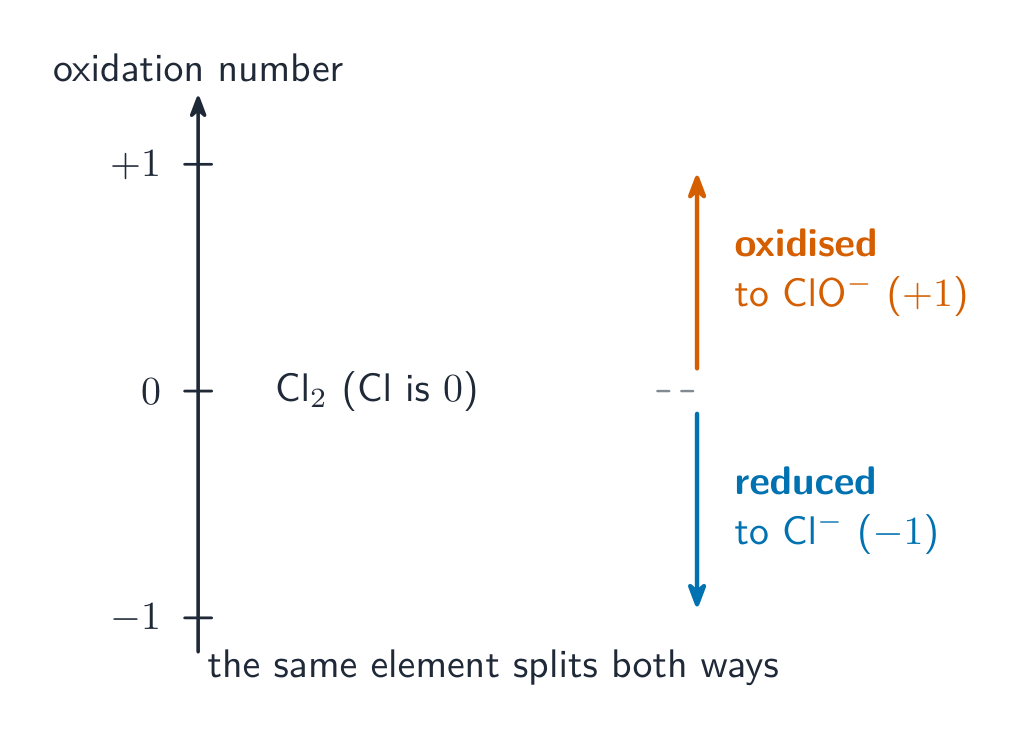
- The same element is oxidised and reduced in one reaction.
- $\text{Cl}_2+2\text{NaOH}\rightarrow\text{NaCl}+\text{NaClO}+\text{H}_2\text{O}$ (cold): Cl goes $0\rightarrow-1$ in NaCl and $0\rightarrow+1$ in NaClO.
Disproportionation is a reaction in which:
Difficulté 1/5 · 100 pièces + un petit bonus lors de la première réussite aujourd'hui
In disproportionation one element goes both up and down in oxidation number (e.g. Cl₂ → Cl⁻ and ClO⁻).
Oxidising and reducing agents
- An oxidising agent 氧化剂 takes electrons, so it is itself reduced (MnO₄⁻, Cl₂, O₂).
- A reducing agent gives electrons, so it is itself oxidised (Fe²⁺, I⁻, metals).

An oxidising agent:
Difficulté 1/5 · 100 pièces + un petit bonus lors de la première réussite aujourd'hui
An oxidising agent removes electrons from another species, so it gains electrons and is reduced itself.
A reducing agent:
Difficulté 1/5 · 100 pièces + un petit bonus lors de la première réussite aujourd'hui
A reducing agent donates electrons, causing reduction of the other species while being oxidised itself.
An oxidising agent is itself oxidised during a reaction.
Difficulté 1/5 · 100 pièces + un petit bonus lors de la première réussite aujourd'hui
False. An oxidising agent gains the electrons lost by the other species, so it is itself reduced.
In $\text{Zn}+\text{Cu}^{2+}\rightarrow\text{Zn}^{2+}+\text{Cu}$, which species is the oxidising agent?
Difficulté 1/5 · 100 pièces + un petit bonus lors de la première réussite aujourd'hui
Cu²⁺ takes 2 electrons from Zn and is reduced to Cu. The species that is reduced is the oxidising agent.
- Electrons must cancel when you add half-equations. If they don't, the multipliers are wrong.
- Half-equations need H⁺ and H₂O only when oxygen or hydrogen is involved.
- An oxidising agent is reduced, not oxidised. Name the species, e.g. "MnO₄⁻ is the oxidising agent".
Match each redox term to its meaning.
Difficulté 2/5 · 140 pièces + un petit bonus lors de la première réussite aujourd'hui
Each item links the term to its correct meaning.
You've got it
- Balance redox by total rise = total fall, or by combining half-equations so the electrons cancel.
- Half-equations in acid: balance the element, O with H₂O, H with H⁺, charge with e⁻.
- Disproportionation: one element is both oxidised and reduced (Cl₂ → Cl⁻ + ClO⁻).
- Oxidising agent takes electrons (is reduced); reducing agent gives them (is oxidised).