This page needs a recent browser (with SharedArrayBuffer support). Please update Chrome, Edge, Firefox or Safari to the latest version. · Cette page nécessite un navigateur récent (avec support SharedArrayBuffer). Veuillez mettre à jour Chrome, Edge, Firefox ou Safari vers la dernière version.
English
Tables
- A table uses the
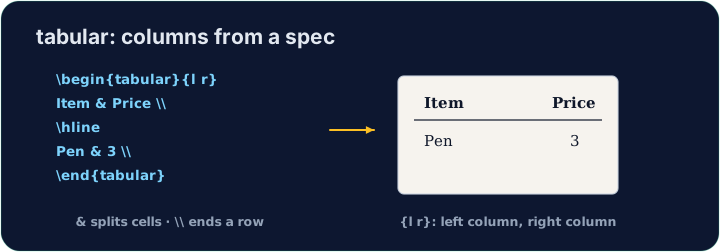
tabularenvironment. You first describe the columns:
{l c r}means three columns: left-aligned, centred, right-aligned.
Français
Tableaux
- Un tableau utilise l'environnement
tabular. Vous décrivez d'abord les colonnes :
\begin{tabular}{l c r}
  left & centre & right \\
\end{tabular}
{l c r}signifie trois colonnes : left-aligné (gauche), centred (centré), right-aligné (droite).
English
Rows and cells
- Inside,
&jumps to the next column and\\starts a new row:
- The number of cells in each row must match the number of columns you declared.
Français
Lignes et cellules
- À l'intérieur,
&passe à la colonne suivante et\\commence une nouvelle ligne :
\begin{tabular}{l l}
  Apple & 5 \\
  Banana & 3 \\
\end{tabular}
- Le nombre de cellules dans chaque ligne doit correspondre au nombre de colonnes déclarées.
English
Lines (optional)
- Add
|between column letters for vertical lines, and\hlinefor horizontal ones:
- For a cleaner look, professionals use the
booktabspackage instead of many lines.
Français
Lignes (optionnel)
- Ajoutez
|entre les lettres de colonnes pour des lignes verticales, et\hlinepour des lignes horizontales :
\begin{tabular}{|l|l|}
  \hline
  Apple & 5 \\ \hline
\end{tabular}
- Pour un rendu plus propre, les professionnels utilisent le paquet
booktabsau lieu de nombreuses lignes.
English
Common mistakes
tabularneeds a column spec like{lcr}; separate cells with&and end rows with\\.- The number of
&per row must fit the column spec.
Français
Erreurs courantes
tabularnécessite une spécification de colonnes comme{lcr}; séparez les cellules avec&et terminez les lignes avec\\.- Le nombre de
&par ligne doit correspondre à la spécification des colonnes.
Build a small two-column table with \begin{tabular}{l l}. Separate the two cells in a row with &, and end each row with \\. Add the rows for Bob (30) and Mei (25). · Construisez une petite table à deux colonnes avec \begin{tabular}{l l}. Séparez les deux cellules d'une ligne avec &, et terminez chaque ligne avec \\. Ajoutez les lignes pour Bob (30) et Mei (25).
Click Run to compile and preview the PDF. · Cliquez sur Exécuter pour compiler et prévisualiser le PDF.
Add lines to the table. Put \hline at the top, after the header row, and at the bottom, and use |l|l| in the column spec for vertical lines. · Ajoutez des lignes à la table. Placez \hline en haut, après la ligne d'en-tête, et en bas, et utilisez |l|l| dans la spécification des colonnes pour les lignes verticales.
Click Run to compile and preview the PDF. · Cliquez sur Exécuter pour compiler et prévisualiser le PDF.