Itération : FOR
FOR counts
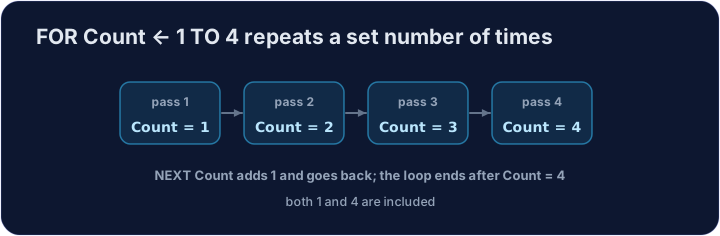
- A count-controlled loop runs once for each integer from the start to the end, inclusive.
- The counter is an
INTEGER. - It is good practice to repeat the counter's name after
NEXT.
DECLARE Total : INTEGER
DECLARE I : INTEGER
Total ← 0
FOR I ← 1 TO 5
  Total ← Total + I
NEXT I
OUTPUT Total
Tracez le total accumulé
Une boucle FOR répète un nombre défini de fois. Passez étape par étape et observez Total croître.
STEP changes the jump
STEPsets the gap between values. It can be negative.- If the start is already past the end in the step's direction, the body does not run.
DECLARE Minute : INTEGER
FOR Minute ← 0 TO 60 STEP 15
  OUTPUT Minute, " minutes"
NEXT Minute
Watch out
NEXT Imust name the counter of this loop.- The body is indented.
NEXTlines up withFOR.
Common mistakes
Before a loop, distinguish DECLARE Count : INTEGER (choose a type) from Count ← 0 (store a value). The loop header changes the counter; the body changes the result you are computing.
1 TO 5includes both 1 and 5.- Do not change the counter yourself inside the body.
Now you try
- Use a
FORloop to print a run of numbers.
Independent transfer
The final task has no supplied algorithm. Plan its inputs, processing and outputs, then solve it before opening support. Check more than the sample case.
Difficulté 2/5 · 140 pièces + un petit bonus lors de la première réussite aujourd'hui
Utilisez une boucle FOR pour afficher les nombres 1 à 5, un par ligne.
Cliquez sur Exécuter pour voir le résultat ici.
Difficulté 2/5 · 140 pièces + un petit bonus lors de la première réussite aujourd'hui
Affichez 5, 3 et 1, en utilisant FOR avec STEP -2.
Cliquez sur Exécuter pour voir le résultat ici.
Difficulté 3/5 · 200 pièces + un petit bonus lors de la première réussite aujourd'hui
Lire UpperLimit (1 à 10). Afficher la somme des carrés des entiers de 1 à UpperLimit inclus.
Cliquez sur Exécuter pour voir le résultat ici.