Autoimmunity and tolerance
Introducido| English | Significado |
|---|---|
| central tolerance | central tolerance |
| negative selection | negative selection |
| peripheral tolerance | peripheral tolerance |
| molecular mimicry | molecular mimicry |
A library that can also bind you
- The receptor library from 7.2 is built at random, so it is certain to contain receptors against your own proteins.
- The body does not prevent this; it checks and removes. Autoimmune diseases are the places where a checkpoint failed.
Central tolerance
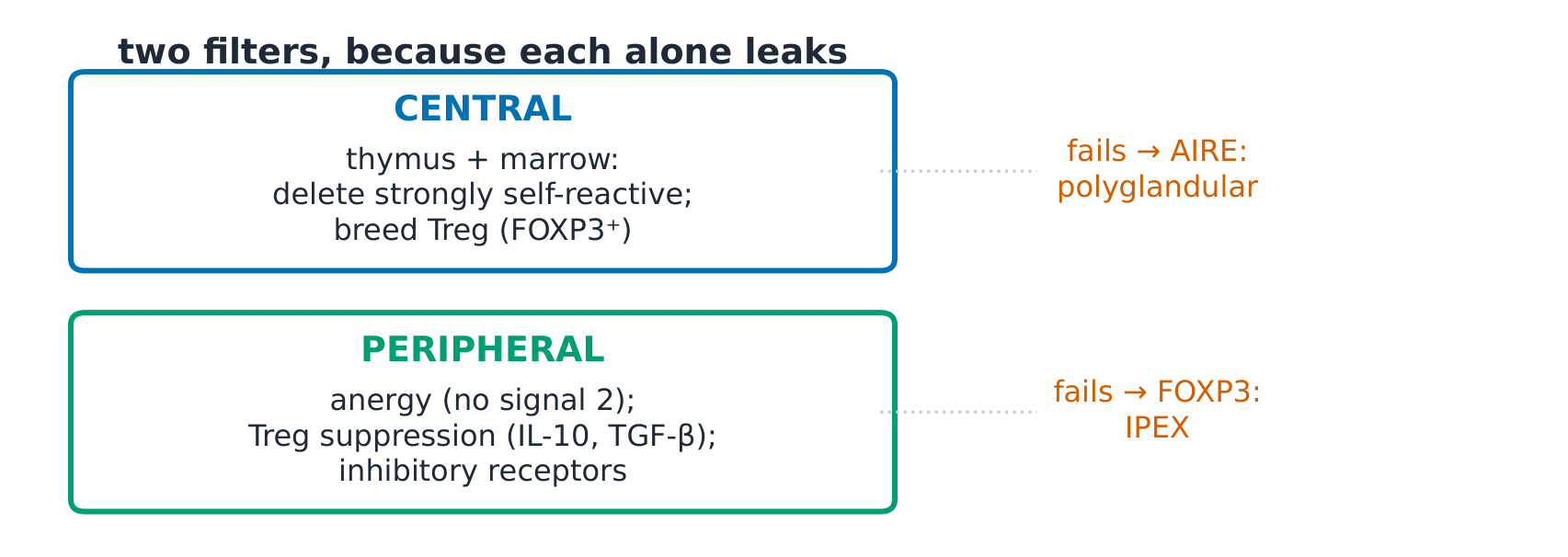
- In central tolerance 中枢耐受, developing T cells in the thymus (and B cells in the marrow) that bind self strongly are deleted: negative selection 阴性选择.
- A protein called AIRE lets thymus cells make proteins from other organs, such as insulin, so T cells against them can be removed early.
What does AIRE do in the thymus?
Dificultad 1/5 · 100 monedas + un pequeño bono en el primer intento de hoy
Without AIRE, T cells against many organs' proteins escape deletion.
Peripheral tolerance
- Peripheral tolerance 外周耐受 catches cells that escaped: self-reactive T cells meeting antigen without co-stimulation become anergic, and Tregs suppress them with IL-10 and TGF-β.
- Inhibitory receptors such as CTLA-4 and PD-1 act as brakes on activated T cells.
Named failures
- No AIRE: autoimmune polyendocrine syndrome type 1, attacking several glands. No FOXP3, so no Tregs: IPEX, with gut, skin and gland disease in infancy.
- Cancer drugs that block CTLA-4 or PD-1 release the brakes; autoimmune side effects such as colitis and thyroiditis are expected.
Match each failure to its result.
Dificultad 2/5 · 140 monedas + un pequeño bono en el primer intento de hoy
Each named gene or drug marks a checkpoint.
Genes load, environment triggers
- If one identical twin has type 1 diabetes, the other develops it in about 30–50% of cases. Genes (especially HLA-DR3 and DR4) raise the risk a lot but do not decide it.
- Infections, diet and chance in T-cell selection supply the rest.
If one identical twin has type 1 diabetes, the other always develops it.
Dificultad 1/5 · 100 monedas + un pequeño bono en el primer intento de hoy
Concordance is about 30–50%; the environment and chance decide the rest.
Molecular mimicry
- In molecular mimicry 分子模拟, a response to a microbe cross-reacts with a self protein that looks similar.
- Rheumatic fever is the classic example: 2–4 weeks after a streptococcal sore throat, antibodies against the bacterium attack heart and joints.
How does a streptococcal sore throat lead to rheumatic heart disease?
Dificultad 1/5 · 100 monedas + un pequeño bono en el primer intento de hoy
This is molecular mimicry, a response built for the microbe hitting self.
Organ-specific or systemic
- Some diseases attack one organ: Hashimoto thyroiditis, type 1 diabetes, Graves disease. Others are systemic, such as systemic lupus erythematosus, hitting skin, joints, kidneys and blood.
- Autoantibody tests need care: a low-titre positive ANA is found in 5–15% of healthy adults.
Which is a systemic autoimmune disease?
Dificultad 1/5 · 100 monedas + un pequeño bono en el primer intento de hoy
Lupus attacks skin, joints, kidneys and blood; the others target one organ.
A low-titre positive ANA in a healthy adult proves lupus.
Dificultad 1/5 · 100 monedas + un pequeño bono en el primer intento de hoy
5–15% of healthy adults have a low positive ANA; the titre, pattern and symptoms decide.
Worked example: the twin arithmetic
- (Fictional figures) Lifetime risk of type 1 diabetes is about 0.4% in the population; an identical twin of a patient has about 40%.
- $40\% \div 0.4\% = 100$: shared genes raise the risk a hundred times, yet more than half of identical twins stay healthy, so genes alone do not decide.
Population risk is 0.4% and an identical twin's risk is 40%. How many times higher is the twin's risk?
Dificultad 2/5 · 140 monedas + un pequeño bono en el primer intento de hoy
40 ÷ 0.4 = 100.
Worked example: a sore throat's bill
- (Fictional) Three weeks after a sore throat, a 10-year-old has painful joints that move from one to another and a new heart murmur. The antistreptolysin O titre has risen.
- Antibodies made against streptococcus are binding heart and joint proteins (type II). Penicillin treats the infection; anti-inflammatory drugs treat the crossfire.
Three common slips
- "A positive ANA means lupus." Low titres are common in healthy people; titre, pattern and symptoms matter.
- "Tolerance is a perfect library." It is overproduction plus checkpoints, and each checkpoint leaks a little.
- "Identical genes mean identical disease." Twin concordance for type 1 diabetes is well under 100%.
Recap
- Central tolerance deletes strongly self-reactive cells (AIRE shows other organs' proteins in the thymus).
- Peripheral tolerance: anergy, Tregs (FOXP3) and brakes (CTLA-4, PD-1).
- Genes load the gun, environment pulls the trigger; mimicry turns an infection into a self-attack.