Transformations · Transformaciones
| English | Español |
|---|---|
| transformations/trænsfɔːˈmeɪʃnz/ | transformaciones |
| reflection/rɪˈflekʃn/ | reflexión |
| rotation/rəʊˈteɪʃn/ | rotación |
| enlargement/enˈlɑːdʒmənt/ | agrandamiento |
| mirror line/ˈmɪrə laɪn/ | eje de simetría |
| scale factor/skeɪl ˈfæktə/ | factor de escala |
| translation/trænˈsleɪʃn/ | traducción |
| column vector/ˈkɒlʌm ˈvektə/ | vector columna |
The mirror, the spin, the zoom, the slide
- Computer graphics use transformations 变换 to animate characters — reflections 反射 for mirror images, rotations 旋转 for spinning, enlargements 放大 for zooming.
- Every transformation needs a complete description to earn full marks.
El espejo, la rotación, el aumento y el desplazamiento
- Los gráficos por computadora usan transformaciones para animar personajes: reflexiones para imágenes especulares, rotaciones para girar, ampliaciones para hacer zoom.
- Cada transformación necesita una descripción completa para obtener la puntuación máxima.
Reflection
- Flips a shape over a mirror line 对称轴. Give the line's equation.
- Reflect $(3,2)$ in the $y$-axis → $(-3, 2)$ (only $x$'s sign changes).
- Reflect in the $x$-axis → $(3, -2)$ (only $y$'s sign changes).
Reflection in the $y$-axis: flip the sign of $x$. The shape stays the same size — it's congruent.
Reflexión
- Voltea una figura sobre una línea de reflexión. Proporcione la ecuación de la línea.
- Refleja $(3,2)$ en el eje $y$ → $(-3, 2)$ (solo cambia el signo de $x$).
- Refleja en el eje $x$ → $(3, -2)$ (solo cambia el signo de $y$).
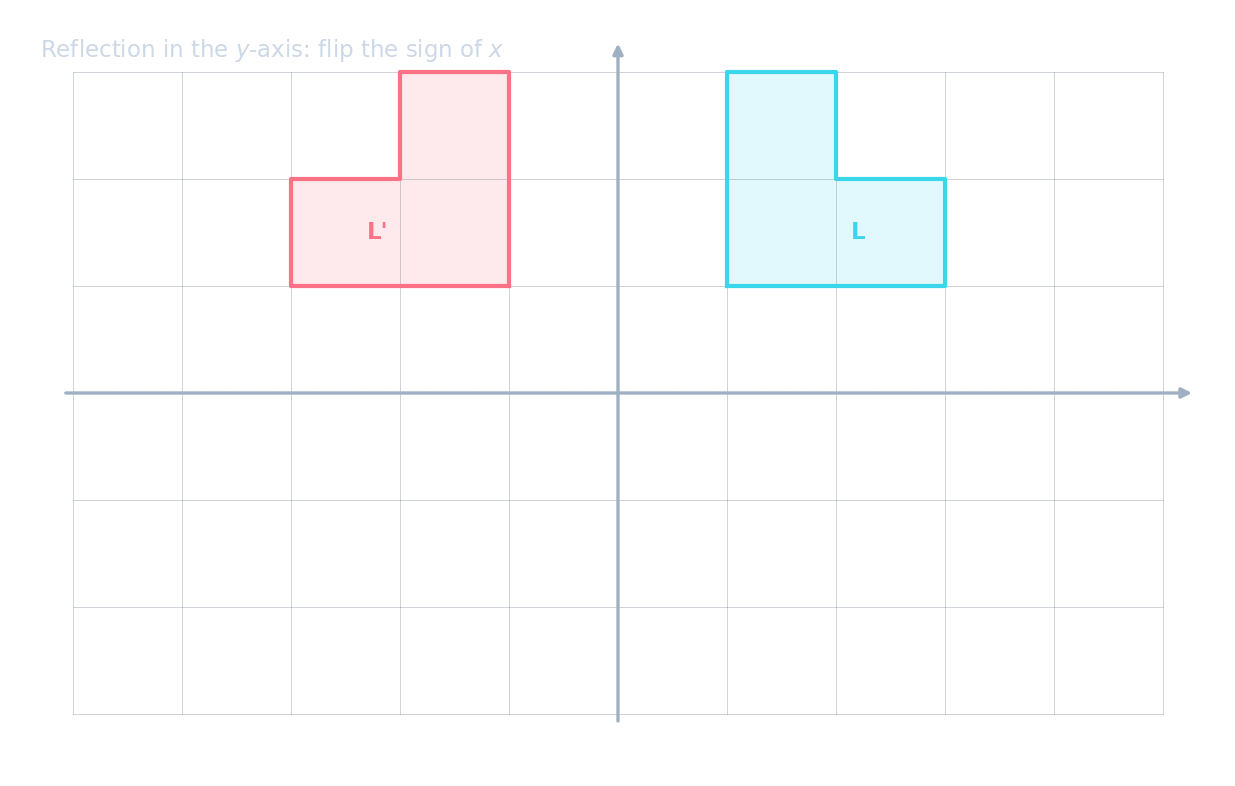
Reflexión en el eje $y$: invierte el signo de $x$. La figura mantiene su tamaño original; es congruente.
Transformations · Transformaciones
(x, y) → (x', y')
Translate, reflect, rotate or enlarge a shape — and see what stays the same. · Traducir, reflejar, rotar o agrandar una figura — y ver qué permanece igual.
Reflect the point (3, 2) in the y-axis. The image is (a, 2). What is a? · Refleja el punto (3, 2) en el eje y. La imagen es (a, 2). ¿Cuál es a?
Reflecting in the y-axis flips the sign of x: a = −3. · Reflejar en el eje y invierte el signo de x: a = −3.
Rotation
- Turns a shape about a centre. Give centre, angle, and direction.
- Rotate $(3,1)$ by $90^{\circ}$ anticlockwise about $O$: $(x,y) \to (-y, x) \to (-1, 3)$.
Quick rules about the origin: $90^{\circ}$ clockwise: $(x,y) \to (y, -x)$. $90^{\circ}$ anticlockwise: $(x,y) \to (-y, x)$. $180^{\circ}$: $(x,y) \to (-x, -y)$.
Geometric tiles are built by reflecting, rotating and translating shapes
Rotación
- Gira una figura alrededor de un centro. Indica el centro, el ángulo y la dirección.
- Rota $(3,1)$ $90^{\circ}$ antihorario alrededor de $O$: $(x,y) \to (-y, x) \to (-1, 3)$.
Reglas rápidas respecto al origen: $90^{\circ}$ horario: $(x,y) \to (y, -x)$. $90^{\circ}$ antihorario: $(x,y) \to (-y, x)$. $180^{\circ}$: $(x,y) \to (-x, -y)$.

Mosaicos geométricos construidos mediante reflexiones, rotaciones y traslaciones de figuras
Rotate (3, 1) by 90° anticlockwise about the origin. The rule is (x, y) → (−y, x). The image is (a, 3). What is a? · Rota (3, 1) 90° antihorario respecto al origen. La regla es (x, y) → (−y, x). La imagen es (a, 3). ¿Cuál es a?
(3, 1) → (−1, 3). So a = −1. · (3, 1) → (−1, 3). Por lo tanto, a = −1.
Enlargement
- Changes size by a scale factor 比例因子 $k$ from a centre. Give centre and $k$.
- Enlarge $(1,2)$ from $O$ by $k=2$ → $(2, 4)$.
- Core includes positive fractional factors: $k=\dfrac12$ makes it smaller. Extended also includes negative factors, such as $k=-1$, which puts the image on the opposite side of the centre.
Describe fully. "It got bigger" is not enough. You must give: centre of enlargement AND scale factor. Both are needed for full marks.
An enlargement multiplies every distance from the centre by the scale factor (here 2)
A rotation turns the shape about a fixed centre, here $90^\circ$ anticlockwise about the origin
Aumento
- Cambia el tamaño mediante un factor de escala $k$ desde un centro. Proporcione el centro y $k$.
- Aumenta $(1,2)$ desde $O$ con $k=2$ → $(2, 4)$.
- El núcleo incluye factores fraccionarios positivos: $k=\dfrac12$ lo hace más pequeño. El ampliado también incluye factores negativos, como $k=-1$, que coloca la imagen en el lado opuesto del centro.
Describe completamente. Decir "se hizo más grande" no es suficiente. Debes dar: el centro de aumento Y el factor de escala. Ambos son necesarios para obtener la puntuación máxima.

Un aumento multiplica cada distancia desde el centro por el factor de escala (aquí 2)

Una rotación gira la figura alrededor de un centro fijo, aquí $90^\circ$ antihorario respecto al origen
Which transformation changes the size of a shape? · ¿Qué transformación cambia el tamaño de una figura?
Only enlargement changes size; the other three keep it congruent. · Solo el agrandamiento cambia el tamaño; los otros tres mantienen la congruencia.
Enlarge the point (4, 6) from the origin with scale factor 3. The image is (12, b). What is b? · Agranda el punto (4, 6) desde el origen con factor de escala 3. La imagen es (12, b). ¿Cuál es b?
Multiply both coordinates by 3: (4×3, 6×3) = (12, 18). · Multiplicar ambas coordenadas por 3: (4×3, 6×3) = (12, 18).
Translation 平移
- Slides every point by the same amount. Describe with a column vector 列向量 $\begin{pmatrix} x \\ y \end{pmatrix}$.
- Translate $(5,3)$ by $\begin{pmatrix} -2 \\ 4 \end{pmatrix}$ → $(5-2, 3+4) = (3, 7)$.
- Translation preserves everything: size, shape, and orientation.
A translation slides every point by the same column vector, with no turning
Traslación
- Desliza cada punto la misma cantidad. Describa con un vector columna $\begin{pmatrix} x \\ y \end{pmatrix}$.
- Traslada $(5,3)$ con $\begin{pmatrix} -2 \\ 4 \end{pmatrix}$ → $(5-2, 3+4) = (3, 7)$.
- La traslación preserva todo: tamaño, forma y orientación.

Una traslación desliza cada punto mediante el mismo vector columna, sin giros
Translate (5, 3) by the vector (−2, 4). The image is (3, b). What is b? · Traduce (5, 3) mediante el vector (−2, 4). La imagen es (3, b). ¿Cuál es b?
Move 4 up: 3 + 4 = 7. · Mover 4 unidades hacia arriba: 3 + 4 = 7.
A translation changes the size and shape of an object. · Una traslación cambia el tamaño y la forma de un objeto.
Translation only changes position — the shape stays congruent (same size and shape). · La traslación solo cambia la posición — la figura permanece congruente (mismo tamaño y forma).
The centre need not be the origin
- Enlarge $P=(3,2)$ by factor 2 about $C=(1,1)$. Displacement $P-C=(2,1)$ doubles to $(4,2)$, so $P'=C+2(P-C)=(5,3)$.
- To find a centre from a shape and image, rule lines through matching vertices and extend them; they meet at the centre. A factor $1/2$ puts each image point halfway from the centre to its original. Core transformations are single operations, not combinations.
El centro no necesariamente es el origen
- Amplíe $P=(3,2)$ por un factor 2 respecto a $C=(1,1)$. El desplazamiento $P-C=(2,1)$ se duplica a $(4,2)$, por lo tanto $P'=C+2(P-C)=(5,3)$.
- Para hallar un centro a partir de una figura y su imagen, traza líneas por vértices correspondientes y extiéndelas; se intersectan en el centro. Un factor $1/2$ sitúa cada punto de la imagen a la mitad entre el centro y su posición original. Las transformaciones básicas son operaciones individuales, no combinadas.
Enlarge P = (3,2) by factor 2 about C = (1,1). Find the image x-coordinate. · Amplía P = (3,2) por un factor 2 respecto a C = (1,1). Encuentra la coordenada x de la imagen.
x′ = 1 + 2(3−1) = 5.
You've got it
- reflection (mirror line), rotation (centre, angle, direction)
- enlargement (centre, scale factor $k$), translation (column vector)
- describe each fully — that's what earns the marks
Lo has entendido
- reflexión (línea de simetría), rotación (centro, ángulo, dirección)
- aumento (centro, factor de escala $k$), traslación (vector columna)
- describe cada una completamente — eso es lo que otorga los puntos