Conocimiento y conocedor: ¿qué cambiaría tu juicio?
Introducido| English | Significado |
|---|---|
| perspective/pəˈspektɪv/ | perspectiva |
| value/ˈvæljuː/ | valor |
| blind spot/blaɪnd spɒt/ | punto ciego |
Two students describe the same library
- One student calls the library quiet after morning visits. Another calls it noisy after afternoon group work. Their experiences can both be accurate while supporting different claims.
- A perspective 视角 reflects a knower’s position, experiences and assumptions. Identify the settings of the observations before treating disagreement as a contradiction.
State the question and the criterion
- Quiet at 09:00 differs from quiet throughout the day. A good library for silent study may also differ from a good library for collaboration. State the claim you are evaluating.
- A value 价值取向 affects what people judge worth pursuing. Preferring silence can guide a decision without establishing that every observed sound level is low.
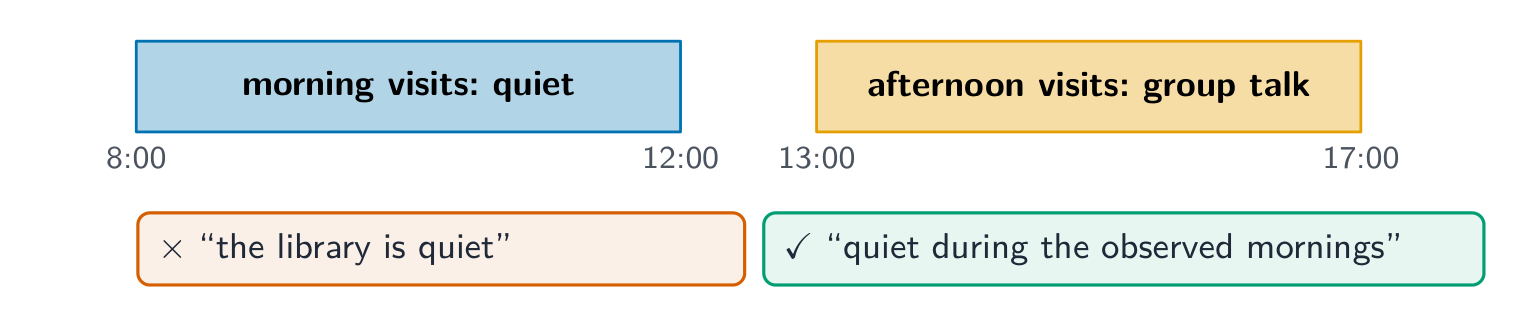
¿Por qué pueden ser ambos informes iniciales correctos?
Dificultad 1/5 · 100 monedas + un pequeño bono en el primer intento de hoy
Los entornos de la mañana y la tarde difieren.
Preferir una biblioteca silenciosa demuestra que los niveles de sonido observados son bajos.
Dificultad 1/5 · 100 monedas + un pequeño bono en el primer intento de hoy
Un juicio de valor sobre el propósito no es una medición de las condiciones actuales.
Identify a blind spot in the evidence
- Morning visitors may not observe afternoon use; regular users may not know which barriers keep others away. A blind spot 认知盲点 is a relevant part of a question that the current viewpoint misses.
- Compare observations across the periods or groups that the claim covers. Including another perspective helps when it supplies relevant missing evidence, not merely because it adds another opinion.
¿Qué evidencia aborda el punto ciego del visitante matutino?
Dificultad 1/5 · 100 monedas + un pequeño bono en el primer intento de hoy
La afirmación de todo el día requiere evidencia del período no observado.
Name what would revise the claim
- A student claiming silence all day should be ready to revise that claim after reliable afternoon observations. Specify a relevant check before seeing whether it supports your preference.
- Disagreement can reveal a difference in evidence, meaning or values. Decide which kind matters here instead of assuming every disagreement is solved by collecting more numbers.
¿Qué revisión se ajusta a la evidencia matutina?
Dificultad 1/5 · 100 monedas + un pequeño bono en el primer intento de hoy
La afirmación revisada retiene el hallazgo respaldado y estrecha su alcance.
Reflect on responsibility as a knower
- Ask how your position affects what you notice and trust. Explain the initial judgement, the evidence it lacked and the revision supported by another setting.
- Being open to revision does not mean accepting every claim. Use clear criteria and relevant checks, acknowledge uncertainty and explain why some reasons deserve more weight.
Asocia cada diferencia con su función.
Dificultad 2/5 · 140 monedas + un pequeño bono en el primer intento de hoy
Aclara el tipo de desacuerdo antes de elegir una verificación.
¿Qué movimientos muestran apertura razonada a la revisión?
Dificultad 2/5 · 140 monedas + un pequeño bono en el primer intento de hoy
La revisión sigue razones y evidencia, no un acuerdo automático.
The morning student reports quiet visits and initially generalizes to the whole day. The afternoon student supplies dated observations of group discussion. The first student revises the claim to quiet during the observed mornings. They then separate a factual question about use across times from a value question about balancing silence and collaboration. Their disagreement becomes clearer without pretending that one purpose must matter equally to every student.
Adding both sides is not sufficient reflection. Explain how the second perspective changes the claim, its meaning or the evidence required.
Locate your perspective, distinguish evidence from values, identify what is missing and state which relevant check would justify revision.
Write from two visits
- Morning visits find the library quiet. Afternoon group work finds it noisy.
- Both can be accurate. Name the missing check before revising a claim that the library is always quiet.
Un estudiante encuentra la biblioteca tranquila por la mañana. Otro la encuentra ruidosa durante el trabajo grupal de la tarde. ¿Cómo pueden ser ambos correctos y qué verificación revisaría la afirmación de que siempre está tranquila?
La perspectiva incluye cuándo y dónde miró el conocedor. Un contexto faltante es una razón para limitar la afirmación.
¿Cuál conclusión se ajusta a las dos visitas?
Dificultad 1/5 · 100 monedas + un pequeño bono en el primer intento de hoy
Las visitas abarcan diferentes momentos. La primera visita no invalida la tarde.