Matemáticas: ¿por qué una demostración establece más que ejemplos?
Introducido| English | Significado |
|---|---|
| conjecture/kənˈdʒektʃə/ | Conjetura |
| proof/pruːf/ | Demostración |
| induction/ɪnˈdʌkʃn/ | Inducción |
A pattern seems to continue
- The first odd number is 1; the first two sum to 4; the first three sum to 9. A student claims the first n positive odd numbers always sum to n².
- A conjecture 猜想 is a proposed statement awaiting justification. Checking three cases suggests a pattern but leaves infinitely many positive integers unchecked.
State the claim and its domain
- The claim concerns every positive integer n and the list 1, 3, 5, up to 2n−1. It does not concern any arbitrary collection of odd numbers.
- A proof 证明 gives a chain of valid reasons that covers the stated domain. One counterexample could defeat a universal claim, while many successful examples do not by themselves establish it.
¿Qué establecen por sí mismos las sumas 1, 4 y 9?
Dificultad 1/5 · 100 monedas + un pequeño bono en el primer intento de hoy
Las observaciones finitas no cubren todo el dominio.
Explain how the next case follows
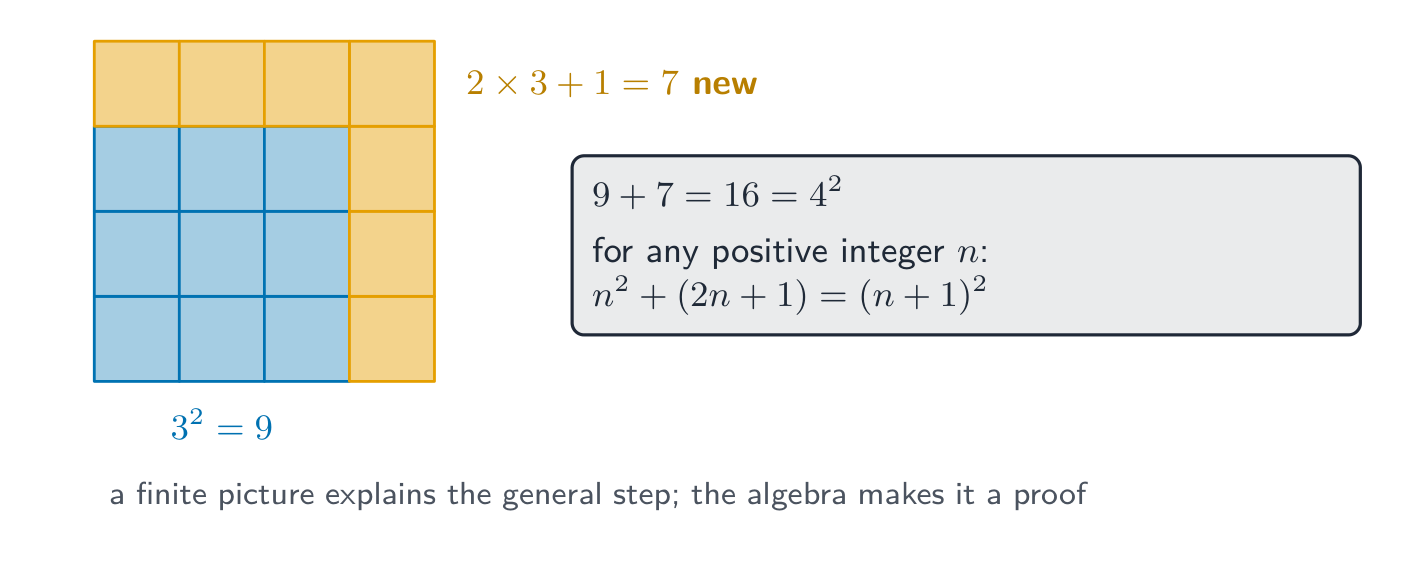
- Suppose the first n positive odd numbers sum to n². The next odd number is 2n+1, so the next sum is n²+2n+1=(n+1)². This step works for any positive integer n.
- The starting case is n=1, where the sum is 1=1². Starting there and applying the general step establishes each successive positive integer case.
¿Cuál es el siguiente número impar después de 2n−1?
Dificultad 1/5 · 100 monedas + un pequeño bono en el primer intento de hoy
Los números impares sucesivos difieren en 2.
Check what the reasoning assumes
- This is induction 数学归纳法: a valid starting case plus a step from any case to the next. Both parts matter. A step alone does not establish that the chain begins.
- Ask whether the algebra, definition of the next term and domain are correct. A calculation error or a changed starting sequence can invalidate the argument.
Un paso de inducción válido es suficiente incluso cuando no se establece un caso inicial.
Dificultad 1/5 · 100 monedas + un pequeño bono en el primer intento de hoy
La transición general necesita un caso establecido a partir del cual comience la cadena.
¿Por qué la suma 3+5+7=15 no es un contraejemplo?
Dificultad 1/5 · 100 monedas + un pequeño bono en el primer intento de hoy
Esta lista difiere de la especificada en la afirmación.
Compare proof with observation fairly
- The reason for confidence is the general chain, rather than the number of tested examples. A diagram of a few squares can explain the idea, but the argument must show why the construction extends.
- Ask how mathematical justification differs from checking repeated observations. Do not infer that proofs settle claims outside their assumptions or that empirical testing has no value in its own field.
Asocia cada parte de la demostración con su función.
Dificultad 2/5 · 140 monedas + un pequeño bono en el primer intento de hoy
Una demostración debe conectar su inicio, transición y dominio.
¿Qué razones respaldan la afirmación universal?
Dificultad 2/5 · 140 monedas + un pequeño bono en el primer intento de hoy
El razonamiento general, junto con un inicio válido, establece el dominio.
For n=1, the sum is 1. Assume the sum through 2n−1 is n². Adding 2n+1 gives n²+2n+1, which equals (n+1)². The base case and general transition establish the claim for all positive integers. The list 3,5,7 has sum 15, not 9, because it does not start at 1. That different list is outside the original claim, not a counterexample to it.
Do not use a successful calculator check for n=100 as a substitute for the general transition. It checks one more case.
State the domain, justify a starting case and establish a valid general step; explain exactly what the resulting proof covers.
Write from three sums
- The first odd number is 1. The first two sum to 4. The first three sum to 9.
- Say why these three checks do not prove the claim for every positive integer.
Los primeros uno, dos y tres números impares positivos suman 1, 4 y 9. ¿Por qué eso no demuestra que los primeros n siempre sumen al cuadrado de n?
Una conjetura puede ajustarse a los casos probados y seguir siendo no demostrada. La confianza proviene de un argumento general.
¿Qué muestran las tres sumas?
Dificultad 1/5 · 100 monedas + un pequeño bono en el primer intento de hoy
1, 4 y 9 se ajustan a los primeros tres casos. Una demostración debe abarcar todos los números enteros positivos, no solo los casos ya añadidos.