Different questions need different methods
Introducido| English | Significado |
|---|---|
| standard/ˈstændəd/ | criterio |
| measurement/ˈmeʒəmənt/ | medición |
| method/ˈmeθəd/ | método |
| interpretation/ɪnˌtɜːprɪˈteɪʃn/ | interpretación |
Brown water in Flint, 2014–2015
- In April 2014 the city of Flint, Michigan, switched its water supply to the Flint River. Residents soon complained that the tap water was brown and smelled bad, and some children had rashes. Officials said the water met standards.
- In 2015 a team led by the engineer Marc Edwards tested water from hundreds of homes and found high lead levels, and the paediatrician Mona Hanna-Attisha showed that more children had raised lead in their blood. Residents' experience and scientific measurement answered different parts of the same problem.
What did the 2015 testing in Flint find?
Dificultad 1/5 · 100 monedas + un pequeño bono en el primer intento de hoy
Measurement named the substance and amount.
The question decides the method
- "Is the water safe to drink?" needs measurement 测量: a named substance, a sampling method, a date. "Why did the city switch its water?" needs historical sources: budgets, meeting records, letters.
- Choose a method 方法 that fits the question; one method cannot answer every question about the same place.
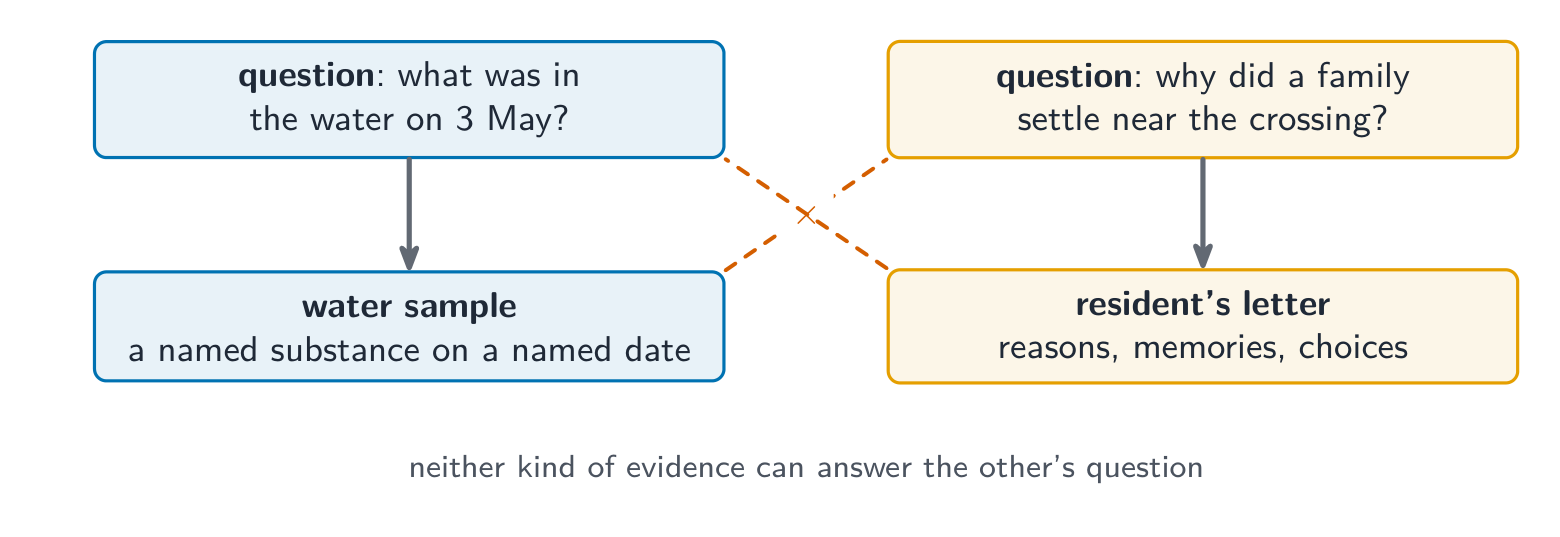
Match each question to a fitting method.
Dificultad 2/5 · 140 monedas + un pequeño bono en el primer intento de hoy
The question decides the method.
What a measurement can show
- A scientific claim says what was measured, how and when. Repeated sampling across many homes tests whether a result is general.
- One clean sample does not show that every tap is safe at every time; the claim must match the sampling and the instrument's limits.
One clean water sample shows every tap in a city is safe.
Dificultad 1/5 · 100 monedas + un pequeño bono en el primer intento de hoy
The claim must match the sampling.
Worked example: two kinds of evidence in Flint
- Residents' testimony: reports of brown water, smells and rashes in 2014. Strength: early, direct experience across many homes. Limit: cannot identify which substance, or how much.
- Measurement: the 2015 home sampling found lead above the federal action level in many homes; blood tests showed more children with raised lead after the switch. Strength: names the substance and the amount. Limit: depends on which homes were sampled and how.
- Historical question: why the switch happened needs budget records and decisions by state-appointed managers — neither testimony nor water tests can answer it. Together the three methods explain what happened, how bad it was and why.
What is a limit of residents' testimony about the water?
Dificultad 1/5 · 100 monedas + un pequeño bono en el primer intento de hoy
Testimony gives experience, not amounts.
Which evidence answers why the switch happened?
Dificultad 1/5 · 100 monedas + un pequeño bono en el primer intento de hoy
Reasons need historical sources.
Interpretation in history
- A historian builds an interpretation from sources: who wrote them, when, and why. Several independent sources make a claim stronger.
- In Flint, official documents later showed that warnings had been ignored — a historical finding, not a measurement.
A fair standard
- Do not judge one area of knowledge by another's standard: history cannot repeat an experiment, and a lab test cannot read a council's motives.
- Ask what each method does well, and where its limits lie.
History should be judged by whether it can repeat experiments.
Dificultad 1/5 · 100 monedas + un pequeño bono en el primer intento de hoy
Judge each area by its own standards.
Testimony is not worthless because it is not a measurement. In Flint, residents were right that something was wrong months before tests proved it. Each kind of evidence has its own strengths and limits.
In Flint, residents' testimony was worthless because it was not a measurement.
Dificultad 1/5 · 100 monedas + un pequeño bono en el primer intento de hoy
Residents were right before tests proved it.
The question decides the method. Measurement names a substance, amount and sample; testimony gives direct experience; historical sources explain reasons. Judge each method by its own standards, and combine them when a problem has several questions.
Pick one place or event and write two questions about it that need different methods.
Question, method, limit.