Solo theatre piece and theory in action
Introducido| English | Significado |
|---|---|
| alienation effect | Brecht's technique of making the familiar strange so the audience thinks critically instead of simply feeling |
| theatre theory/ˈθɪətə ˈθɪəri/ | teoría del teatro |
| solo theatre piece | the IB Theatre higher-level assessment: a 4 to 7 minute solo performance applying a theorist's idea |
| direct address/daɪˈrekt əˈdres/ | a performer speaking straight to the audience instead of to other characters |
| fourth wall | the imaginary wall between the stage and the audience |
Brecht watches Mei Lanfang, 1935
- In 1935 the Chinese opera star Mei Lanfang performed in Moscow. The German playwright Bertolt Brecht watched him demonstrate a role in an ordinary suit, without costume or lighting, and was struck that the actor showed the character rather than becoming it.
- In 1936 Brecht wrote "Alienation Effects in Chinese Acting". His theatre theory 戏剧理论 asked actors to make the familiar strange, so audiences would think rather than simply feel.
Whose performance in Moscow in 1935 influenced Brecht's theory?
Dificultad 1/5 · 100 monedas + un pequeño bono en el primer intento de hoy
Brecht wrote about Chinese acting after watching Mei Lanfang.
The solo theatre piece
- At HL you create a solo theatre piece 独角戏 of 4–7 minutes that puts one aspect of a theatre theorist's ideas into practice.
- Choose one specific idea — not "Brecht's style", but "breaking the fictional frame by addressing the audience directly".
What is the maximum length of the HL solo theatre piece in minutes?
Dificultad 2/5 · 140 monedas + un pequeño bono en el primer intento de hoy
The piece lasts 4–7 minutes.
Which is a specific enough aspect of theory for the solo piece?
Dificultad 1/5 · 100 monedas + un pequeño bono en el primer intento de hoy
Choose one precise idea.
Theory changes a choice
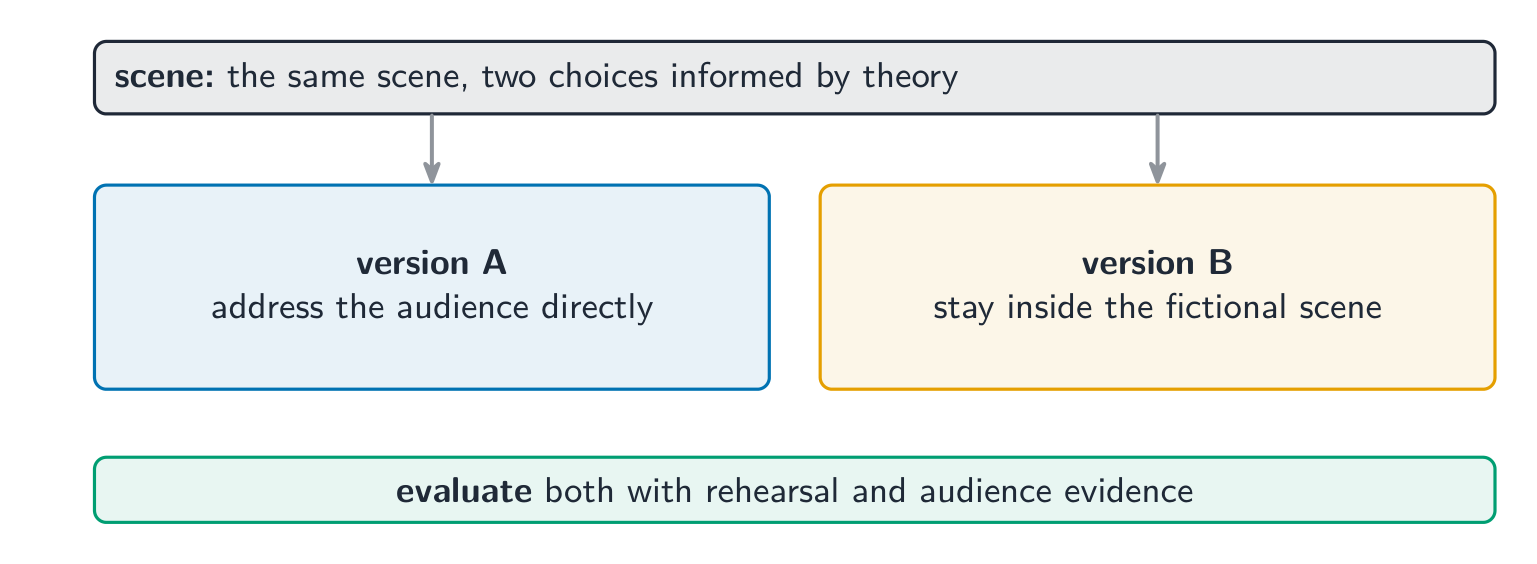
- Test the theory by comparing two versions of the same moment: one that applies it and one that does not.
- Direct address 直接面对观众 — speaking to the audience — breaks the fourth wall 第四堵墙, the imaginary wall between stage and audience.
Match each term to its meaning.
Dificultad 2/5 · 140 monedas + un pequeño bono en el primer intento de hoy
These are Brechtian terms.
Worked example: two versions of a scene
Scene: a worker is fired from a factory. Theory: Brecht's alienation effect 间离效果 — making the audience step back and question.
- Version B (inside the scene): the actor cries alone; test viewers feel sorry for her but say nothing about why it happened.
- Version A (direct address): she stops, turns to the audience and asks, "Who decided this — and could it have been different?", then returns to the scene.
- Evaluation: after A, viewers discuss the factory owner's choice and the economy. The theory changed the audience's response from pity to questioning — the effect Brecht wanted.
In the worked example, how did version A change the audience's response?
Dificultad 1/5 · 100 monedas + un pequeño bono en el primer intento de hoy
That is the effect Brecht wanted.
Research the theorist
- Read the theorist's own writing and study recordings or productions of their work. Note one quotation that defines the idea you test.
- Place the theory in its context: Brecht wrote in Germany in the 1920s–30s and wanted theatre to change society.
Brecht wanted theatre to make audiences think about society.
Dificultad 1/5 · 100 monedas + un pequeño bono en el primer intento de hoy
His theory aimed at social change.
The report
- Your report explains the theory, shows how you put it into practice, and evaluates the result with evidence from rehearsals and audience responses.
- Link each staging choice to the specific part of the theory it applies.
Wearing a placard is not "doing Brecht". Copying surface features — signs, bare stages — without the purpose behind them misses the theory. Show how your choice makes the audience think differently.
Using a placard on stage is enough to apply Brecht's theory.
Dificultad 1/5 · 100 monedas + un pequeño bono en el primer intento de hoy
Surface features without purpose miss the theory.
The HL solo theatre piece puts one specific idea of a theorist into practice in 4–7 minutes. Compare versions with and without the theory, evaluate with audience evidence, research the theorist's own writing and context, and link each choice to its purpose.
Pick a theorist's idea and describe two versions of a short moment that test it.
Idea, two versions, evidence.