From play text to production proposal
Introducido| English | Significado |
|---|---|
| production proposal | an argued plan for staging a play text, with design and staging choices justified by an intention |
| artistic intention/ɑːˈtɪstɪk ɪnˈtenʃn/ | The meaning or audience experience that the filmmaker aims to create through creative choices. |
| blocking/ˈblɒkɪŋ/ | the planned positions and movements of actors on stage |
| actor–audience relationship | how close the audience is to the performers and how the seating is arranged |
| context/ˈkɒntekst/ | The surrounding circumstances, information or language that help determine meaning and interpretation. |
A white box for a forest, 1970
- In 1970 Peter Brook directed A Midsummer Night's Dream for the Royal Shakespeare Company in a bright white box. There was no forest: the fairies swung on trapezes and spun plates, and the actors stood on a gallery above the stage.
- Shakespeare's words stayed the same; the space changed what they meant. That is the core of a production proposal 制作提案: an argued plan for staging a play text.
What did Peter Brook's 1970 production change?
Dificultad 1/5 · 100 monedas + un pequeño bono en el primer intento de hoy
The white box and trapezes changed meaning without changing the text.
Intention first
- Start with your artistic intention 艺术意图: what you want the audience to feel, think or notice. Brook wanted the magic to come from the actors' skill, not from scenery.
- Every design choice — space, set, costume, lighting, sound — should serve that intention.
Every design choice in a proposal should serve the artistic intention.
Dificultad 1/5 · 100 monedas + un pequeño bono en el primer intento de hoy
The intention is what justifies each choice.
Staging and blocking
- Blocking 走位 is where actors stand and move. The actor–audience relationship 演员与观众关系 is how near the audience is and where they sit — end-on, thrust, in the round, promenade.
- Distance between two actors shows their relationship; moving one closer or further changes the scene without changing a word.
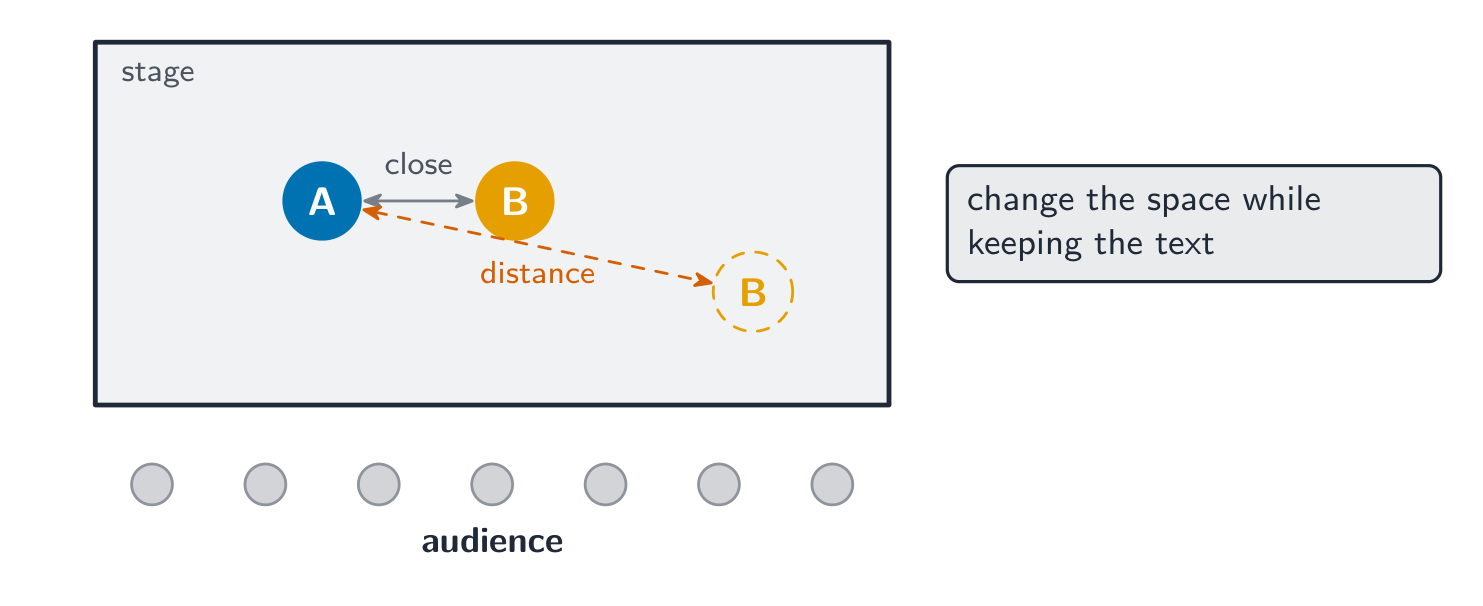
Match each term to its meaning.
Dificultad 2/5 · 140 monedas + un pequeño bono en el primer intento de hoy
These are the core terms of staging.
Which are stage configurations?
Dificultad 2/5 · 140 monedas + un pequeño bono en el primer intento de hoy
A monologue is a speech, not a configuration.
Worked example: one moment, two stagings
Moment: in A Midsummer Night's Dream, Hermia's lover Lysander suddenly rejects her under a spell. Intention: the audience should feel her shock and humiliation.
- Staging A: Lysander downstage, close to the audience; Hermia far upstage. The gap makes her seem small and alone, and the audience is placed on his side.
- Staging B: they stay close, but he turns his back. The rejection is more intimate and painful because she can almost touch him.
- Choice: B serves the intention better — closeness makes the betrayal sharper — so the proposal would justify B with that reason.
In the worked example, why is staging B chosen?
Dificultad 1/5 · 100 monedas + un pequeño bono en el primer intento de hoy
The choice is justified by the intention.
Design elements
- Choose a few strong design ideas rather than many weak ones. Explain each: what it looks or sounds like, where it appears, and how it serves the intention.
- Use sketches, ground plans and images to show the ideas.
Text and context
- Show you understand the play's context 背景 — when and why it was written — and decide how your staging responds: faithful, updated or deliberately challenging.
- Justify changes from the text's own evidence.
A proposal can update a play's setting if the choice is justified.
Dificultad 1/5 · 100 monedas + un pequeño bono en el primer intento de hoy
Faithful, updated or challenging — all must be justified.
A list of design ideas is not a proposal. "Red lights, modern costumes, a big staircase" says nothing unless each choice is linked to the intention and to a specific moment in the play.
A list of design ideas without reasons is a strong proposal.
Dificultad 1/5 · 100 monedas + un pequeño bono en el primer intento de hoy
Each idea must link to the intention and a moment.
A production proposal starts from an artistic intention and justifies every staging and design choice by it. Use blocking and the actor–audience relationship to change meaning without changing the text, and ground each choice in the play and its context.
Choose one moment from a play you know, state an intention, and justify one blocking choice.
Moment, intention, choice.