Motor learning, feedback and retention
Introducido| English | Significado |
|---|---|
| retention/rɪˈtenʃn/ | retención |
| knowledge of result | Feedback about the outcome of a movement. |
| feedback/ˈfiːdbæk/ | Information about an outcome returned to a person or system to guide subsequent action. |
| transfer/ˈtrænsfɜː/ | transfer |
| transfer test | A test in a new task or setting, showing whether learning can be applied. |
| intrinsic feedback | Information from one's own senses during movement. |
| plateau/ˈplætəʊ/ | plateau |
| contextual interference | contextual interference |
What would explain this observation?
- A learner performs well while a coach gives constant instructions, then struggles the next day. Immediate performance and retained learning are different outcomes.
Build the model
- Motor learning is a relatively lasting change in movement capability from practice.
- Knowledge of results 结果反馈 concerns the outcome; knowledge of performance concerns movement quality.
- retention 保持: Persistence of learning after a delay.
- knowledge of results: Feedback about the task outcome.

Which measure best tests lasting learning?
Dificultad 1/5 · 100 monedas + un pequeño bono en el primer intento de hoy
Learning is a lasting change, so it is tested by performance after a delay without help. Strong performance while the coach corrects every attempt may reflect guidance, not learning; favourite colour is irrelevant to the skill.
Match each technical term to its precise meaning.
Dificultad 2/5 · 140 monedas + un pequeño bono en el primer intento de hoy
Use the definitions to distinguish related quantities and processes.
Choose evidence that can test it
- A retention test after a delay and without the same assistance can provide evidence of learning.
- Practice conditions, prior experience and task difficulty need control before comparing feedback methods.
In the lab: Use a low-risk target task, equal practice time, random or balanced assignment, and a delayed retention test. Record outcome accuracy separately from movement quality. Seek consent and avoid labels about a participant ability or personality.
Which two habits make the investigation or model in this case more defensible?
Dificultad 2/5 · 140 monedas + un pequeño bono en el primer intento de hoy
Stating the conditions and assumptions lets others repeat the work exactly, and recording the supporting evidence lets them check the conclusion. Hiding disagreeing results removes the evidence that could challenge a wrong conclusion, and one measurement can never establish a wider claim.
Work from known quantities
- Known: 12 of 20 throws hit a target during retention.
- Accuracy = successful attempts/total attempts ×100 = 12/20×100 = 60%.
- Another group at 70% is not automatically superior without sample variability and comparable starting performance.
Your turn: 15 of 25 retention attempts succeed. Find success percentage.
15 of 25 retention attempts succeed. Find success percentage.
Dificultad 2/5 · 140 monedas + un pequeño bono en el primer intento de hoy
The result is 60 %. Known: 15 of 25 retention attempts succeed. Use success percentage = successes / total x 100. Percentage = 15/25 x 100 = 60%. This is an unassisted retention measure; judge learning against starting performance, conditions and variability rather than one count.
Check the conclusion and its limits
- More feedback is not always better for independent performance.
- A short-term improvement alone does not demonstrate a lasting learning change.
Not true: High performance during guided practice always proves lasting motor learning. Guidance can temporarily improve performance without establishing a lasting change in capability. Compare delayed unassisted retention and suitable transfer with starting performance under comparable conditions. Fatigue, motivation and task changes can also affect test scores; one drop does not uniquely establish dependence on guidance.
- Motor learning is a relatively lasting change in movement capability from practice.
- A retention test after a delay and without the same assistance can provide evidence of learning.
- Watch for: more feedback is not always better for independent performance.
High performance during guided practice always proves lasting motor learning.
Dificultad 1/5 · 100 monedas + un pequeño bono en el primer intento de hoy
Guidance can temporarily improve performance without establishing a lasting change in capability. Compare delayed unassisted retention and suitable transfer with starting performance under comparable conditions. Fatigue, motivation and task changes can also affect test scores; one drop does not uniquely establish dependence on guidance.
Persistence of learning after a delay: write the technical term.
Dificultad 1/5 · 100 monedas + un pequeño bono en el primer intento de hoy
retention means Persistence of learning after a delay.
Write from the data given
- 16 of 20 throws hit the target during retention.
- Find the success percentage. Guided practice does not prove lasting learning.
16 of 20 retention throws hit the target. What is the success percentage, and why does guided practice not prove lasting learning?
Accuracy is successful attempts divided by total attempts. Retention is the unassisted delayed test.
In a delayed retention test, 16 of 20 throws hit the target. What is the success percentage?
Dificultad 1/5 · 100 monedas + un pequeño bono en el primer intento de hoy
16 divided by 20 is 80 percent. The worked example's 12 of 20 is 60 percent. Other options — 16 percent (the successful-throw count); 60 percent (the worked retention percentage).
C.2: Distinguish capability from one score
- Learning is inferred as relatively lasting change in capability through experience. Performance is what is observed on one occasion and fluctuates with fatigue, help, motivation and chance.
- A delayed unassisted retention test and a suitable new-condition transfer test 迁移测验 give different evidence. Neither one score nor a smooth curve directly measures every aspect of learning.
Can a single high prompted score establish lasting independent learning?
Dificultad 1/5 · 100 monedas + un pequeño bono en el primer intento de hoy
Use evidence appropriate to persistence and adaptation.
Find success percentage for 16 of 20 retention attempts.
Dificultad 2/5 · 140 monedas + un pequeño bono en el primer intento de hoy
16/20×100=80%; this preserves the original written case.
C.2: Describe the cognitive phase
- A novice works out the goal and a workable movement, often making variable errors and using conscious attention. Demonstration and a few understandable cues can help.
- Avoid supplying a long technical checklist before the learner can use it. Give accurate encouragement and a manageable task; being new is not a diagnosis of low ability.
Which coaching response is usually appropriate to initial learning?
Dificultad 1/5 · 100 monedas + un pequeño bono en el primer intento de hoy
Match information demands to current task capability.
C.2: Refine in the associative phase
- With suitable practice, the learner can refine timing and consistency, detect more errors and use relevant intrinsic feedback 内在反馈. Specific actionable feedback can guide improvement.
- Add meaningful variations when appropriate rather than demanding maximum challenge immediately. Phase labels describe patterns and do not impose exact dates or ages.
Do all learners enter this phase after an identical number of trials?
Dificultad 1/5 · 100 monedas + un pequeño bono en el primer intento de hoy
Avoid turning an organising description into a fixed timetable.
C.2: Support autonomous performance
- A well-practised action may require less conscious movement control, leaving attention available for decisions. Occasional targeted feedback can still be useful.
- Experts can revisit conscious refinement when a technique or condition changes. Automatic movement does not mean absence of attention, feedback, or capacity to learn.
Does autonomous performance mean no further feedback can help?
Dificultad 1/5 · 100 monedas + un pequeño bono en el primer intento de hoy
Distinguish efficient control from a fixed final ceiling.
C.2: Investigate a plateau 平台期
- A plateau is little observed score improvement over a period. Fatigue, increased difficulty, inappropriate practice or an insensitive measure are plausible explanations.
- Rest addresses fatigue; task redesign addresses a mismatch; better measurement may reveal hidden improvements. The graph alone does not prove a permanent biological limit or identify a cause.
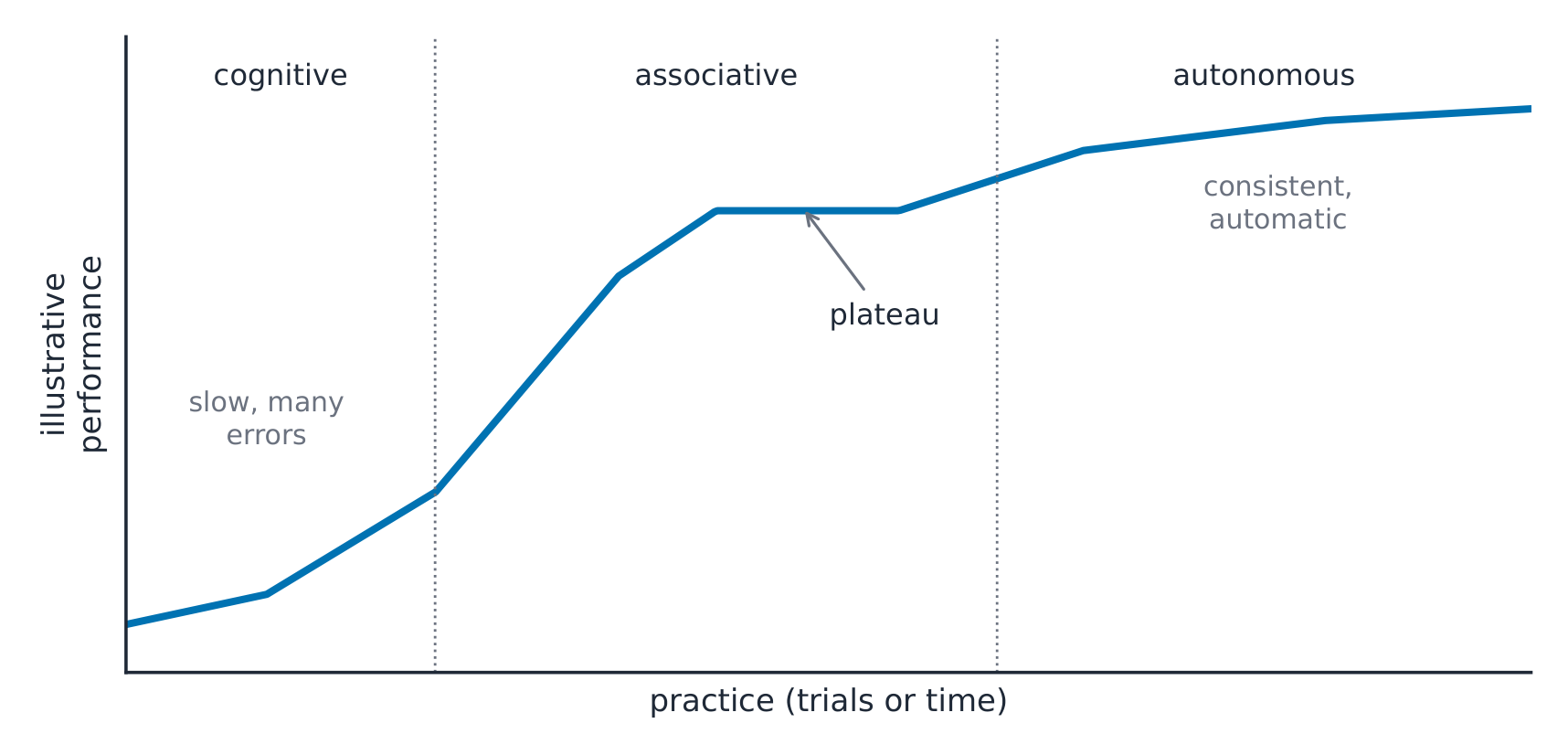
What can a flat practice score establish by itself?
Dificultad 1/5 · 100 monedas + un pequeño bono en el primer intento de hoy
Explain the measured pattern before proposing its mechanism.
C.2: Separate feedback source from content
- Intrinsic feedback arises from the performer’s senses. Augmented feedback adds information from a coach, video or other source.
- Knowledge of results concerns outcome, such as a measured jump of 4.10 m. Knowledge of performance concerns the movement, such as take-off foot placement. Source and content categories can overlap.
Which statement is knowledge of results?
Dificultad 1/5 · 100 monedas + un pequeño bono en el primer intento de hoy
Ask whether the information describes outcome or movement quality.
C.2: Classify the take-off comment precisely
- A coach’s post-attempt statement that the foot was 20 cm behind the board is augmented, terminal knowledge of performance. It describes the movement that produced a jump.
- The number alone does not make it knowledge of results. A final measured jump distance is outcome feedback; feedback categories depend on what is described, not whether numbers appear.
Why is foot placement performance feedback?
Dificultad 1/5 · 100 monedas + un pequeño bono en el primer intento de hoy
Define the content before attaching the category.
C.2: Time feedback to its purpose
- Concurrent feedback occurs during the action; terminal feedback comes afterwards. Both can supply useful information, but timing affects how it can be used.
- A coach’s call during a slow drill may support adjustment; video afterwards supports evaluation and later attempts. A brief released throw cannot be corrected by feedback arriving after release.
What can post-release video usefully inform?
Dificultad 1/5 · 100 monedas + un pequeño bono en el primer intento de hoy
Connect the feedback arrival to the action window.
C.2: Reduce dependence without withholding safety
- Feedback after every attempt may improve prompted scores but create dependence. The guidance hypothesis predicts possible loss when external guidance is removed.
- Faded feedback reduces frequency over time; bandwidth feedback occurs when a defined error threshold is exceeded. Keep necessary safety feedback and check whether the learner can evaluate errors independently.
Does fading require withholding urgent safety information?
Dificultad 1/5 · 100 monedas + un pequeño bono en el primer intento de hoy
Distinguish an instructional schedule from essential supervision.
C.2: Choose useful correction
- A concise correction identifies a feasible next action; accurate positive feedback identifies what was effective. Neither requires judging the learner’s worth or promising success.
- Beginners may need simple outcome information and one movement cue; experienced performers may need detail. Learner, task and comprehension matter more than a rigid rule that one phase always receives only one feedback type.
What makes a correction actionable?
Dificultad 1/5 · 100 monedas + un pequeño bono en el primer intento de hoy
Describe the action and evidence rather than a fixed personal judgement.
C.2: Choose whole or part practice
- Whole practice preserves the action’s organisation. Part practice isolates a component when it can meaningfully be separated; progressive part gradually links components.
- Whole–part–whole identifies a weak component and restores it to context. Excessive separation can disrupt timing, so complex does not automatically mean every element should be practised alone.
Why return an isolated component to the whole skill?
Dificultad 1/5 · 100 monedas + un pequeño bono en el primer intento de hoy
Practice organisation should reflect how components interact.
C.2: Distribute practice when needed
- Massed practice provides little rest; distributed practice includes rest or intervening activities. Fatigue and attention demands affect the useful schedule.
- A beginner in a tiring supervised task may need brief bouts and rest. No single work–rest prescription follows from the label alone; define the task, capability and supervision.
What supports using distributed practice in a demanding novice task?
Dificultad 1/5 · 100 monedas + un pequeño bono en el primer intento de hoy
Justify the schedule from the learner and task.
C.2: Distinguish fixed and variable conditions
- Fixed practice repeats a specified version; variable practice changes relevant conditions such as target distance. Variable is not identical to random order.
- A learner can practise several distances in blocks or mix them. Distinguish which tasks occur from the order in which they occur before interpreting a comparison.
Can variable practice be presented in blocks?
Dificultad 1/5 · 100 monedas + un pequeño bono en el primer intento de hoy
Describe the schedule precisely.
C.2: Interpret contextual interference 情境干扰 conditionally
- Blocked practice repeats one task before another; random practice mixes tasks. Switching tasks may increase reconstruction or planning demands and lower immediate scores.
- Potential retention or transfer 迁移 benefits depend on learner and task. Neither the theory nor one invented graph proves that maximum interference always improves sport learning.
Does random practice always outperform blocked practice for every skill?
Dificultad 1/5 · 100 monedas + un pequeño bono en el primer intento de hoy
Distinguish a theoretical prediction from a universal result.
C.2: Calculate the invented schedule comparison
- In the handout’s invented scores, blocked accuracy changes 85→60% and random 70→72%. Blocked falls 25 percentage points; random gains 2 points.
- Blocked leads by 15 points at practice, but random leads by 12 points at retention. The delayed pattern differs from the practice ranking, without establishing a causal effect from two scores alone.
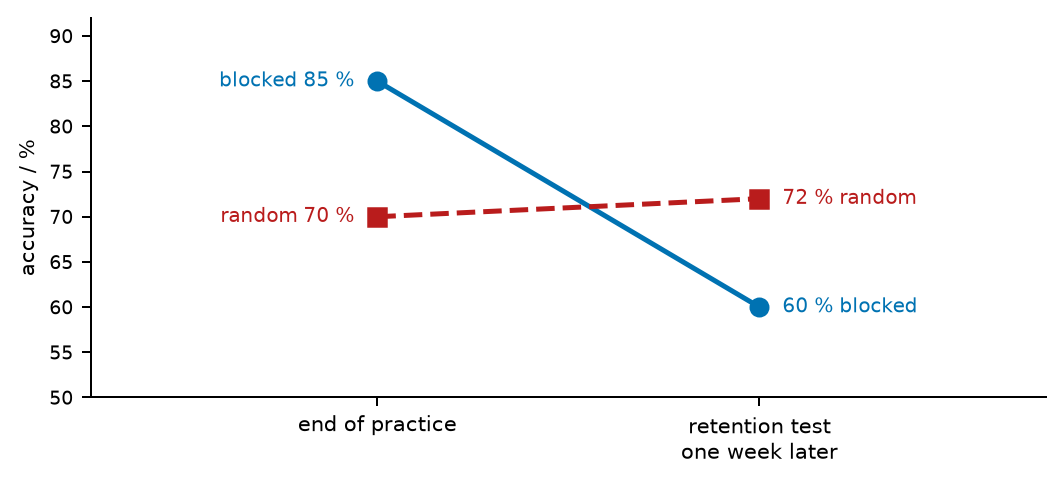
Blocked-practice accuracy changes from 85% in practice to 60% at retention. Random-practice accuracy changes from 70% to 72%. Which group leads at retention?
Dificultad 1/5 · 100 monedas + un pequeño bono en el primer intento de hoy
At retention, random accuracy is 72% and blocked accuracy is 60%. Random leads by 72 − 60 = 12 percentage points. The earlier blocked practice lead, 85 − 70 = 15 points, describes a different time point.
Find the retention percentage-point advantage of 72% over 60%.
Dificultad 2/5 · 140 monedas + un pequeño bono en el primer intento de hoy
72−60=12 percentage points.
C.2: Keep percentage points and relative change separate
- The blocked decline from 85 to 60% is 25 percentage points. Relative decline divides by the starting rate: 25/85×100 = 29.411764…%.
- The two quantities answer different questions. Use unrounded working and specify the starting denominator rather than dividing by 60 or calling the point change a 25% relative decline.
Blocked-practice accuracy falls from 85% in practice to 60% at retention. Which denominator gives the relative percentage decline from the starting rate?
Dificultad 1/5 · 100 monedas + un pequeño bono en el primer intento de hoy
Fall = 85 − 60 = 25 percentage points. Relative decline = 25/85 × 100 ≈ 29.4%, using the initial 85%. Dividing by 60% gives a different comparison.
Find relative percentage decline from 85% to 60%. Give the percentage to three significant figures.
Dificultad 2/5 · 140 monedas + un pequeño bono en el primer intento de hoy
The fall is 25 percentage points. Relative decline = (85−60)/85×100=29.411764…%, or 29.4% to three significant figures. Divide by the starting 85%, not by the final 60%.
C.2: Compare schedules with a defensible design
- Define practice opportunity, starting experience, task conditions, outcome measure and feedback availability. Use appropriate allocation and independent participants.
- Twenty attempts from one learner are not twenty independent learners. Examine baseline comparability and variability, then test delayed unassisted retention and representative transfer.
Do many throws from one person create the same independent sample as many people?
Dificultad 1/5 · 100 monedas + un pequeño bono en el primer intento de hoy
Match the sample unit to the inference.
C.2: Evaluate guidance with consent and supervision
- Visual demonstrations and concise verbal explanations can establish the goal. Manual guidance involves physical assistance; mechanical guidance uses equipment.
- Physical contact needs appropriate consent and qualified supervision. Floats or harnesses require suitability and do not eliminate risk; dependence and changed movement feel may limit transfer.
Does guidance equipment automatically make a risky skill safe without supervision?
Dificultad 1/5 · 100 monedas + un pequeño bono en el primer intento de hoy
Assess the actual task rather than relying on the guidance label.
C.2: Plan a supervised beginner example
- For a low-risk component of front crawl under qualified water supervision, demonstrate a manageable action, allow brief practice and rest, then reconnect it to the whole movement.
- Use appropriate assistance, checking understanding and comfort. Add relevant conditions gradually and assess unassisted skill within normal safety limits; the lesson is not an instruction to attempt unsupervised swimming.
Why reconnect component practice to the whole stroke?
Dificultad 1/5 · 100 monedas + un pequeño bono en el primer intento de hoy
Integration and safe conditions are essential to the learning inference.
C.2: Specify skill-to-skill transfer
- Experience with an overarm throw may support a serve because some coordination is relevant; differences in implement, timing and goals can limit transfer.
- Positive transfer helps the target, negative transfer hinders it, and little effect is also possible. Similar-looking skills do not prove either benefit or interference.
Does naming two similar sports establish positive transfer?
Dificultad 1/5 · 100 monedas + un pequeño bono en el primer intento de hoy
State the shared feature and test the actual target.
C.2: Connect practice and performance transfer
- A live-decision drill can preserve cues relevant to a match. Transfer asks whether capability is useful in the target performance setting.
- A practice score can be high while match decisions remain weak if the drill removes defenders or time pressure. Preserve important information without reproducing every detail or creating unnecessary risk.
What matters for representative transfer practice?
Dificultad 1/5 · 100 monedas + un pequeño bono en el primer intento de hoy
Identify the functional demand that must carry over.
C.2: Connect abilities and bilateral experience
- A supporting ability such as balance may help learn a handstand, but increasing balance alone does not automatically teach the skill. Bilateral transfer concerns learning across body sides.
- Practising on one side may support the other through shared coordination or understanding, while side-specific demands remain. The magnitude and direction require evidence.
Does improved general balance guarantee a learned handstand?
Dificultad 1/5 · 100 monedas + un pequeño bono en el primer intento de hoy
Keep supporting capacity separate from learned action.
C.2: Transfer between stages and from principles
- A learned basic coordination can support more autonomous execution; an expert may still refine a changed technique consciously. Stage-to-stage transfer is not an automatic age transition.
- A principle such as creating space can guide a new passing game even when the exact action differs. Name the source principle, target decision and evidence of useful application.
What is an example of principle-to-skill transfer?
Dificultad 1/5 · 100 monedas + un pequeño bono en el primer intento de hoy
Transfer can involve understanding rather than copying surface movement.
C.2: Compare explanatory models without slogans
- Information processing explains selection, representations and prepared responses; ecological dynamics explains adaptation through constraints, opportunities and perception–action coupling.
- A fair teaching comparison defines task, learner, practice time and retained/transfer outcomes. Demonstration, explicit cues and exploration can coexist; a theory’s name is not evidence that one lesson caused more learning.
What supports a comparison of teaching approaches?
Dificultad 1/5 · 100 monedas + un pequeño bono en el primer intento de hoy
Evaluate what the learner can do rather than the approach’s name.