Exercise physiology: responses and recovery
Introducido| English | Significado |
|---|---|
| cardiac output/ˈkɑːdiæk ˈaʊtpʊt/ | gasto cardíaco |
| stroke volume/strəʊk ˈvɒljuːm/ | volumen de eyección |
| threshold/ˈθreʃəʊld/ | A boundary value at which a specified effect begins or a decision changes. |
| effector/ɪˈfektə/ | A muscle, gland or other structure that carries out a response to a stimulus. |
| receptor/rɪˈseptə/ | A cell or molecule that detects a stimulus or binds a specific signalling molecule to initiate a response. |
| gland/ɡlænd/ | An organ or group of cells that produces and releases a substance. |
| reflex/ˈriːfleks/ | reflex |
| sympathetic/ˌsɪmpəˈθetɪk/ | The autonomic division that prepares the body for action. |
| parasympathetic/ˌpærəˌsɪmpəˈθetɪk/ | The autonomic division that supports rest and recovery. |
| motor neuron | A neuron that carries impulses from the central nervous system to muscle. |
| dendrite | A short branch of a neuron that receives signals. |
| cell body/sel ˈbɒdi/ | The part of a neuron that contains the nucleus. |
| axon/ˈæksɒn/ | A long projection of a neuron that carries electrical impulses away from the cell body. |
| action potential/ˈækʃn pəˈtenʃl/ | A brief reversal of the charge across a neuron or muscle membrane that carries a signal. |
| nodes of Ranvier | Gaps in the myelin sheath where an impulse is regenerated. |
| neuromuscular junction/ˌnjuːrəˈmʌskjʊlə ˈdʒʌŋkʃn/ | The specialised synapse through which a motor neurone signals to a muscle fibre. |
| neuron/ˈnjuːrɒn/ | A nerve cell that carries electrical impulses. |
| neurotransmitter/ˈnjuːrətrænsmɪtə/ | A chemical released by a neuron that transmits a signal across a synapse by binding to receptors on a target cell. |
| repolarisation/rɪˌpəʊləraɪˈzeɪʃn/ | The membrane returning towards its resting charge as potassium ions leave. |
| acetylcholine/ˈæsɪtɪlkəliːn/ | A neurotransmitter released at neuromuscular junctions and at many other synapses. |
| depolarisation/diːˌpəʊləraɪˈzeɪʃn/ | The inside of a membrane becoming less negative as sodium ions enter. |
| recruitment/rɪˈkruːtmənt/ | recruitment |
| motor unit | One motor neuron and all the muscle fibres it controls. |
| muscle spindle | A stretch receptor inside a muscle that detects changes in length. |
| golgi tendon organ | A receptor at the muscle-tendon junction that detects tension. |
| hormone/ˈhɔːməʊn/ | A chemical messenger released by a cell or gland that affects target cells with suitable receptors. |
| synapse/ˈsɪnæps/ | A junction through which a neuron communicates with another cell, usually using a chemical transmitter. |
| adrenaline/əˈdrenəlɪn/ | A hormone released by the adrenal medulla that prepares the body for rapid action during stress or excitement. |
| double circulation/ˈdʌbl ˌsɜːkjʊˈleɪʃn/ | A system in which blood passes through the heart twice in a complete journey through the lungs and body. |
| ventricle/ˈventrɪkl/ | A lower heart chamber, which pumps blood out of the heart. |
| artery/ˈɑːtəri/ | A thick-walled vessel that carries blood away from the heart at high pressure. |
| vein/veɪn/ | A blood vessel that carries blood towards the heart. |
| valve/vælv/ | A flap of tissue that keeps blood flowing in one direction. |
| atria/ˈeɪtrɪə/ | The two upper heart chambers, which receive blood. |
| purkinje fibre | A specialised fibre that spreads the impulse through the ventricle walls. |
| myogenic/ˌmaɪəʊˈdʒenɪk/ | Starting within the muscle itself, as the heartbeat does. |
| venous return | The volume of blood flowing back to the heart. |
| vasodilation/ˌvæsədɪˈleɪʃn/ | Widening of blood vessels, which can increase blood flow through them. |
| inspiration | Breathing in. |
| diaphragm/ˈdaɪəfræm/ | The dome-shaped muscle under the lungs, which flattens during inspiration. |
| expiration | Breathing out. |
| tidal volume | The volume of air moved in one normal breath. |
| vital capacity | The largest volume of air that can be breathed out after a maximal breath in. |
| residual volume | The air left in the lungs after a maximal breath out. |
| minute ventilation/ˈmɪnɪt ˌventɪˈleɪʃn/ | The volume of air breathed per minute: tidal volume times breathing frequency. |
| alveoli/ˈælvɪɒli/ | Tiny air sacs in the lungs where gases are exchanged between air and blood. |
| diffusion/dɪˈfjuːʒn/ | The net movement of particles from higher to lower concentration due to their random motion. |
| capillary/kəˈpɪləri/ | A very small blood vessel with thin walls that allow exchange between blood and tissues. |
| haemoglobin/ˌhiːməˈɡləʊbɪn/ | The iron-containing protein in red blood cells that binds and transports oxygen. |
| chemoreceptor/ˌkiːməʊˈreseptə/ | A receptor that detects chemical changes, such as carbon dioxide or pH in the blood. |
| negative feedback/ˈneɡətɪv ˈfiːdbæk/ | A control process in which a change triggers responses that oppose that change. |
| vasoconstriction/ˌvæsəkənˈstrɪkʃn/ | The narrowing of blood vessels due to contraction of muscle in their walls. |
| insulin/ˈɪnsjuːlɪn/ | A hormone produced by pancreatic beta cells that helps lower blood glucose concentration. |
| glucagon/ˈɡluːkæɡən/ | A hormone from pancreatic alpha cells that helps raise blood glucose concentration. |
| systolic pressure | Arterial blood pressure while the ventricles contract. |
| diastolic pressure | Arterial blood pressure while the ventricles relax. |
| supercompensation | Fitness rising above its starting level after training and rest. |
| specificity/ˌspesɪˈfɪsɪti/ | The principle that training adaptations match the type of training done. |
| progressive overload | Gradually raising training demand so the body keeps adapting. |
| reversibility/rɪˌvɜːsəˈbɪlɪti/ | The principle that fitness gains fade when training stops. |
| heart rate reserve | Maximum heart rate minus resting heart rate. |
| maximum heart rate | The highest heart rate a person can reach during all-out exercise. |
| ventilatory threshold | The exercise intensity at which ventilation starts to rise faster than oxygen uptake. |
| continuous training | Sustained exercise without rest intervals. |
| fartlek | Continuous running with unstructured changes of pace. |
| resistance training | Exercise against a load to build strength, power or muscular endurance. |
| plyometrics | Jumping and bounding exercises that train the stretch-shortening cycle. |
| macrocycle | A long planning cycle; mesocycles are intermediate blocks; microcycles organise shorter sequences. |
| mesocycle | mesocycle |
| microcycle | A short training block, usually about a week. |
| taper | A planned reduction in training load before competition. |
| functional overreaching | A short planned overload that dips performance before it improves with rest. |
What would explain this observation?
- Heart rate increases during a short exercise bout, then recovers. This time course connects energy demand, oxygen transport and cardiovascular regulation.
Build the model
- Cardiac output 心输出量 is heart rate multiplied by stroke volume 每搏输出量.
- Ventilation supports gas exchange, while blood transport delivers oxygen to working tissues.
- ATP demand changes as muscle activity changes.
- cardiac output: Blood volume pumped per minute.
- stroke volume: Blood volume pumped per beat.

Which distinguishes a training adaptation from an acute response?
Dificultad 1/5 · 100 monedas + un pequeño bono en el primer intento de hoy
An adaptation is a lasting change built over repeated training sessions, such as increased stroke volume. An acute response, like a raised heart rate during one session, appears and fades immediately; the time course is what distinguishes them.
Match each technical term to its precise meaning.
Dificultad 2/5 · 140 monedas + un pequeño bono en el primer intento de hoy
Use the definitions to distinguish related quantities and processes.
Choose evidence that can test it
- An acute response occurs during or soon after exercise.
- A training adaptation develops over repeated sessions.
- A lower post-exercise heart rate cannot alone establish greater fitness without comparable workload and participant conditions.
In the lab: Use voluntary informed participation, school supervision and an approved low-intensity protocol. Record baseline, a standardized workload and timed recovery measurements. Stop for discomfort and do not use maximal exertion or health diagnosis as a classroom task.
Which two habits make the investigation or model in this case more defensible?
Dificultad 2/5 · 140 monedas + un pequeño bono en el primer intento de hoy
Stating the conditions and assumptions lets others repeat the work exactly, and recording the supporting evidence lets them check the conclusion. Hiding disagreeing results removes the evidence that could challenge a wrong conclusion, and one measurement can never establish a wider claim.
Work from known quantities
- Known: heart rate is 120 beats per minute and stroke volume 80 millilitres per beat.
- Cardiac output = heart rate × stroke volume = 120×80 = 9,600 millilitres per minute = 9.6 litres per minute.
Your turn: Heart rate is 100 beats/min and stroke volume is 70 mL/beat. Find cardiac output in L/min.
Heart rate is 100 beats/min and stroke volume is 70 mL/beat. Find cardiac output in L/min.
Dificultad 2/5 · 140 monedas + un pequeño bono en el primer intento de hoy
The result is 7 L/min. Known: heart rate 100 beats per minute; stroke volume 70 mL per beat. Use cardiac output = heart rate x stroke volume. Cardiac output = 100 x 70 = 7,000 mL per minute = 7 litres per minute.
Check the conclusion and its limits
- A heart-rate monitor measures one response, not every dimension of performance.
- Hydration, stress, medication and recent activity can confound comparisons.
Not true: A single heart-rate reading proves a person fitness level. One heart-rate reading mixes fitness with hydration, stress, caffeine, posture and recent activity. Fitness judgements need repeated measurements under controlled conditions, and heart rate alone says nothing about strength or skill.
- Cardiac output is heart rate multiplied by stroke volume.
- An acute response occurs during or soon after exercise.
- Watch for: A heart-rate monitor measures one response, not every dimension of performance.
One heart-rate reading mixes fitness with hydration, stress, caffeine, posture and recent activity.
Dificultad 1/5 · 100 monedas + un pequeño bono en el primer intento de hoy
True. One heart-rate reading mixes fitness with hydration, stress, caffeine, posture and recent activity. Fitness judgements need repeated measurements under controlled conditions, and heart rate alone says nothing about strength or skill.
Blood volume pumped per minute: write the technical term.
Dificultad 1/5 · 100 monedas + un pequeño bono en el primer intento de hoy
cardiac output means Blood volume pumped per minute.
Write from the data: find the cardiac output
- Heart rate is 90 beats per minute and stroke volume is 60 millilitres per beat.
- Find the cardiac output. One heart-rate reading does not prove fitness.
Heart rate is 90 beats per minute and stroke volume is 60 millilitres per beat. What is the cardiac output, and why does one heart-rate reading not prove fitness?
Cardiac output is heart rate times stroke volume. A single reading is not a fitness test.
What is the cardiac output?
Dificultad 1/5 · 100 monedas + un pequeño bono en el primer intento de hoy
90 times 60 millilitres is 5,400 millilitres per minute, which is 5.4 litres per minute. Other options — 90 litres per minute (the heart rate); 60 litres per minute (the stroke volume).
Separate a measured start from nerve travel
- Bolt’s dated Berlin 2009 result was 9.58 s with a recorded reaction of 0.146 s. A start response includes sensory processing, motor signalling and development of detectable force.
- The 2026 athletics rule uses a recorded response below 0.100 s to flag a possible false start for examination. A rule threshold 阈值 is not proof of an absolute biological limit.
Is the recorded start reaction simply one nerve’s conduction time?
Dificultad 1/5 · 100 monedas + un pequeño bono en el primer intento de hoy
Distinguish the measured performance variable from one component process.
Map sensory input and motor output
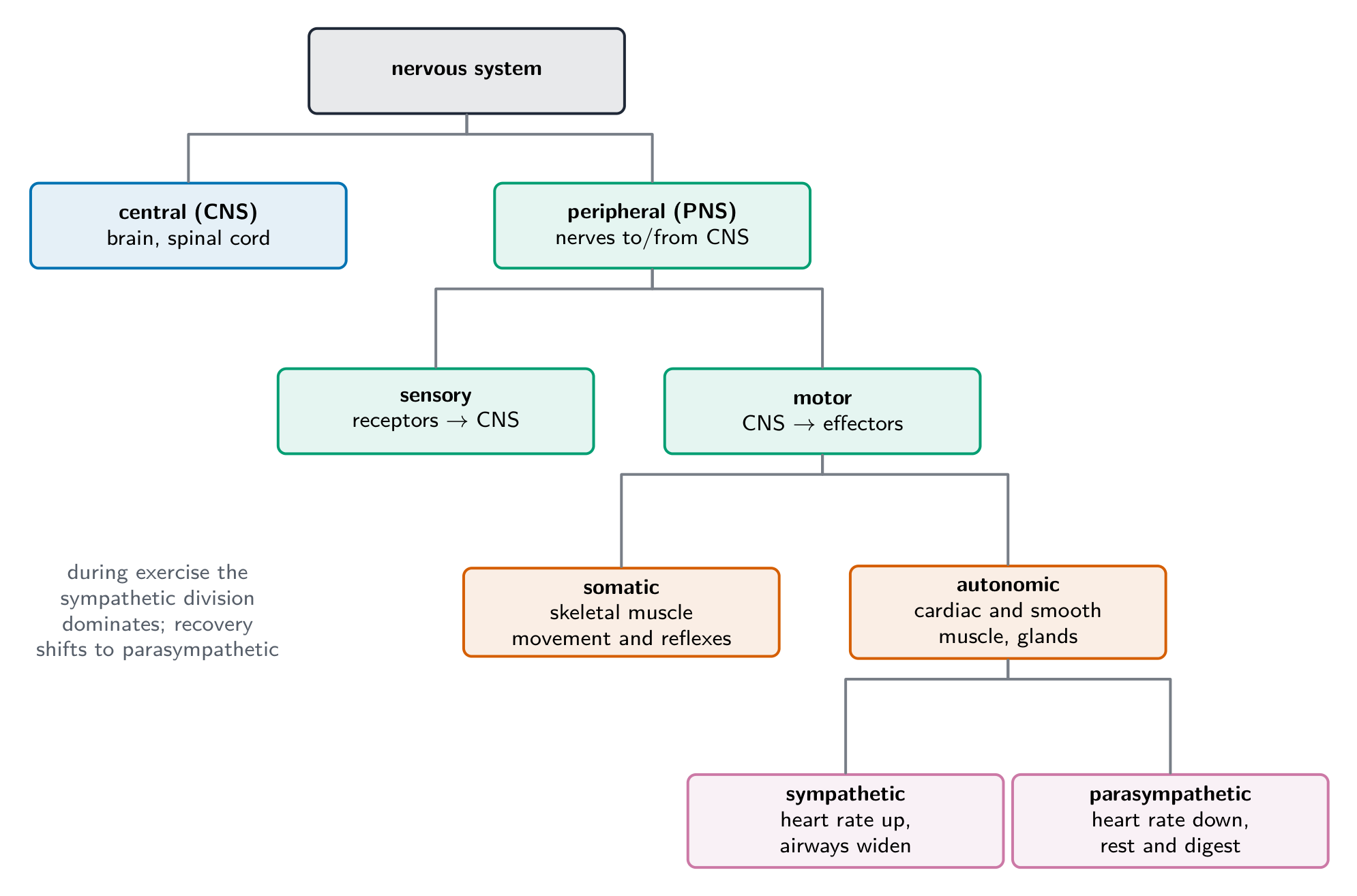
- The CNS contains brain and spinal cord. The PNS carries sensory information towards it and motor commands away from it to effectors 效应器.
- A receptor 感受器 detects a change; integration selects or coordinates a response; a muscle or gland 腺体 acts. Name the direction of a signal rather than just saying nerves carry messages.
Which signal travels towards the CNS?
Dificultad 1/5 · 100 monedas + un pequeño bono en el primer intento de hoy
Afferent sensory and efferent motor pathways have opposite directions relative to the CNS.
Distinguish somatic and autonomic control
- Somatic motor pathways control skeletal muscle, including voluntary actions and automatic somatic reflexes 反射. Autonomic pathways regulate cardiac muscle, smooth muscle and glands.
- Voluntary versus involuntary is a useful introduction but not a complete separation: a knee reflex uses skeletal muscle without a conscious decision.
Can a somatic response be automatic?
Dificultad 1/5 · 100 monedas + un pequeño bono en el primer intento de hoy
Classify the pathway and effector rather than relying only on awareness.
Avoid treating sympathetic 交感 as faster everywhere
- Sympathetic activity can raise heart rate and alter vascular resistance; parasympathetic 副交感 activity can slow SA-node firing through the vagus. Effects depend on the target and receptor.
- Before activity, anticipatory neural and hormonal signals can change circulation. During recovery the balance changes; the systems do not simply switch every organ on or off together.
What explains different effects in different organs?
Dificultad 1/5 · 100 monedas + un pequeño bono en el primer intento de hoy
A coordinated response can increase one activity and reduce another.
Follow a motor neuron 运动神经元’s structure
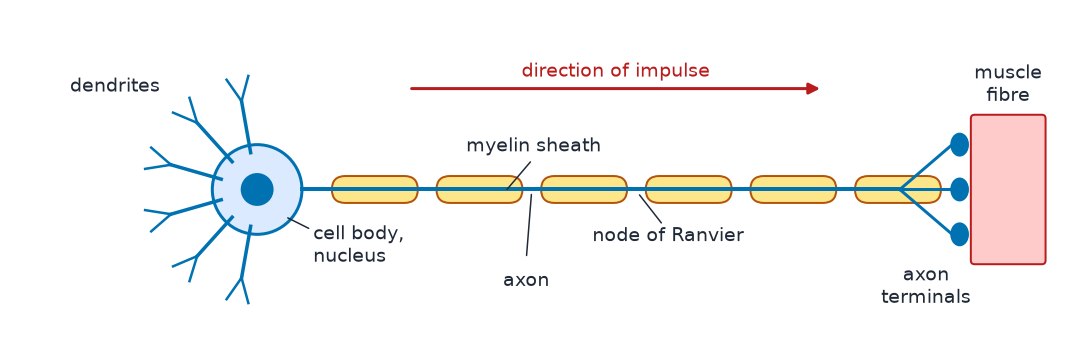
- Dendrites 树突 and the cell body 细胞体 receive and integrate inputs; the axon 轴突 conducts action potentials 动作电位 to terminals. Myelin insulates stretches of axon, with gaps at nodes of Ranvier 郎飞结.
- Motor axon terminals communicate with muscle fibres at neuromuscular junctions 神经肌肉接头. A neuron 神经元’s electrical signal and a neurotransmitter 神经递质 crossing a cleft are different mechanisms.
Where is the chemical signal released?
Dificultad 1/5 · 100 monedas + un pequeño bono en el primer intento de hoy
The terminal releases transmitter; myelin supports efficient electrical conduction.
Explain the action potential in sequence
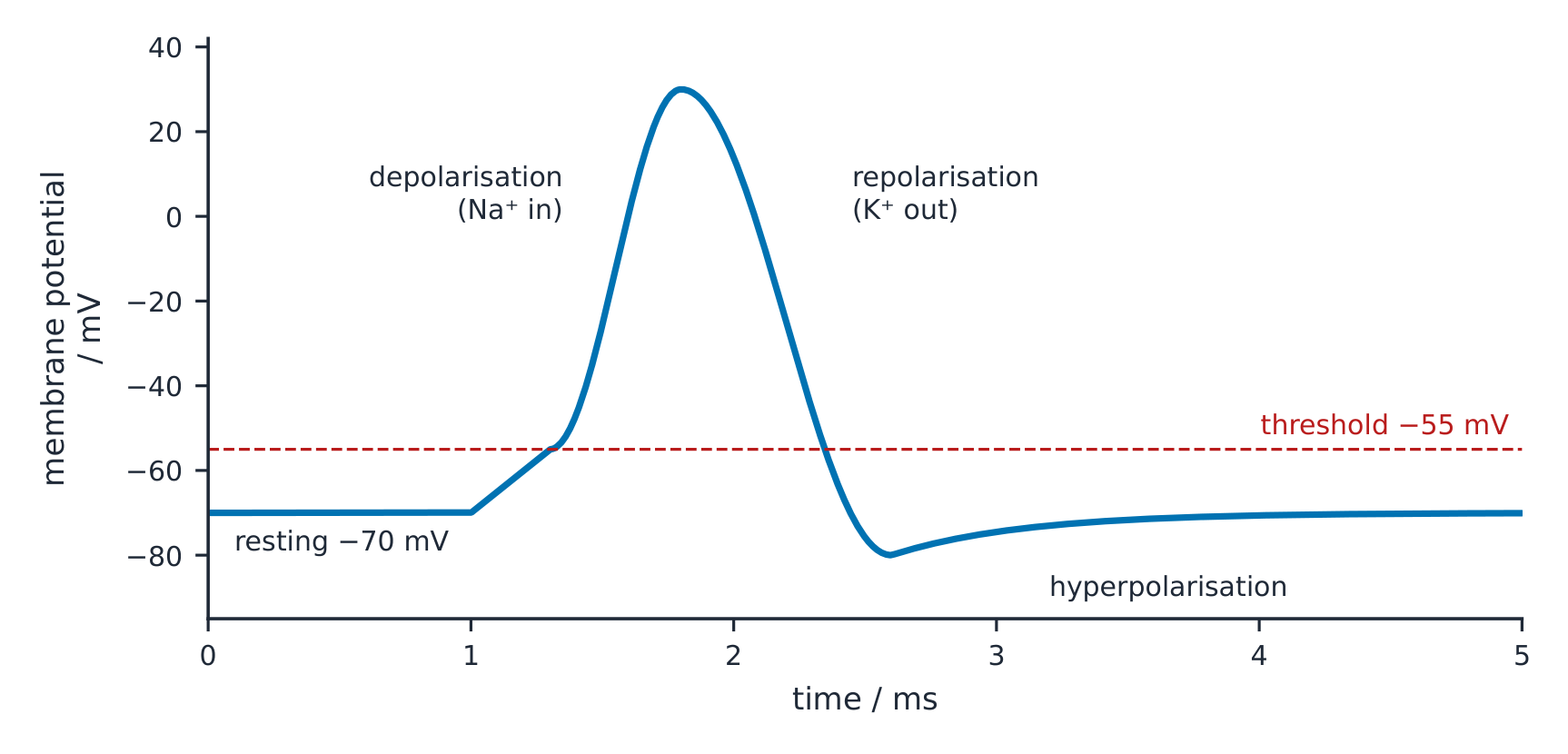
- Illustrative voltages are rest −70 mV, threshold near −55 mV and a peak near +30 mV. Voltage-gated sodium entry depolarises; sodium-channel inactivation and potassium exit support repolarisation 复极化.
- These values vary among cells. Pumps maintain ion gradients over time; they are not a substitute for explaining rapid channel opening and closing in one action potential.
Which event principally causes the rapid rising phase in this model?
Dificultad 1/5 · 100 monedas + un pequeño bono en el primer intento de hoy
Identify the relevant membrane channels and ion movement.
Keep all-or-none electrical signalling distinct from force
- Once threshold is reached, an action potential is generated; a stronger stimulus does not simply create a proportionately taller action potential in that axon.
- Information can involve firing frequency and the number of active neurons. Mechanical muscle force has further determinants and is not fixed at its maximum by one electrical impulse.
Does all-or-none imply maximum muscle force on every impulse?
Dificultad 1/5 · 100 monedas + un pequeño bono en el primer intento de hoy
Do not transfer an electrical amplitude rule into an incorrect mechanical claim.
Explain conduction without imagining jumping ions
- In a myelinated axon, current spreads beneath myelin and action potentials are regenerated at nodes. This is called saltatory conduction.
- Myelination and axon diameter affect speed; sensory processing and muscle activation still add to total reaction time. A quoted maximum speed is not the speed of every nerve.
What is regenerated at successive nodes?
Dificultad 1/5 · 100 monedas + un pequeño bono en el primer intento de hoy
Saltatory conduction describes electrical propagation, not a cell or ions leaping down the nerve.
Cross the neuromuscular junction
- An arriving action potential opens terminal calcium channels, triggering vesicles to release acetylcholine 乙酰胆碱. It diffuses across the cleft and binds receptors on the muscle membrane.
- The resulting depolarisation 去极化 can initiate a muscle action potential. Acetylcholinesterase breaks down acetylcholine; calcium handling within muscle also matters for ending contraction.
What crosses the chemical synaptic cleft?
Dificultad 1/5 · 100 monedas + un pequeño bono en el primer intento de hoy
The chemical step links action potentials in two separate excitable membranes.
Grade force with recruitment 募集 and rate coding
- A motor unit 运动单位 is one motor neuron and all the muscle fibres it innervates. Its action potential normally activates those fibres, but their mechanical force can vary.
- Recruiting additional units and increasing firing rate increase force under suitable conditions. Closely spaced twitches can sum; fatigue and muscle length also affect the result.
Which pair helps grade whole-muscle force?
Dificultad 1/5 · 100 monedas + un pequeño bono en el primer intento de hoy
Recruitment changes active units; rate coding changes temporal activation.
Use proprioception without a one-switch story
- Muscle spindles 肌梭 provide information about muscle length and stretch; Golgi tendon organs 高尔基腱器 report transmitted force. Feedback interacts with spinal circuits and descending control.
- The familiar stretch reflex and inhibitory tendon-organ pathway are useful simplified examples. A tendon organ does not invariably turn a muscle off during every movement.
Which receptor is especially associated with transmitted muscle force?
Dificultad 1/5 · 100 monedas + un pequeño bono en el primer intento de hoy
Receptor roles differ, and their effects depend on the active circuit.
Describe a reflex arc and its scope
- A spinal reflex can pass from receptor through a sensory pathway, spinal circuitry and a motor pathway to an effector without conscious decision.
- Some reflexes involve brainstem circuitry. The brain can receive information and modify reflexes; automatic does not mean the brain can never be involved.
Does every reflex require a conscious decision?
Dificultad 1/5 · 100 monedas + un pequeño bono en el primer intento de hoy
Separate conscious intention from neural processing.
Compare nerves and hormones 激素 conditionally
- Chemical synapses 突触 act locally between connected cells; endocrine hormones are released into blood and act on responsive target cells with suitable receptors.
- Nervous effects are often fast and brief; endocrine effects vary from seconds to much longer. A hormone’s wide distribution does not make every body cell an identical target.
Why does a circulating hormone act on some cells?
Dificultad 1/5 · 100 monedas + un pequeño bono en el primer intento de hoy
Distribution and target responsiveness are different.
Coordinate the anticipatory response
- Epinephrine is adrenaline 肾上腺素; norepinephrine is noradrenaline. Sympathetic nerves and adrenal signals can coordinate cardiac activity and fuel mobilisation before or during exercise.
- Name the mechanism and target. A rise in heart rate can reflect anticipation, workload or other influences, so it is not an isolated measurement of fitness.
Does an anticipatory heart-rate rise prove a training adaptation?
Dificultad 1/5 · 100 monedas + un pequeño bono en el primer intento de hoy
The timescale and comparison conditions determine the interpretation.
Locate ADH synthesis and release
- ADH is synthesised in hypothalamic neurons and released from nerve terminals in the posterior pituitary. Its renal effects increase water reabsorption.
- A water-balance signal can increase release and reduce urine water loss. Retaining water is not replacing water already lost; drinking and kidney regulation are distinct processes.
Which distinction is correct?
Dificultad 1/5 · 100 monedas + un pequeño bono en el primer intento de hoy
A production site, a release site and a target organ are different roles.
Explain reproductive hormones without a performance stereotype
- Progesterone can affect regulated temperature, sleep and fuel use; oestrogen influences substrate use and connective-tissue properties; testosterone supports protein, bone and erythropoietic pathways.
- Concentrations, individual responses, symptoms, task and contraception vary. Cycle day or sex alone does not establish a person’s performance or prescribe a training plan.
Can a calendar day alone establish one individual’s best performance?
Dificultad 1/5 · 100 monedas + un pequeño bono en el primer intento de hoy
A physiological influence is not a deterministic ranking.
Trace the double circulation 双循环
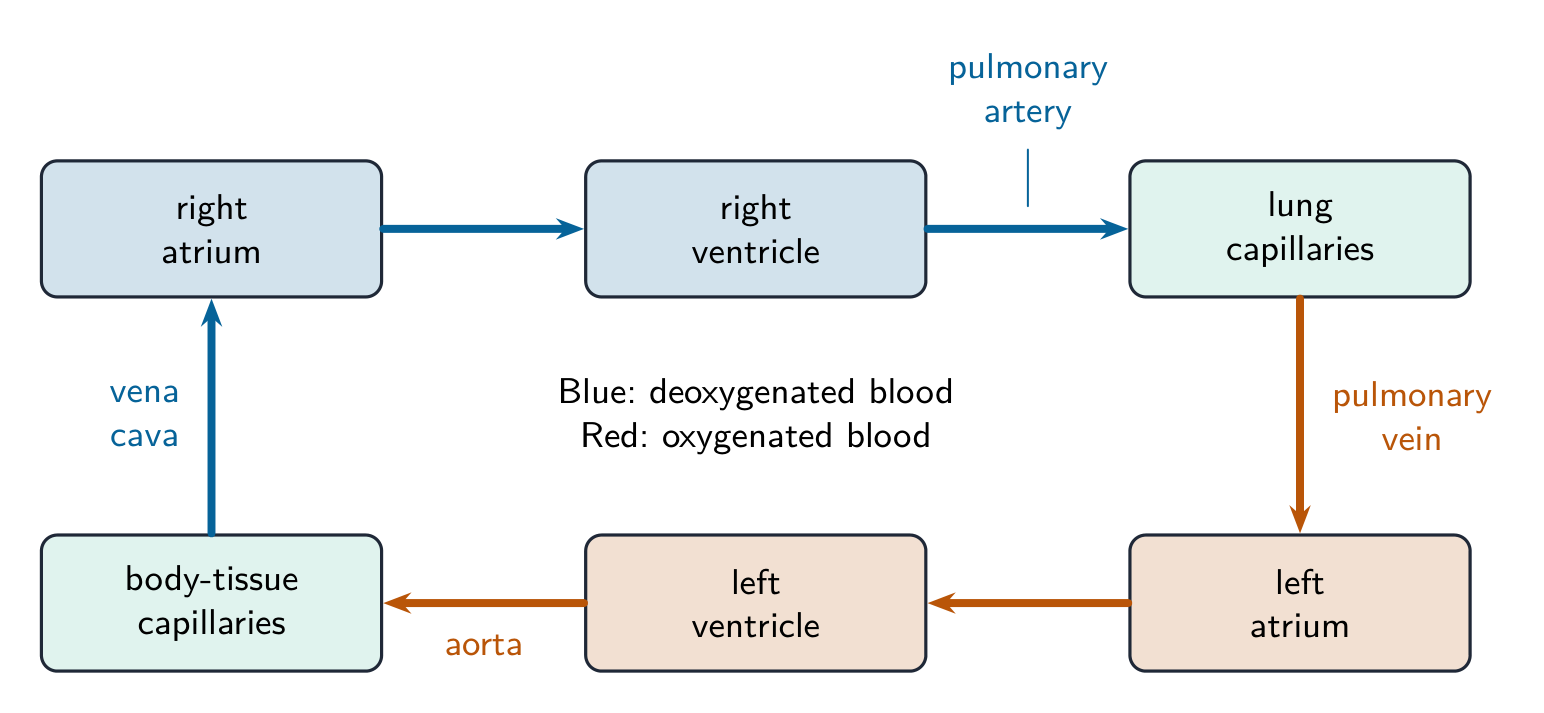
- From the body: venae cavae → right atrium → right ventricle 心室 → pulmonary artery 动脉 → lungs. Return through pulmonary veins 静脉 → left atrium → left ventricle → aorta → body.
- Artery and vein name direction relative to the heart, not oxygen content. The pulmonary artery carries relatively deoxygenated blood; the pulmonary veins carry oxygenated blood.
What defines an artery?
Dificultad 1/5 · 100 monedas + un pequeño bono en el primer intento de hoy
Direction defines the vessel category.
Connect chamber, valve 瓣膜 and pressure
- Atria 心房 receive blood; ventricles eject it. Valves permit one-way flow in response to pressure differences. The left ventricle generates pressure for systemic circulation.
- Do not describe valves as active pumps or say the left side contains more blood simply because its wall is thicker. In steady circulation the two sides pump approximately the same flow.
Why is the left ventricular wall thicker?
Dificultad 1/5 · 100 monedas + un pequeño bono en el primer intento de hoy
Pressure requirements and flow balance are different.
Follow intrinsic cardiac excitation
- SA-node activity initiates the normal rhythm; excitation spreads through atria, the AV node, conducting bundles and Purkinje fibres 浦肯野纤维 to ventricular muscle. AV delay supports coordinated filling.
- Myogenic 肌源性 means the rhythm arises within cardiac tissue. Autonomic nerves and hormones modify rate and contraction rather than normally commanding each beat from scratch.
What normally initiates the heart’s rhythm?
Dificultad 1/5 · 100 monedas + un pequeño bono en el primer intento de hoy
Intrinsic initiation and extrinsic modulation work together.
Apply baroreceptor feedback to a stated situation
- Baroreceptors respond to arterial stretch. In a simplified resting model, a pressure fall reduces their firing and can trigger increased sympathetic and reduced parasympathetic activity.
- The response supports cardiac output and vascular resistance. During exercise the operating regulation changes; it does not simply cancel every necessary increase in heart rate.
What do baroreceptors directly sense in this model?
Dificultad 1/5 · 100 monedas + un pequeño bono en el primer intento de hoy
Name the sensed variable and distinguish it from the resulting response.
Relate vessels and venous return 静脉回流
- Arteries have muscular elastic walls; capillaries provide thin exchange surfaces; veins return blood at lower pressure, with valves in relevant regions.
- Skeletal-muscle and respiratory pumps assist venous return. Increased filling can raise stroke volume within physiological limits; contractility and outflow pressure also matter.
Does more filling increase stroke volume without limit?
Dificultad 1/5 · 100 monedas + un pequeño bono en el primer intento de hoy
A useful mechanism still needs a stated range and conditions.
Calculate cardiac output with cancellation
- In an invented swimmer example, 65 beats/min × 75 mL/beat = 4875 mL/min = 4.875 L/min at rest. Exercise values 150 × 110 give 16.5 L/min.
- The beat units cancel. Preserve unrounded values during comparison and round the reported result sensibly. Neither value alone identifies why two participants differ.
What converts mL/min into L/min?
Dificultad 1/5 · 100 monedas + un pequeño bono en el primer intento de hoy
One litre is 1000 millilitres; retain the per-minute denominator.
Calculate L/min when heart rate is 65 beats/min and stroke volume 75 mL/beat.
Dificultad 2/5 · 140 monedas + un pequeño bono en el primer intento de hoy
65×75/1000=4.875 L/min; 4.9 is a rounded report.
Distinguish a share from an absolute flow
- Invented resting muscle flow is 20% of 5 L/min = 1 L/min. An exercise case is 80% of 20 L/min = 16 L/min.
- Both total output and distribution change. Local metabolic vasodilation 血管舒张, autonomic control and skin cooling demands can affect the pattern; percentages are not universal fixed values.
Can the same percentage imply different absolute flows?
Dificultad 1/5 · 100 monedas + un pequeño bono en el primer intento de hoy
A share needs its denominator before it becomes an absolute quantity.
Calculate muscle flow when its share is 80% of 20 L/min.
Dificultad 2/5 · 140 monedas + un pequeño bono en el primer intento de hoy
0.8×20=16 L/min.
Explain the pressure mechanism of inspiration 吸气
- Diaphragm 膈 and external intercostal contraction increase thoracic volume, lowering alveolar pressure relative to the atmosphere so air enters.
- Quiet expiration 呼气 mainly uses elastic recoil; high ventilatory demand can recruit active expiratory muscles. Ventilation moves air; it is not itself cellular ATP production.
Why does air enter during inspiration?
Dificultad 1/5 · 100 monedas + un pequeño bono en el primer intento de hoy
Describe volume, pressure and airflow in the correct causal order.
Read a spirogram and its limits
- Tidal volume 潮气量 is air moved in a usual breath. Inspiratory and expiratory reserves are additional movable volumes; vital capacity 肺活量 combines these with tidal volume.
- Residual volume 余气量 remains after maximal expiration and is not directly measured by simple spirometry. Illustrated volumes vary among people and are not diagnostic reference values.
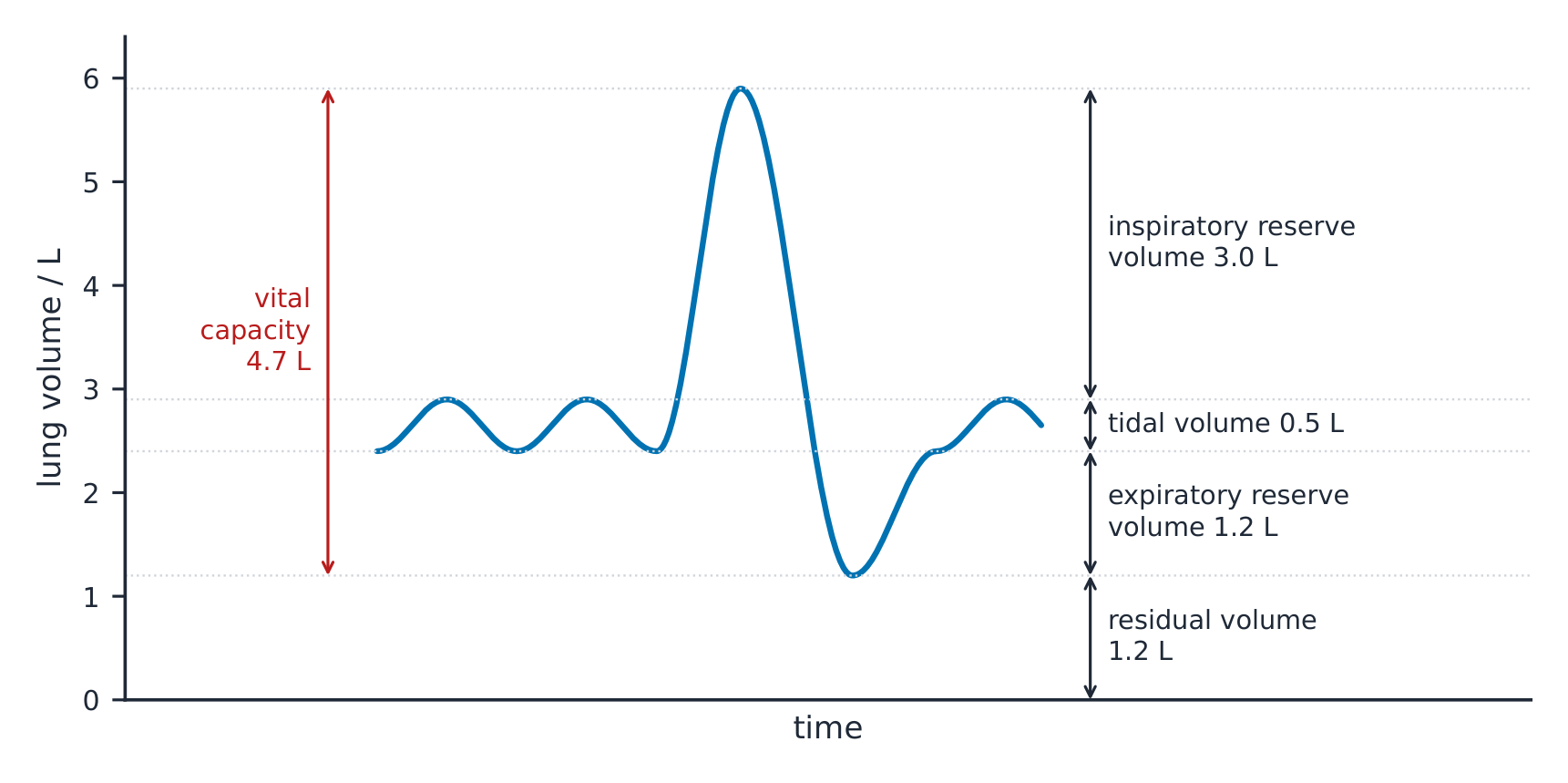
Which volume cannot be directly measured by simple spirometry?
Dificultad 1/5 · 100 monedas + un pequeño bono en el primer intento de hoy
Air that never leaves the lungs is not measured by simply recording exhaled volume.
Calculate minute ventilation 每分通气量
- An invented resting case gives 0.5 L/breath × 12 breaths/min = 6 L/min. A rower with 2.5 L/breath and 36 breaths/min has 90 L/min, fifteen times that resting value.
- Minute ventilation includes air that does not reach gas-exchanging alveoli 肺泡. A total air-flow value is not interchangeable with oxygen uptake or cardiac output.
Does 90 L/min ventilation mean 90 L/min oxygen uptake?
Dificultad 1/5 · 100 monedas + un pequeño bono en el primer intento de hoy
Distinguish the measured volume and the underlying process.
Calculate minute ventilation for tidal volume 2.5 L and frequency 36 breaths/min.
Dificultad 2/5 · 140 monedas + un pequeño bono en el primer intento de hoy
2.5×36=90 L/min.
Explain diffusion 扩散 using partial pressure
- Oxygen moves down its partial-pressure gradient across thin alveolar-capillary 毛细血管 and tissue surfaces. Carbon dioxide moves down its own gradient in the opposite net direction at the lungs.
- Haemoglobin 血红蛋白 carries much oxygen bound to protein; bound oxygen content is not the same as freely dissolved oxygen pressure. Ventilation and perfusion help maintain gradients.
Does more haemoglobin-bound oxygen automatically mean the same increase in dissolved oxygen pressure?
Dificultad 1/5 · 100 monedas + un pequeño bono en el primer intento de hoy
A carrier changes oxygen content without making these variables interchangeable.
Control breathing without requiring carbon dioxide accumulation
- Chemoreceptor 化学感受器 feedback relates carbon dioxide and acidity to ventilation. Neural feedforward and feedback from moving muscles also contribute during exercise.
- At steady moderate exercise, ventilation can match metabolic demand while arterial carbon dioxide remains near its regulated value. A maintained variable can indicate successful regulation.
Must arterial carbon dioxide rise before exercise ventilation increases?
Dificultad 1/5 · 100 monedas + un pequeño bono en el primer intento de hoy
A regulated concentration need not rise in proportion to metabolic production.
Build a negative-feedback 负反馈 explanation
- Identify the regulated condition, receptors, integrating system, effectors and response. Negative feedback opposes the initiating change rather than amplifying it indefinitely.
- Core temperature is regulated within a range; it is not exactly 37 °C for every person, time and activity. The direction of feedback matters more than repeating the word balance.
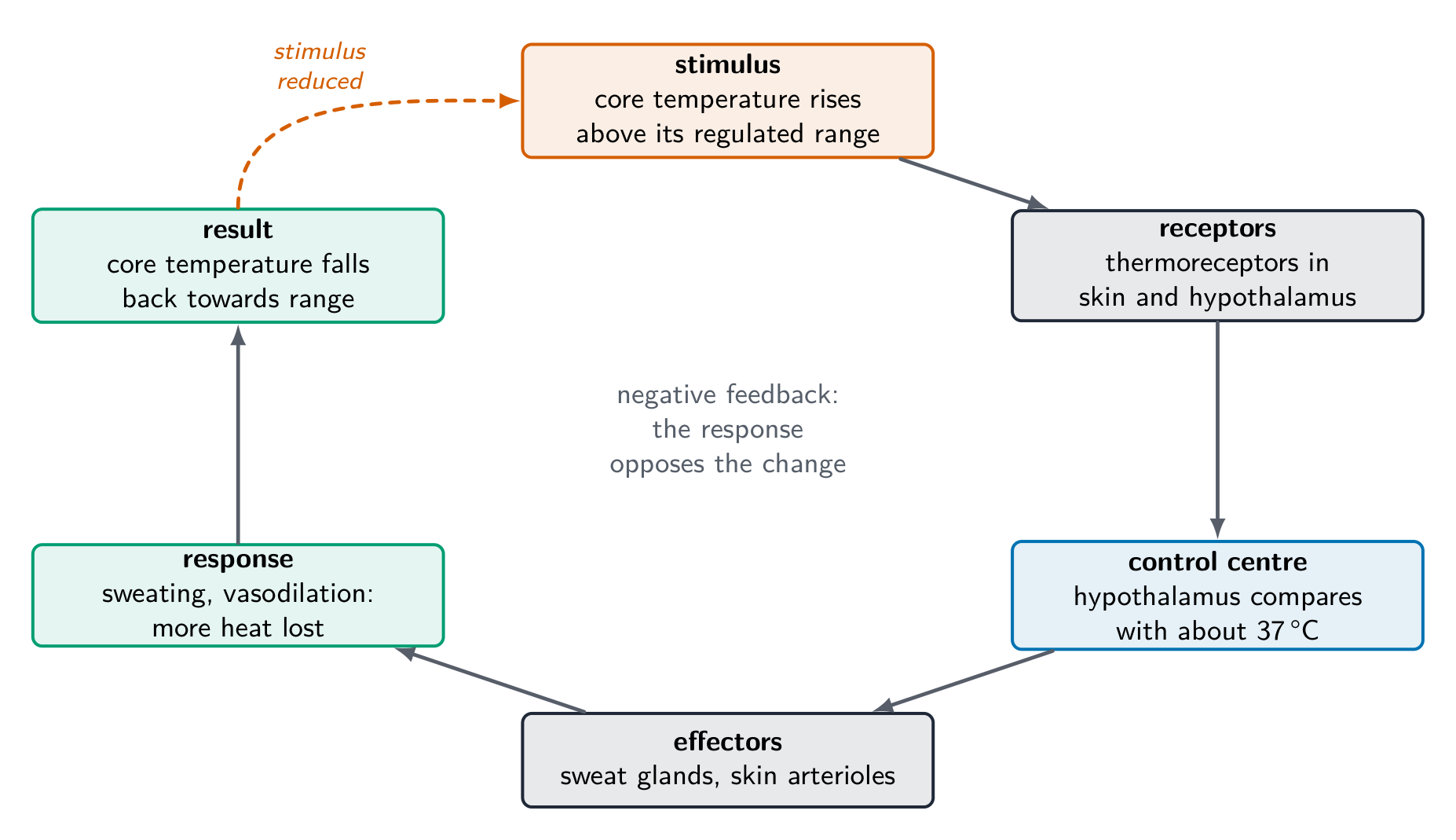
What makes feedback negative?
Dificultad 1/5 · 100 monedas + un pequeño bono en el primer intento de hoy
Negative describes the control relationship, not a judgement or universal direction of change.
Connect heat transfer to gradients
- Sweat evaporation removes heat; sweating without evaporation is less effective. Skin vasodilation brings heat to the surface, but radiation and convection depend on environmental temperature gradients.
- Humidity, airflow, clothing, workload and duration matter. Hot surroundings can add heat; dry air alone does not guarantee that a demanding activity is safe.
Does every drop of secreted sweat remove the same heat?
Dificultad 1/5 · 100 monedas + un pequeño bono en el primer intento de hoy
Distinguish sweat production from successful evaporative heat transfer.
Compare cold responses and sources of variation
- Skin vasoconstriction 血管收缩 reduces heat transfer; shivering and non-shivering thermogenesis can increase heat production. Clothing, wetness and wind change the heat balance.
- Training, body composition, environment and hormonal state influence thermoregulation. Avoid inferring a person’s response from a single group average or diagnosing from one classroom reading.
Which response increases metabolic heat production?
Dificultad 1/5 · 100 monedas + un pequeño bono en el primer intento de hoy
Heat production and redistribution are different components of regulation.
Explain glucose regulation during exercise
- Muscle contraction can increase glucose uptake even while circulating insulin 胰岛素 falls. Glucagon 胰高血糖素 and other counter-regulatory signals help maintain liver glucose output.
- Liver glycogen breakdown and gluconeogenesis support blood glucose; muscle glycogen is mainly used locally. During prolonged activity supply may fail to meet use, but fatigue has multiple possible causes.
Why can muscle uptake increase while insulin falls?
Dificultad 1/5 · 100 monedas + un pequeño bono en el primer intento de hoy
Do not assume every glucose-uptake change requires increased circulating insulin.
Separate a response from a training adaptation
- A response during an exercise bout is acute. A change developing over repeated sessions can be an adaptation, but interpreting a measured difference requires comparable conditions.
- Record workload, timing, recent activity, hydration and relevant participant conditions. One lower heart-rate reading does not prove a causal training effect or measure all dimensions of fitness.
What strengthens an adaptation comparison?
Dificultad 1/5 · 100 monedas + un pequeño bono en el primer intento de hoy
Control alternative explanations before attributing a difference to training.
Choose low-risk evidence for the question
- Use fictional, published or voluntary teacher-approved low-intensity observations. Define timing, instrument resolution, consent, privacy, stopping rules and the measured outcome.
- Students do not need to reveal sensitive reproductive or health data or undertake maximal exertion. Evidence about one response should lead to a proportional claim, not a diagnosis or personal prescription.
Which investigation claim is proportionate?
Dificultad 1/5 · 100 monedas + un pequeño bono en el primer intento de hoy
Keep the conclusion within the variables, design and population actually studied.
A.3: Identify response and adaptation
- An acute response occurs during or after a bout, such as an increase in heart rate. A training adaptation persists beyond one bout after repeated stimulus, such as increased mitochondrial capacity. Different variables recover on different timescales.
- Kipchoge’s supported Vienna challenge on 12 October 2019 covered 42.195 km in 1:59:40.2, about 21.16 km/h. The result does not supply his heart-rate or temperature trace. The physiological graphs in this lesson are invented examples, not his measurements.
Does the finish time supply a measured heart-rate trace?
Dificultad 1/5 · 100 monedas + un pequeño bono en el primer intento de hoy
Do not invent physiological measurements from a performance result.
A.3: Read the phases without overclaiming
- Anticipation can raise heart rate before movement. At onset, autonomic and other neural signals change the rate quickly; during sustained work a plateau may develop, followed by recovery after stopping.
- A plateau only establishes that the measured heart rate is approximately stable over the sampled interval. It does not directly measure oxygen uptake or guarantee that temperature, stroke volume and oxygen extraction are unchanged.
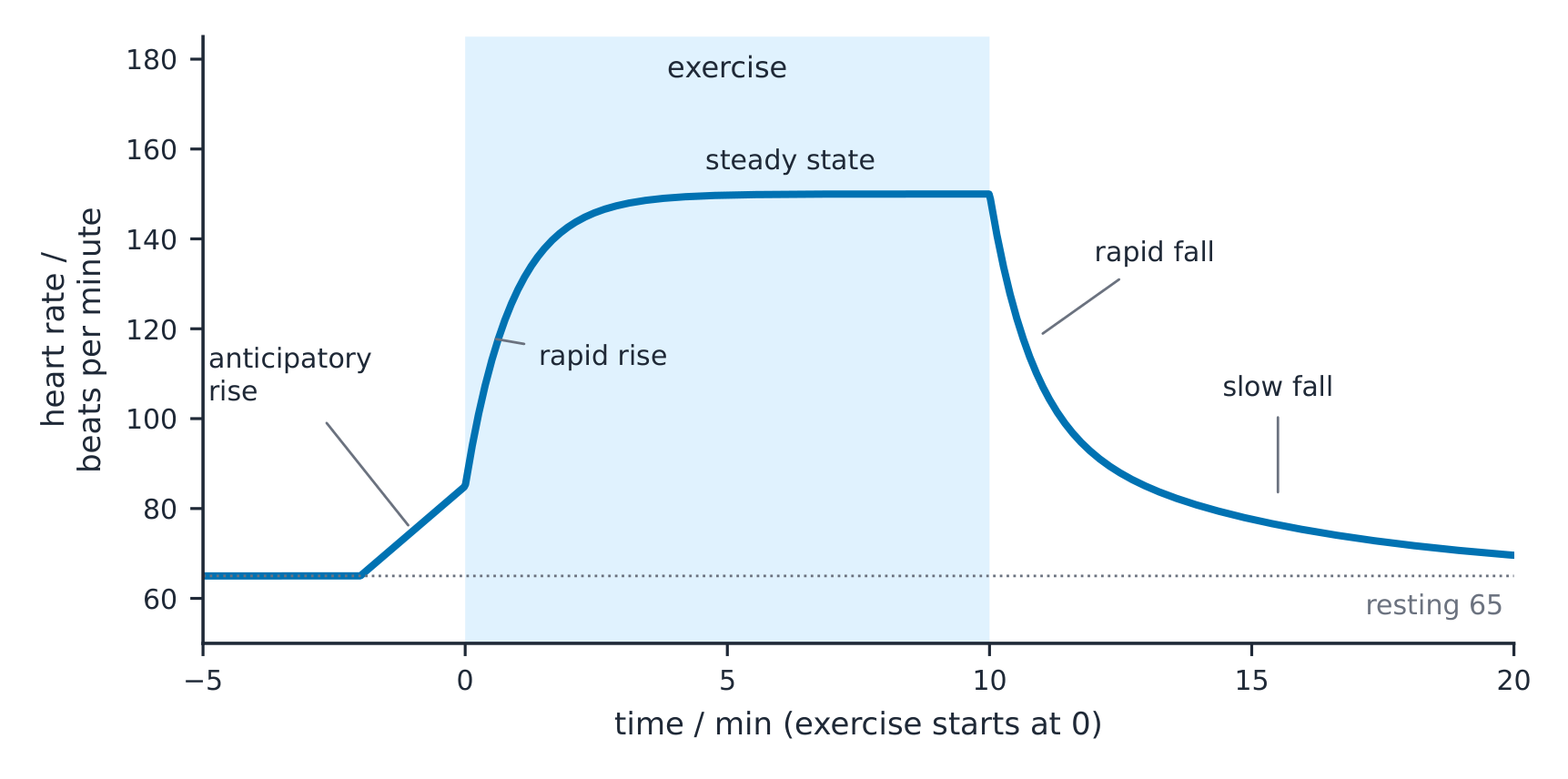
What does a flat heart-rate segment directly show?
Dificultad 1/5 · 100 monedas + un pequeño bono en el primer intento de hoy
Interpret the measured variable before inferring an unmeasured mechanism.
A.3: Explain stroke volume mechanically
- Muscle and respiratory pumps can increase venous return. Increased ventricular filling and stretch can increase contraction strength through the Frank–Starling mechanism; sympathetic input also increases contractility.
- Stroke volume may plateau or continue rising depending on posture, intensity, training and individual context. One fixed percentage is not a universal point at which every stroke volume stops rising.
Which mechanism links greater filling to stronger contraction?
Dificultad 1/5 · 100 monedas + un pequeño bono en el primer intento de hoy
Link the stimulus, ventricular change and output.
A.3: Recalculate cardiac output
- Invented resting values of 70 beats/min and 70 mL/beat give 4900 mL/min = 4.9 L/min. Exercise values of 170 and 105 give 17 850 mL/min = 17.85 L/min.
- The factor increase is 17.85/4.9 = 3.642857… . Multiply rate by volume per beat, then convert millilitres to litres. An increase in rate is not the same as the whole change in output.
For invented exercise heart rate 170 beats/min and stroke volume 105 mL/beat, what is cardiac output?
Dificultad 1/5 · 100 monedas + un pequeño bono en el primer intento de hoy
Cardiac output = heart rate × stroke volume = 170 beats/min × 105 mL/beat = 17 850 mL/min. Divide by 1000 mL/L to obtain 17.85 L/min. The beat units cancel in the product. Reporting 17 850 L/min misses the millilitre-to-litre conversion and makes the output 1000 times too large.
Find output in L/min for 170 beats/min and 105 mL/beat.
Dificultad 2/5 · 140 monedas + un pequeño bono en el primer intento de hoy
170×105/1000=17.85.
A.3: Match the oxygen-content boundary
- The Fick relationship is oxygen uptake = blood flow × arterial–venous oxygen-content difference. A whole-body calculation needs cardiac output and an appropriate mixed-venous value.
- Invented output 18 L/min multiplied by an arterial–mixed-venous oxygen-content difference of 140 mL oxygen/L blood gives 18×140 = 2520 mL oxygen/min = 2.52 L oxygen/min. Blood from one working muscle is not necessarily representative of all venous return.
Can one muscle-vein sample automatically stand for mixed venous return?
Dificultad 1/5 · 100 monedas + un pequeño bono en el primer intento de hoy
Match the concentration difference and flow to the same system.
Find whole-body oxygen uptake in L/min for cardiac output 18 L blood/min and an arterial–mixed-venous oxygen-content difference of 140 mL oxygen/L blood.
Dificultad 2/5 · 140 monedas + un pequeño bono en el primer intento de hoy
Oxygen uptake = cardiac output × arterial–mixed-venous oxygen-content difference = 18 × 140 = 2520 mL oxygen/min. Divide by 1000 to obtain 2.52 L oxygen/min.
A.3: Separate pressure, extraction and unloading
- Dynamic running commonly raises systolic pressure 收缩压 while diastolic pressure 舒张压 changes less as working-muscle arterioles dilate. Heavy resistance can raise both substantially.
- Active muscle extracts more oxygen. Increased carbon dioxide and hydrogen-ion concentration lower haemoglobin oxygen affinity, the Bohr effect; warmth also favours unloading but is not itself the definition of the Bohr effect.
What defines the Bohr effect here?
Dificultad 1/5 · 100 monedas + un pequeño bono en el primer intento de hoy
Distinguish related curve shifts from the named mechanism.
A.3: Distinguish model and timetable
- The supercompensation 超量恢复 sketch shows fatigue, recovery and a possible above-baseline response. Its smooth curve is a model, not an individual’s measured timetable.
- Glycogen, force, skill and perceived readiness can follow different trajectories. Training can sometimes be planned before complete recovery, but the purpose and monitoring matter; there is no universally perfect peak deadline.
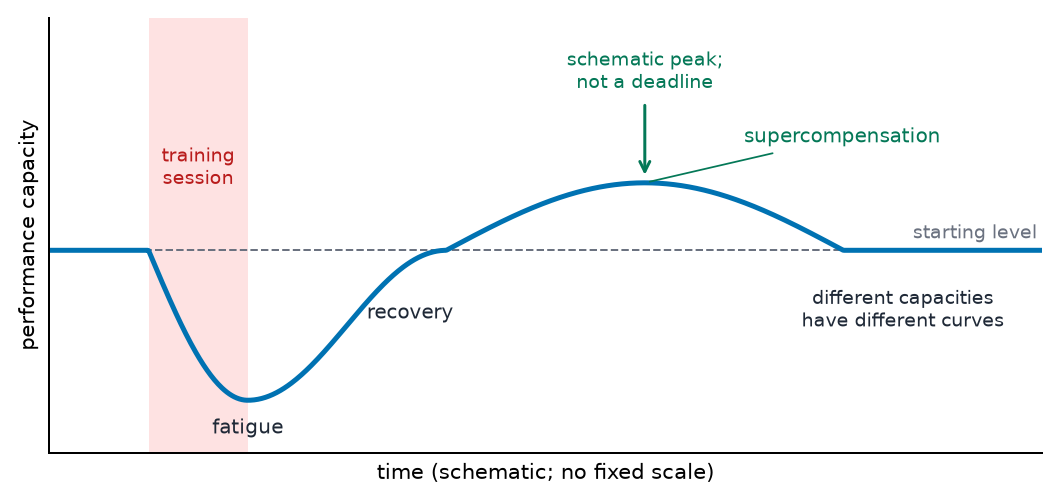
Does the drawn peak identify an exact session time for everyone?
Dificultad 1/5 · 100 monedas + un pequeño bono en el primer intento de hoy
A useful model can explain a pattern without determining an individual schedule.
A.3: Apply specificity 专项性 and progression
- Specificity links adaptations to the movement, muscles, speed and metabolic demand trained. A swimmer needs swimming skill practice, while other activity may support relevant capacities.
- Progressive overload 渐进超负荷 gradually changes a suitable stimulus after evaluating response and technique. More load is not automatically better, and changing several variables together can conceal which change caused a problem.
What makes progression more interpretable?
Dificultad 1/5 · 100 monedas + un pequeño bono en el primer intento de hoy
Connect the stimulus to the objective and the observed response.
A.3: Explain reversibility 可逆性, variation and recovery
- A reduced stimulus can lead to loss of some adaptations, at rates that differ by capacity and person. Purposeful variation can support engagement and distribute repeated loading.
- Recovery balances demands with readiness; adaptation and fatigue interact during and between sessions. Variety does not guarantee freedom from injury, and one late session does not erase every prior gain.
Does adding varied activities guarantee no injury?
Dificultad 1/5 · 100 monedas + un pequeño bono en el primer intento de hoy
A planning principle supports judgement rather than guaranteeing an outcome.
A.3: Define each FITT dimension
- Frequency counts sessions or exposures per stated interval. Intensity specifies how hard using an explicit measure. Time records duration, and type identifies the activity or loading pattern.
- Two programmes can have the same weekly minutes but different intensity, movement and recovery distribution. Describe those features before claiming they are equivalent.
Which FITT dimension identifies the activity performed?
Dificultad 1/5 · 100 monedas + un pequeño bono en el primer intento de hoy
A duration does not identify the movement or loading pattern.
A.3: Treat heart-rate reserve 心率储备 as a definition
- Reserve = supplied maximum heart rate 最大心率 − resting heart rate. A reserve-percentage model adds the selected fraction of reserve back to rest. A percentage of maximum uses a different formula.
- For supplied maximum 203 and rest 63, reserve is 140. At 70% reserve the value is 161; at 70% maximum it is 142.1 beats/min. These invented inputs are not an age-based prediction or a personal programme.
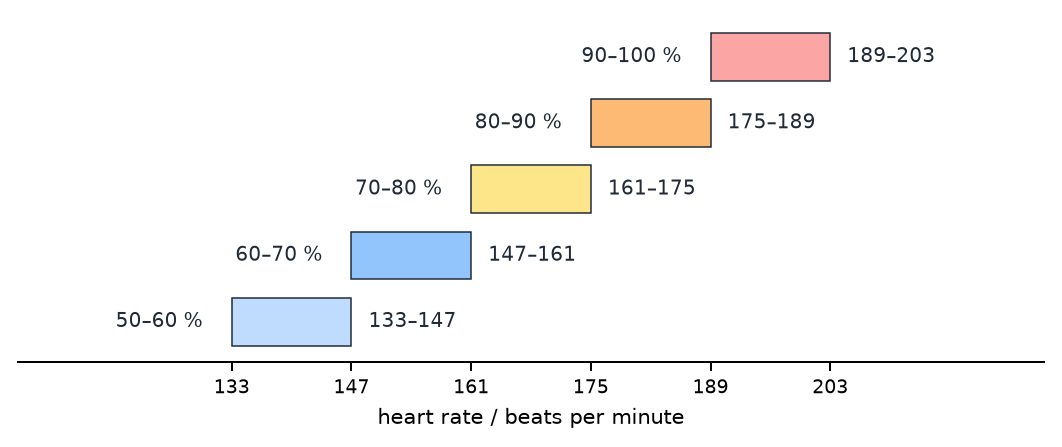
For supplied maximum heart rate 203 and resting rate 63 beats/min, are 70% reserve and 70% maximum interchangeable?
Dificultad 1/5 · 100 monedas + un pequeño bono en el primer intento de hoy
Heart-rate reserve = 203 − 63 = 140 beats/min. At 70% reserve, the model gives 63 + 0.70 × 140 = 161 beats/min. At 70% maximum it gives 0.70 × 203 = 142.1 beats/min. The reserve method applies the fraction to the gap above rest and then adds rest back. The two definitions therefore give different values; these invented inputs do not prescribe an individual training intensity.
A.3: Solve a second reserve example
- Given hypothetical maximum 200 and rest 68 beats/min, reserve = 132. At 75% reserve the value is 68 + 0.75×132 = 167 beats/min.
- At 75% maximum it is 150 beats/min. Age equations have individual error, especially outside their studied population. Neither arithmetic bands nor age alone measure a person’s lactate or ventilatory threshold 通气阈.
For hypothetical maximum heart rate 200 and resting rate 68 beats/min, what is the 75%-reserve model value?
Dificultad 1/5 · 100 monedas + un pequeño bono en el primer intento de hoy
Reserve = 200 − 68 = 132 beats/min. The model value is rest + 0.75 × reserve = 68 + 0.75 × 132 = 68 + 99 = 167 beats/min. The alternative 150 beats/min comes from 0.75 × 200, which is 75% of maximum rather than 75% of reserve. Use the supplied values for this model; this arithmetic is not a personal training recommendation.
Given maximum 200 and resting 68 beats/min, find the 75%-reserve model value.
Dificultad 2/5 · 140 monedas + un pequeño bono en el primer intento de hoy
68+0.75×(200−68)=167.
A.3: Use an exertion scale explicitly
- Borg 6–20 and CR-10 are different perceived-exertion scales. A rating reports perception under stated anchors; it is not a direct conversion into a unique heart rate.
- For the session-load proxy in this unit, use CR-10 multiplied by minutes. Percentage of 1RM describes external resistance relative to a maximal single lift, but defining it does not require classmates to perform a maximal-lift test.
What must be specified before comparing ratings?
Dificultad 1/5 · 100 monedas + un pequeño bono en el primer intento de hoy
A number has meaning only within its measurement definition.
A.3: Compare training methods by their demands
- Continuous training 持续训练 has no planned recovery breaks. Intervals alternate defined work and recovery. Fartlek 法特莱克训练 varies pace during continuous activity and can include planned changes.
- Resistance training 抗阻训练 loads force production; plyometrics 增强式训练 use rapid stretch–shortening actions; circuits organise stations; flexibility work targets range of motion. Method labels alone do not determine every adaptation: intensity, volume and context matter.
Does an interval label specify its entire physiological stimulus?
Dificultad 1/5 · 100 monedas + un pequeño bono en el primer intento de hoy
Describe the actual task rather than relying on its category name.
A.3: Calculate work to rest with compatible units
- In an invented interval model, work lasts 40 seconds and recovery 160 seconds. The ratio is 40:160 = 1:4.
- A statement such as 300 m work and 3 minutes rest does not by itself give a time ratio: work duration is missing. Energy systems overlap, and adequate rest for one purpose may differ from that for another.
What information is missing when work is given only as a distance?
Dificultad 1/5 · 100 monedas + un pequeño bono en el primer intento de hoy
A ratio must compare defined quantities in compatible units.
A.3: Avoid rigid repetition switches
- Resistance adaptations depend on load, volume, effort, speed, rest and training history. Heavier loading commonly supports maximal strength, but muscle growth can occur across more than one narrow repetition range.
- Strength, size and local endurance outcomes can overlap. A repetition boundary is not a biological switch, and an elite load is not automatically an appropriate school or beginner programme.
Does one repetition boundary isolate all hypertrophy?
Dificultad 1/5 · 100 monedas + un pequeño bono en el primer intento de hoy
Do not turn a convenient programme category into an exclusive biological rule.
A.3: Organise cycles around the purpose
- A macrocycle 大周期 is a long planning cycle; mesocycles 中周期 are intermediate blocks; microcycles 小周期 organise shorter sequences. A season, several weeks and one week are examples, not mandatory durations.
- Preparation develops general and sport-specific capacities; competition balances performance and maintenance; transition supports recovery and variation. A plan should respond to evidence rather than guarantee a peak.
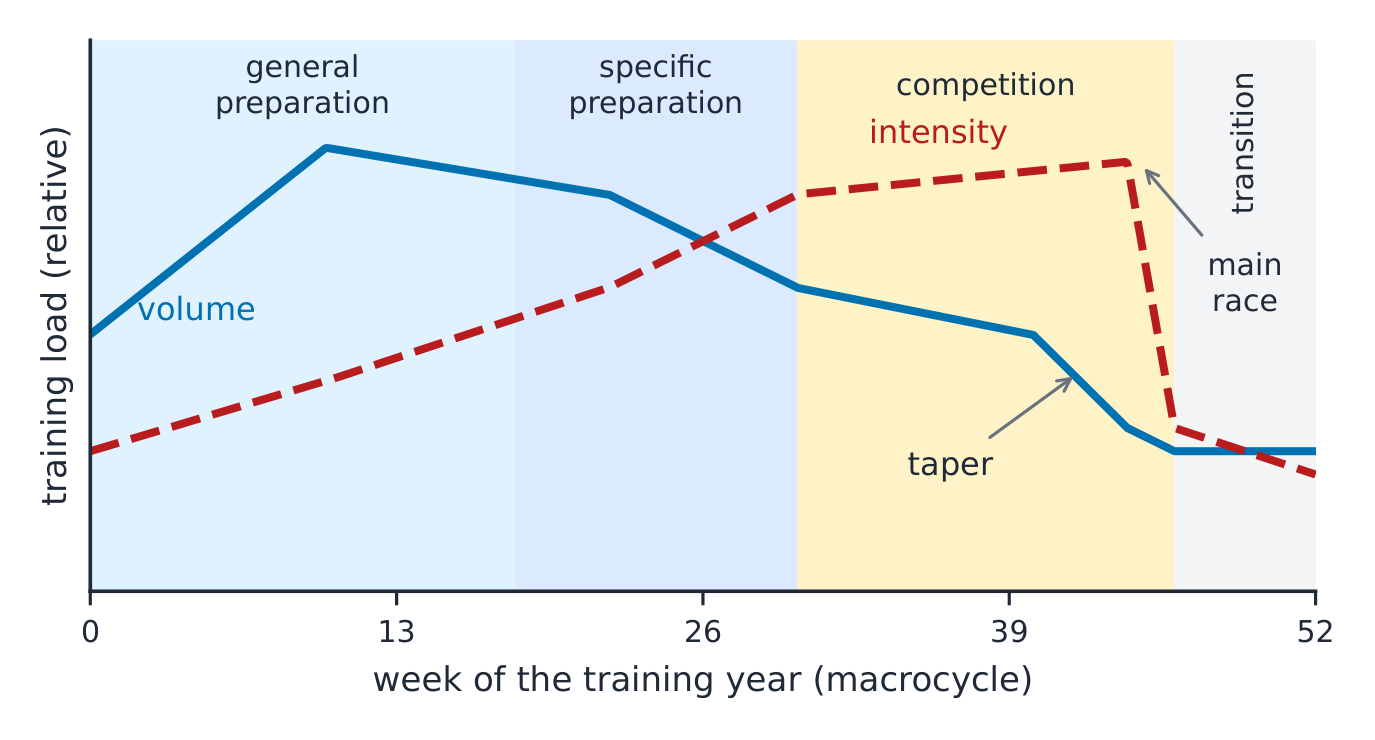
Must every mesocycle last exactly the same number of weeks?
Dificultad 1/5 · 100 monedas + un pequeño bono en el primer intento de hoy
The planning hierarchy matters more than one arbitrary duration.
A.3: Calculate taper 减量训练 volume without inventing a benefit
- A taper aims to reduce accumulated fatigue while retaining readiness. An invented weekly volume falls from 600 to 360 minutes.
- The fall is 240/600×100 = 40%. This is a volume reduction, not a measured 40% change in intensity or a guaranteed race improvement. Timing and retained loading depend on the goal and participant.
Weekly training volume falls from 600 to 360 minutes, a calculated reduction of 40%. What does this percentage describe?
Dificultad 1/5 · 100 monedas + un pequeño bono en el primer intento de hoy
Reduction = 600 − 360 = 240 minutes. Percentage reduction = 240/600 × 100 = 40% of the initial weekly minutes. No race-performance change was measured.
A.3: Explain a trained heart through the product
- Invented values 45 beats/min ×110 mL/beat give 4950 mL/min = 4.95 L/min, similar to 70×70 = 4.9 L/min. A larger stroke volume can support similar resting output with fewer beats.
- This does not mean maximal output is unchanged, or that every low resting pulse proves fitness or health. Cardiac and blood-volume adaptations depend on the training and individual.
Can resting output remain similar despite lower heart rate?
Dificultad 1/5 · 100 monedas + un pequeño bono en el primer intento de hoy
Use both factors rather than treating one as the entire output.
A.3: Link muscle structure to task capacity
- Endurance training can increase mitochondrial capacity, aerobic enzymes and muscle capillarisation. Resistance training can increase fibre size and neural force production; sprint-related adaptations depend on the work performed.
- Recruitment, firing and coordination can improve strength before a clearly measured size change. Neural and structural changes overlap; there is no universal week at which one stops and the other starts.
Does early strength improvement require already visible hypertrophy?
Dificultad 1/5 · 100 monedas + un pequeño bono en el primer intento de hoy
Connect the observed outcome to more than one plausible adaptation.
A.3: Compare maximum and fractional use
- In invented data, maximal uptake changes from 45 to 52 mL/kg/min and the fraction at a defined threshold changes from 60% to 75%. Threshold uptake changes from 27 to 39.
- Threshold increase = 12/27×100 = 44.444…%; maximum increase = 7/45×100 = 15.555…%. The metrics differ. These data alone do not supply a running speed, prove training caused the changes or rank predictors universally.
Can the two uptake values alone determine running speed?
Dificultad 1/5 · 100 monedas + un pequeño bono en el primer intento de hoy
Do not infer an unmeasured performance variable from uptake alone.
Find percentage increase in threshold uptake from 27 to 39 mL/kg/min, relative to 27.
Dificultad 2/5 · 140 monedas + un pequeño bono en el primer intento de hoy
(39−27)/27×100=44.444…%.
A.3: Interpret monitoring load as a proxy
- Four 75-minute sessions at CR-10 RPE 6 give 1800 units. One 20-minute race at RPE 9 gives 180. The weekly total is 1980 arbitrary units.
- Equal totals can hide different intensity distributions, impacts and recovery spacing. The score is not kilojoules, and a sudden rise is a reason to investigate context rather than a universal diagnostic injury threshold.
What unit belongs to this session-load proxy?
Dificultad 1/5 · 100 monedas + un pequeño bono en el primer intento de hoy
The units follow the definition, not an assumed equivalence with energy.
Use session load = duration in minutes × CR-10 RPE. Find total load for four 75-minute sessions at CR-10 RPE 6 and one 20-minute race at RPE 9.
Dificultad 2/5 · 140 monedas + un pequeño bono en el primer intento de hoy
Each session contributes 75 × 6 = 450 AU. Four sessions contribute 4 × 450 = 1800 AU; the race contributes 20 × 9 = 180 AU. Total load = 1800 + 180 = 1980 AU.
A.3: Distinguish a warning from a diagnosis
- Persistent underperformance, fatigue, poor sleep, illness and mood changes warrant attention to training and wider context. Morning pulse is one limited observation.
- Functional overreaching 功能性过度训练 can involve a short-term performance reduction with recovery. More persistent maladaptation needs appropriate assessment; illness, injury, stress and low energy availability can overlap with the signs. Do not diagnose overtraining from a fixed number of days.
Does one elevated morning pulse establish overtraining syndrome?
Dificultad 1/5 · 100 monedas + un pequeño bono en el primer intento de hoy
A warning indicator does not isolate one syndrome.
A.3: Teach health beyond elite performance
- Appropriate activity supports muscle and bone function, cardiometabolic health and everyday functional capacity. It can reduce risks of hypertension, cardiovascular disease and type 2 diabetes.
- Risk reduction is not zero risk, and health benefits do not require elite results. Appropriate loading and recovery matter: more work is not automatically better for injury risk or immune health.
Does reduced disease risk mean no active person can develop disease?
Dificultad 1/5 · 100 monedas + un pequeño bono en el primer intento de hoy
Distinguish a population risk effect from a guarantee for an individual.
A.3: Use a complete energy interval
- Whole-day energy balance combines intake and all relevant expenditure over that day; changes in stored energy concern that full accounting boundary. A workout alone does not determine it.
- Physical activity can contribute to obesity and osteoporosis prevention or management, but one session cannot establish a body-fat change or full bone-health outcome. Avoid inferring health from appearance or asking classmates for sensitive disclosures.
What is missing before a daily energy-deficit conclusion?
Dificultad 1/5 · 100 monedas + un pequeño bono en el primer intento de hoy
Match the accounting period and include the relevant flows.
A.3: Evaluate individual variation fairly
- Two people can show different changes because of baseline fitness, training history, adherence, recovery, stress, physiology or measurement error. Reproductive and menstrual circumstances may matter individually without dictating one universal programme by presumed phase.
- Standardise tests, repeat measurements, record exposure and use suitable comparisons. Protect privacy. A difference between two change scores does not isolate genetics or justify labelling one person unable to respond.
What strengthens a claim about response differences?
Dificultad 1/5 · 100 monedas + un pequeño bono en el primer intento de hoy
Consider alternative explanations and measurement quality before assigning cause.