Explanations, studies and inference
Introducido| English | Significado |
|---|---|
| experiment/ekˈsperɪmənt/ | A planned investigation in which conditions or treatments are manipulated to observe their effects. |
| correlation/ˌkɒrɪˈleɪʃn/ | A statistical association between variables, which does not by itself establish causation. |
| confounding variable/kənˈfaʊndɪŋ ˈveərɪəbl/ | variable de confusión |
| independent variable/ˌɪndɪˈpendənt ˈveərɪəbl/ | An input or factor whose value is chosen or varied to examine its effect on another quantity. |
| dependent variable/dɪˈpendənt ˈveərɪəbl/ | The measured or calculated outcome whose response to changes in another variable is studied. |
| random allocation/ˈrændəm ˌæləˈkeɪʃn/ | assigning participants to experimental conditions by chance, so that other differences are spread across the groups |
| sample/ˈsæmpl/ | A subset of a population selected for observation, measurement or analysis. |
| generalised | applied from the sample studied to a wider population |
Two students and a list of syllables, 1924
- In 1924 John Jenkins and Karl Dallenbach at Cornell University had two students learn lists of nonsense syllables, then either sleep or stay awake before being tested. After sleep the students recalled far more than after the same time awake.
- The study was tiny, but it was an experiment 实验: the researchers changed one thing — sleep or waking — and measured memory. That lets psychologists test a cause, not just notice a pattern.
What did Jenkins and Dallenbach find in 1924?
Dificultad 1/5 · 100 monedas + un pequeño bono en el primer intento de hoy
The experiment compared sleep and waking.
Correlation is not causation
- A correlation 相关 is a relationship between two variables: students who sleep longer tend to get higher test scores. It does not show that sleep causes the higher scores.
- A confounding variable 混淆变量 — stress, prior ability, study time — might cause both.
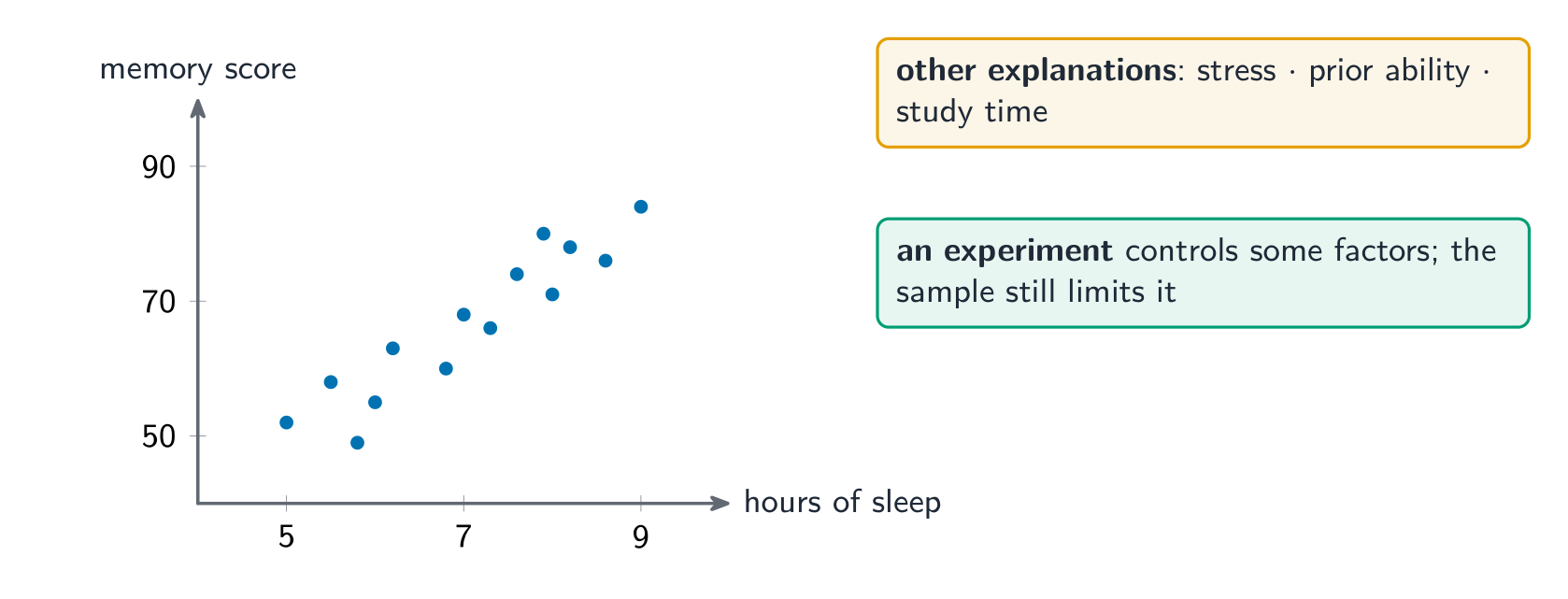
A correlation between sleep and test scores shows that sleep causes higher scores.
Dificultad 1/5 · 100 monedas + un pequeño bono en el primer intento de hoy
A confounding variable may cause both.
Which could be confounding variables in the sleep–scores correlation?
Dificultad 2/5 · 140 monedas + un pequeño bono en el primer intento de hoy
These could affect both sleep and scores.
What an experiment adds
- In an experiment the researcher manipulates the independent variable 自变量 (IV) — sleep or no sleep — and measures the dependent variable 因变量 (DV) — recall — while controlling other variables.
- Random allocation 随机分配 to conditions spreads confounds like ability across the groups.
Match each term to its meaning.
Dificultad 2/5 · 140 monedas + un pequeño bono en el primer intento de hoy
These define an experiment.
Worked example: evaluating a claim
Claim: "A survey of 500 students found that those who slept 8+ hours scored 12% higher, so sleep improves exam results."
- Type of evidence: a correlation from a survey; the researcher did not change anyone's sleep.
- Alternative explanations: less anxious students may sleep better and also score higher; students with part-time jobs may sleep less and study less.
- Better test: randomly allocate volunteers to normal sleep or one restricted night before a memory test, controlling the test and time of day. Even then, a sample of volunteers limits how far results generalise.
Why does the survey of 500 students not show that sleep causes higher scores?
Dificultad 1/5 · 100 monedas + un pequeño bono en el primer intento de hoy
Only manipulation can test cause.
Sampling and generalisation
- The sample 样本 is who took part. Jenkins and Dallenbach tested two students — results may not apply to everyone.
- Ask: who was studied, how were they chosen, and to whom can the findings be generalised 推广?
A study of two students can be safely generalised to all people.
Dificultad 1/5 · 100 monedas + un pequeño bono en el primer intento de hoy
A tiny sample limits generalisation.
Levels of explanation
- Behaviour can be explained at biological (hormones, brain), cognitive (memory processes) and sociocultural (culture, groups) levels. Sleep and memory involve all three.
- A strong answer uses more than one level and evidence for each.
Never write "the study proves". Psychology studies support or challenge a claim. Say what the evidence suggests, and note its limits — sample, method, setting.
It is accurate to write that a psychology study "proves" a theory.
Dificultad 1/5 · 100 monedas + un pequeño bono en el primer intento de hoy
Evidence supports or challenges a claim.
A correlation shows a relationship, not a cause; confounding variables may explain it. Experiments manipulate an IV, measure a DV, control other variables and randomly allocate participants. Evaluate who was sampled, how far results generalise, and use several levels of explanation.
Evaluate the claim "Students who use phones more are lonelier, so phones cause loneliness."
Correlation, alternatives, experiment, limit.