Energy stores, work and efficiency
Introducido| English | Significado |
|---|---|
| work/wɜːk/ | Energy transferred by a force acting through a displacement. |
| kinetic energy/kɪˈnetɪk ˈenədʒi/ | The energy an object has because of its motion. |
| power/ˈpaʊə/ | potencia |
| efficiency/ɪˈfɪʃənsi/ | eficiencia |
| gravitational potential energy/ˌɡrævɪˈteɪʃənl pəˈtenʃl ˈenədʒi/ | Energy stored because of an object’s position in a gravitational field. |
| mechanical energy/mɪˈkænɪkl ˈenədʒi/ | mechanical energy |
| Sankey diagram/ˈsæŋki ˈdaɪəɡræm/ | An energy-flow diagram with arrow widths proportional to the amounts transferred. |
| energy density | The energy released per unit volume of a fuel. |
What would explain this observation?
- A motor can transfer some input energy to lifting and the rest to heating. Useful output is part of the total energy transfer.
Build the model
- Work done by a constant force parallel to displacement is force multiplied by distance.
- Kinetic energy depends on speed squared.
- Energy is conserved when all transfers and stores are included.
- power 功率: Energy transferred per unit time.
- efficiency 效率: Useful output divided by total input.

What happens to kinetic energy when speed doubles at fixed mass?
Dificultad 1/5 · 100 monedas + un pequeño bono en el primer intento de hoy
Kinetic energy depends on v squared: KE = 1/2 m v^2. Doubling v squares the factor 2, giving four times the energy at the same mass - which is why braking distances grow so quickly with speed.
Match each technical term to its precise meaning.
Dificultad 2/5 · 140 monedas + un pequeño bono en el primer intento de hoy
Use the definitions to distinguish related quantities and processes.
Choose evidence that can test it
- Define the system and useful output before calculating efficiency.
- Doubling speed quadruples kinetic energy at constant mass.
- Power describes transfer per time, not total energy.
In the lab: Measure a lifting height and load, time the lift, and record electrical input with suitable instruments. Repeat trials and account for heating or friction as transfers, not missing energy.
Which two habits make the investigation or model in this case more defensible?
Dificultad 2/5 · 140 monedas + un pequeño bono en el primer intento de hoy
Stating the conditions and assumptions lets others repeat the work exactly, and recording the supporting evidence lets them check the conclusion. Hiding disagreeing results removes the evidence that could challenge a wrong conclusion, and one measurement can never establish a wider claim.
Work from known quantities
- Known: a device receives 600 J and transfers 420 J usefully.
- Efficiency = useful output / total input.
- Efficiency = 420/600 = 0.70 = 70%.
- Over 3 s, useful power = useful energy/time = 420/3 = 140 W.
Your turn: A device receives 250 J and gives 150 J useful output. Find efficiency as a percentage.
Same energy split, different power
Account for the 600 J input as 420 J useful and 180 J other transfers. Compare durations: efficiency stays 70%, while useful power changes.
A device receives 250 J and gives 150 J useful output. Find efficiency as a percentage.
Dificultad 2/5 · 140 monedas + un pequeño bono en el primer intento de hoy
The result is 60 %. Known: input 250 J; useful output 150 J. Use efficiency = useful output / total input. Efficiency = 150/250 = 0.60 = 60%. The remaining 100 J is dissipated, typically as heating of the surroundings.
Check the conclusion and its limits
- Efficiency cannot exceed 100% for a properly defined energy balance.
- Energy dissipated by heating is still conserved.
Not true: Dissipated energy is destroyed. Energy is always conserved. "Dissipated" means spread into the surroundings as heating, where it becomes hard to use again - not destroyed.
- Work done by a constant force parallel to displacement is force multiplied by distance.
- Define the system and useful output before calculating efficiency.
- Watch for: efficiency cannot exceed 100% for a properly defined energy balance.
Energy is always conserved. "Dissipated" means spread into the surroundings as heating, where it becomes hard to use again - not destroyed.
Dificultad 1/5 · 100 monedas + un pequeño bono en el primer intento de hoy
True. Energy is always conserved. "Dissipated" means spread into the surroundings as heating, where it becomes hard to use again - not destroyed.
Energy transferred per unit time: write the technical term.
Dificultad 1/5 · 100 monedas + un pequeño bono en el primer intento de hoy
power means Energy transferred per unit time.
Write from an efficiency of 40 percent
- A device receives 300 J and gives 120 J of useful output.
- Find the efficiency. The other energy is dissipated, not destroyed.
A device receives 300 J and gives 120 J of useful output. What is the efficiency, and what happens to the other energy?
Efficiency = useful output / total input = 120/300 = 0.40; multiply by 100 to obtain 40%. Dissipated energy = 300 − 120 = 180 J. The useful and dissipated outputs add back to the input; energy is conserved.
For the written device receiving 300 J and giving 120 J usefully, what is the efficiency?
Dificultad 1/5 · 100 monedas + un pequeño bono en el primer intento de hoy
120 divided by 300 is 0.40, so the efficiency is 40 percent. Other options — 60 percent (the lesson device that gives 150 J from 250 J); 180 J (the dissipated energy).
Define work using the force and its displacement
- A force transfers energy mechanically when its point of application moves along a component of that force. For a constant force and straight displacement, $W=Fs\cos\theta$, where the angle is between the force and displacement, not automatically the slope angle. Work is a scalar in joules; negative work occurs when the force component opposes the displacement, not because a coordinate happens to be negative.
- In this lesson all numerical examples are invented teaching models. A 50 N pull directed 30° above a horizontal displacement of 20 m does $50(20)\cos30^\circ\approx866$ J of work, or 870 J to two significant figures. Its upward component does no work during that horizontal displacement. A horizontal 40 N force over 5.0 m does 200 J; at 60° to the displacement it does 100 J.
An invented constant 40 N force acts at 60 degrees to a straight displacement of 5.0 m. Find the work done by this force.
Dificultad 2/5 · 140 monedas + un pequeño bono en el primer intento de hoy
W = Fs cos60° = 40 × 5.0 × 0.50 = 100 J. Use the angle between this force and the displacement.
Identify the particular force before deciding the work sign
- A force along the displacement does positive work; one opposing it does negative work. A force perpendicular to the instantaneous motion does zero work. Thus the inward resultant in uniform circular motion changes velocity direction but not speed. A fixed floor's normal force does no work on an ideal object sliding horizontally along it.
- In an ideal level-corridor model, a carried bag moves horizontally at constant velocity while its support force is vertical, so that support force does zero work on the bag. The carrier can still expend metabolic energy: this is a different system and does not invalidate the mechanical calculation. Do not generalize that every normal force or friction force always does zero or negative work; a moving support or conveyor can transfer energy to an object.
In the ideal corridor model, a person supports a bag with a vertical force while it moves horizontally at constant speed. Which statement follows?
Dificultad 1/5 · 100 monedas + un pequeño bono en el primer intento de hoy
The support force is perpendicular to the displacement, so its mechanical work on the bag is zero. The carrier’s metabolic transfers concern a different system.
Read signed area on a force–displacement graph
- Plot the force component along the displacement against position. Its signed area gives work, even when the force changes; force–time area instead gives impulse. For an invented graph, the force rises linearly from 0 to 8 N over 0–2 m, remains at 8 N over 2–5 m, then is −4 N over 5–7 m. The works are 8 J, 24 J and −8 J, giving net 24 J.
- The negative part subtracts from net work; adding its magnitude would incorrectly give 40 J. If the graph is a resultant-force graph and the object is a constant-mass particle, its net area determines the kinetic-energy change. If it is only the applied pull, include gravity, friction or other forces separately before claiming it gives the whole change.
A model resultant force rises linearly from 0 to 8 N over 0–2 m, stays at 8 N over 2–5 m, then is −4 N over 5–7 m. Find the net work.
Dificultad 2/5 · 140 monedas + un pequeño bono en el primer intento de hoy
Add signed areas: ½ × 2 × 8 + 3 × 8 − 2 × 4 = 8 + 24 − 8 = 24 J. Force–position area gives work, whereas force–time area gives impulse.
Connect resultant work with the change in speed squared
- The work–energy principle is $W_{\rm net}=\Delta E_k$, with $E_k=\dfrac12mv^2$ for non-relativistic translational motion. A model 1,200 kg car changing speed from 10 to 20 m/s gains 180,000 J, not the energy calculated from a speed change of 10 m/s. Over 100 m, its average resultant force component along the path is 1,800 N.
- Doubling speed at fixed mass quadruples kinetic energy. Momentum is a vector, whereas kinetic energy is a scalar; $E_k=p^2/(2m)$ uses momentum magnitude squared. A 2.0 kg trolley with momentum magnitude 6.0 kg m/s has 9.0 J of kinetic energy. At fixed momentum, increasing mass reduces kinetic energy; at fixed speed it increases kinetic energy. State which quantity is held fixed.
A model 1,200 kg car speeds up from 10 to 20 m/s. Find the change in translational kinetic energy.
Dificultad 2/5 · 140 monedas + un pequeño bono en el primer intento de hoy
½m(v² − u²) = 600(400 − 100) = 180,000 J. Squaring the speed change would give the wrong result.
Obtain elastic energy from the area rather than the final force
- For a Hookean spring, force magnitude increases as $F=kx$. Quasistatic stretching from natural length stores $E_H=\dfrac12kx^2$, the triangular area under the force–extension line. A line rising to 12 N at 0.060 m has gradient 200 N/m and area 0.36 J. Multiplying the final 12 N by the full extension would count twice the actual work.
- Between two nonzero extensions use the difference of stored energies. A 200 N/m spring stretched from 0.020 to 0.060 m gains 0.32 J, not $\dfrac12k(0.040)^2$. Compression also stores positive energy because extension is squared; the restoring force has the opposing direction. Check the proportional range and absence of irreversible deformation before using this model.
An ideal spring of stiffness 200 N/m stretches from 0.020 to 0.060 m relative to natural length. Find its increase in elastic energy.
Dificultad 2/5 · 140 monedas + un pequeño bono en el primer intento de hoy
ΔE = ½k(x₂² − x₁²) = 100(.0036 − .0004) = .32 J. Use the difference of squares, not the square of the extension change.
Choose a gravitational reference and the right system
- Close to Earth's surface with approximately uniform gravitational field, $\Delta E_p=mg\Delta h$. The height change is vertical, not distance along the slope. Gravitational potential energy 重力势能 belongs to the Earth–object interaction; its zero is a reference choice. A negative value relative to that zero is allowed, and only differences affect the energy balance.
- If gravity and an ideal spring merely exchange energy with a particle, total mechanical energy 机械能 $E_k+E_p+E_H$ stays constant. This requires no net transfer into or out of those mechanical stores by other processes: a motor can increase them even if friction is absent. If you instead use resultant work, include gravity's work once; do not also add the same gravitational transfer as a second energy input.
Which condition justifies conserving the modeled total kinetic, gravitational and elastic energy?
Dificultad 1/5 · 100 monedas + un pequeño bono en el primer intento de hoy
Gravity and an ideal spring can exchange energy internally among the chosen stores. A motor or resistance can change their total; absence of friction alone is insufficient.
Use an energy balance on a curved path
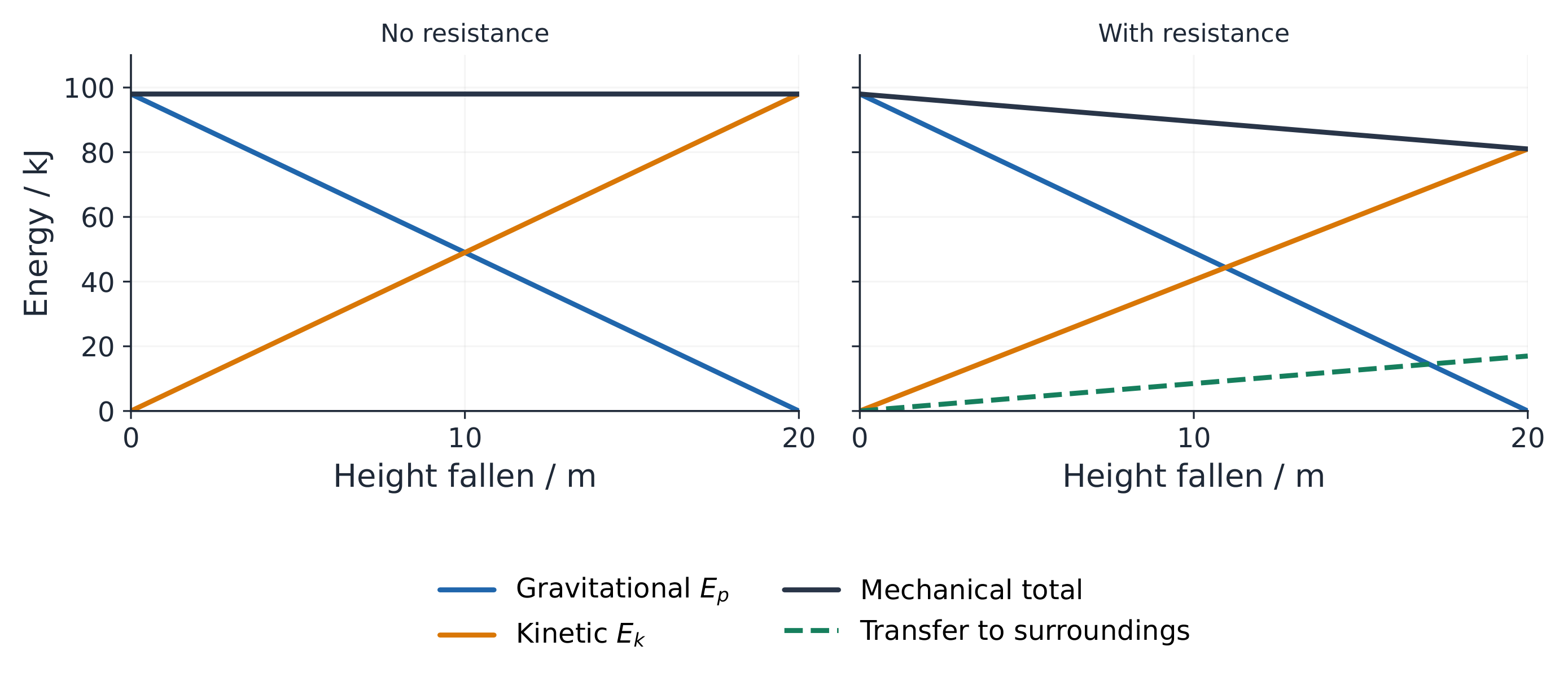
- A model coaster starts from rest 20 m above its lowest point. Neglect air resistance, friction and rotational energy, and assume a fixed track does no work through its normal force. Then $mgh=\dfrac12mv^2$, giving $v=\sqrt{2gh}\approx19.8$ m/s for $g=9.8$ metres per second squared. The mass cancels under these assumptions, although the track length may be much greater than 20 m.
- An ideal pendulum released from 0.20 m above its lowest point reaches 1.98 m/s there. A ball thrown vertically upward at 12 m/s rises by 7.35 m when drag is negligible. Energy finds speed or height without a time calculation; it does not by itself determine the direction of velocity, the travel time, or the normal force at a point.
Account for dissipation without destroying energy
- For the separate model 500 kg coaster dropping 20 m but reaching only 18 m/s, initial gravitational energy is 98,000 J and final kinetic energy is 81,000 J. Their 17,000 J difference is transferred out of the modeled mechanical stores to thermal energy and sound. Over a 60 m path, an average resistive-force magnitude of about 283 N accounts for that transfer.
- In each graph panel, add that panel's potential and kinetic energies to obtain its mechanical total. In the right panel, the mechanical total plus energy transferred to the surroundings remains 98 kJ. The linear growth of this transfer with height fallen is an invented model assumption, not a universal resistance law. A 70 kg skier dropping 40 m with 6,000 J dissipated has 21,440 J of final kinetic energy and speed about 24.8 m/s. A negative calculated final kinetic energy would expose an inconsistent assumption about completing the path.
An invented 70 kg skier starts from rest and drops 40 m. Take g = 9.8 metres per second squared and 6,000 J dissipated. Find final speed.
Dificultad 2/5 · 140 monedas + un pequeño bono en el primer intento de hoy
Taking the bottom as the gravitational reference, initial energy = mgh = 70 × 9.8 × 40 = 27,440 J. Final KE = 27,440 − 6,000 = 21,440 J. From KE = mv²/2, v = √(2KE/m) = √(2 × 21,440/70) ≈ 24.75 m/s. Dissipated energy is transferred, not destroyed.
Predict a spring launch while listing the omitted stores
- A model spring of stiffness 250 N/m compressed 0.080 m stores 0.80 J. If all of it becomes the translational kinetic energy of a 0.020 kg dart, the dart leaves at $\sqrt{2(0.80)/0.020}\approx8.94$ m/s. A different 400 N/m spring compressed 0.10 m stores 2.0 J; it would launch a 0.050 kg ball at the same speed under the same ideal assumptions.
- For a real launch, some energy may remain in spring motion, become rotational energy, raise the projectile, or be dissipated. Include any stated contributions before taking a square root. If only 75% of the first spring's energy reaches the dart's translational motion, it receives 0.60 J and leaves at about 7.75 m/s. A 25% energy reduction does not mean a 25% speed reduction: speed scales with the square root of energy.
A model spring stores 0.80 J. Only 75% becomes translational kinetic energy of a 0.020 kg dart initially at rest. Find its final speed.
Dificultad 2/5 · 140 monedas + un pequeño bono en el primer intento de hoy
The dart receives .75 × .80 = .60 J. Therefore v = √(2 × .60/.020) = √60 ≈ 7.75 m/s. Speed depends on the square root of energy.
Distinguish energy transferred from the rate of transfer
- Average power is energy transferred divided by elapsed time, in watts, where 1 W = 1 J/s. Transferring 600 J in 3.0 s means 200 W; 600 W over 3.0 s would mean 1,800 J. A kilowatt hour is an energy unit: $1\ {\rm kW\,h}=3.6\ {\rm MJ}$, because an hour contains 3,600 seconds.
- For an instantaneous force and point-of-application velocity, $P=Fv\cos\theta$. In straight motion with force parallel to velocity, this is $P=Fv$; constant speed is not required for that instantaneous relation. At steady 25 m/s against 600 N of resistance, a car needs 15 kW of driving power at the wheels despite zero resultant force. Zero net work does not imply zero work by each force.
A model car travels steadily at 25 m/s against 600 N of resistance. Find the driving power delivered at the wheels.
Dificultad 2/5 · 140 monedas + un pequeño bono en el primer intento de hoy
Steady speed requires a driving force of 600 N. P = Fv = 600 × 25 = 15,000 W. Zero resultant force does not mean each individual force does zero work.
Compare useful and input quantities over the same boundary
- Define the useful task before calculating efficiency: $\eta=E_{\rm useful}/E_{\rm input}$, or the matching power ratio over the same operating condition. A crane lifts a 500 kg load 12 m in 20 s while taking 4.2 kW electrically. Its useful energy is 58,800 J, useful power 2,940 W, input energy 84,000 J and efficiency 0.70, or 70%.
- The remaining 25,200 J is accounted for through other stores/transfers, not destroyed. For energy-conversion efficiency the output cannot exceed the total input under a complete balance. A useful fraction is dimensionless; 70% means 0.70 in calculations. Two successive devices with efficiencies 0.80 and 0.75 deliver an overall useful fraction of 0.60 if the first device's useful output is the second's input; do not add the percentages.
A crane raises a 500 kg load through 12 m in 20 s, taking 4.2 kW electrically. Use g = 9.8 metres per second squared. Find efficiency as a percentage.
Dificultad 2/5 · 140 monedas + un pequeño bono en el primer intento de hoy
Useful energy = mgh = 500 × 9.8 × 12 = 58,800 J. Convert input power: 4.2 kW = 4,200 W. Input energy = Pt = 4,200 × 20 = 84,000 J. Efficiency = 58,800/84,000 × 100 = 70%. Independently, useful power = 58,800/20 = 2,940 W, and 2,940/4,200 × 100 = 70%.
Read Sankey widths as a conserved energy or power balance
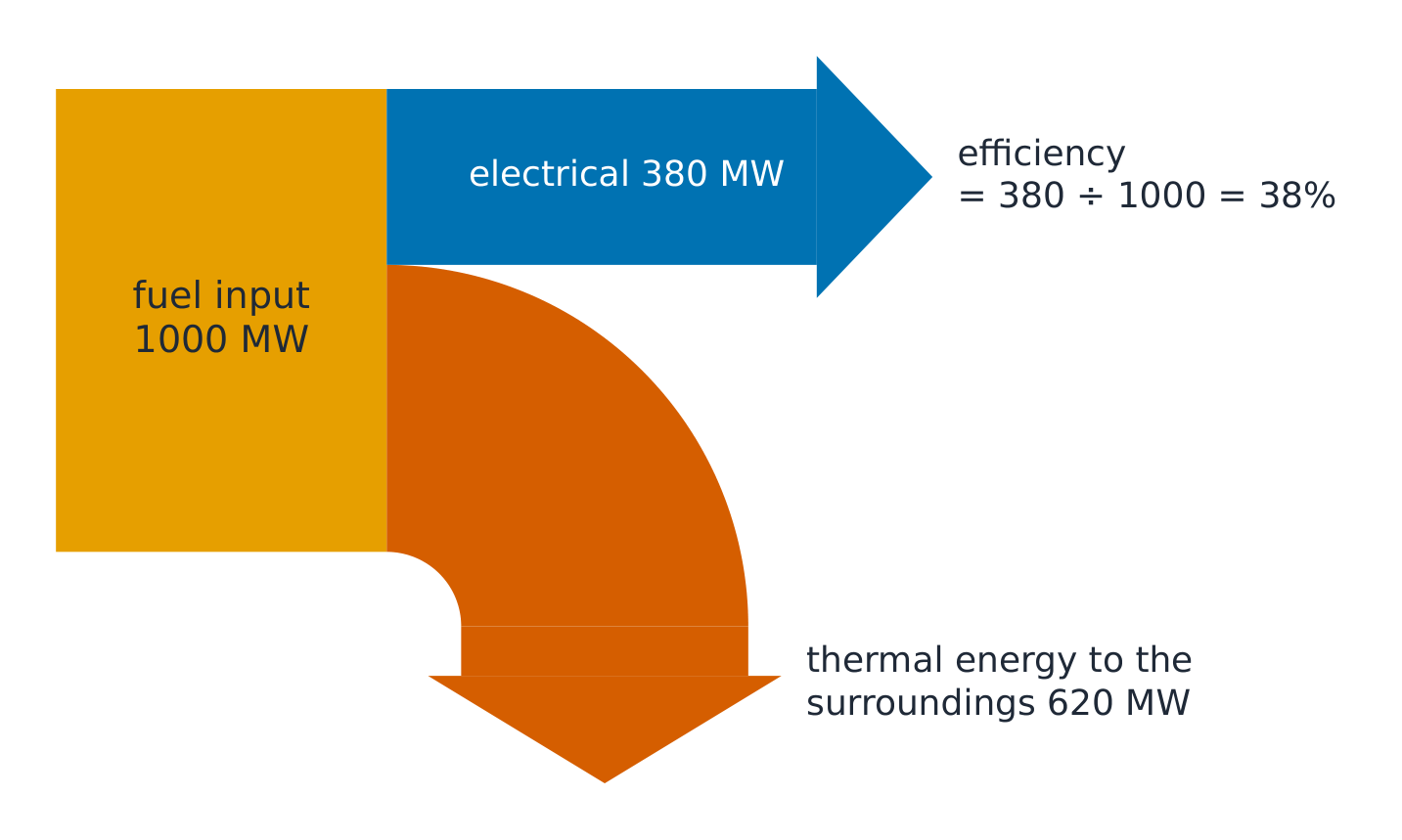
- A Sankey diagram 桑基图 splits an input into outputs whose widths are proportional to a common energy or power scale. In the illustrated invented power station, 1,000 MW of input splits into 380 MW of useful electrical output and 620 MW transferred to the surroundings. Efficiency is 38%, not 380/620. Do not combine a power arrow in MW with an energy arrow in MJ as if they were directly additive.
- Arrow length is a layout choice; width carries the quantitative information. An arrow bending downward still represents a positive outward transfer, not a negative supply. If a device receives 2,400 J and transfers 600 J usefully, draw widths in the ratio 600:1,800, or 1:3, and state 25% efficiency. This conveys the balance before any claim about how useful the dissipated energy might be elsewhere.
Convert fuel energy into a mass rate
- A stated fuel energy per kilogram links mass to released energy: $E=mq$. Check whether an energy-density 能量密度 number means energy per mass or per volume; these require different units. Use values supplied for the case rather than treating every sample of wood, coal or gas as identical. Useful output also depends on conversion efficiency, so compare devices on the same output task.
- For a model station delivering 500 MW at 38% efficiency with fuel releasing 30 MJ/kg, input power is about 1,316 MW and fuel rate is about 43.9 kg/s. Over one day this is about 3,790 tonnes. Separately, an engine delivering 15 kW for one hour at 25% efficiency uses 216 MJ of input energy; a stipulated 46 MJ/kg fuel requires about 4.70 kg. Convert output to input before dividing by energy per kilogram.
An invented engine delivers 15 kW for one hour at 25% efficiency. Fuel releases a stipulated 46 MJ/kg. Find the fuel mass.
Dificultad 2/5 · 140 monedas + un pequeño bono en el primer intento de hoy
Useful energy = 15,000 × 3,600 = 54 MJ. Input energy = 54/.25 = 216 MJ, so mass = 216/46 ≈ 4.70 kg. Do not apply efficiency again after calculating input energy.
Measure a motor's efficiency and test the explanation
- Lift a measured load through a vertical height, record the lift time, and measure electrical potential difference and current. For steady readings use input power $VI$ and useful power $mgh/t$; for changing readings use time-resolved input energy rather than multiplying unrelated averages. An invented 80 kg load raised 6.0 m in 12 s gives 392 W useful power; a 600 W input implies about 65.3% efficiency.
- Repeat trials with the same height and controlled operating conditions, allow for start/stop energy changes, and report measurement uncertainty. For independent small uncertainties, a simple worst-case percentage estimate for useful power adds the percentage uncertainties in mass, height and time. A longer timed lift reduces the fractional influence of a fixed timing error, but verify that changing load or speed has not changed the motor's efficiency.
Choose a balance and check it independently
- Start with a system boundary, initial/final states and a stated useful task. Choose signed work and kinetic-energy change, mechanical-energy conservation, or a full input–output balance according to the assumptions. Draw a force–displacement graph, store diagram or Sankey where it reveals the transfers; an equation alone should not hide gravity, resistance or another energy supply.
- Check dimensions, signs and limiting cases: zero displacement gives zero mechanical work by that force; doubling speed quadruples kinetic energy at fixed mass; longer time reduces average power for the same energy. Recompute a spring or variable-force result using area, and compare a power calculation with energy divided by time. Explain discrepancies through the model and measurements rather than declaring energy missing.
Explain how to solve a mechanical-energy transfer problem and test whether its assumptions and answer are defensible. Include one graph method, a power calculation and a measurement check.
A complete answer explains why the selected conservation or transfer relation applies, as well as carrying out the calculation.