Ethical reasoning and textual interpretation
Introducido| English | Significado |
|---|---|
| ethics/ˈeθɪks/ | The branch of philosophy that asks what is right and wrong and how we should live. |
| consequentialism/ˌkɒnsɪˈkwenʃɪəlɪzəm/ | consequentialism |
| utilitarianism | The ethical theory that the right act produces the greatest happiness. |
| deontology/diːənˈtɒlədʒi/ | The view that some actions are right or wrong in themselves, whatever their results. |
| virtue ethics/ˈvɜːtʃuː ˈeθɪks/ | An ethical theory that judges actions by what a person of good character would do. |
The murderer at the door, 1797
- In 1797 Immanuel Kant argued that you must not lie even to a murderer who asks where your friend is hiding. The French philosopher Benjamin Constant called this absurd.
- Their dispute is still the starting point for ethics 伦理学: is the right act the one with the best results, the one that follows a duty, or the one a good person would do?
Consequentialism
- Consequentialism 后果主义 judges acts by their results. Jeremy Bentham and John Stuart Mill's utilitarianism 功利主义 says the right act produces the greatest happiness for the greatest number.
- Strength: it takes everyone's wellbeing seriously. Problem: it may approve of harming one innocent person if it benefits many.
What is a common objection to utilitarianism?
Dificultad 1/5 · 100 monedas + un pequeño bono en el primer intento de hoy
Adding up happiness can override individual rights.
Deontology
- Deontology 义务论 judges acts by duties and rules, whatever the results. Kant's test: act only on a rule you could will everyone to follow, and treat people as ends, never merely as means.
- Strength: it protects rights and promises. Problem: duties can clash, and rigid rules can lead to terrible results, as with the murderer at the door.
For Kant, an act is right if it produces good results.
Dificultad 1/5 · 100 monedas + un pequeño bono en el primer intento de hoy
Kant judges an act by its rule and respect for persons, not by its consequences.
Virtue ethics
- Virtue ethics 美德伦理学, from Aristotle, asks what a good person would do. Virtues such as honesty, courage and kindness are a "mean" between extremes, learned by practice.
- Strength: it looks at character and real situations. Problem: it may give less clear guidance in a hard case.
Match each claim to its ethical theory.
Dificultad 2/5 · 140 monedas + un pequeño bono en el primer intento de hoy
Results, duties, character.
For Aristotle, courage lies between which two extremes? Match each to its description.
Dificultad 2/5 · 140 monedas + un pequeño bono en el primer intento de hoy
Each virtue is a mean between a deficiency and an excess.
Worked example: a promise against safety
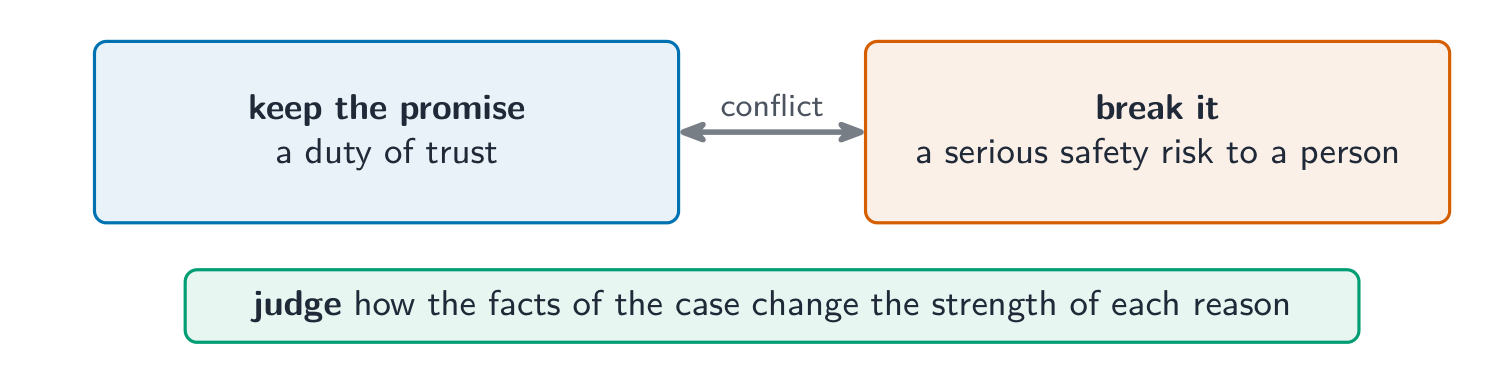
You promised a friend to keep a secret. You then learn the friend plans to drive home drunk tonight. Should you tell their parents?
- Consequentialist: telling prevents a serious risk to life; the cost — a damaged friendship — is far smaller. Tell.
- Deontologist: keeping promises is a duty, but so is not letting someone be harmed. Many Kantians accept that a promise does not bind you to help someone endanger life. Tell, but explain why.
- Judgement: the theories agree here because the harm is serious and close. If the secret were only embarrassing, the duty of trust would weigh more — the facts change each reason's strength.
In the worked example, why does the duty to keep the secret weigh less?
Dificultad 1/5 · 100 monedas + un pequeño bono en el primer intento de hoy
The seriousness of the harm changes the balance of reasons.
Reading a philosophical text
- For a prescribed text, such as Mill's On Liberty (1859), find the thesis, the key terms, the main argument and the examples. Mill's harm principle: power may be used against a person's will only to prevent harm to others.
- Then evaluate: is the argument valid, are the premises plausible, what would an opponent say? Quote briefly and explain what each quotation shows.
What does Mill's harm principle say?
Dificultad 1/5 · 100 monedas + un pequeño bono en el primer intento de hoy
Mill defends freedom over one's own life, limited only by harm to others.
"Ethics is just opinion, so no view is better" is wrong. People disagree, but views can be compared by their reasons, their consistency and how they handle hard cases. "Torturing for fun is fine" is not as well supported as its opposite, and philosophy shows why.
Because people disagree about ethics, every ethical view is equally well supported.
Dificultad 1/5 · 100 monedas + un pequeño bono en el primer intento de hoy
Disagreement does not make all reasons equally good; views can be compared by argument.
Consequentialism judges results, deontology judges duties and rights, and virtue ethics judges character. In a dilemma, apply each theory, show where they agree or conflict, and explain how the facts change the strength of each reason. Read texts for thesis, terms, argument and evaluation.
Should a doctor lie to a dying patient who asks if a treatment will work? Apply two theories and reach a judgement.
Apply, compare, judge.