Collaborative real-life music project
Introducido| English | Significado |
|---|---|
| real-life music project | the IB Music higher-level project in which students plan and carry out music-making for a real audience |
| musical aim | what a music project sets out to achieve, and for whom |
| audience/ˈɔːdɪəns/ | The people a text is written for. |
| collaborators | the people who work together on a project |
| contribution/ˌkɒntrɪˈbjuːʃn/ | Sales revenue minus variable costs, available to cover fixed costs and then provide profit. |
A studio full of singers, one night, 1985
- On 28 January 1985, more than forty artists gathered in a Los Angeles studio to record "We Are the World" for famine relief in Ethiopia. The producer Quincy Jones taped a sign to the door: "Check your ego at the door". The song was recorded in one night.
- It worked because the purpose was clear, every singer had a planned line, and the schedule was fixed. At HL, the real-life music project 真实音乐项目 asks you to plan and carry out something like this, on a smaller scale.
What did Quincy Jones's sign on the studio door say?
Dificultad 1/5 · 100 monedas + un pequeño bono en el primer intento de hoy
Collaboration needed shared purpose over personal fame.
"We Are the World" was recorded in a single night.
Dificultad 1/5 · 100 monedas + un pequeño bono en el primer intento de hoy
A clear plan and fixed schedule made one night enough.
Purpose first
- Start from a musical aim 音乐目标: what the project should achieve for whom — a concert for a care home, music for a short film, a recording for a charity.
- The aim decides the repertoire, the people you need and the schedule.
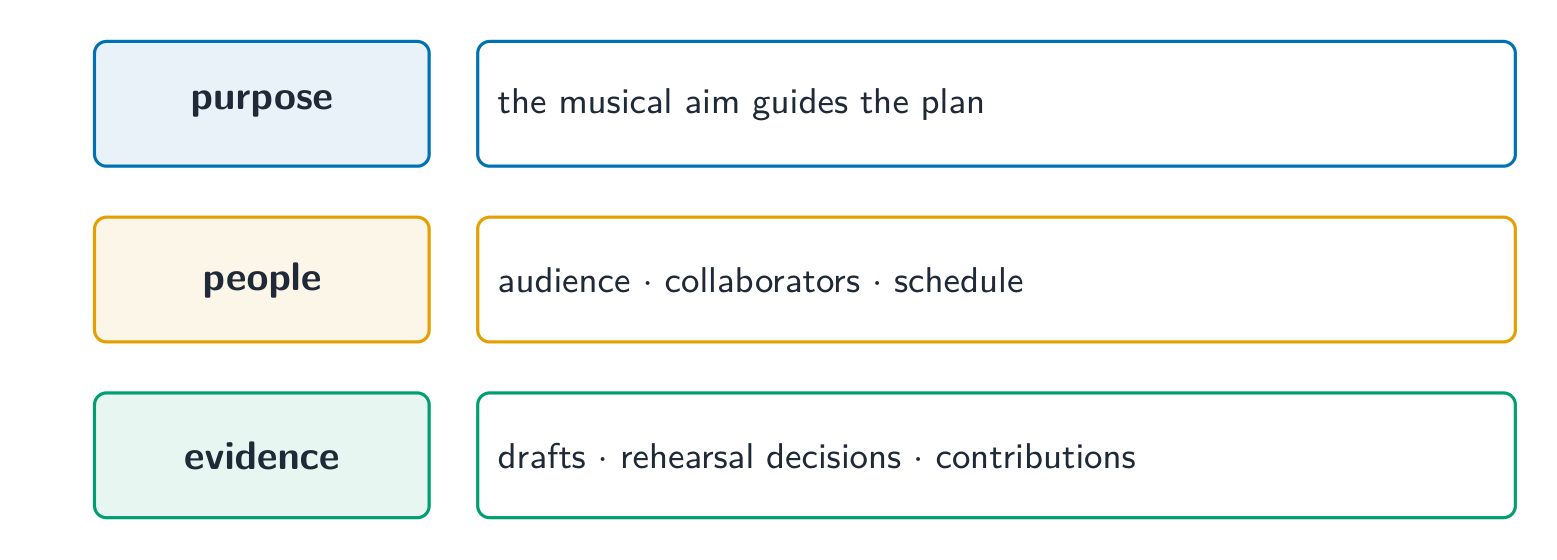
The musical aim decides repertoire, people and schedule.
Dificultad 1/5 · 100 monedas + un pequeño bono en el primer intento de hoy
Purpose comes first.
People and planning
- Identify the audience 受众, the collaborators 合作者 (performers, a technician, a film-maker) and a schedule with deadlines.
- Agree roles in writing. A clear plan prevents the most common failure: the project running out of time.
Which belong in the project plan?
Dificultad 2/5 · 140 monedas + un pequeño bono en el primer intento de hoy
People and planning keep the project on time.
Worked example: music for a short film
Aim: compose and record a two-minute score for a classmate's silent film for the school film night.
- People: the film-maker (gives timings and feedback), two string players, a student sound engineer. Audience: about 200 students and parents.
- Plan: week 1 spotting session with the film-maker, marking where music starts and stops; weeks 2–3 draft and test with the film; week 4 record; week 5 mix and deliver.
- Decision recorded: at the test, the film-maker said the chase music hid the dialogue cards, so the student cut the cello and kept only a light pizzicato under them.
In the worked example, why was the cello cut?
Dificultad 1/5 · 100 monedas + un pequeño bono en el primer intento de hoy
A recorded decision with a reason.
Evidence of the process
- Keep drafts, rehearsal recordings, emails or messages, and notes of decisions — what changed and why.
- Record your own contribution 贡献 precisely: which parts you wrote, led or arranged.
Messages and rehearsal recordings can count as evidence of the process.
Dificultad 1/5 · 100 monedas + un pequeño bono en el primer intento de hoy
They show decisions and changes.
Evaluating the project
- Judge the result against the aim: did it work for the audience? Use feedback and recordings.
- Say what you would change next time and why.
A project with no clear aim drifts. "We will make some music together" gives no way to choose repertoire, plan a schedule or judge success. Fix the purpose and audience first.
"We will make some music together" is a clear project aim.
Dificultad 1/5 · 100 monedas + un pequeño bono en el primer intento de hoy
It gives no way to plan or judge success.
The HL real-life project starts from a musical aim for a real audience, then plans people, roles and a schedule. Keep evidence of drafts, rehearsal decisions and your own contributions, and evaluate the result against the aim with feedback.
Plan a small real-life music project with an aim, audience, people and a four-step schedule.
Aim, people, plan, evaluation.