Reading literature for performance possibilities
Introducido| English | Significado |
|---|---|
| perceptible | able to be seen, heard or felt by an audience |
| performance possibility | A feature of a text that could become something an audience sees or hears: a sound, a silence, a movement, a use of space. |
| absence | the state of someone or something not being there |
| literary analysis/ˈlɪtərəri əˈnæləsɪs/ | análisis literario |
Nothing happens, twice, 1953
- Samuel Beckett's Waiting for Godot opened in Paris in 1953. Two men wait by a tree for someone who never comes. In 1956 the critic Vivian Mercier wrote that it was a play in which "nothing happens, twice".
- Yet audiences feel the waiting — through silences, repeated actions and the empty road. Making something abstract like waiting perceptible 可感知的 to an audience is what Literature and Performance asks you to find in a text.
How did Vivian Mercier describe Waiting for Godot in 1956?
Dificultad 1/5 · 100 monedas + un pequeño bono en el primer intento de hoy
The play makes waiting itself the action.
Reading for performance possibilities
- A performance possibility 表演可能性 is a feature of a text that could become something an audience sees or hears: a sound, a silence, a movement, a use of space.
- Read for what the text makes present and what it makes absent: who is there, who has gone, what can be heard.
A performance possibility is a feature of a text that an audience could see or hear on stage.
Dificultad 1/5 · 100 monedas + un pequeño bono en el primer intento de hoy
Sound, silence, movement and space are examples.
Sound, absence, perception
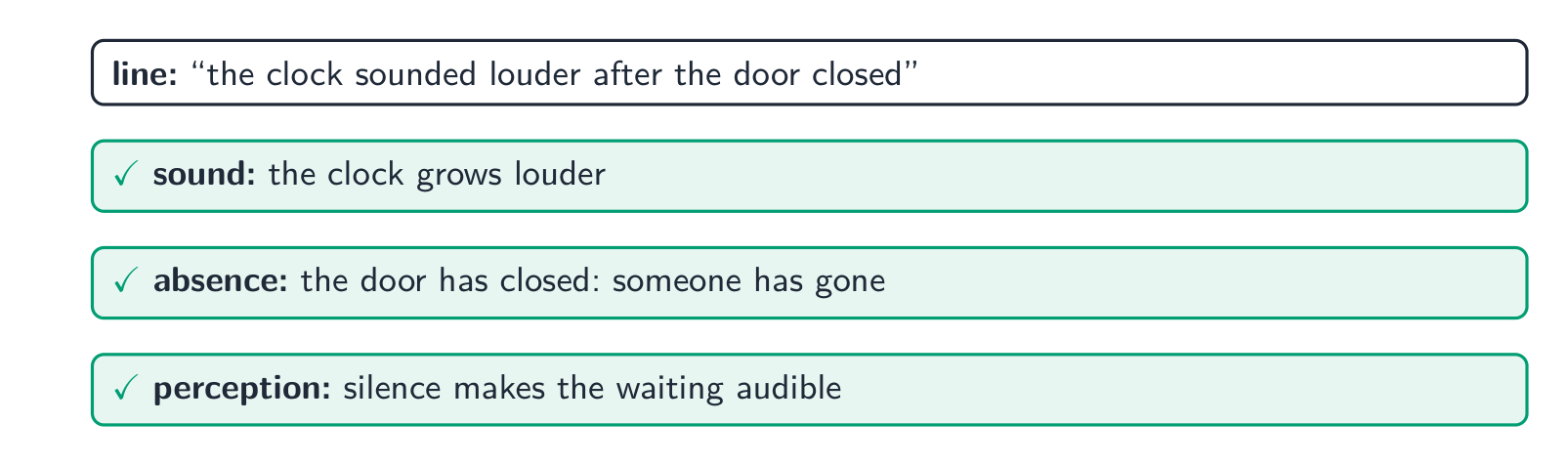
- Take the line: "The clock sounded louder after the door closed." Nothing about the clock changed — the room became emptier, so the character noticed it.
- The line joins sound, absence 缺席 and perception. On stage, a ticking that grows louder after an exit could make the audience feel the empty room.
Why does the clock sound "louder" in the line?
Dificultad 1/5 · 100 monedas + un pequeño bono en el primer intento de hoy
The line joins sound, absence and perception.
Worked example: from line to staging idea
Line: "The clock sounded louder after the door closed."
- Literary analysis: the clock has not changed; the comparative "louder" shows the character's heightened attention after someone leaves. The short sentence makes the moment feel sudden.
- Performance possibility: after the exit, the actor stays still; a recorded tick rises slowly in volume; the actor's eyes move to the clock and stay there.
- Test: would an audience feel absence, or just notice a sound effect? If the actor turns towards the closed door before the clock, the link between the two becomes clearer.
In the worked example, what makes the link between door and clock clearer?
Dificultad 1/5 · 100 monedas + un pequeño bono en el primer intento de hoy
The movement connects absence and sound.
Elements of performance
- Space (where actors stand), voice (pace, pause, volume), movement, sound and light — each can make a literary feature visible or audible.
- Choose the element that best fits the feature: silence for absence, distance for separation, repetition for routine.
Match each literary feature to a fitting element.
Dificultad 2/5 · 140 monedas + un pequeño bono en el primer intento de hoy
Choose the element that fits the feature.
Writing about the choice
- Link the text to the staging: quote the line, analyse its effect on the page, then explain how the performance choice carries that effect to an audience.
- Name what is gained and what might be lost in the move from page to stage.
A good analysis notes what might be lost in the move from page to stage.
Dificultad 1/5 · 100 monedas + un pequeño bono en el primer intento de hoy
Name gains and losses.
A staging idea is not analysis on its own. "I would play a ticking sound" needs a reason from the text: which words create the effect, and why sound is the best way to make it perceptible.
"I would play a ticking sound" is complete analysis.
Dificultad 1/5 · 100 monedas + un pequeño bono en el primer intento de hoy
It needs a reason from the text.
Reading for performance finds features — sound, absence, silence, space — that could become perceptible to an audience. Analyse the line on the page, propose a staging that carries its effect, test whether an audience would feel it, and explain what is gained and lost.
Find a performance possibility in the line "She set two cups on the table, then put one back."
Page, stage, test.