Literary comparison and context
Introducido| English | Significado |
|---|---|
| context/ˈkɒntekst/ | The surrounding circumstances, information or language that help determine meaning and interpretation. |
| narrative voice/ˈnærətɪv vɔɪs/ | Voz narrativa |
| withhold | to keep information, such as a character's motives, from the reader |
| interior thought | a character's private thoughts and feelings shown by the narrator |
| context of production | The time, place and circumstances in which a text was written. |
| context of reception | The circumstances in which a text is read and understood. |
Writing back, 1958
- Chinua Achebe published Things Fall Apart in 1958. He later said he wrote it partly in response to European novels about Africa, in which Africans hardly speak. In a 1975 lecture he called Joseph Conrad's Heart of Darkness (1899) a book that denied Africans their humanity.
- Achebe's novel gives its Igbo characters history, law, argument and inner lives. Reading the two together shows how context 语境 — who writes, when, for whom — shapes literature.
Why did Achebe write Things Fall Apart partly as a response?
Dificultad 1/5 · 100 monedas + un pequeño bono en el primer intento de hoy
Achebe gave Igbo characters history and inner lives.
Narrative voice
- Narrative voice 叙述声音 is who tells the story and how much they reveal. A narrator can withhold 隐瞒 a character's motives, or present their interior thought 内心思想.
- When a narrator shows a character's thoughts, readers understand and judge them from inside; when motives are hidden, the character stays a stranger.
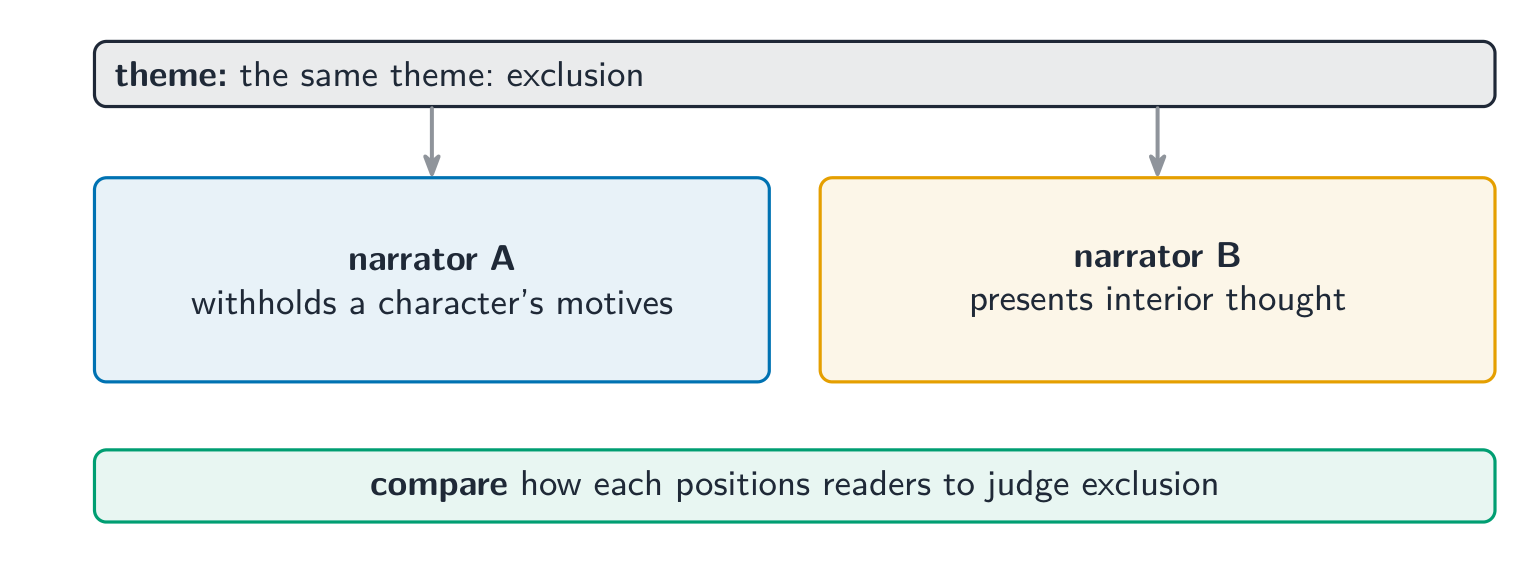
When a narrator presents a character's interior thought, readers can judge the character from inside.
Dificultad 1/5 · 100 monedas + un pequeño bono en el primer intento de hoy
Shown thought builds understanding.
Context of writing and reading
- Context of production 创作语境: the time, place and beliefs in which a work was written. Context of reception 接受语境: how readers at different times respond to it.
- Heart of Darkness was praised in 1899 as a critique of empire; after Achebe's lecture, many readers saw its treatment of Africans as part of the problem.
Match each context to its meaning.
Dificultad 2/5 · 140 monedas + un pequeño bono en el primer intento de hoy
Both shape how a work is read.
How did the reception of Heart of Darkness change after 1975?
Dificultad 1/5 · 100 monedas + un pequeño bono en el primer intento de hoy
Achebe's lecture changed many readers' view.
Worked example: comparing narrators
Compare how Heart of Darkness and Things Fall Apart position readers to view African characters.
- Conrad: the narrator Marlow describes Africans mostly from outside, as figures in a landscape; their motives are rarely given, so the reader sees them through a European traveller's eyes.
- Achebe: the narrator shows Okonkwo's private fear of becoming weak like his father, and explains village law and debate, so the reader judges Igbo society from inside.
- Comparison: the difference in narrative voice changes who counts as a full human being in each novel — which is exactly Achebe's point about context.
In the worked example, how does Conrad's narrator present African characters?
Dificultad 1/5 · 100 monedas + un pequeño bono en el primer intento de hoy
They remain strangers seen through a traveller's eyes.
Paper 2 structure
- Paper 2 asks you to compare two works you have studied in response to a general question. Choose works that give a real contrast in method.
- Integrate both works in each paragraph and link choices of voice, structure and language to the question.
Paper 2 asks you to compare two studied works in response to a general question.
Dificultad 1/5 · 100 monedas + un pequeño bono en el primer intento de hoy
Choose works that give a real contrast in method.
Judging fairly
- Avoid simply condemning older works. Explain how their context shaped them, then evaluate how they position readers today.
- Use evidence from the texts, not only from biographies.
Context is not a biography paragraph. "Achebe was born in 1930 in Nigeria" adds nothing unless you show how context shapes a specific choice in the text — such as giving Okonkwo an inner voice.
A paragraph of the author's biography counts as analysis of context.
Dificultad 1/5 · 100 monedas + un pequeño bono en el primer intento de hoy
Show how context shapes a specific choice.
Compare how two works make different choices — narrative voice, withheld or shown thought — to position readers. Use the contexts of production and reception to explain those choices, integrate both works, and judge with evidence from the texts.
Choose two works you have studied and compare how their narrative voices position readers on one issue.
Voice, positioning, comparison.