Film language and contextual interpretation
Introducido| English | Significado |
|---|---|
| film language | the techniques of shot, angle, mise-en-scène, sound and editing through which films make meaning |
| editing/ˈedɪtɪŋ/ | Selecting and arranging shots to shape a film's rhythm, relationships and meaning. |
| shot size | how much of the subject and its surroundings a shot shows, from wide shot to close-up |
| camera angle | the position from which the camera views the subject, such as high, low or eye level |
| mise-en-scène | Mise-en-scène |
| non-diegetic sound/ˌnɒndaɪəˈdʒetɪk saʊnd/ | sound added for the audience that does not come from the story world, such as background music or narration |
| diegetic sound/ˌdaɪəˈdʒetɪk saʊnd/ | sound that comes from inside the story world, such as dialogue or a door closing |
| context/ˈkɒntekst/ | The surrounding circumstances, information or language that help determine meaning and interpretation. |
A bomb under the table, 1962
- In 1962, in his long interviews with François Truffaut, Alfred Hitchcock explained the difference between surprise and suspense. If a bomb under a table suddenly explodes, the audience gets fifteen seconds of surprise. If they are shown the bomb first, and the clock ticking, an ordinary conversation becomes fifteen minutes of suspense.
- The scene is the same; what the camera shows, and when, changes everything. That is film language 电影语言: the choices of shot, angle, sound and editing that make meaning.
According to Hitchcock, what creates suspense rather than surprise?
Dificultad 1/5 · 100 monedas + un pequeño bono en el primer intento de hoy
Knowledge turns an ordinary scene into suspense.
Shots and angles
- Shot size 景别: a wide shot shows a person in their space; a close-up shows a face or object in detail. Camera angle 机位角度: a high angle looks down and can make a subject seem small or trapped; a low angle can make them seem powerful.
- Mise-en-scène 场面调度 is everything arranged inside the frame: setting, props, costume, lighting, actors' positions — a coat still on, one lamp, a sealed letter. Delaying a close-up of a face withholds emotion and builds tension.
Match each choice to a common effect.
Dificultad 2/5 · 140 monedas + un pequeño bono en el primer intento de hoy
Effects depend on context, but these are common.
Diegetic and non-diegetic sound
- Diegetic sound 画内音 comes from inside the story world: a kettle, a door creak, dialogue. Non-diegetic sound 画外音 is added for the audience: music, a low tone, narration.
- A sound with no source in the room tells the audience something the character may not know.
Classify each sound.
Dificultad 2/5 · 140 monedas + un pequeño bono en el primer intento de hoy
Diegetic sound belongs to the story world.
Worked example: reading the sequence
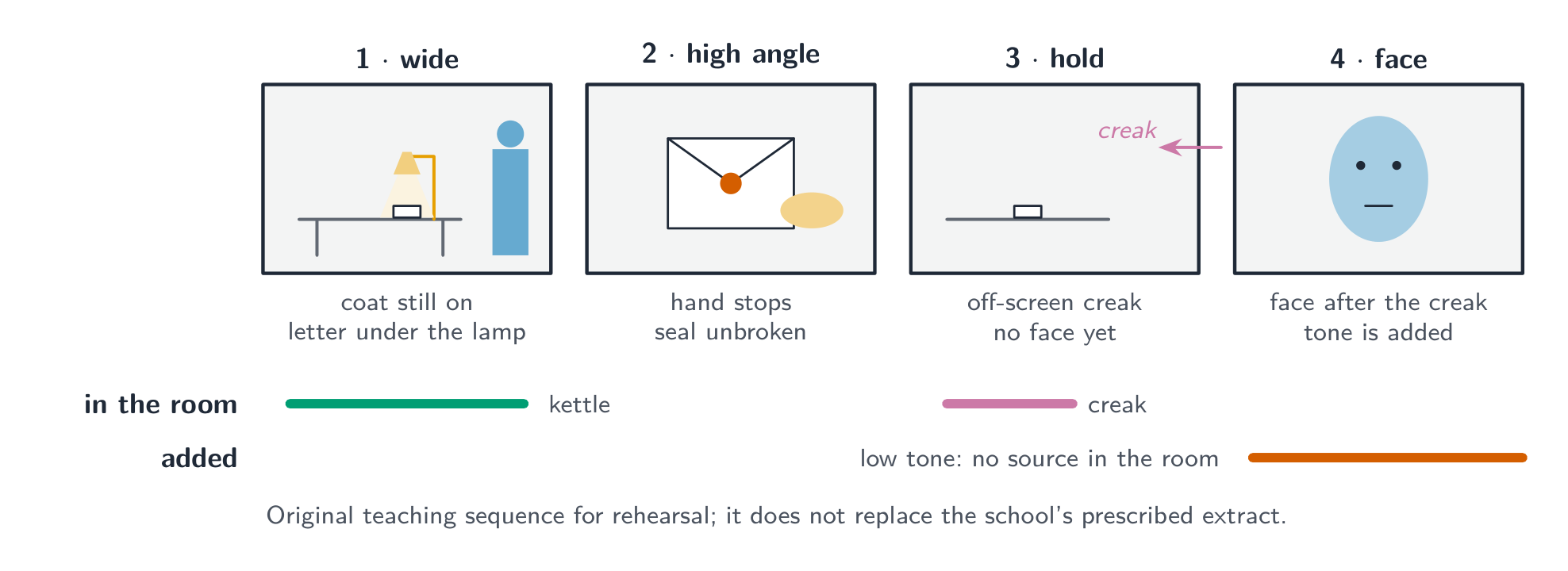
Sequence: a woman comes home and finds an unopened letter (see figure).
- Shot 1 — wide: her coat is still on and the letter sits under the lamp. The wide frame shows her alone in the room and places the letter at the centre of attention.
- Shots 2–3 — high angle, then hold: looking down on her hand as it stops makes her seem small and hesitant; holding on an off-screen creak, with her face still hidden, delays her reaction and builds suspense, as Hitchcock described.
- Shot 4 — face, then tone: we finally see her face; then a low non-diegetic tone with no source in the room tells the audience the letter means danger before she knows it.
In the worked example, why is her face hidden until shot 4?
Dificultad 1/5 · 100 monedas + un pequeño bono en el primer intento de hoy
Withholding emotion builds tension.
The low tone tells the audience something the character may not yet know.
Dificultad 1/5 · 100 monedas + un pequeño bono en el primer intento de hoy
Non-diegetic sound speaks to the audience.
Editing
- Editing 剪辑 joins shots. Its rhythm — long takes or fast cuts — controls pace. A cut can link two images to suggest a connection the film never states.
- Ask why a cut happens at that moment and what it makes the audience expect.
What does fast cutting usually do?
Dificultad 1/5 · 100 monedas + un pequeño bono en el primer intento de hoy
Editing rhythm controls pace.
Context
- Interpret film language in context 语境: the film's time, place, industry and audience. Hitchcock's suspense methods grew from the Hollywood studio system and audiences who knew genre rules.
- The same technique can mean different things in different film cultures. In the textual analysis task you analyse an extract of at most five minutes from a prescribed film, in at most 1,750 words, with a source list.
Do not describe a shot without its effect. "This is a close-up" is identification, not analysis. Say what the close-up shows, what it hides, and how it shapes the audience's response at that moment.
"This is a close-up" is a complete analysis.
Dificultad 1/5 · 100 monedas + un pequeño bono en el primer intento de hoy
Explain what it shows, hides and does.
Film language — shot size, angle, diegetic and non-diegetic sound, and editing — makes meaning through what is shown and when. Analyse each choice by its effect on the audience, as Hitchcock's bomb shows: knowledge creates suspense. Interpret choices in their production context.
Analyse two film-language choices in a scene you know.
Choice, effect, meaning.