Environmental law: rules, evidence and enforcement
Introducido| English | Significado |
|---|---|
| enforcement/enˈfɔːsmənt/ | aplicación |
| jurisdiction/ˌdʒʊərɪsˈdɪkʃn/ | jurisdicción |
| statute | A written law passed by a legislature. |
| regulation/ˌreɡjʊˈleɪʃn/ | A detailed binding rule made by a government body under a law. |
| soft law | Guidelines and declarations that shape behaviour without being legally binding. |
| hard law | Legally binding rules that can be enforced. |
| treaty | A written agreement between states that binds those that accept it. |
| information/ˌɪnfəˈmeɪʃn/ | Data or communicated content that conveys meaning or reduces uncertainty. |
| transboundary | Crossing the border between states. |
| ratify | To give formal national approval that makes a state bound by a treaty. |
| CITES | The treaty that controls international trade in endangered species. |
| ecological red line | A boundary in China around areas that must keep strict protection. |
| corruption | Misuse of public power for private gain. |
| local protectionism | Local officials shielding local businesses from rules to protect jobs or revenue. |
| displacement/dɪˈspleɪsmənt/ | Pollution or harvesting moving to places with weaker rules. |
| liability/ˌlaɪəˈbɪlɪti/ | Legal responsibility for harm, usually including the duty to pay for it. |
What would explain this observation?
- Two catchments have the same discharge limit but different water quality. A legal rule can influence behaviour only through its coverage, implementation and enforcement 执法.
Build the model
- Environmental law defines obligations and permissions within a jurisdiction 管辖范围.
- A discharge permit may specify a concentration, a total load, monitoring and consequences of non-compliance.
- International agreements require implementation through institutions; signing an agreement alone does not show that an environmental outcome has improved.
- enforcement: Implementation of rules through monitoring and consequences.
- jurisdiction: The geographical or institutional scope of an authority.

Which evidence most directly tests whether the fictional rule improves water quality?
Dificultad 1/5 · 100 monedas + un pequeño bono en el primer intento de hoy
A rule's effect is tested by outcomes: comparable water-quality observations with monitoring, and confounders recorded, before and after the rule. A signed document shows a rule exists, not that it worked; word counts measure nothing.
Match each technical term to its precise meaning.
Dificultad 2/5 · 140 monedas + un pequeño bono en el primer intento de hoy
Use the definitions to distinguish related quantities and processes.
Choose evidence that can test it
- Distinguish the legal instrument from the evidence about its effect.
- A concentration limit can be satisfied while total pollutant load rises if flow increases.
- Evaluate monitoring coverage, detection probability, incentives, access to justice and effects on different groups.
- An observed change after a policy is compatible with an effect but also with rainfall, industrial changes or other interventions.
In the lab: Use an attributed historical or clearly fictional permit and paired monitoring data. Identify the regulated activity, responsible authority, geographical boundary and date. Compare upstream/downstream and before/after observations where available, document sampling gaps, and discuss whose evidence or costs are excluded. Do not present this classroom model as advice about current local law.
Which two habits make the investigation or model in this case more defensible?
Dificultad 2/5 · 140 monedas + un pequeño bono en el primer intento de hoy
Stating the conditions and assumptions lets others repeat the work exactly, and recording the supporting evidence lets them check the conclusion. Hiding disagreeing results removes the evidence that could challenge a wrong conclusion, and one measurement can never establish a wider claim.
Work from known quantities
- Known: a fictional permit caps discharge at 2 mg/L.
- A monitored discharge is 1.5 mg/L at 400 L/min.
- Load = concentration × flow = 600 mg/min.
- At the same concentration and 800 L/min the load is 1,200 mg/min.
- Both concentration observations satisfy the fictional cap, while the second transports twice the mass.
Your turn: A discharge contains 1.2 mg/L at 500 L/min. Calculate transported mass per minute.
A discharge contains 1.2 mg/L at 500 L/min. Calculate transported mass per minute.
Dificultad 2/5 · 140 monedas + un pequeño bono en el primer intento de hoy
The result is 600 mg/min. Known: concentration 1.2 mg per litre; flow 500 litres per minute. Use load = concentration x flow. Load = 1.2 x 500 = 600 mg per minute. A compliant concentration at higher flow can still move a large mass.
Check the conclusion and its limits
- Compliance with one indicator does not prove ecological safety or fair enforcement.
- Compare actual outcomes with the policy objective and consider both administrative feasibility and affected communities.
Not true: A concentration-compliant discharge necessarily has a small total pollutant load. Concentration compliance limits how strong the discharge is, not how much total mass flows. Load = concentration x flow, so a compliant concentration at very high flow can deliver a large pollutant load.
- Environmental law defines obligations and permissions within a jurisdiction.
- Distinguish the legal instrument from the evidence about its effect.
- Watch for: compliance with one indicator does not prove ecological safety or fair enforcement.
Concentration compliance limits how strong the discharge is, not how much total mass flows.
Dificultad 1/5 · 100 monedas + un pequeño bono en el primer intento de hoy
True. Concentration compliance limits how strong the discharge is, not how much total mass flows. Load = concentration x flow, so a compliant concentration at very high flow can deliver a large pollutant load.
Implementation of rules through monitoring and consequences: write the technical term.
Dificultad 1/5 · 100 monedas + un pequeño bono en el primer intento de hoy
enforcement means Implementation of rules through monitoring and consequences.
Write from a load of 800 mg per minute
- A discharge is 0.8 mg per litre at 1,000 litres per minute.
- Find the load. Meeting a concentration limit does not prove the total load is small.
A discharge is 0.8 mg per litre at 1,000 litres per minute. What is the load, and why can a concentration limit still allow a large total load?
Load is concentration times flow. A legal concentration cap and the transported mass answer different questions.
A fictional discharge contains 0.8 mg of pollutant per litre at a flow of 1000 litres per minute. What is its pollutant load per minute?
Dificultad 1/5 · 100 monedas + un pequeño bono en el primer intento de hoy
Load = concentration × flow = 0.8 mg/L × 1000 L/min = 800 mg/min. Litres cancel. Concentration and total mass per time are distinct; this load alone does not prove ecological safety.
Ask what a legal rule changes
- A law defines duties and permissions through an authority and legal framework. It can regulate natural resources, pollution, biodiversity or development.
- A promised rule, an enforced rule and a measured ecological outcome are different evidence. Trace each link.
What does passing a law establish by itself?
Dificultad 1/5 · 100 monedas + un pequeño bono en el primer intento de hoy
Implementation and outcomes require separate evidence.
Identify source and jurisdiction
- Statutes 成文法, regulations 法规, judicial decisions, treaties and customary law have different sources. A jurisdiction defines an authority’s reach.
- Court decisions and their precedential effects depend on the legal system. A pollution plume can cross a boundary that limits one authority.
Why identify jurisdiction?
Dificultad 1/5 · 100 monedas + un pequeño bono en el primer intento de hoy
Legal authority and environmental system boundaries can differ.
Distinguish hard and soft law 软法
- Hard law 硬法 is legally binding; soft law includes non-binding declarations and guidelines. Binding status differs from actual effectiveness.
- Soft law can influence institutions and later legislation. A treaty 条约 can be binding while enforcement remains weak.
Does soft law necessarily have no practical effect?
Dificultad 1/5 · 100 monedas + un pequeño bono en el primer intento de hoy
Legal status and influence are separate dimensions.
Apply prevention and precaution
- Prevention addresses known risks; precaution supports proportionate action despite uncertainty about serious or irreversible harm.
- Precaution does not universally reverse the legal burden of proof or require proof of zero risk. Specify the instrument, evidence and review process.
What is a sound precautionary argument?
Dificultad 1/5 · 100 monedas + un pequeño bono en el primer intento de hoy
The details and evidence requirements depend on the legal framework.
Connect polluter pays and participation
- Polluter pays assigns prevention, control or cleanup costs to those responsible, under applicable rules. It does not guarantee the price captures all harm.
- Participation and access to information 信息 help affected people challenge decisions; legal rights need practical access, resources and protection.
Which would undermine practical access to justice?
Dificultad 1/5 · 100 monedas + un pequeño bono en el primer intento de hoy
A formal right may be difficult to exercise without support.
Compare standards and incentives
- A standard or ban specifies a required condition; taxes and tradable permits use incentives. Both need monitoring and institutions.
- A tax fixes a price while emissions may vary. A well-enforced cap constrains covered quantity while permit prices may vary. Neither guarantees fairness or perfect compliance.
Which comparison is correct?
Dificultad 1/5 · 100 monedas + un pequeño bono en el primer intento de hoy
Separate the variable fixed by the instrument from its uncertain response.
Calculate concentration and load
- Concentration describes mass per volume. Load per time equals concentration multiplied by discharge volume per time.
- Invented discharge:1.5 milligrams per litre at 400 litres per minute gives 600 milligrams per minute; at 800 litres per minute it gives 1200.
Can the same concentration carry twice the mass per minute?
Dificultad 1/5 · 100 monedas + un pequeño bono en el primer intento de hoy
Concentration and flow both determine transported mass.
Convert a daily pollutant load
- Invented 2.4 milligrams per litre at 600 litres per minute gives 1440 milligrams per minute. Multiply by 60 and 24 for a full day at constant discharge.
- The result is 2 073 600 milligrams per day, or 2.0736 kilograms per day. A short spot sample does not prove that rate persisted all day.
What assumption supports that daily conversion?
Dificultad 1/5 · 100 monedas + un pequeño bono en el primer intento de hoy
A calculated total is conditional on the sampling and time model.
At 2.4 milligrams per litre and 600 litres per minute continuously for 24 hours, find kilograms per day.
Dificultad 2/5 · 140 monedas + un pequeño bono en el primer intento de hoy
Load = concentration × flow = 2.4×600 = 1440 milligrams per minute. Multiply by 60×24 and divide by 1 000 000 milligrams per kilogram to obtain 2.0736 kilograms per day, or 2.07 to three significant figures. This daily total assumes the stated rate persists for all 24 hours.
Recognise dilution and permit coverage
- Adding clean water can lower concentration without reducing pollutant mass. A concentration limit alone need not protect a receiving ecosystem.
- Check total-load limits, sampling frequency, receiving-water conditions, cumulative sources and ecology. Compliance with one number is not a complete safety assessment.
Does dilution alone destroy pollutant mass?
Dificultad 1/5 · 100 monedas + un pequeño bono en el primer intento de hoy
A physical mass balance differs from a concentration comparison.
Distinguish legal scales
- Shanghai waste-sorting rules illustrate local regulation; China’s Environmental Protection Law is national; Montreal is an international treaty.
- How rules interact depends on authority, the instrument and national implementation. Do not assume every international text automatically overrides every local rule.
What should be checked before claiming one rule overrides another?
Dificultad 1/5 · 100 monedas + un pequeño bono en el primer intento de hoy
Scale alone does not settle domestic legal effect.
Explain why transboundary 跨界 rules matter
- Air pollution, rivers and migrating wildlife cross jurisdictions. Shared environmental interests need cooperation, but “global commons” does not give every system the same legal status. No state may claim sovereignty over the high seas; international rules still apply there. States have sovereignty over airspace above their territory, even though a legal boundary cannot contain greenhouse gases.
- Antarctica has a distinct treaty arrangement: Article IV preserves positions on existing territorial claims and their recognition, while barring new or enlarged claims during the treaty's operation. It does not erase every claim. Compare the relevant legal regime before proposing shared measurements, responsibilities, funding and dispute procedures; cooperation does not itself imply an absence of sovereignty.
Why can a purely local rule be insufficient?
Dificultad 1/5 · 100 monedas + un pequeño bono en el primer intento de hoy
Match the management arrangement to the environmental system.
Separate signing from becoming a party
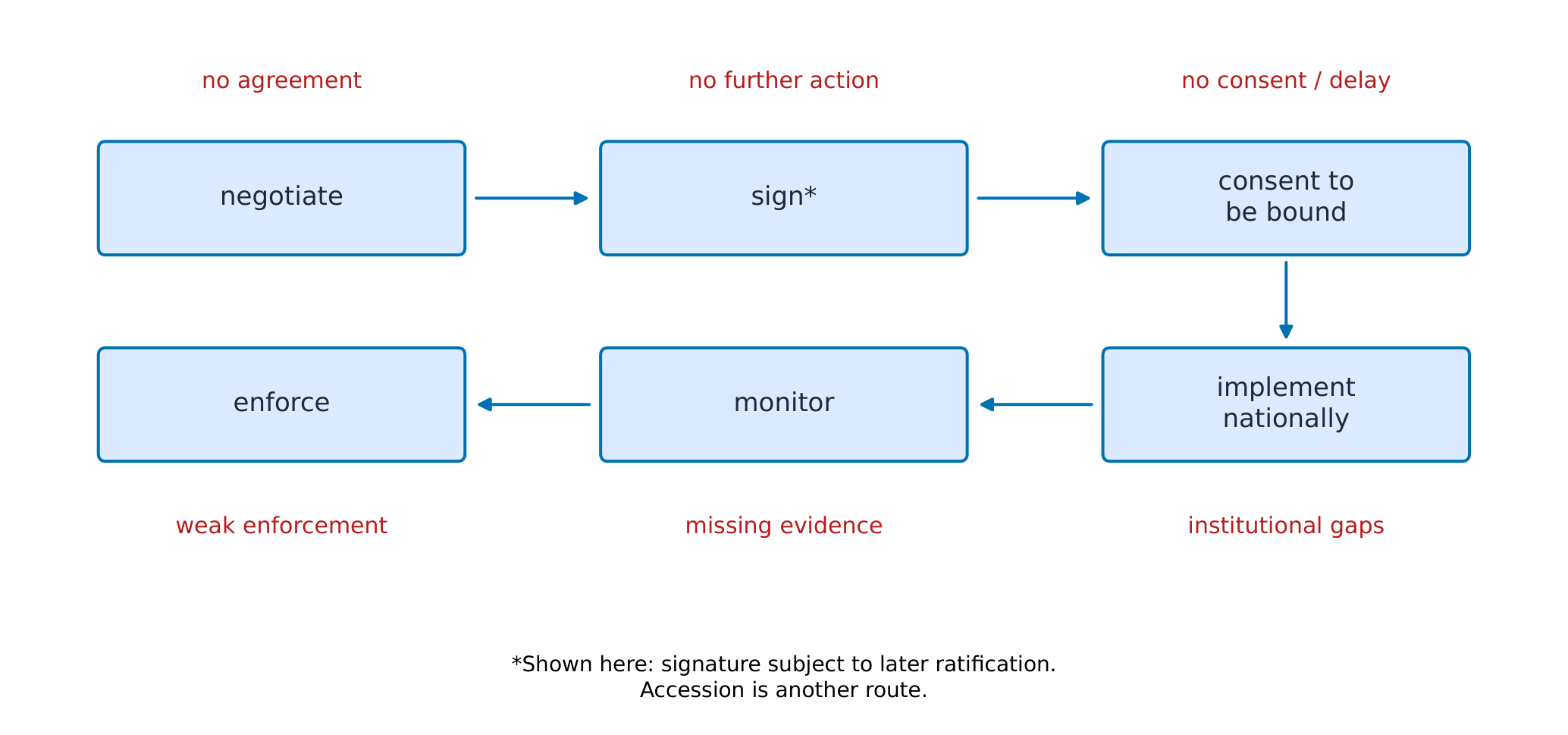
- For signature subject to ratification, signing does not itself establish consent to be bound by the whole treaty. Ratification, acceptance, approval or accession can express consent.
- Entry into force and applicable provisions matter. Accession can follow a different route from signature then ratification; a signature is not meaningless symbolism.
Is signature followed by ratification the only route into every treaty?
Dificultad 1/5 · 100 monedas + un pequeño bono en el primer intento de hoy
The agreement and treaty rules determine valid consent and legal effects.
Date participation and withdrawal
- The USA did not ratify 批准 Kyoto. Its first Paris withdrawal took effect in 2020, it rejoined in 2021 and its second withdrawal took effect on 27 January 2026.
- An announcement date and an effective date are different. Leaving a treaty does not erase independent customary duties or obligations under other applicable instruments.
Does leaving one treaty remove all international environmental duties?
Dificultad 1/5 · 100 monedas + un pequeño bono en el primer intento de hoy
Identify each source of obligation rather than treating all law as one agreement.
Trace implementation without a fixed recipe
- An illustrative pathway is negotiation, consent, national implementation, monitoring and enforcement. Constitutional systems and treaty provisions alter the steps.
- Secretariats support reporting, meetings and assistance; they do not automatically replace national inspectors or provide a global police force.
Which provides evidence of implementation?
Dificultad 1/5 · 100 monedas + un pequeño bono en el primer intento de hoy
Implementation links legal commitments with conduct and measured results.
Explain negotiations and lobbying
- States may disagree over finance, historical responsibility, development needs and rapidly changing scientific evidence. Domestic stakeholders also face different costs.
- Lobbying can provide information or entrench powerful interests. Transparent evidence and participation help reveal whose priorities dominate.
What is a plausible barrier to an agreement?
Dificultad 1/5 · 100 monedas + un pequeño bono en el primer intento de hoy
Technical and distributional issues interact with political choices.
Compare Montreal with climate agreements
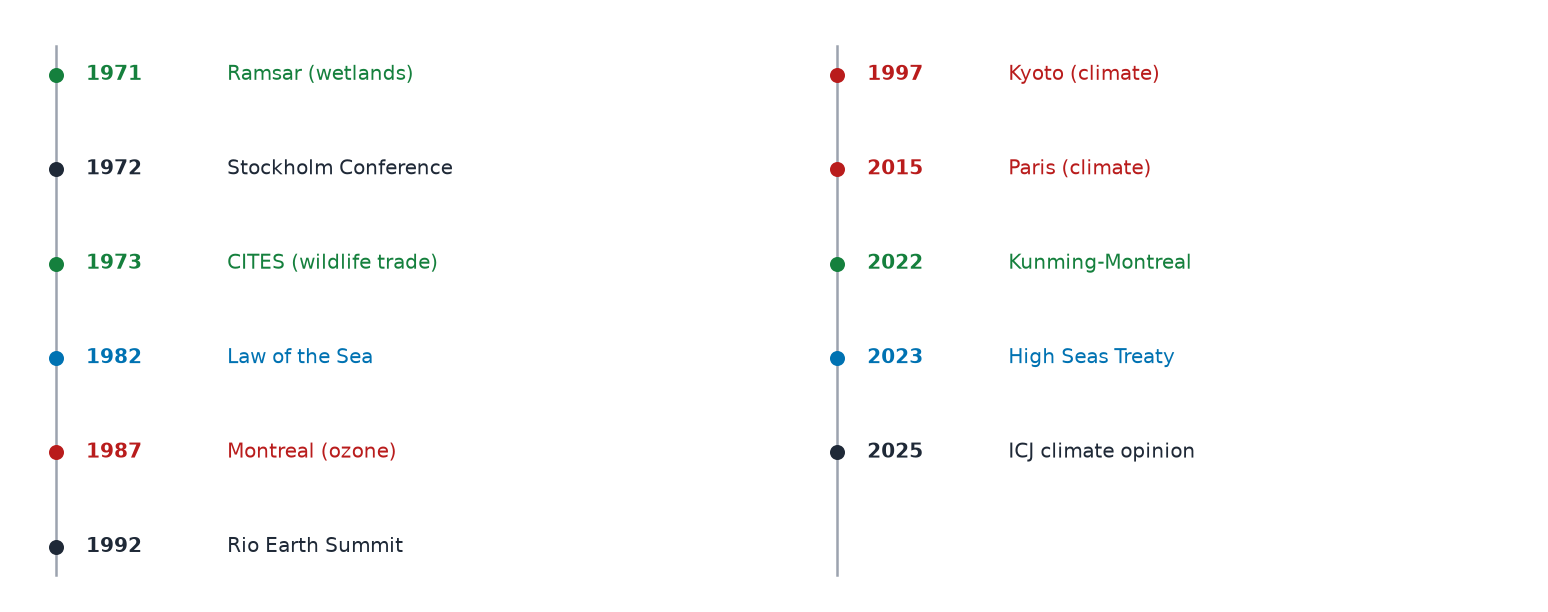
- Montreal combined scientific evidence, controls on a comparatively concentrated set of uses, finance, trade measures, alternatives and later review.
- Climate emissions span economies and long-lived infrastructure. Climate agreements also use science, finance and review; it is wrong to say they have none of Montreal’s advantages.
What is a defensible comparison?
Dificultad 1/5 · 100 monedas + un pequeño bono en el primer intento de hoy
Success is explained through several conditions rather than one universal treaty template.
Distinguish an institution from a legal ban
- CITES 濒危野生动植物种国际贸易公约 is a treaty with parties and national authorities; its Appendix I rules generally restrict international commercial trade in wild specimens, with specified exceptions.
- IUCN supplies conservation expertise and Red List assessments. A Red List category is not by itself a binding CITES listing or trade prohibition.
Does an IUCN category automatically create a CITES trade ban?
Dificultad 1/5 · 100 monedas + un pequeño bono en el primer intento de hoy
Science can inform a law without being identical to its legal provisions.
Distinguish judgments and opinions
- A judgment can bind parties within a court’s jurisdiction; an advisory opinion has a different legal status. Enforcement can remain difficult.
- Urgenda 2019, KlimaSeniorinnen 2024 and the ICJ2025 climate opinion illustrate different forums and legal bases. Do not describe each as the same type of order.
Is an advisory opinion identical to a binding judgment between parties?
Dificultad 1/5 · 100 monedas + un pequeño bono en el primer intento de hoy
A legally informed evaluation names the forum, decision and practical effects.
Explain compensation with evidence
- An environmental harm claim separates damage, legal responsibility, causal attribution and an available remedy. A pollutant reading alone cannot establish a compensation amount.
- Health costs, lost livelihoods, restoration and uncertainty matter. Some rights and irreversible ecological losses cannot be settled by an unexamined market price.
What is needed beyond a concentration reading?
Dificultad 1/5 · 100 monedas + un pequeño bono en el primer intento de hoy
A remedy needs a defensible legal and evidential foundation.
Read national instruments precisely
- China’s revised Environmental Protection Law took effect in 2015; daily penalties, information and public-interest litigation can support implementation.
- Environmental taxation, inspections, ecological red lines 生态保护红线 and river-basin laws address different tasks. Eligibility, powers and procedures vary; one label does not explain every legal detail.
What makes a named legal example useful?
Dificultad 1/5 · 100 monedas + un pequeño bono en el primer intento de hoy
Connect the instrument to behaviour and environmental outcomes.
Calculate a one-off fine comparison
- Invented firm saves 30 000 yuan daily by not treating waste:30 000×365=10.95 million yuan annually. A one-off 500 000-yuan fine is much smaller.
- A daily 50 000-yuan penalty for 365 penalised days totals 18.25 million. These simplified comparisons assume how breaches and penalties are counted.
In an invented model, a firm incurs one 50000-yuan daily penalty on each of 365 days. What is the annual penalty total?
Dificultad 1/5 · 100 monedas + un pequeño bono en el primer intento de hoy
Annual total = 50000 yuan/day × 365 days = 18250000 yuan = 18.25 million yuan. This assumes a penalty on every day; a one-off fine is counted only once.
Add detection probability
- Invented model: avoiding treatment saves 30 000 yuan each day and a detected breach costs 50 000 yuan. At detection probability 0.2, expected fine is 10 000 yuan daily.
- At probability 0.8 it is 40 000 yuan. Break-even probability is 30 000/50 000=0.6, ignoring other consequences and assuming risk-neutral choice.
In an invented daily model, avoiding treatment saves 30000 yuan. Detection triggers one 50000-yuan fine that day; no detection means no fine. Ignoring other consequences, what detection probability makes expected fine equal the daily saving?
Dificultad 1/5 · 100 monedas + un pequeño bono en el primer intento de hoy
Expected fine = p × 50000 + (1 − p) × 0. Break-even requires p × 50000 = 30000, giving p = 30000/50000 = 0.6, or 60%. Other liabilities and risk preferences can alter decisions.
In an invented daily model, avoiding treatment saves 30000 yuan per day. A breach is detected with probability 0.2 each day. A detected breach incurs one 50000-yuan fine; an undetected breach incurs none. Find the expected fine per day.
Dificultad 2/5 · 140 monedas + un pequeño bono en el primer intento de hoy
Expected daily fine = probability of detection × fine if detected + probability of no detection × fine if undetected = 0.2 × 50 000 + 0.8 × 0 = 10 000 yuan per day. This is the model average over repeated days, not a claim that exactly 10 000 yuan is paid every day. Against the stated 30 000-yuan daily saving, the expected fine alone is smaller. Other costs and consequences are outside this simplified comparison.
Explain why enforcement needs institutions
- Staff, reliable laboratories, data, funding, judicial independence and accepted procedures can connect a rule with compliance.
- Falsified monitoring, corruption 腐败, local protectionism 地方保护主义 and conflicts over jobs can undermine implementation. A maximum penalty alone does not show what happens.
What should an enforcement evaluation measure?
Dificultad 1/5 · 100 monedas + un pequeño bono en el primer intento de hoy
Institutional capacity and incentives affect whether legal duties change conduct.
Use communities without idealising them
- Local and Indigenous rules may protect common resources through participation, monitoring and graduated sanctions. They are not necessarily unregulated open access.
- Ostrom showed that some communities manage commons through institutions. Outcomes depend on context, power and rights; neither local nor national scale guarantees success.
Is community management necessarily the same as unregulated open access?
Dificultad 1/5 · 100 monedas + un pequeño bono en el primer intento de hoy
Compare actual governance rather than treating all shared resources as institution-free.
Define environmental constitutionalism
- Environmental constitutionalism introduces environmental rights or duties into constitutional frameworks and interpretation. It can support challenges to harmful decisions.
- Standing, information, money and an effective remedy determine practical access. Constitutional recognition is a legal achievement, not proof of clean water.
What distinguishes recognition from environmental recovery?
Dificultad 1/5 · 100 monedas + un pequeño bono en el primer intento de hoy
Rights can support action while restoration still requires resources and compliance.
Use Colombia’s Atrato example
- In T-622/2016, Colombia’s Constitutional Court addressed illegal-mining harms and affected communities’ rights, recognizing the Atrato River as a subject of rights.
- State and community representation links protection with participation. Evaluate restoration, funding and safety separately from the existence of the decision.
What does the Atrato decision demonstrate directly?
Dificultad 1/5 · 100 monedas + un pequeño bono en el primer intento de hoy
A legal result is distinct from the eventual ecological and social outcomes.
Evaluate rights of nature
- Whanganui River legislation in New Zealand 2017 and Ecuador’s 2008 constitution illustrate different approaches to representing nature’s interests.
- Guardianship, resources, standing and relationships with resource users matter. Do not assume all Indigenous perspectives or legal systems are identical.
What can make rights of nature practical?
Dificultad 1/5 · 100 monedas + un pequeño bono en el primer intento de hoy
Legal personhood is a tool requiring specific institutions and rules.
Read the Yangtze recovery evidence
- The 2022 survey estimated 1249 finless porpoises versus 1012 in 2017: increase 237/1012×100≈23.42%. The commercial fishing ban began in 2021.
- The five-year comparison includes years before the ban. Habitat, other conservation, pressures and survey methods affect interpretation; the whole rise cannot be attributed to a 2021 policy.
Does the 2017–2022 increase alone isolate the ban’s effect?
Dificultad 1/5 · 100 monedas + un pequeño bono en el primer intento de hoy
A before/after association needs timing, alternatives and measurement checks.
Compare people and ecological outcomes
- Fishing controls can reduce harvest pressure but change livelihoods and cultural practices. Evaluate compensation, retraining, access and participation.
- Monitor stocks, habitat, illegal activity and displacement 转移 elsewhere. A local improvement can coincide with pressure transferred to another place.
Why check displacement?
Dificultad 1/5 · 100 monedas + un pequeño bono en el primer intento de hoy
Use a sufficiently broad environmental and social boundary.
Design a defensible policy evaluation
- State a testable objective, then choose comparable before/after indicators, controls or reference trends where feasible. Document methods and sampling gaps.
- Rainfall, economic activity and other interventions can change outcomes. Include costs, fairness, cumulative impacts and uncertainty before reaching a judgement.
Which makes a causal claim stronger?
Dificultad 1/5 · 100 monedas + un pequeño bono en el primer intento de hoy
A policy evaluation needs a counterfactual argument as well as a measured trend.
Combine law and economics without losing rights
- A legal ban, emissions cap, liability 责任, incentives and practical support can complement one another. Identify the mechanism and the regulated actors.
- Money can affect behaviour, but valuation uncertainty and ecological limits remain. A cost comparison alone cannot determine which legal rights should be protected.
Can the cheapest option alone settle every environmental legal decision?
Dificultad 1/5 · 100 monedas + un pequeño bono en el primer intento de hoy
Economic evidence informs choices within legal and ethical frameworks.