Dance investigation and cultural context
Introducido| English | Significado |
|---|---|
| cultural context/ˈkʌltʃərəl ˈkɒntekst/ | the community, place, time and meaning in which a dance or other art form is practised |
| dance investigation/dæns ɪnˌvestɪˈɡeɪʃn/ | a comparison of two dance forms from different cultures or traditions, based on research and practice |
| rhythm/ˈrɪðəm/ | A pattern of timing, stress or beats in speech, music or movement. |
| movement vocabulary/ˈmuːvmənt vəʊˈkæbjʊləri/ | vocabulario de movimiento |
| spatial organisation | how dancers use and arrange the performance space, such as lines, circles or levels |
| cultural function | the purpose a dance serves in its community, such as worship, celebration or storytelling |
A dance brought back to the stage, 1936
- In 1936 Rukmini Devi Arundale founded the Kalakshetra school in Madras (now Chennai) to teach Bharatanatyam, a classical dance of south India that had been pushed out of public life. She trained dancers from many backgrounds and brought it to concert stages.
- To understand a dance form you need its cultural context 文化背景: who dances it, where, when, and what it means to them.
What did Rukmini Devi Arundale found in 1936?
Dificultad 1/5 · 100 monedas + un pequeño bono en el primer intento de hoy
Kalakshetra helped bring Bharatanatyam to concert stages.
Investigating a dance form
- A dance investigation 舞蹈探究 compares two dance forms from different cultures or traditions — one familiar and one new to you.
- Research from reliable sources: practitioners, recordings, books and, where possible, workshops with dancers of that form.
A dance investigation compares two dance forms from different cultures or traditions.
Dificultad 1/5 · 100 monedas + un pequeño bono en el primer intento de hoy
One familiar and one new form.
Four ways to compare
- Compare rhythm 节奏, movement vocabulary 动作语汇 (the steps and gestures the form uses), spatial organisation 空间组织 and cultural function 文化功能 (worship, celebration, storytelling, social life).
- Record what your research changed in your understanding. The aim is to understand, not to rank one form above another.
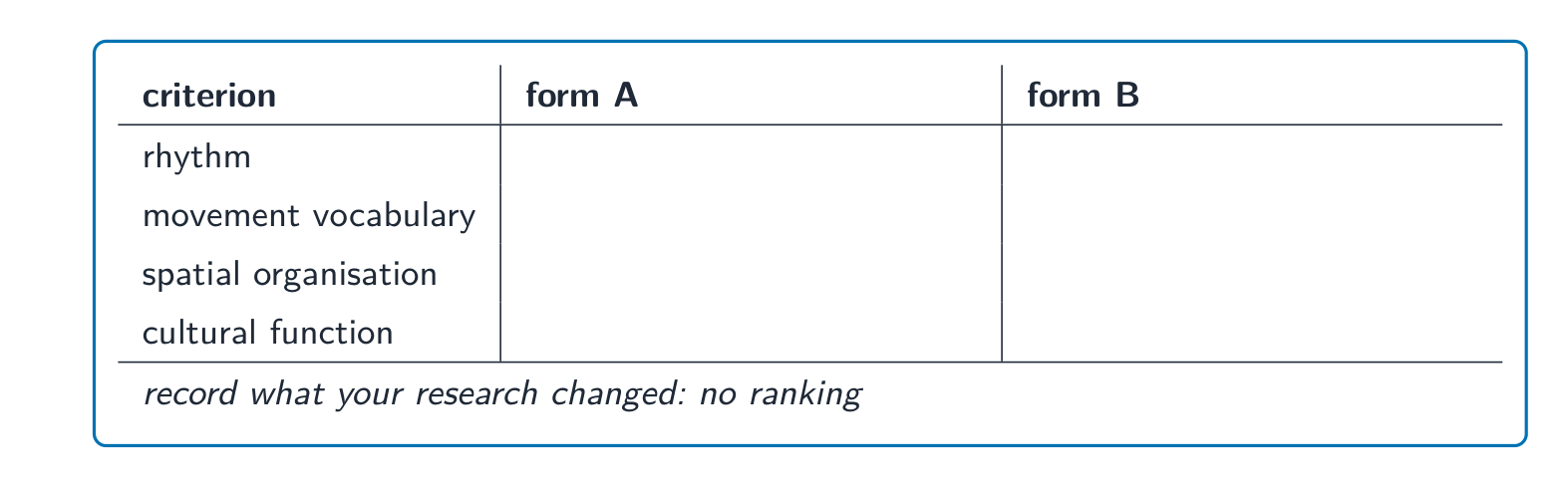
Match each criterion to an example.
Dificultad 2/5 · 140 monedas + un pequeño bono en el primer intento de hoy
These are the four comparison criteria.
The aim of the comparison is to decide which dance form is better.
Dificultad 1/5 · 100 monedas + un pequeño bono en el primer intento de hoy
The aim is understanding, not ranking.
Worked example: Bharatanatyam and flamenco
- Rhythm: Bharatanatyam dancers strike the floor with bare feet in patterns set to a rhythmic cycle; flamenco dancers drive rhythm with shoe heels in cycles such as the 12-beat compás.
- Vocabulary: Bharatanatyam uses hand gestures (mudras) and facial expression to tell stories from Hindu texts; flamenco uses arm curves, turns and footwork that answer the guitar and singer.
- Function and change: Bharatanatyam was linked to temple worship before reaching concert stages; flamenco grew among the Roma of Andalusia in Spain. Research changed the student's view: both forms moved from community to stage in the 20th century.
What do mudras do in Bharatanatyam?
Dificultad 1/5 · 100 monedas + un pequeño bono en el primer intento de hoy
Mudras and facial expression carry the story.
Respect and accuracy
- Use the names, terms and meanings that practitioners use. Avoid words like "exotic" or "primitive".
- If you perform movements from another culture, say where you learned them and what they mean.
Which are respectful research practices?
Dificultad 2/5 · 140 monedas + un pequeño bono en el primer intento de hoy
Accuracy and respect go together.
Writing it up
- Organise by the comparison criteria, with evidence for each form. Use images or video links where the format allows.
- End with what the comparison taught you about dance — for example how rhythm can carry the story in one form and the emotion in another.
"Flamenco is more exciting than Bharatanatyam" is not analysis. Ranking forms by personal taste ignores their purposes. Compare what each form does, in its context, and why.
"Flamenco is more exciting" is a strong analytical point.
Dificultad 1/5 · 100 monedas + un pequeño bono en el primer intento de hoy
Compare what each form does in its context.
Investigate two dance forms through their cultural context. Compare rhythm, movement vocabulary, spatial organisation and cultural function with reliable evidence, use practitioners' terms respectfully, and record how research changed your understanding — without ranking.
Compare two dance forms you know on two of the four criteria.
Forms, criteria, comparison.