Latin morphology and translation
Introducido| English | Significado |
|---|---|
| endings | the final letters of a Latin word that show its case, number, person or tense |
| case/keɪs/ | caso |
| nominative | the Latin case that marks the subject of a sentence |
| accusative | the Latin case that marks the direct object of a verb, and follows some prepositions |
| declensions | the groups into which Latin nouns are divided, each with its own set of endings |
A tired wall in Pompeii, AD 79
- When Vesuvius buried Pompeii in AD 79, it preserved thousands of messages scratched on walls. One reads: Admiror, o paries, te non cecidisse ruinis, qui tot scriptorum taedia sustineas — "I am amazed, wall, that you have not fallen in ruins, since you bear the boring writings of so many."
- Ordinary Romans wrote Latin like this, with the words in an order English would never use. Latin can do this because the endings 词尾 of words, not their order, show their job in the sentence.
Why did so many Latin wall writings survive in Pompeii?
Dificultad 1/5 · 100 monedas + un pequeño bono en el primer intento de hoy
The ash preserved ordinary Romans' writing.
Case shows the job
- Case 格 is the form of a noun that shows its role. The nominative 主格 marks the subject (who acts); the accusative 宾格 marks the direct object (who is acted on).
- puella (nominative) = the girl as subject; poetam (accusative) = the poet as object.
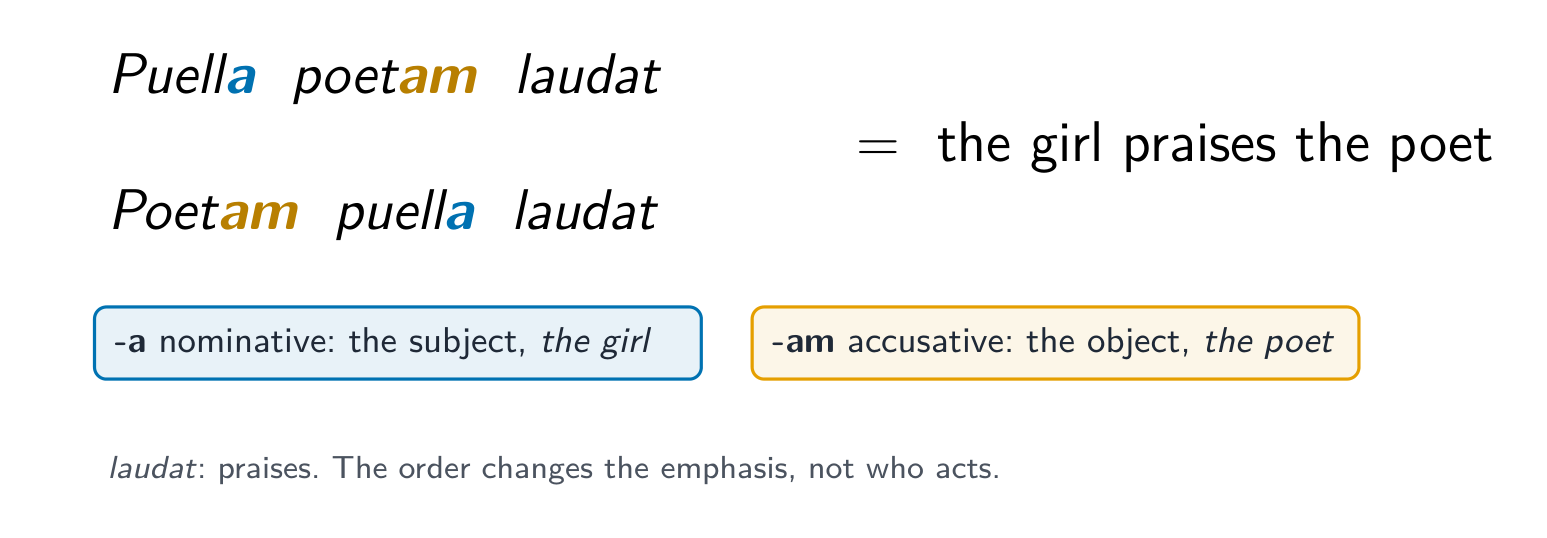
Match each case to its job.
Dificultad 2/5 · 140 monedas + un pequeño bono en el primer intento de hoy
Endings show the role.
Word order and emphasis
- Puella poetam laudat and Poetam puella laudat mean the same: "the girl praises the poet". The verb often comes last.
- Word order adds emphasis instead: putting poetam first stresses the poet — "It is the poet the girl praises."
Puella poetam laudat y Poetam puella laudat have the same basic meaning.
Dificultad 1/5 · 100 monedas + un pequeño bono en el primer intento de hoy
Endings, not order, show who acts.
Worked example: translating by endings
Translate Servum dominus vocat.
- Find the verb: vocat — "calls", third person singular, so the subject is one person.
- Find the nominative: dominus (-us ending, 2nd declension) — "the master" is the subject. Find the accusative: servum (-um) — "the slave" is the object.
- Translate: "The master calls the slave." Putting servum first emphasises the slave — the master calls the slave, not anyone else. Translating it as "the slave calls the master", just from the word order, would reverse the meaning.
In Servum dominus vocat, which word is the subject?
Dificultad 1/5 · 100 monedas + un pequeño bono en el primer intento de hoy
The -us ending is nominative.
Translate Reginam nauta amat.
Dificultad 1/5 · 100 monedas + un pequeño bono en el primer intento de hoy
Nauta is nominative (1st declension, masculine); reginam is accusative.
Declensions and agreement
- Nouns belong to declensions 变格 — groups with shared endings. 1st declension: puella, puellam; 2nd: dominus, dominum; 3rd: rex, regem.
- Adjectives agree with their nouns in case, number and gender: puellam bonam ("the good girl", accusative).
Which adjective agrees with puellam?
Dificultad 1/5 · 100 monedas + un pequeño bono en el primer intento de hoy
Accusative singular feminine.
Translating unseen passages
- For each sentence: find the verb, then the nominative, then the accusative and other cases. Check that the subject and verb agree in number.
- Write a translation that is accurate first, then natural English.
Do not translate Latin in its word order. The first noun is often not the subject. Check every ending before you decide who does what.
The first noun in a Latin sentence is always the subject.
Dificultad 1/5 · 100 monedas + un pequeño bono en el primer intento de hoy
Check the endings.
In Latin, case endings — nominative for the subject, accusative for the object — show each word's role, so word order is free and used for emphasis. Learn the declensions, check agreement, and translate by finding the verb and the cases, not by word order.
Translate Regem milites laudant and explain how you found the subject.
Verb, nominative, accusative.