Particles, bonding and bulk properties
Introducido| English | Significado |
|---|---|
| ion/ˈaɪɒn/ | An atom or group of atoms with a net electric charge from losing or gaining electrons. |
| ionic bond/aɪˈɒnɪk bɒnd/ | enlace iónico |
| electron/ɪˈlektrɒn/ | A negatively charged subatomic particle found outside an atom's nucleus. |
| delocalized electron/dɪˈlɒkəlaɪzd ɪˈlektrɒn/ | electrón deslocalizado |
| nucleon/ˈnjuːklɪən/ | A proton or neutron in an atomic nucleus. |
| energy level/ˈenədʒi ˈlevl/ | An allowed value of energy that a quantum system can have. |
| material/məˈtɪərɪəl/ | A substance chosen for its properties to make something, such as a metal, ceramic, polymer or composite. |
| nuclear symbol | Notation writing the mass number at the top left and the atomic number at the bottom left of the element symbol. |
| positive ion/ˈpɒzɪtɪv ˈaɪɒn/ | An atom or group that has lost electrons and carries a positive charge. |
| negative ion | An atom or group that has gained electrons and carries a negative charge. |
| isotope/ˈaɪsətəʊp/ | An atom of an element with the same proton number but a different neutron number from another atom of that element. |
| abundance/əˈbʌndəns/ | The amount or relative frequency of a particular entity, such as a species or an isotope. |
| periodic table/ˌpɪərɪˈɒdɪk ˈteɪbl/ | An arrangement of chemical elements by atomic number that displays recurring patterns in their properties. |
| photon/ˈfəʊtɒn/ | A quantum of electromagnetic radiation with energy equal to Planck's constant multiplied by its frequency. |
| converge/kənˈvɜːdʒ/ | Of spectral lines: get closer together toward higher frequency. |
| sublevel | A division of an energy level: s, p, d or f. |
| opposite spins | The two allowed spin states of electrons sharing an orbital, shown as up and down arrows. |
| degenerate/dɪˈdʒenəreɪt/ | Of orbitals: having the same energy, like the three 2p orbitals. |
| condensed configuration | An electron configuration starting from the previous noble gas, such as [Ne] 3s¹. |
| nuclear charge/ˈnjuːklɪə tʃɑːdʒ/ | The total positive charge of an atomic nucleus, determined by its number of protons. |
| group/ɡruːp/ | A vertical column in the periodic table whose elements have related outer-electron configurations and chemical properties. |
| excited state/ekˈsaɪtɪd steɪt/ | States of a system with energy above its ground-state energy. |
| transition element/trænˈsɪʃn ˈelɪmənt/ | A d-block element that forms at least one ion with a partly filled d sublevel. |
| lattice/ˈlætɪs/ | A regular, repeating arrangement of particles or points in a solid. |
| polyatomic ion | polyatomic ion |
| cation/ˈkætaɪən/ | An ion with a positive electric charge. |
| anion/ˈænaɪən/ | An ion with a negative electric charge. |
| lattice enthalpy | The energy to separate one mole of an ionic solid into gaseous ions. |
| volatility/ˌvɒləˈtɪlɪti/ | The tendency of a substance to vaporise readily under given conditions. |
| metallic model/məˈtælɪk ˈmɒdl/ | A bonding model with positive metal ions held together by attraction to delocalized electrons. |
| shared pair | Two electrons shared between two atoms, forming a covalent bond. |
| polar/ˈpəʊlə/ | Having a separation of charge, with a partly positive and a partly negative end. |
| Lewis formula | A diagram showing all valence electrons as bonding pairs and lone pairs. |
| lone pair/ləʊn peə/ | A pair of outer-shell electrons on one atom that is not shared in a covalent bond. |
| incomplete octet | An atom with fewer than eight outer electrons in a molecule, such as boron in BF₃. |
| octet rule | Atoms tend to bond until they have eight electrons in their outer shell. |
| coordination bond | A covalent bond in which both shared electrons come from one atom. |
| electron domain | A region of electron density around an atom: a lone pair or a single, double or triple bond. |
| electronegativity/ɪˌlektrəʊŋɡəˈtɪvɪti/ | The tendency of an atom in a chemical bond to attract the shared electrons towards itself. |
| polar bond | A covalent bond with unequal sharing because the atoms differ in electronegativity. |
| allotrope | A different structural form of the same element, such as diamond and graphite. |
| hydrogen bonding/ˈhaɪdrədʒn ˈbɒndɪŋ/ | An attraction involving a hydrogen atom bonded to an electronegative atom and an electron-rich site on another atom. |
| chromatography/krəʊməˈtɒɡrəfi/ | A separation technique based on different affinities of substances for a stationary phase and a mobile phase. |
| stationary phase/ˈsteɪʃənəri feɪz/ | The phase that remains fixed in a chromatography system and interacts differently with components of a mixture. |
| mobile phase/ˈməʊbaɪl feɪz/ | The solvent that moves through the stationary phase in chromatography. |
| non-directional | Acting equally in all directions, like metallic and ionic bonding. |
| thermal conductivity/ˈθɜːml kɒndəkˈtɪvɪti/ | thermal conductivity |
| malleability/ˌmæləˈbɪlɪti/ | The ability to be hammered into shape without breaking. |
| ductility/dʌkˈtɪlɪti/ | the strain at fracture, the property heat treatment trades away for strength |
| block/blɒk/ | The region of the periodic table named by the sublevel being filled: s, p, d or f. |
| period/ˈpɪərɪəd/ | período |
| bonding triangle | A triangle chart using electronegativity to place a substance between ionic, covalent and metallic bonding. |
| alloy/ˈælɔɪ/ | A metallic material combining a metal with other elements. |
| polymer/ˈpɒlɪmə/ | A large molecule made from many linked repeating units derived from smaller molecules. |
| monomer/ˈmɒnəʊmə/ | A molecule that can join with other molecules to form a polymer. |
| repeating unit/rɪˈpiːtɪŋ ˈjuːnɪt/ | The part of a polymer chain that repeats again and again. |
| biodegradable/ˌbaɪəʊdɪˈɡreɪdəbl/ | Able to be broken down by living organisms. |
| alkali metal/ˈælkəlaɪ ˈmetl/ | A group 1 metal, such as sodium, that reacts vigorously with water. |
| metalloid | An element with properties between metals and non-metals, such as silicon. |
| shielding/ˈʃiːldɪŋ/ | The reduction in nuclear attraction experienced by an electron because of repulsion from other electrons. |
| electron affinity/ɪˈlektrɒn əˈfɪnɪti/ | The energy change when a gaseous atom gains one electron. |
| halogen/ˈhælədʒn/ | The elements in group 17 of the periodic table. |
| basic/ˈbeɪsɪk/ | Of an oxide: reacting with acids, typical of metal oxides. |
| amphoteric/ˌæmfəʊˈterɪk/ | Able to react as both an acid and a base, like aluminium oxide. |
| acidic/əˈsɪdɪk/ | Of an oxide: reacting with bases, typical of non-metal oxides. |
| acid deposition | Acidic substances from sulfur and nitrogen oxides falling to the ground as rain or dry particles. |
| ocean acidification/ˈəʊʃn əˌsɪdɪfɪˈkeɪʃn/ | The fall in ocean pH as seawater absorbs more carbon dioxide. |
| oxidation state/ˌɒksɪˈdeɪʃn steɪt/ | A number showing the charge an atom would have if all of its bonds were ionic. |
What would explain this observation?
- A salt crystal conducts when dissolved but not when solid. The ions exist in both states; their ability to move changes.
Build the model
- Ionic bonding 离子键 is electrostatic attraction between oppositely charged ions.
- A covalent bond involves shared electrons.
- Metallic bonding involves attraction between positive metal ions and delocalized electrons 离域电子.
- ionic bond: Attraction between oppositely charged ions.
- delocalized electron: An electron not confined to one atom or bond.

Why does molten sodium chloride conduct?
Dificultad 1/5 · 100 monedas + un pequeño bono en el primer intento de hoy
Sodium chloride is ionic; melting frees the ions from the lattice so they can move and carry charge. The solid does not conduct because its ions are fixed, and there are no neutral molecules or free atoms becoming electrons.
Match each technical term to its precise meaning.
Dificultad 2/5 · 140 monedas + un pequeño bono en el primer intento de hoy
Use the definitions to distinguish related quantities and processes.
Choose evidence that can test it
- To explain a bulk property, name the structure, particles, forces and mobile charge carriers.
- Simple molecular substances can have strong covalent bonds inside molecules but weak attractions between molecules.
In the lab: Compare substances using evidence such as melting point, conductivity when solid and molten, and solubility. One property rarely proves a structure; use a pattern of evidence.
Salt conducts when its ions can move
Compare solid, molten and dissolved NaCl. The same ions can be held at lattice sites or mobile; reversing the field changes their drift, not their charge.
Which two habits make the investigation or model in this case more defensible?
Dificultad 2/5 · 140 monedas + un pequeño bono en el primer intento de hoy
Stating the conditions and assumptions lets others repeat the work exactly, and recording the supporting evidence lets them check the conclusion. Hiding disagreeing results removes the evidence that could challenge a wrong conclusion, and one measurement can never establish a wider claim.
Work from known quantities
- Known: an element has atomic number 12 and mass number 24.
- Protons = 12; neutrons = mass number - atomic number = 24 - 12 = 12.
- A 2+ ion has electrons = 12 - 2 = 10.
- Charge changes electron count, not the nucleus.
Your turn: An atom has atomic number 17 and mass number 35. Find its number of neutrons.
An atom has atomic number 17 and mass number 35. Find its number of neutrons.
Dificultad 2/5 · 140 monedas + un pequeño bono en el primer intento de hoy
The result is 18 . Known: atomic number 17, mass number 35. Neutrons = mass number - atomic number = 35 - 17 = 18. The atom has 17 protons and 18 neutrons; changing the electron count would make an ion, not change the nucleus.
Check the conclusion and its limits
- Melting a simple molecular substance usually overcomes intermolecular attractions; it does not require breaking all covalent bonds within each molecule.
Not true: All covalent substances have low melting points. Giant covalent substances such as diamond and silicon dioxide have very high melting points because covalent bonds must be broken throughout the structure. Low melting points belong to simple molecular substances, where only intermolecular attractions are overcome.
- Ionic bonding is electrostatic attraction between oppositely charged ions.
- To explain a bulk property, name the structure, particles, forces and mobile charge carriers.
- Watch for: melting a simple molecular substance usually overcomes intermolecular attractions; it does not require breaking all covalent bonds within each molecule.
All covalent substances have low melting points.
Dificultad 1/5 · 100 monedas + un pequeño bono en el primer intento de hoy
Giant covalent substances such as diamond and silicon dioxide have very high melting points because covalent bonds must be broken throughout the structure. Low melting points belong to simple molecular substances, where only intermolecular attractions are overcome.
Attraction between oppositely charged ions: write the technical term.
Dificultad 1/5 · 100 monedas + un pequeño bono en el primer intento de hoy
ionic bond means Attraction between oppositely charged ions.
Write from 20 neutrons
- An atom has atomic number 19 and mass number 39.
- Find the neutron count and the electron count in the 1+ ion. The charge does not change the nucleus.
An atom has atomic number 19 and mass number 39. How many neutrons does it have, how many electrons does its 1+ ion have, and what does the charge not change?
Neutrons are mass number minus atomic number. A positive ion has fewer electrons than protons.
An atom has atomic number 19 and mass number 39. How many neutrons does it have?
Dificultad 1/5 · 100 monedas + un pequeño bono en el primer intento de hoy
39 minus 19 is 20 neutrons. The mass number counts protons and neutrons together. Other options — 39 neutrons (the mass number); 19 neutrons (the atomic number).
S1.2: Locate the charge and mass
- A neutral atom contains a small, dense, positively charged nucleus and electrons outside it. Protons and neutrons are nucleons 核子 in the nucleus; hydrogen-1 has one proton and no neutrons.
- Most atomic mass is nuclear. The electrons occupy a much larger region, so a drawing that makes nuclear particles visible cannot be a faithful scale model. Shell circles summarize energy levels 能级 rather than physical rails.
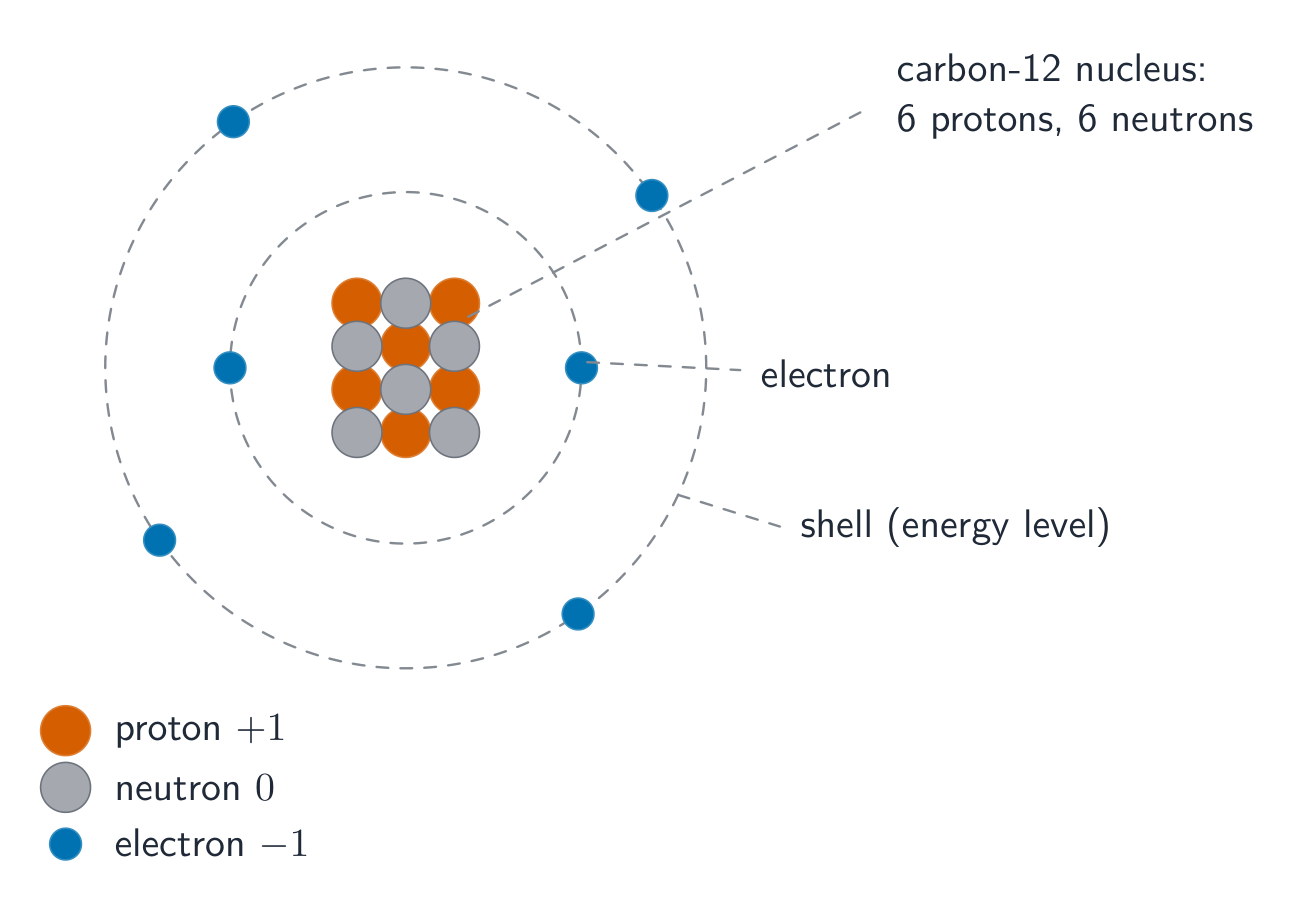
Must every nucleus contain a neutron?
Dificultad 1/5 · 100 monedas + un pequeño bono en el primer intento de hoy
Nuclear composition depends on the nuclide.
S1.2: Compare subatomic particles
- A proton has relative mass about 1 and charge +1; a neutron has relative mass about 1 and charge 0. An electron has relative mass about 1/1836 and charge −1.
- The proton and electron have equal-magnitude opposite charges but very different masses. Neglecting electron mass in a nucleon-count calculation does not mean an electron has literally zero mass.
Which pair has equal-magnitude opposite charge?
Dificultad 1/5 · 100 monedas + un pequeño bono en el primer intento de hoy
Relative charge and relative mass describe different properties.
S1.2: Interpret scattering as evidence
- Most alpha particles pass through a sufficiently thin foil with little deflection; a small fraction are strongly deflected. Concentrated positive charge repels the positive alpha particle and can explain a large deflection.
- This is evidence for the compact nuclear model, not a photograph of electron orbits or a direct observation of neutrons. The fraction scattered depends on material 材料, thickness, energy and angle; do not memorize a universal gold-foil fraction.
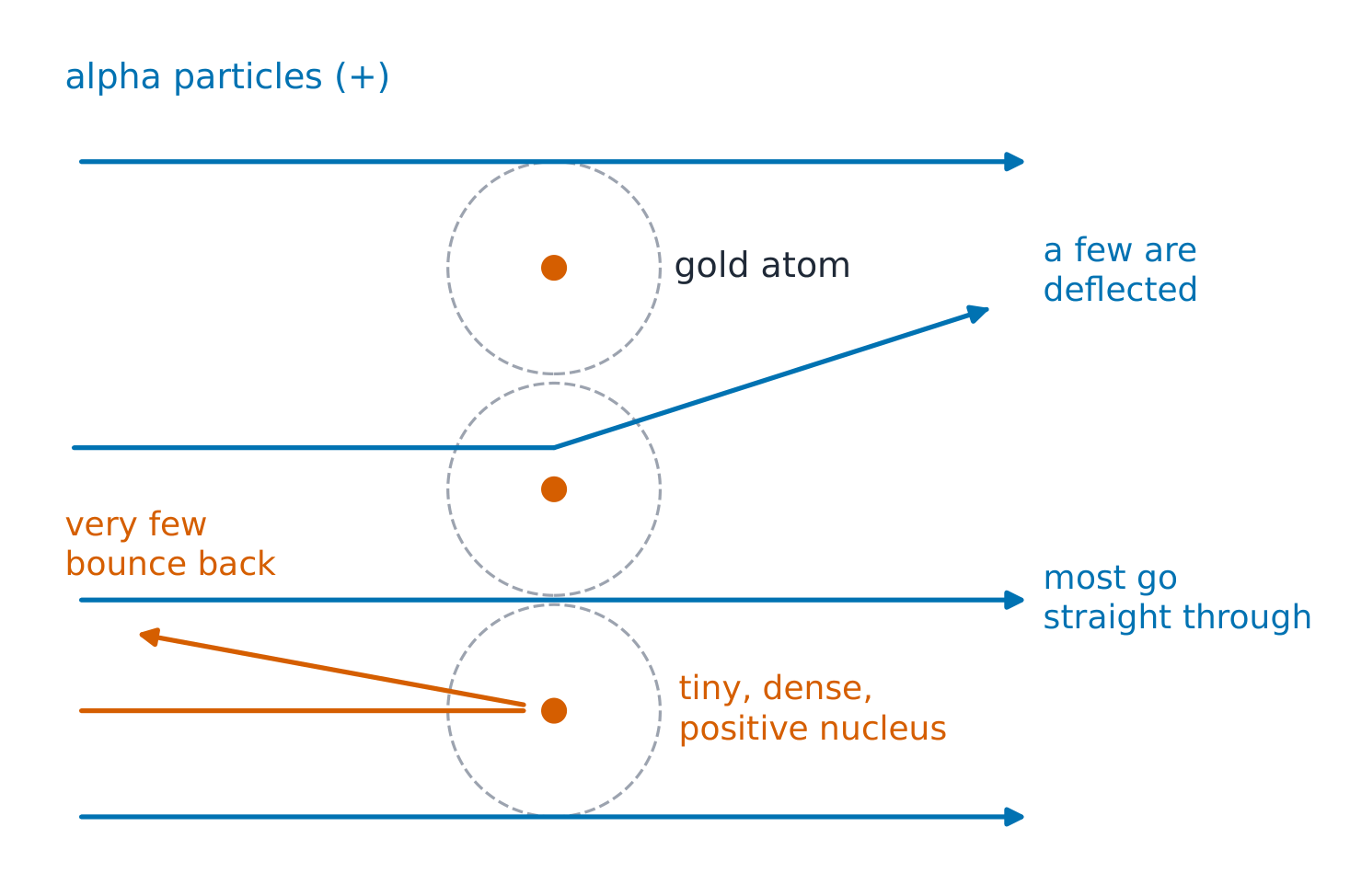
Does large-angle scattering establish literal circular electron paths?
Dificultad 1/5 · 100 monedas + un pequeño bono en el primer intento de hoy
Keep the inference tied to what was measured.
S1.2: Read a nuclear symbol 核素符号
- In a nuclear symbol, A is the mass number at upper left and Z is the atomic number at lower left. Z counts protons and identifies the element; A counts protons plus neutrons.
- For sodium-23 with Z=11, neutrons=23−11=12. A is an integer nucleon count for a nuclide, not its element’s weighted mean relative atomic mass.
Which quantity identifies the element?
Dificultad 1/5 · 100 monedas + un pequeño bono en el primer intento de hoy
An ion remains the same element when its electrons change.
S1.2: Count electrons with the sign
- For charge q expressed in elementary-charge units, q=protons−electrons, so electrons=Z−q. A positive ion 阳离子 has lost electrons; a negative ion 阴离子 has gained them.
- Calcium-40 with Z=20 and charge +2 has 20 protons, 20 neutrons and 18 electrons. Fluorine-19 with Z=9 and charge −1 has 9 protons, 10 neutrons and 10 electrons.
Calcium has atomic number Z = 20. How many electrons has a calcium-40 ion with charge +2?
Dificultad 1/5 · 100 monedas + un pequeño bono en el primer intento de hoy
Electrons = Z − charge = 20 − 2 = 18. The mass number 40 counts nucleons and does not enter the electron calculation.
Find electron count for calcium-40, Z=20, charge +2.
Dificultad 2/5 · 140 monedas + un pequeño bono en el primer intento de hoy
20−2=18; neutrons remain 20.
S1.2: Reconstruct a species
- A species with 26 protons, 30 neutrons and 23 electrons has Z=26, A=56 and charge +3: iron-56, Fe³⁺. Use proton count to choose the symbol before adding mass and charge.
- For 17 protons, 20 neutrons and 18 electrons the species is chlorine-37, Cl⁻. Losing one electron gives neutral chlorine-37; its nucleus has not changed.
What changes when chlorine-37 chloride loses one electron?
Dificultad 1/5 · 100 monedas + un pequeño bono en el primer intento de hoy
Electron transfer and nuclear change are different processes.
S1.2: Distinguish isotopes 同位素 from ions
- Isotopes are atoms of the same element with different neutron counts: same Z, different A. Neutral hydrogen-1, hydrogen-2 and hydrogen-3 all have one proton and one electron, but zero, one and two neutrons.
- An ion differs from its neutral atom in electron count. Two species can be both different isotopes and different charge states, so specify which comparison is being made rather than treating the labels as mutually exclusive.
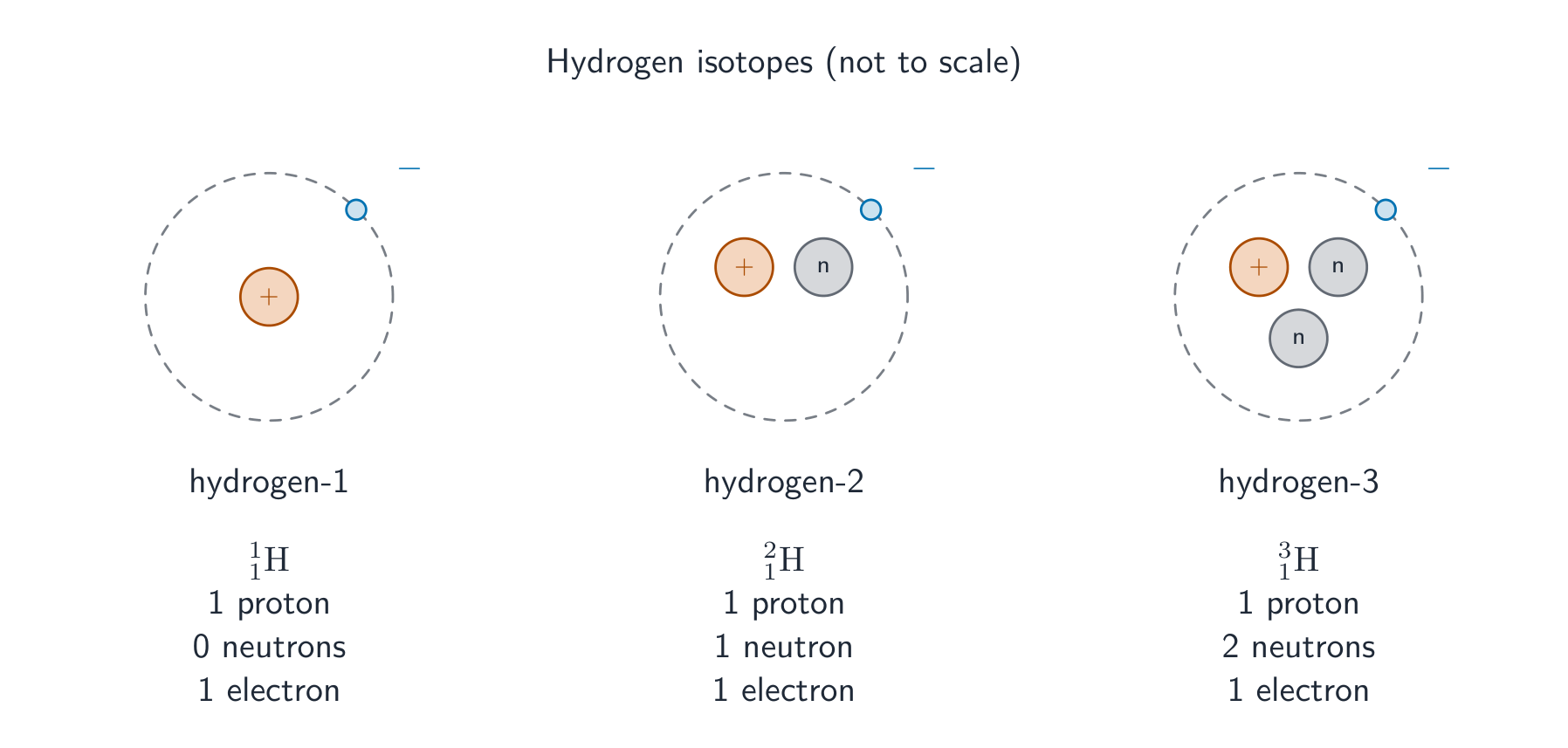
Are hydrogen-1 and hydrogen-2 different elements?
Dificultad 1/5 · 100 monedas + un pequeño bono en el primer intento de hoy
Protons define the element; neutrons distinguish its isotopes.
S1.2: Compare chemistry without an absolute claim
- Neutral isotopes of one element have the same electron configuration and therefore very similar bonding behaviour. Their masses differ, which can affect physical properties and chemical rates or equilibria.
- Compare like charge states and conditions. Saying all isotope reactions proceed at exactly identical rates overstates the electronic argument; similarly, not every physical property must differ by the same percentage.
Can isotope mass affect a chemical reaction rate?
Dificultad 1/5 · 100 monedas + un pequeño bono en el primer intento de hoy
Separate electronic structure from isotope mass effects.
S1.2: Define relative atomic mass
- Relative atomic mass is the weighted mean mass of atoms in a stated sample relative to one-twelfth of a carbon-12 atom’s mass. It is a ratio with no unit.
- A mass number such as 35 counts nucleons in one nuclide; relative atomic mass such as 35.5 generally averages an isotopic mixture. An average does not require an atom with fractional nucleons.
Does relative atomic mass 35.5 require an atom containing 35.5 nucleons?
Dificultad 1/5 · 100 monedas + un pequeño bono en el primer intento de hoy
A mean and an individual count are different quantities.
S1.2: Weight an isotope mean
- Use the supplied relative isotope masses and fractions: mean=Σ(mass×fraction), with fractions totaling 1. Percentages totaling 100 must be divided by 100 once.
- With supplied approximate chlorine inputs 35 at 75.8% and 37 at 24.2%, the mean is 35×0.758 +37×0.242 =35.484, or 35.5 at the stated precision. It lies nearer 35 because that isotope is more abundant.
For supplied chlorine isotope masses 35 and 37 with abundances 75.8% and 24.2%, why is the weighted mean nearer 35?
Dificultad 1/5 · 100 monedas + un pequeño bono en el primer intento de hoy
The weighted mean is 35 × 0.758 + 37 × 0.242 = 35.484. The lighter isotope contributes 75.8% of the atoms, so it pulls the mean closer to 35 than to 37.
S1.2: Use three-isotope data
- For supplied neon data, relative masses 20,21,22 with abundances 丰度 90.5%,0.3%,9.2% give 20×0.905 +21×0.003 +22×0.092 =20.187. Report 20.19 if two decimal places are requested.
- Do not omit the small middle isotope merely because its contribution is small. Check the abundance total first and retain intermediate precision; the rounded average must lie within the supplied isotope-mass range.
May the 0.3% isotope be silently removed from a stated three-isotope calculation?
Dificultad 1/5 · 100 monedas + un pequeño bono en el primer intento de hoy
Use all the stated data unless an approximation is justified.
Find the unrounded mean for masses20,21,22 with abundances90.5%,0.3%,9.2%.
Dificultad 2/5 · 140 monedas + un pequeño bono en el primer intento de hoy
20×0.905+21×0.003+22×0.092=20.187.
S1.2: Recover an unknown abundance
- For an invented two-isotope sample with relative masses 64.00 and 66.00 and mean 64.60, let f be the fraction of the lighter isotope. Then 64f +66(1−f)=64.60.
- Rearranging gives f=0.700: 70.0% lighter and 30.0% heavier. Check both the total and the mean: 64×0.70 +66×0.30=64.60. Do not mix an unknown percentage with a fraction in the same equation.
What fraction accompanies f in a two-isotope sample?
Dificultad 1/5 · 100 monedas + un pequeño bono en el primer intento de hoy
Choose fraction or percentage notation and keep it consistent.
For isotope masses64.00,66.00 and mean64.60, find percentage of the lighter isotope.
Dificultad 2/5 · 140 monedas + un pequeño bono en el primer intento de hoy
Let f be the lighter-isotope fraction; the heavier fraction is 1 − f. Weighted mean: 64.00f + 66.00(1 − f) = 64.60. Expanding gives 66.00 − 2.00f = 64.60, hence f = (66.00 − 64.60)/2.00 = 0.700. Percentage = 0.700 × 100 = 70.0%.
S1.2: Respect the supplied mass approximation
- The simplified copper inputs 63 and 65 with mean 63.55 give 72.5% of the lighter isotope. Using supplied isotope masses 62.93 and 64.93 with the same mean gives 69.0% instead.
- A mass number is not an exact relative isotope mass. Do not present an abundance found from rounded whole-number masses as a precise measurement of natural composition; state the approximation used.
Must whole-number and more precise isotope masses give exactly the same inferred abundance?
Dificultad 1/5 · 100 monedas + un pequeño bono en el primer intento de hoy
Use the data given rather than silently substituting an incompatible convention.
Use masses62.93,64.93 and mean63.55; find percentage of the lighter isotope.
Dificultad 2/5 · 140 monedas + un pequeño bono en el primer intento de hoy
Let f be the lighter-isotope fraction. Then 62.93f + 64.93(1 − f) = 63.55, so 64.93 − 2.00f = 63.55. Thus f = (64.93 − 63.55)/2.00 = 0.690, giving 69.0%.
S1.2: Test the range of a mean
- With only relative masses 64 and 66 and nonnegative abundances, a weighted mean must lie between 64 and 66. An alleged mean of 67 would require incompatible data, a missing isotope or a calculation error.
- The mean can change between samples if isotopic proportions change. A periodic-table 元素周期表 value describes a specified convention or representative sample; it is not permission to round it into a nuclear mass number for any chosen atom.
Can nonnegative weights of masses 64 and 66 yield mean 67?
Dificultad 1/5 · 100 monedas + un pequeño bono en el primer intento de hoy
The bounds are a useful independent check.
S1.3: Connect wavelength and photon 光子 energy
- In vacuum c=fλ and photon energy E=hf=hc/λ. Higher frequency means greater photon energy and a shorter wavelength; doubling wavelength halves one-photon energy.
- The stated speed c is the vacuum value, approximately 3.00×10⁸ m/s. Energy per photon differs from total beam energy: a greater number of lower-energy photons can carry more total energy than a smaller number of high-energy photons.
Which photon has greater energy,400 nm or 800 nm in vacuum?
Dificultad 1/5 · 100 monedas + un pequeño bono en el primer intento de hoy
E = hc/λ, so E(400 nm)/E(800 nm) = 800/400 = 2. The 400 nm photon has twice the energy because its wavelength is half as large.
S1.3: Distinguish continuous and line spectra
- A hot filament gives a broad continuous visible spectrum; isolated excited gas atoms produce discrete bound-to-bound emission lines. Compare a spread of wavelengths with particular allowed transitions.
- A pattern can identify elements when sufficient assigned lines and suitable resolution are available. A single colour is weaker evidence: mixtures, overlapping lines and experimental conditions complicate identification.
Does one observed flame colour uniquely prove a pure element?
Dificultad 1/5 · 100 monedas + un pequeño bono en el primer intento de hoy
A spectral pattern carries more evidence than a broad colour label.
S1.3: Explain a line through an energy gap
- Absorbing suitable energy can excite an atom. An electron returning to a lower allowed bound level emits a photon whose energy equals the positive gap Eupper−Elower=hf.
- The electron does not emit an arbitrary fraction of the gap in that one radiative transition. Allowed discrete gaps explain line positions; do not confuse a downward transition with absorption, which requires an energy input.
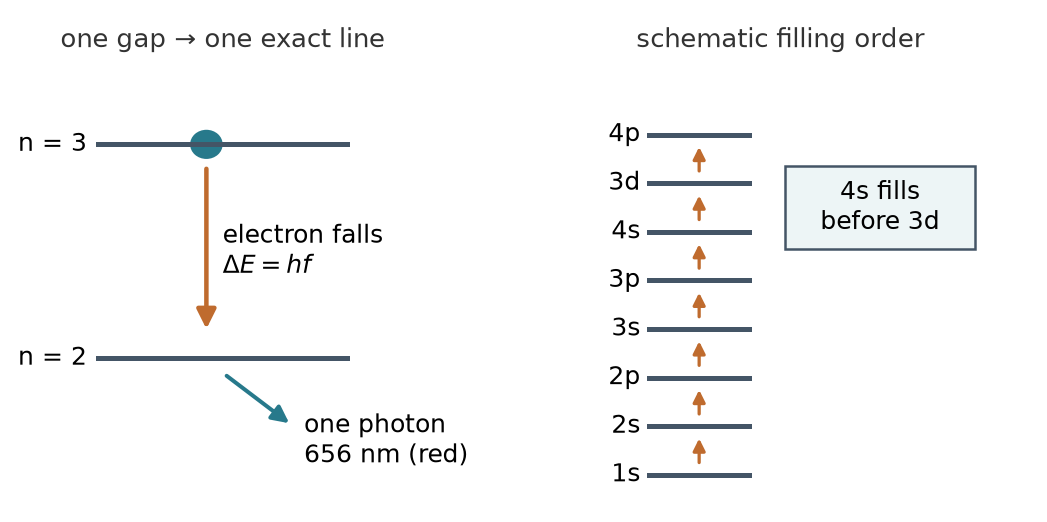
What is emitted during an allowed downward radiative transition?
Dificultad 1/5 · 100 monedas + un pequeño bono en el primer intento de hoy
Use the difference between the two stated levels.
S1.3: Read a hydrogen series correctly
- Hydrogen transitions ending on n=1 form an ultraviolet series; transitions ending on n=2 include visible lines such as 3→2 near 656 nm, while higher members enter the near ultraviolet. Transitions to n=3 are infrared.
- Within one series, upper bound levels get closer at larger n and the lines converge 会聚 towards a finite limit. That series limit does not forbid other series or continuum radiation; not every n=2-series line is visible.
Must every hydrogen line ending on n=2 be visible?
Dificultad 1/5 · 100 monedas + un pequeño bono en el primer intento de hoy
A shared final level gives a series, not one identical photon energy.
S1.3: Calculate one-photon energy
- For supplied 589 nm, use λ=589×10⁻⁹m. With c=3.00×10⁸ and h=6.63×10⁻³⁴, f=5.0933786…×10¹⁴Hz and E=3.3769100…×10⁻¹⁹J.
- Report 3.38×10⁻¹⁹J to three significant figures. Retain the unrounded frequency in E=hf, or use hc/λ directly; rounding a displayed frequency early can change the last digit. This is one photon, not one mole of photons.
Why retain unrounded frequency before calculating energy?
Dificultad 1/5 · 100 monedas + un pequeño bono en el primer intento de hoy
Guard digits preserve precision; they do not change the physical quantity.
For a photon of vacuum wavelength 589 nm, use c = 3.00 × 10⁸ m/s and h = 6.63 × 10⁻³⁴ J s. Find coefficient a in E = a × 10⁻¹⁹ J.
Dificultad 2/5 · 140 monedas + un pequeño bono en el primer intento de hoy
Convert wavelength: λ = 589 × 10⁻⁹ m. Use E = hf and f = c/λ, giving E = hc/λ = (6.63 × 10⁻³⁴)(3.00 × 10⁸)/(589 × 10⁻⁹) = 3.376910… × 10⁻¹⁹ J. The requested coefficient is 3.376910…, or 3.38 to three significant figures.
S1.3: Separate shell capacity and filling order
- A main energy level n has maximum electron capacity 2 n². For n=3 that is 18, and for n=4 it is 32. These are capacities, not instructions to fill an entire shell before occupying any higher n.
- For the atoms considered,4 s can be occupied before 3 d is filled. A shell label n, a sublevel 亚层 label such as 3 p and an individual orbital specify different levels of description.
Does n=3 capacity 18 force all 18 positions to fill before 4 s?
Dificultad 1/5 · 100 monedas + un pequeño bono en el primer intento de hoy
The energy ordering of sublevels matters.
Find maximum electron capacity of n=4.
Dificultad 2/5 · 140 monedas + un pequeño bono en el primer intento de hoy
2n²=32.
S1.3: Count orbitals within sublevels
- An s sublevel contains 1 orbital, p has 3, d has 5 and f has 7. At two electrons per orbital, their capacities are 2,6,10,14.
- For n=3,3 s+3 p+3 d gives 1+3+5=9 orbitals and 18 electrons at full capacity. Three p orbitals together hold six electrons; one p orbital holds at most two.
What is the capacity of one p orbital?
Dificultad 1/5 · 100 monedas + un pequeño bono en el primer intento de hoy
The six-electron capacity belongs to the complete p sublevel.
S1.3: Interpret an orbital surface
- An orbital describes an electron’s spatial quantum state; classroom surfaces enclose a chosen probability region. An s orbital is spherically symmetric, while each p orbital has two lobes oriented along an axis.
- A drawn surface is not a hard container or an electron trajectory. Lobe colours may indicate wavefunction phase or merely distinguish orientations, depending on the legend; they are not positive and negative electrons.
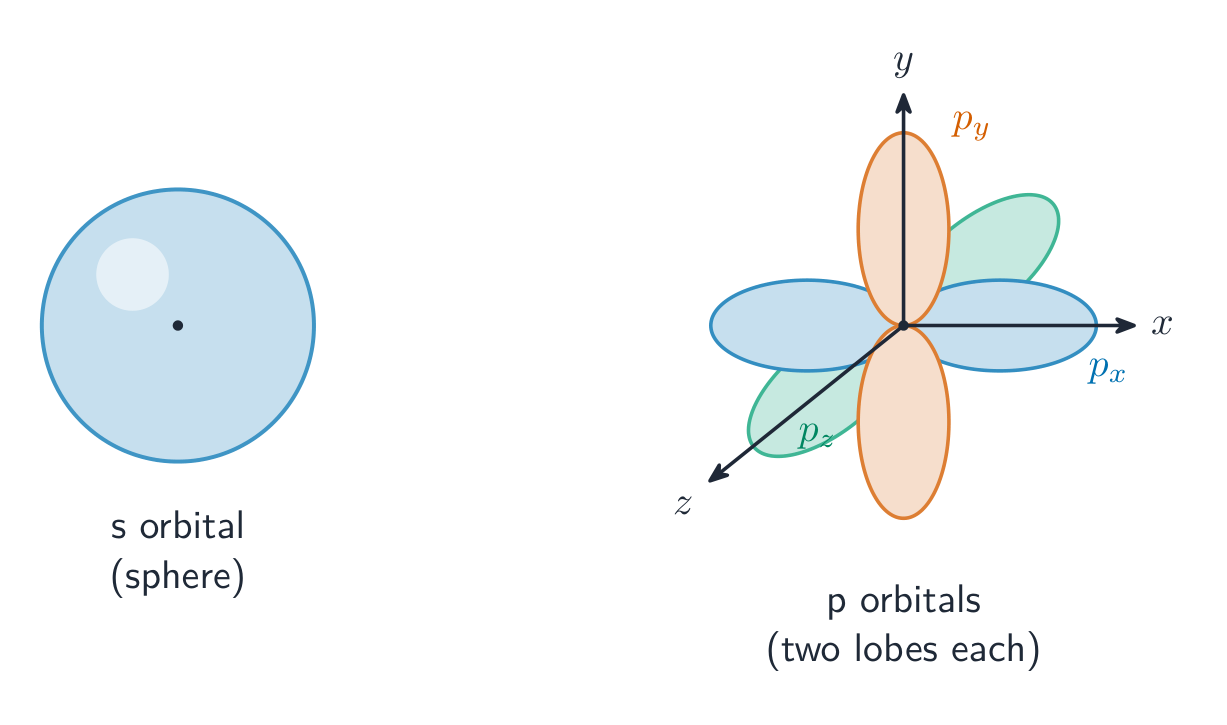
Do two differently coloured p lobes show opposite electric charges?
Dificultad 1/5 · 100 monedas + un pequeño bono en el primer intento de hoy
Read the diagram legend and distinguish a spatial model from particles.
S1.3: Apply Pauli to one orbital
- Pauli allows at most two electrons in one orbital, and a pair must have opposite spins 相反的自旋. Box arrows represent spin states rather than little electrons physically circling clockwise or anticlockwise.
- A box with two upward arrows violates Pauli even if the total electron count is correct. A valid opposite-spin pair can satisfy Pauli while the distribution across several degenerate 简并的 boxes still violates Hund for the ground state.
Can two electrons in one orbital have parallel spin arrows?
Dificultad 1/5 · 100 monedas + un pequeño bono en el primer intento de hoy
Check occupancy and spin within each orbital.
S1.3: Apply Hund across equal-energy orbitals
- For a ground-state degenerate sublevel, occupy orbitals singly with parallel spins before pairing. In 2 p³, three parallel single arrows occupy three p boxes.
- Pair+single+empty can obey Pauli if the pair is opposite-spin, but it is not the lowest-energy 2 p³ distribution. State which rule is violated rather than calling every wrong ground-state diagram a Pauli violation.
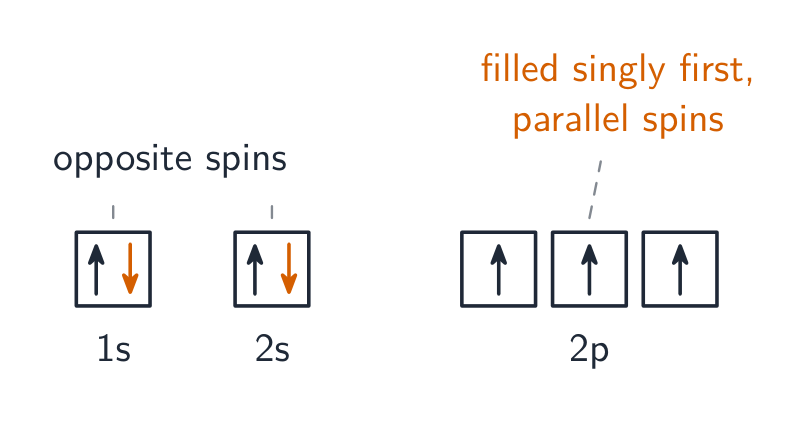
Which rule rejects pair+single+empty as ground-state 2 p³?
Dificultad 1/5 · 100 monedas + un pequeño bono en el primer intento de hoy
Pauli and Hund constrain different aspects of the diagram.
S1.3: Count unpaired electrons
- Nitrogen has 2 p³ and three unpaired electrons; oxygen has 2 p⁴, one opposite-spin pair plus two singles, and therefore two unpaired electrons in the ground-state isolated-atom model.
- Phosphorus has 3 s²3 p³ outside its core: its 3 s pair does not add unpaired electrons, while three 3 p singles give three. Count singles in the boxes, not simply the number of electrons outside the core.
How many unpaired electrons are in ground-state oxygen 2 p⁴?
Dificultad 1/5 · 100 monedas + un pequeño bono en el primer intento de hoy
Use three p boxes and pair only after each has one electron.
S1.3: Write full and condensed configurations 简化电子排布
- A full configuration lists all occupied sublevels. Sulfur is 1 s²2 s²2 p⁶3 s²3 p⁴, totaling 16 electrons. Condensed form replaces the inner filled levels by[Ne], giving[Ne]3 s²3 p⁴.
- Iron is[Ar]4 s²3 d⁶ with 26 electrons. Brackets denote a noble-gas core with its known electron count; they do not remove those electrons from the species or change its nuclear charge 核电荷.
Does[Ar] mean those 18 core electrons are absent?
Dificultad 1/5 · 100 monedas + un pequeño bono en el primer intento de hoy
Include the core when checking the total.
S1.3: Learn chromium and copper exceptions
- Observed neutral chromium is[Ar]4 s¹3 d⁵ and copper is[Ar]4 s¹3 d¹⁰. The naive 4 s²3 d⁴ and 4 s²3 d⁹ predictions do not describe those ground states.
- The actual arrangements have lower total energy. A useful half-filled/full-filled mnemonic is not a universal promotion law, and notation does not require every atom to form the naive state and then visibly transfer an electron.
What is the neutral copper ground-state outer configuration?
Dificultad 1/5 · 100 monedas + un pequeño bono en el primer intento de hoy
Use the observed exception before forming an ion.
S1.3: Form main-group 族 ions
- For a negative ion, add electrons to obtain the stated charge; for a main-group positive ion, remove outer-level electrons. O²⁻ has 10 electrons and configuration 1 s²2 s²2 p⁶; Na⁺ has the same electron count and configuration.
- These ions remain different elements because their proton counts differ. An electron configuration can be shared by several species; it does not uniquely identify a nucleus without charge or atomic-number information.
Do Na⁺ and O²⁻ having the same electron count make them the same element?
Dificultad 1/5 · 100 monedas + un pequeño bono en el primer intento de hoy
Isoelectronic species need not have the same nuclear charge.
S1.3: Remove 4s before 3d in these ions
- Start from the actual neutral configuration. Fe loses its two 4 s electrons to give Fe²⁺=[Ar]3 d⁶; removing another 3 d electron gives Fe³⁺=[Ar]3 d⁵.
- The isolated-ion diagrams give four and five unpaired electrons respectively. Ligand environments can change d-orbital splitting and pairing, so these counts are not universal predictions for every coordination complex.
Which Fe³⁺ configuration follows the required removal order?
Dificultad 1/5 · 100 monedas + un pequeño bono en el primer intento de hoy
Remove 4 s electrons first, then the required 3 d electrons.
Find unpaired-electron count for isolated Fe³⁺=[Ar]3d⁵.
Dificultad 2/5 · 140 monedas + un pequeño bono en el primer intento de hoy
One electron in each of five degenerate d orbitals.
S1.3: Check copper-ion totals
- Cu⁺ is[Ar]3 d¹⁰ after removing the single 4 s electron; Cu²⁺ is[Ar]3 d⁹ after removing one further 3 d electron. Their electron totals are 28 and 27.
- A positive ion has fewer electrons than its neutral atom. Check the core plus outer superscripts against 29−charge; a plausible-looking arrangement with the wrong total cannot be correct.
How many electrons are in Cu²⁺ with Z=29?
Dificultad 1/5 · 100 monedas + un pequeño bono en el primer intento de hoy
Electron count = atomic number − positive charge number = 29 − 2 = 27. Removing electrons changes the ion charge, not the proton count.
Find total electron count in Cu²⁺, Z=29.
Dificultad 2/5 · 140 monedas + un pequeño bono en el primer intento de hoy
29−2=27.
S1.3: State the degeneracy conditions
- The three p orbitals of one sublevel in an isolated atom without an external field have equal energy: they are degenerate. Their different orientations do not automatically give different energies.
- External fields or molecular environments can remove degeneracy. The schematic filling-order ladder does not establish fixed universal energy spacings for every atom, ion or chemical environment.
Does a different p-orbital orientation alone require a different energy in the stated isolated atom?
Dificultad 1/5 · 100 monedas + un pequeño bono en el primer intento de hoy
State the physical setting of an energy comparison.
S1.3: Explain a multicolour sample
- A sample contains many atoms in different excited states 激发态. Different allowed downward transitions can therefore emit different photons, producing several lines in one observed spectrum.
- One electron need not emit all line energies in one transition. Cascades can involve successive transitions and multiple photons, each matching its own gap; distinguish the complete sample spectrum from one selected atomic transition.
Must one selected electron emit every observed line simultaneously?
Dificultad 1/5 · 100 monedas + un pequeño bono en el primer intento de hoy
The sample and one transition are different levels of description.
S2.1: Form ions without changing the nucleus
- Na has 11 protons and 11 electrons. Losing one electron gives Na⁺ with 10 electrons and configuration 1s²2s²2p⁶. Mg²⁺ also has 10 electrons, but its nucleus still has 12 protons.
- Cl gains one electron to give Cl⁻ with 18 electrons and configuration 1s²2s²2p⁶3s²3p⁶. Electron transfer changes charge, not element identity. Noble-gas configurations are a useful pattern for many simple ions, not a universal requirement for every ion.
Does forming Na⁺ change sodium’s proton number?
Dificultad 1/5 · 100 monedas + un pequeño bono en el primer intento de hoy
Charge changes because electron and proton counts differ.
S2.1: Use group charges as a guide
- Common simple ions include group 1 +1, group 2 +2, Al³⁺, N³⁻, O²⁻ and halide −1 ions. Link each charge to the electrons lost or gained.
- These are common patterns, not a rule that every group member forms a stable monatomic ion of that charge in every environment. Transition elements 过渡元素 can have different ionic charges; iron(II) means Fe²⁺ and iron(III) means Fe³⁺.
What does iron(III) specify?
Dificultad 1/5 · 100 monedas + un pequeño bono en el primer intento de hoy
A Roman numeral specifies the metal oxidation state here.
S2.1: Separate ion formation from the ionic bond
- Electron transfer accounts for ion formation. The ionic bond is electrostatic attraction between oppositely charged ions; it is not the transfer event itself.
- Attraction extends throughout the lattice 晶格 rather than making fixed ion pairs. Like charges repel too; a stable lattice arrangement reflects interactions across many particles. Isolated electron removal is not made exothermic merely by obtaining an octet.
Which statement defines the ionic bond?
Dificultad 1/5 · 100 monedas + un pequeño bono en el primer intento de hoy
Describe the force holding the ions together.
S2.1: Balance a simplest charge ratio
- Mg²⁺ needs two Cl⁻ ions: +2 + 2×(−1) = 0, so the formula is MgCl₂. Al³⁺ and O²⁻ require 2×(+3) + 3×(−2) = 0, hence Al₂O₃.
- For Mg²⁺ and O²⁻, the simplest ratio is 1:1, so write MgO rather than Mg₂O₂. Subscripts specify a composition ratio in a giant ionic lattice, not a discrete molecule.
What is the empirical formula from Mg²⁺ and O²⁻?
Dificultad 1/5 · 100 monedas + un pequeño bono en el primer intento de hoy
Reduce the neutral ratio to its smallest whole numbers.
S2.1: Keep polyatomic ions 多原子离子 intact
- Know ammonium NH₄⁺, hydroxide OH⁻, nitrate NO₃⁻, hydrogencarbonate HCO₃⁻, carbonate CO₃²⁻, sulfate SO₄²⁻ and phosphate PO₄³⁻. Each is a covalently bonded group with an overall charge.
- Calcium nitrate is Ca(NO₃)₂: one Ca²⁺ needs two nitrate ions. Ammonium sulfate is (NH₄)₂SO₄: two ammonium ions balance one sulfate ion. An outside subscript multiplies the whole bracketed group.
Which formula correctly balances Ca²⁺ and NO₃⁻?
Dificultad 1/5 · 100 monedas + un pequeño bono en el primer intento de hoy
Two complete nitrate groups are required.
How many oxygen atoms occur per Fe₂(SO₄)₃ formula unit?
Dificultad 2/5 · 140 monedas + un pequeño bono en el primer intento de hoy
Three sulfate groups each contain four oxygen atoms.
S2.1: Read names in both directions
- Name the cation 阳离子 first and a monatomic anion 阴离子 with the suffix -ide: K₂S is potassium sulfide and Mg₃N₂ is magnesium nitride. A polyatomic ion retains its established name.
- FeCl₃ contains three chloride ions of charge −1, requiring Fe³⁺: iron(III) chloride. Copper(II) hydroxide is Cu(OH)₂ because Cu²⁺ needs two hydroxide ions.
What is the iron charge in FeCl₃?
Dificultad 1/5 · 100 monedas + un pequeño bono en el primer intento de hoy
The complete formula must have zero net charge.
S2.1: Distinguish formula ratio and coordination
- NaCl describes a 1:1 composition ratio in a three-dimensional ionic lattice. Each ion in this structure has six nearest neighbours of the opposite charge. Six neighbours does not mean a formula NaCl₆.
- A finite drawing shows only a small part of the extended lattice. A two-dimensional slice cannot display every three-dimensional neighbour, and ions at a cropped edge need not show their full environment.
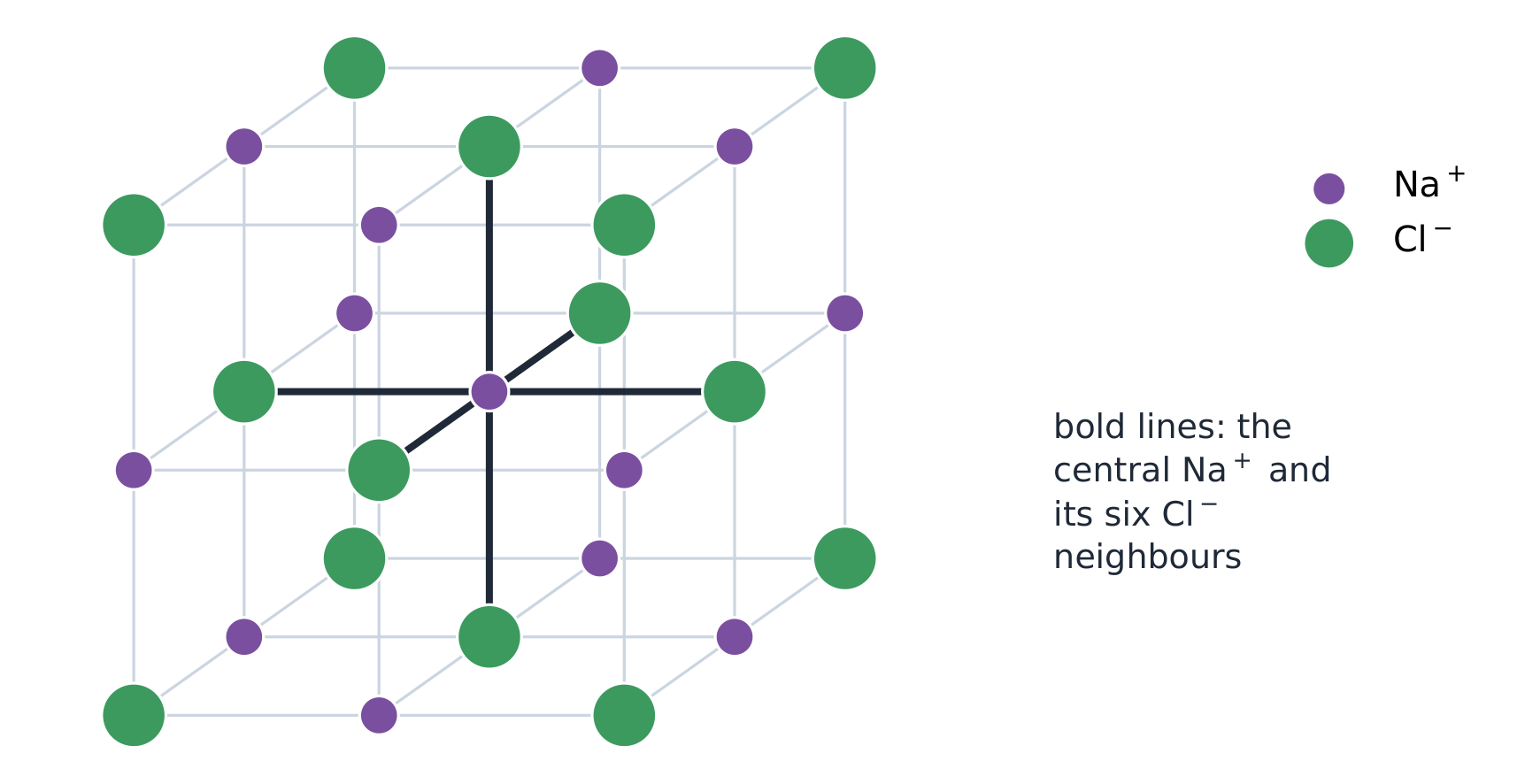
Does six chloride neighbours around Na⁺ imply NaCl₆?
Dificultad 1/5 · 100 monedas + un pequeño bono en el primer intento de hoy
Count the repeating lattice composition rather than just one ion’s neighbours.
S2.1: Define a lattice enthalpy 晶格焓 convention
- Here lattice dissociation enthalpy separates one mole of solid ionic compound into its gaseous ions. NaCl(s) → Na⁺(g) + Cl⁻(g) is endothermic with a positive value.
- Some resources define the reverse lattice-formation process and quote a negative value. Read the equation before comparing signs: reversing the same process reverses the enthalpy sign without changing the magnitude.
If lattice formation is −810 kJ/mol, what is the reverse dissociation value?
Dificultad 1/5 · 100 monedas + un pequeño bono en el primer intento de hoy
A definition must specify initial and final states.
Lattice formation is −810 kJ/mol. Find the reverse dissociation enthalpy in kJ/mol.
Dificultad 2/5 · 140 monedas + un pequeño bono en el primer intento de hoy
Reverse the process and the enthalpy sign.
S2.1: Compare charge and distance carefully
- For comparable lattice structures, larger ionic charge magnitudes and smaller ion separation generally increase lattice dissociation enthalpy. MgO has doubly charged ions and much stronger lattice interactions than the singly charged salts in the supplied examples.
- For equal charge products, pair force varies as 1/r² while pair potential-energy magnitude varies as 1/r. A real lattice includes many interactions; neither pair formula is an exact melting-point equation.
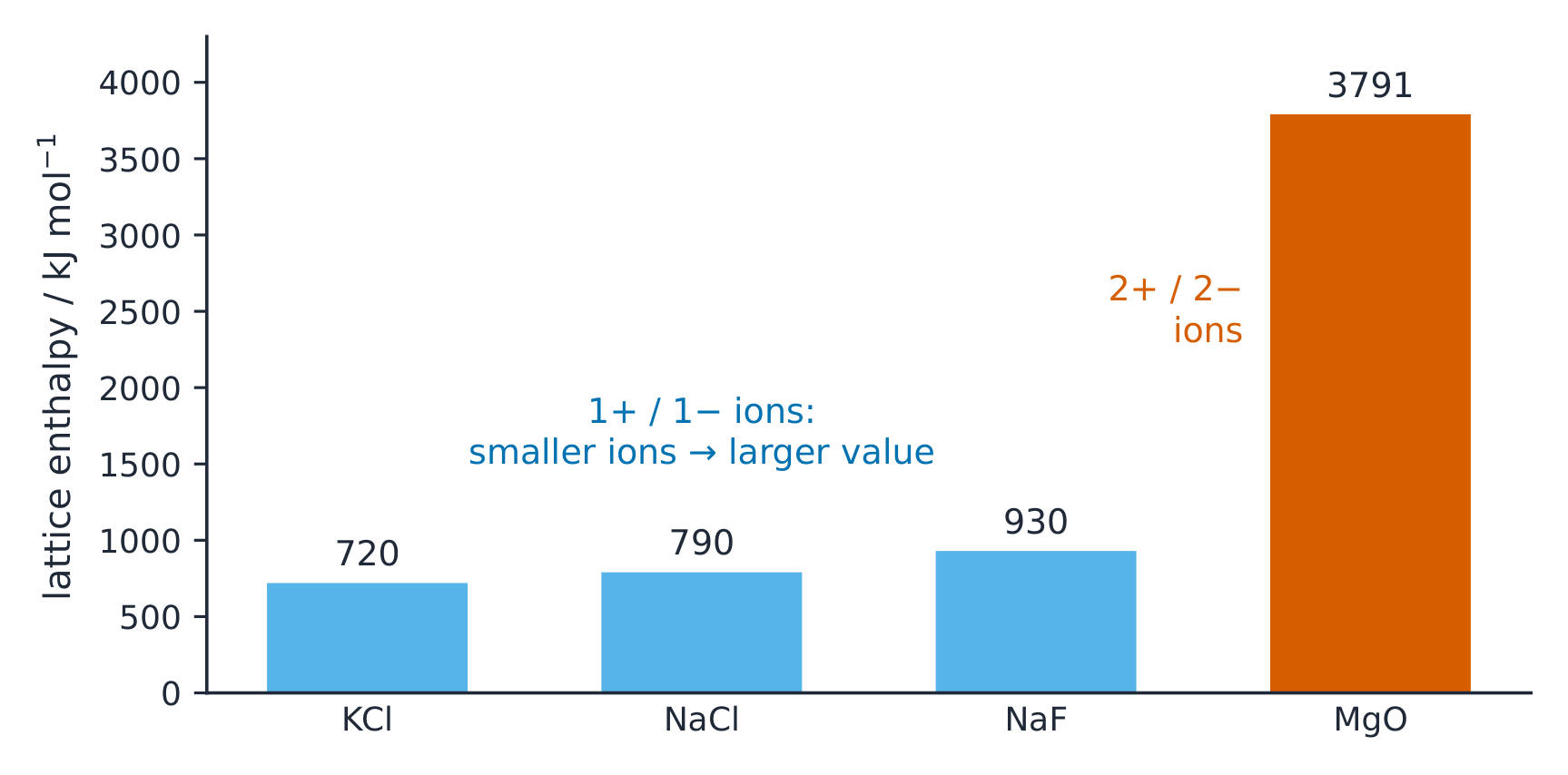
Does a pair-force ratio directly equal a melting-temperature ratio?
Dificultad 1/5 · 100 monedas + un pequeño bono en el primer intento de hoy
Use a model only for the quantity it describes.
For two ion pairs with equal charge products, pair A has separation 240 pm and pair B 300 pm. Find the force-magnitude ratio F_A/F_B using F ∝ 1/r².
Dificultad 2/5 · 140 monedas + un pequeño bono en el primer intento de hoy
For equal charge products, F_A/F_B = (1/r_A²)/(1/r_B²) = (r_B/r_A)². Thus F_A/F_B = (300/240)² = 1.5625. The shorter separation gives greater force; this pair-force ratio is not a melting- temperature ratio.
S2.1: Distinguish melting from gaseous separation
- Melting disrupts the ordered lattice so ions become mobile, but nearby ions still interact in the liquid. Lattice dissociation instead ends with separated gaseous ions.
- Strong lattice interactions help explain the generally high melting points and low volatility 挥发性 of ionic solids. Some compounds decompose before boiling, and a lattice enthalpy is not numerically the enthalpy of melting or dissolution.
Are molten ions already separated gaseous ions?
Dificultad 1/5 · 100 monedas + un pequeño bono en el primer intento de hoy
Check the physical state at the end of each process.
S2.1: Explain conductivity using mobile charge
- In an ordinary ionic solid the ions occupy fixed lattice positions, so it does not conduct appreciably by ion migration. In a molten salt the ions can move and carry charge through the liquid.
- Dissolving adds solvent and can produce solvated mobile ions. Electrons carry current in the external wire, but mobile ions carry current through the electrolyte; electrode reactions connect the two processes.
What carries current through molten sodium chloride?
Dificultad 1/5 · 100 monedas + un pequeño bono en el primer intento de hoy
Do not transfer the metallic conduction model to an ionic liquid.
S2.1: Explain solubility without a universal rule
- Water can stabilize separated ions through ion–dipole interactions. Whether much solid dissolves depends on the overall free-energy balance, involving lattice interactions, solvent interactions and entropy.
- AgCl and CaCO₃ are sparingly soluble ionic solids. Sugar can dissolve as neutral molecules. Thus dissolution alone neither proves nor disproves an ionic structure, and low solubility does not mean exactly zero dissolved ions.
Does every ionic compound dissolve readily in water?
Dificultad 1/5 · 100 monedas + un pequeño bono en el primer intento de hoy
Compare the whole dissolution process rather than only one attraction.
S2.1: Explain brittleness with a displaced layer
- When a suitable shear displaces layers in an ionic crystal, ions of like charge can become adjacent. Their repulsion helps the crystal split rather than deform smoothly.
- This is a schematic explanation, not a claim that every microscopic impact shifts one perfectly intact row. Relate the property to charged particles and lattice arrangement rather than calling all strong materials flexible.
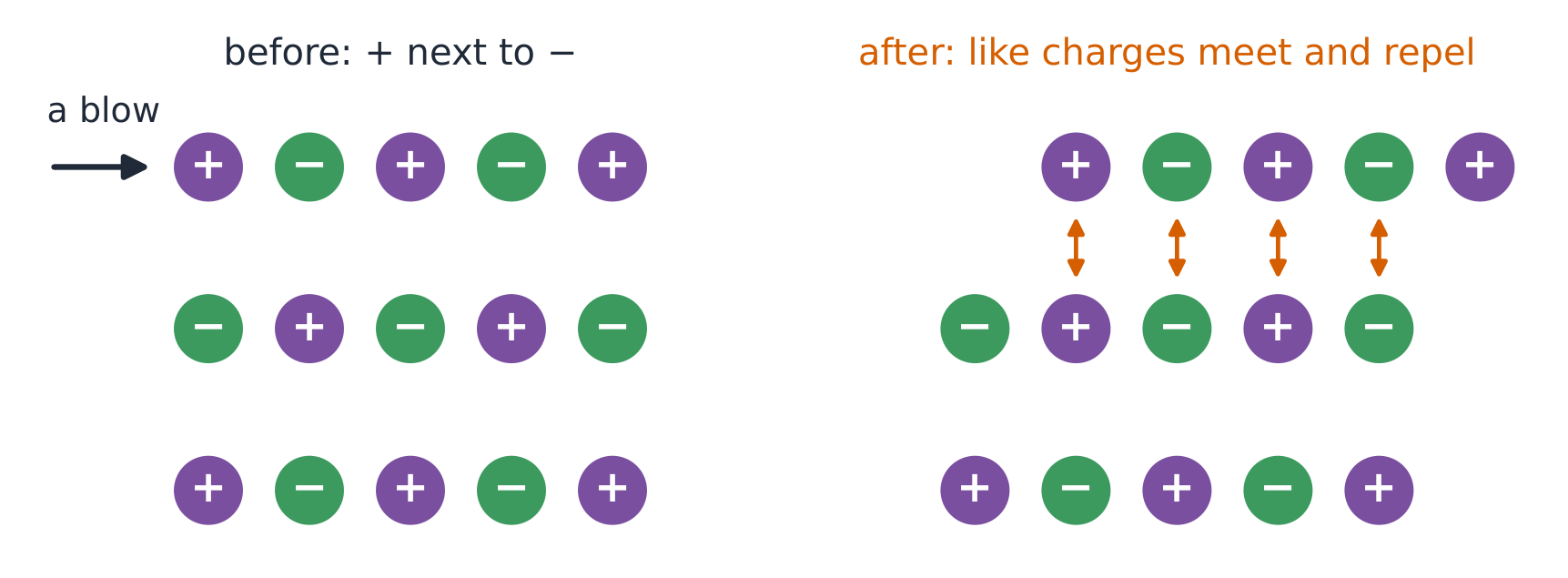
Why can an ionic crystal fracture under a blow?
Dificultad 1/5 · 100 monedas + un pequeño bono en el primer intento de hoy
Use charges and relative positions to explain the observed property.
S2.1: Use a pattern of property evidence
- An invented sample that does not conduct as a solid but does when molten is consistent with an ionic structure. High melting point supports strong lattice interactions but alone is not unique: network covalent solids can also melt at high temperatures.
- A material conducting in solid and liquid states may fit a metallic model 金属模型. A weak aqueous conductivity reading may reflect neutral molecules, low concentration, limited dissolution or instrumental sensitivity. Avoid a unique identification from one ambiguous result.
Does high melting point alone establish ionic bonding?
Dificultad 1/5 · 100 monedas + un pequeño bono en el primer intento de hoy
Combine several independent observations.
S2.1: Compare aqueous measurements fairly
- Use approved safe samples and a suitable low-voltage conductivity instrument. Match concentrations, temperature, electrode spacing and settings; use a deionized-water blank and rinse electrodes between samples.
- The blank checks background conductivity and rinsing reduces carry-over. Do not melt unknown compounds or improvise mains-powered solution experiments. A fair comparison controls factors that can change the signal without changing the structural model.
Why rinse electrodes between samples?
Dificultad 1/5 · 100 monedas + un pequeño bono en el primer intento de hoy
Control carry-over while independently preparing comparable samples.
S2.2: Define the covalent attraction
- A covalent bond is electrostatic attraction between a shared pair 共用电子对 of electrons and the positively charged nuclei of the bonded atoms. Sharing can be equal or unequal; a polar 极性的 covalent bond is still a shared-electron model.
- Distinguish an intramolecular bond from attractions between molecules. Ordinary melting of iodine mainly overcomes intermolecular attractions while preserving I₂ molecules; it does not require breaking every I–I bond into atoms.
What mainly changes when molecular iodine melts?
Dificultad 1/5 · 100 monedas + un pequeño bono en el primer intento de hoy
Match the force being overcome to the actual phase change.
S2.2: Count valence electrons before drawing
- For a Lewis formula 路易斯结构式, sum every atom’s valence electrons, add one for each negative charge and subtract one for each positive charge. CO₂ has 4 + 2×6 = 16 valence electrons; NH₄⁺ has 5 + 4×1 − 1 = 8.
- Join atoms in a sensible skeleton, account for bonding pairs and add lone pairs 孤对电子. Outer hydrogen needs a duet, not an octet. In CO₂, making two double bonds gives carbon an octet while preserving the total 16 electrons.
How many valence electrons belong in NH₄⁺?
Dificultad 1/5 · 100 monedas + un pequeño bono en el primer intento de hoy
Positive charge means fewer electrons than the neutral-atom sum.
Find the total valence electrons for NH₄⁺.
Dificultad 2/5 · 140 monedas + un pequeño bono en el primer intento de hoy
5 + 4×1 − 1 = 8 valence electrons.
S2.2: Allow incomplete octets 不完全八隅体
- The octet rule 八隅体规则 is a useful pattern for many main-group compounds, not a universal physical law. In the simple BF₃ Lewis formula, three B–F bonds place six electrons around B; BeCl₂ has four around Be in its simple molecular model.
- Do not force extra multiple bonds merely to satisfy eight for every central atom. Check the species, charge and total electron count; a drawing algorithm is a model with exceptions rather than a reason to invent electrons.
Must every correct BF₃ drawing put eight electrons around B?
Dificultad 1/5 · 100 monedas + un pequeño bono en el primer intento de hoy
Keep the correct electron count and recognize the model’s exceptions.
S2.2: Compare bond order between the same atoms
- Single, double and triple bonds share one, two and three electron pairs. For the supplied carbon–carbon comparison, lengths are about 154, 134 and 120 pm while bond enthalpies are about 346, 614 and 839 kJ/mol.
- Thus increasing C–C bond order shortens and strengthens these bonds. A double bond is not twice the single-bond enthalpy, and the comparison does not establish that every triple bond between any elements is stronger than every single bond.
Is a C=C bond exactly twice as strong as a C–C bond?
Dificultad 1/5 · 100 monedas + un pequeño bono en el primer intento de hoy
Use the actual comparison and keep its scope.
S2.2: Identify a coordination bond 配位键
- A coordination bond is a covalent bond whose shared pair originates from one donor atom. In NH₃ + H⁺ → NH₄⁺, the nitrogen lone pair is donated towards the proton; a donor arrow points N → H.
- After formation the four N–H bonds in ammonium are equivalent. The donor arrow records electron origin rather than a permanent special weak bond. Hydronium is a useful aqueous hydrated-proton representation, not a claim that all acid solvents contain identical isolated H₃O⁺ particles.
Which way does the donor arrow point when ammonia binds H⁺?
Dificultad 1/5 · 100 monedas + un pequeño bono en el primer intento de hoy
The arrow begins at the electron-pair donor.
S2.2: Count domains rather than shared pairs
- An electron domain 电子域 is one bonding region or one lone pair around the chosen central atom. A single, double or triple bond each counts as one domain for VSEPR even though their electron-pair counts differ.
- CO₂ has two domains around carbon and a linear arrangement. NH₃ has three bonding domains and one lone pair: four domains with tetrahedral electron-domain geometry but trigonal-pyramidal molecular shape. Name the positions of atoms separately from the full domain arrangement.
How many domains surround carbon in CO₂?
Dificultad 1/5 · 100 monedas + un pequeño bono en el primer intento de hoy
Multiple bonds count as single directions of electron density.
S2.2: Work two and three domain geometries
- Two domains spread into a linear arrangement with ideal angle 180°. Three domains give trigonal-planar electron-domain geometry with ideal 120°; BF₃ has three bonded atoms and a trigonal-planar molecular shape.
- With three domains but one lone pair, the bonded atoms give a bent molecular shape, as in the simple SO₂ model. The lone pair and multiple-bond character influence angles: do not label every three-domain molecule exactly 120° without considering its domains.
Is a three-domain molecule with one lone pair necessarily trigonal planar in molecular shape?
Dificultad 1/5 · 100 monedas + un pequeño bono en el primer intento de hoy
Molecular geometry tracks atom positions.
S2.2: Work four domain geometries
- Four domains have tetrahedral electron-domain geometry. Four bonding domains give tetrahedral CH₄; three bonds plus one lone pair give pyramidal NH₃; two bonds plus two lone pairs give bent H₂O.
- The familiar angles are about 109.5°, 107° and 104.5° for those examples. Their values are not a universal subtraction rule: PH₃ is also pyramidal but has a measured H–P–H angle about 93.3°. VSEPR supports an arrangement more reliably than an exact numerical angle.
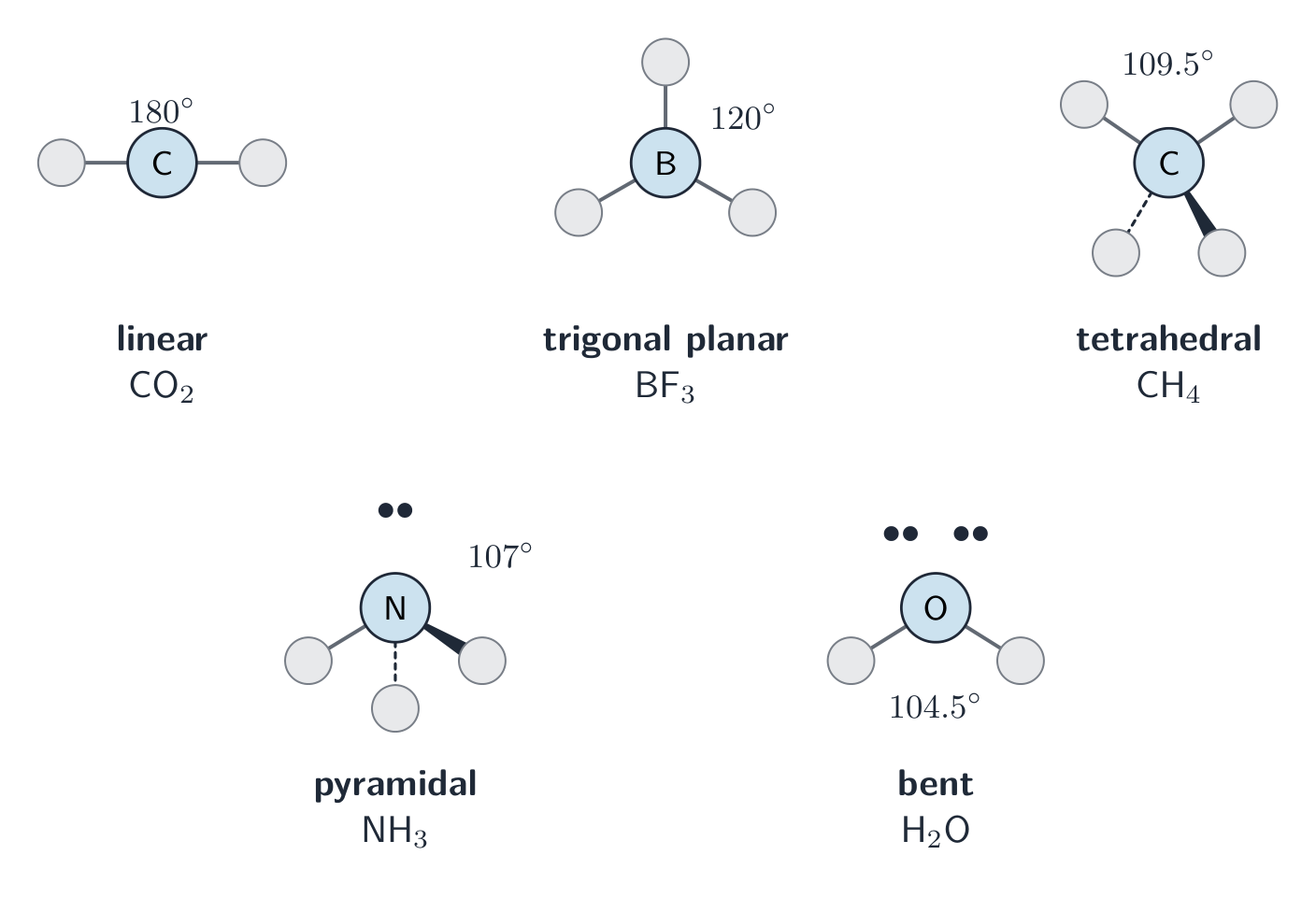
Does every pyramidal AX₃E molecule have a 107° angle?
Dificultad 1/5 · 100 monedas + un pequeño bono en el primer intento de hoy
Keep example measurements separate from a qualitative geometry model.
S2.2: Predict how different domains affect angles
- In the simple VSEPR picture, lone-pair repulsions generally exceed bonding-domain repulsions. A multiple-bond region can occupy more angular space than a single-bond region even though both count as one domain.
- For an approximately trigonal-planar carbonyl carbon, the double-bond region can widen angles involving that region and compress the angle between the other single bonds. Use qualitative comparisons unless a measured angle is supplied; domain count alone does not provide all exact angles.
Can a double bond affect adjacent angles despite counting as one domain?
Dificultad 1/5 · 100 monedas + un pequeño bono en el primer intento de hoy
A domain count simplifies geometry without making all domains identical.
S2.2: Assign bond dipoles from electronegativity 电负性
- Electronegativity describes attraction for the shared electron pair. In O–H, oxygen attracts electron density more strongly, so O is partially negative and H partially positive; partial charges are not full ionic charges.
- Using supplied values O 3.4 and H 2.2 gives a difference of 1.2. A bigger difference generally increases bond polarity, but no universal cutoff number alone proves a lattice is ionic or a substance is molecular.
Which end of an O–H bond is partially negative?
Dificultad 1/5 · 100 monedas + un pequeño bono en el primer intento de hoy
Compare attraction for the shared pair, not the atom’s isolated electron count.
S2.2: Add dipole vectors in the actual geometry
- Linear CO₂ has equal opposing C=O bond dipoles that cancel; the molecule is non-polar despite having polar bonds 极性键. Bent water has O–H dipoles that do not cancel, so it has a net dipole.
- Equivalent dipoles in tetrahedral CCl₄ also cancel; replacing one Cl with H changes the pattern in CHCl₃. Avoid a rule that every lone pair or every rough unsymmetrical sketch proves polarity: use the actual bond vectors and geometry.
Can a non-polar molecule contain polar bonds?
Dificultad 1/5 · 100 monedas + un pequeño bono en el primer intento de hoy
Separate each bond vector from their vector sum.
S2.2: Distinguish a network from a molecule
- Diamond is a three-dimensional covalent network, with each C bonded tetrahedrally to four others. Strong extended bonding gives hardness, high disruption energy and few mobile charge carriers in the ordinary pure solid.
- A molecular solid has discrete molecules with attractions between them. Ordinary molecular phase changes mainly overcome those attractions; an extended network must undergo substantial covalent rearrangement and can decompose or sublime instead of showing a simple boiling process.
Why is a network different from a molecular crystal?
Dificultad 1/5 · 100 monedas + un pequeño bono en el primer intento de hoy
Identify which connections extend through the solid.
S2.2: Explain graphite and graphene
- In graphite, each carbon is bonded to three neighbours in a hexagonal sheet. Delocalized electrons can move within sheets, explaining conduction along the layers. Weak interlayer attractions allow layers to slide.
- Graphene is a single such sheet: strong in-plane covalent bonding gives high tensile strength while delocalized electrons support conduction. Delocalization alone is not a promise of identical conductivity in every carbon allotrope 同素异形体 or direction.
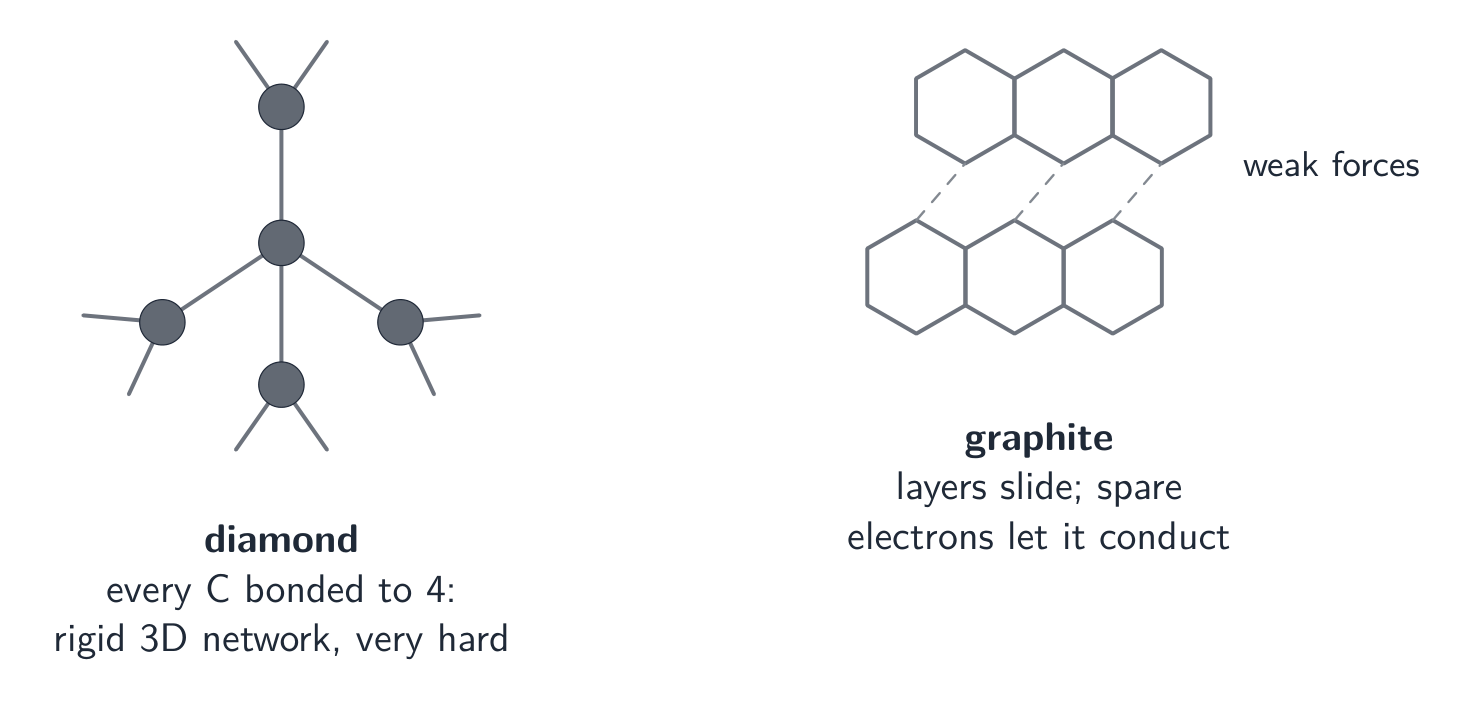
What explains graphite’s softness together with in-plane conduction?
Dificultad 1/5 · 100 monedas + un pequeño bono en el primer intento de hoy
Use separate structural features for the two properties.
S2.2: Compare fullerenes and silicon networks
- C₆₀ consists of individual carbon cages; the solid has intermolecular attractions between cages rather than diamond-like covalent connectivity throughout. It is relatively soft and a poor conductor in the ordinary undoped comparison.
- Silicon has a tetrahedral network and is a semiconductor. In SiO₂ each Si bonds to four O atoms and each O to two Si atoms, yielding the 1:2 composition ratio. CO₂ instead forms small molecules. A formula ratio does not by itself establish molecular structure.
Does SiO₂ represent isolated triatomic molecules in ordinary quartz?
Dificultad 1/5 · 100 monedas + un pequeño bono en el primer intento de hoy
Use connectivity, not formula appearance, to distinguish structures.
S2.2: Recognize dispersion and induced dipoles
- London dispersion interactions arise from correlated instantaneous fluctuations and induced dipoles, and occur between all molecules, including polar ones. Polarizability and contact geometry affect their strength.
- A permanent dipole can also induce a dipole in a non-polar neighbour. Water–hexane interactions therefore include dipole-induced dipole attraction as well as dispersion, even though hexane and water mix poorly under ordinary conditions.
Do non-polar and polar molecules have literally no attraction to each other?
Dificultad 1/5 · 100 monedas + un pequeño bono en el primer intento de hoy
Weak or unfavourable mixing does not mean zero attraction.
S2.2: Distinguish hydrogen bond donors and acceptors
- In common course examples, an N–H, O–H or F–H group supplies a hydrogen-bond donor and a suitable lone pair supplies an acceptor. Hydrogen has a partial positive charge; it is not a free proton.
- Water can donate and accept; ammonia also has donor N–H bonds and a lone pair. Methoxymethane has an oxygen acceptor but lacks a usual self-hydrogen-bond donor. It can accept a hydrogen bond from water even though pure methoxymethane does not self-associate that way in the simple model.
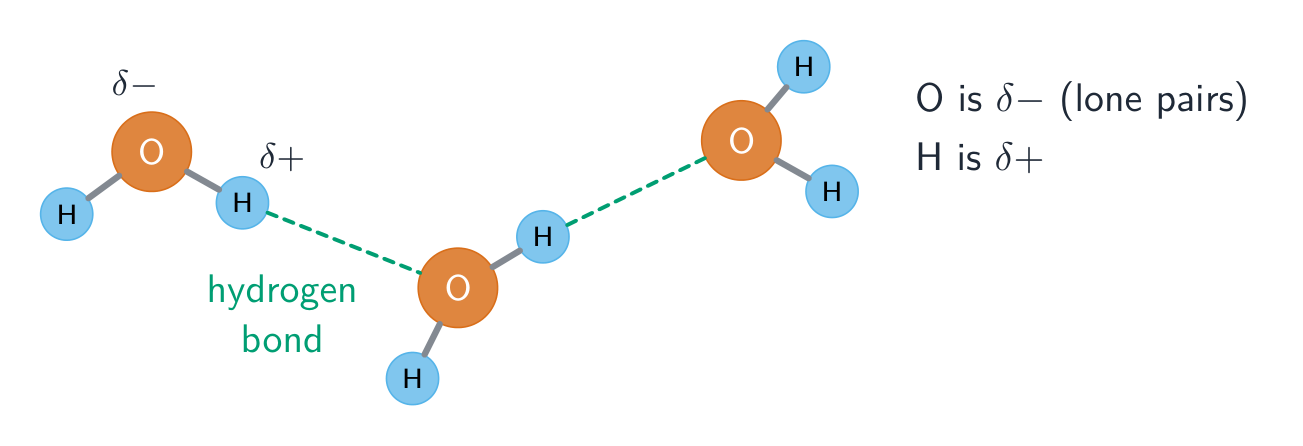
Can an ether oxygen accept a hydrogen bond from water?
Dificultad 1/5 · 100 monedas + un pequeño bono en el primer intento de hoy
Separate donor and acceptor requirements.
S2.2: Compare boiling points under common conditions
- For comparable molar masses, hydrogen bonding 氢键 often produces a higher boiling point than permanent dipole interactions, which often exceed dispersion alone. All interactions still contribute; a large non-polar molecule can have stronger overall attractions than a much smaller polar molecule.
- The supplied propane/ethanal/ethanol comparison has similar molar masses and approximate normal boiling points −42°C, 20°C and 78°C. Ethanal adds a permanent dipole; ethanol has an O–H donor for hydrogen bonding. Always compare boiling points at the same external pressure.
Is the name of the strongest interaction enough to rank arbitrary molecules of very different sizes?
Dificultad 1/5 · 100 monedas + un pequeño bono en el primer intento de hoy
Use a controlled comparison rather than an unconditional ranking.
S2.2: Interpret the hydride evidence
- The heavier hydrides in the supplied group comparisons generally boil higher as polarizability grows. NH₃, H₂O and HF sit unusually high relative to their group trends, consistent with important hydrogen bonding.
- Water’s normal boiling point is about 100°C. A visual extrapolation cannot measure a unique boiling point for hypothetical water with hydrogen bonding removed: it changes the model and has uncertainty. Use the trend as evidence for an explanation, not an exact experiment that was never performed.
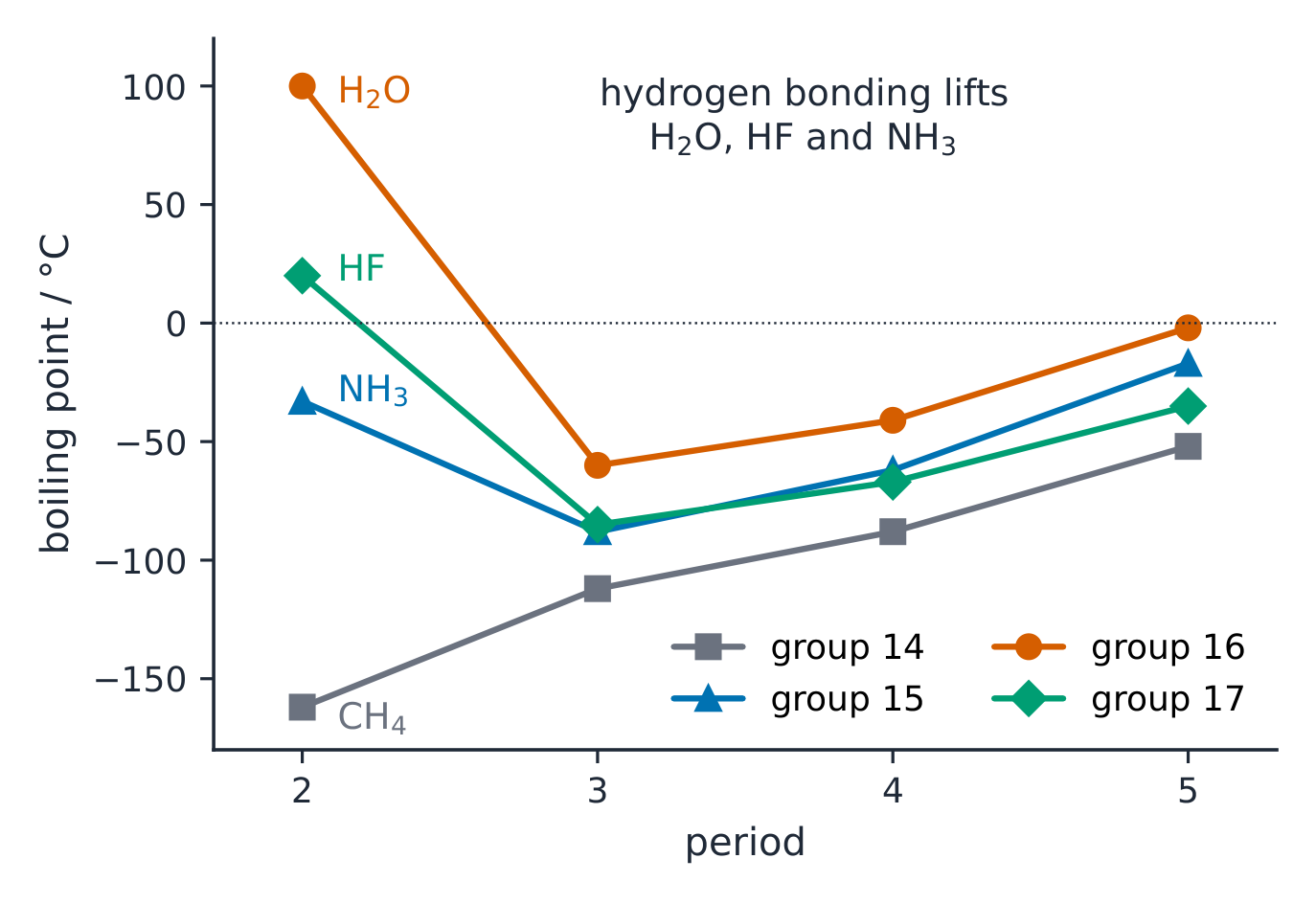
Does extending a plotted trend measure an exact no-hydrogen-bond water boiling point?
Dificultad 1/5 · 100 monedas + un pequeño bono en el primer intento de hoy
Distinguish measured data from a counterfactual model.
S2.2: Explain solubility and conductivity conditionally
- Molecular solubility reflects the overall free-energy change, including disrupted interactions, new solvent interactions and entropy. Ethanol can hydrogen-bond with water; adding a long non-polar chain can reduce water solubility.
- Many pure molecular liquids conduct poorly because they have few mobile ions or electrons. A molecular solute can react with water to form ions, so its aqueous solution need not be a nonelectrolyte. Network solids are generally insoluble in ordinary solvents without reaction, not immune to all chemistry.
Does a substance being molecular guarantee that its aqueous solution cannot conduct?
Dificultad 1/5 · 100 monedas + un pequeño bono en el primer intento de hoy
Specify the state and any reaction with the solvent.
S2.2: Explain chromatographic separation
- Chromatography 色谱法 separates components by different relative attractions for mobile and stationary phases 固定相. A component retained strongly by the stationary phase travels less; one more stabilized in the mobile phase 流动相 travels farther.
- On polar silica with a relatively non-polar mobile solvent, a more polar component often travels less. Changing solvent composition or stationary phase can change the order and distances: polarity alone without naming both phases is not a universal travel rule.
What makes a component travel less in a given chromatographic system?
Dificultad 1/5 · 100 monedas + un pequeño bono en el primer intento de hoy
Explain movement using interactions with both phases.
S2.2: Calculate and interpret Rf
- Measure from the origin line to a spot’s centre and from the same origin to the solvent front. In an invented run, 3.6 cm divided by 9.0 cm gives Rf = 0.40, with no unit; using consistent length units makes the ratio dimensionless.
- The figure shows a separate invented example, with ratios 2.0/8.0 = 0.25 and 6.0/8.0 = 0.75. Keep the starting spots above the solvent level and use a pencil origin. Follow the approved method to locate colourless spots; specific locating agents are not required syllabus knowledge. A badly marked solvent front can invalidate the ratio.
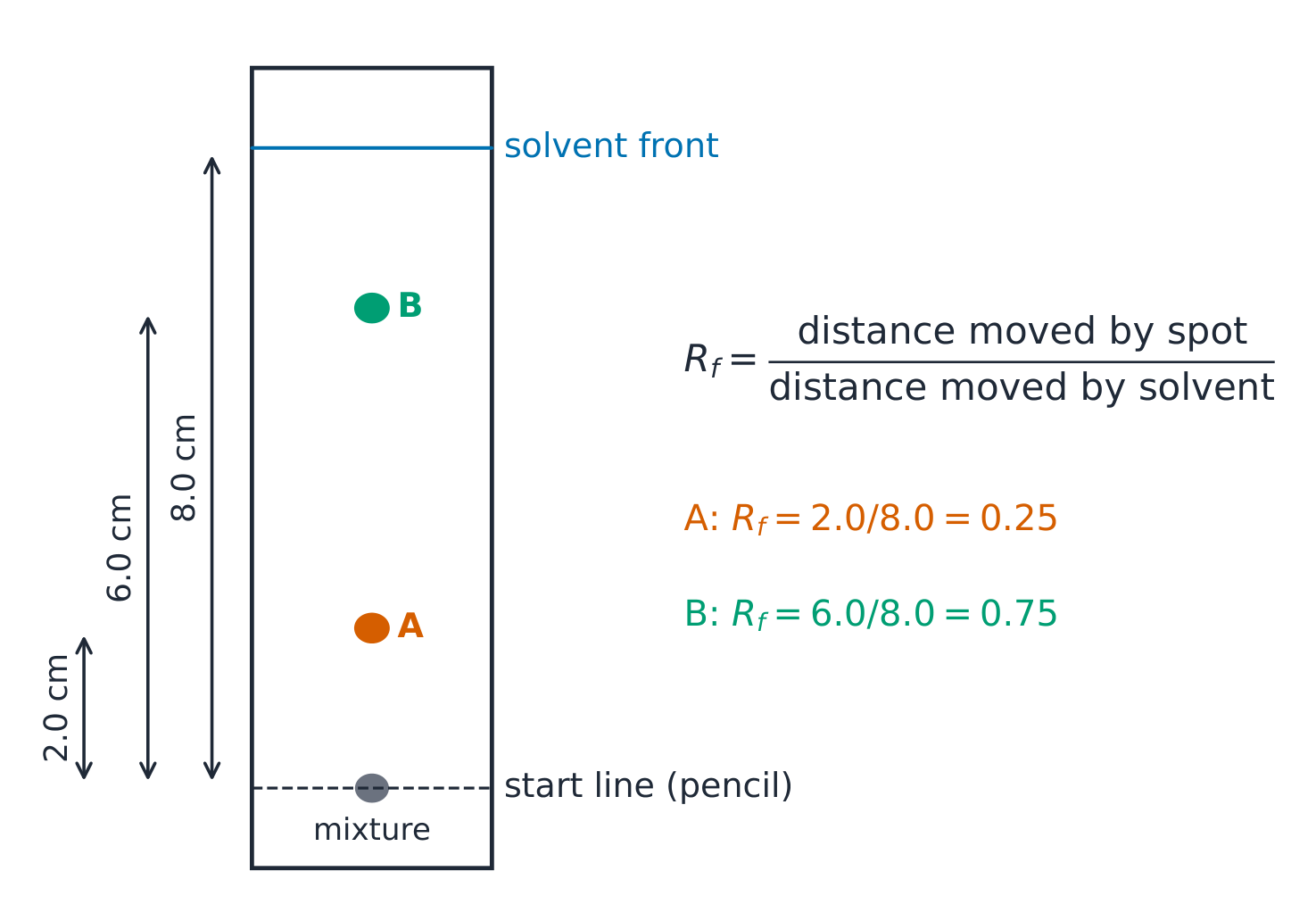
Which spot position belongs in the Rf calculation?
Dificultad 1/5 · 100 monedas + un pequeño bono en el primer intento de hoy
Both distances must use the same origin.
Find Rf for a component centre 3.6 cm and solvent front 9.0 cm from the same origin.
Dificultad 2/5 · 140 monedas + un pequeño bono en el primer intento de hoy
3.6/9.0 = 0.40, dimensionless.
S2.2: Bound an identification claim
- A sample and reference with the same Rf under controlled conditions may be consistent with the same component. Distinct substances can share a value and unresolved mixtures can give one visible spot, so one match does not prove identity or purity.
- Compare references alongside the sample and control stationary phase, solvent composition, temperature and sample loading. A second solvent system or an independent analytical method can discriminate explanations that one plate cannot.
Does one matching Rf prove identity and purity?
Dificultad 1/5 · 100 monedas + un pequeño bono en el primer intento de hoy
State what the evidence supports and what remains unresolved.
S2.3: Describe a neutral metallic model
- A metallic bond is electrostatic attraction between positive ion cores and delocalized electrons. The cores and electron density belong to one electrically neutral solid; they are not a solution of isolated ions.
- In the schematic monovalent example, 15 singly positive cores are balanced by 15 electrons. For the simple Mg model there are two delocalized electrons per core, so ten doubly positive cores require twenty electrons. Keep the net charge zero rather than interpreting a few drawn dots as an unbalanced bulk metal.
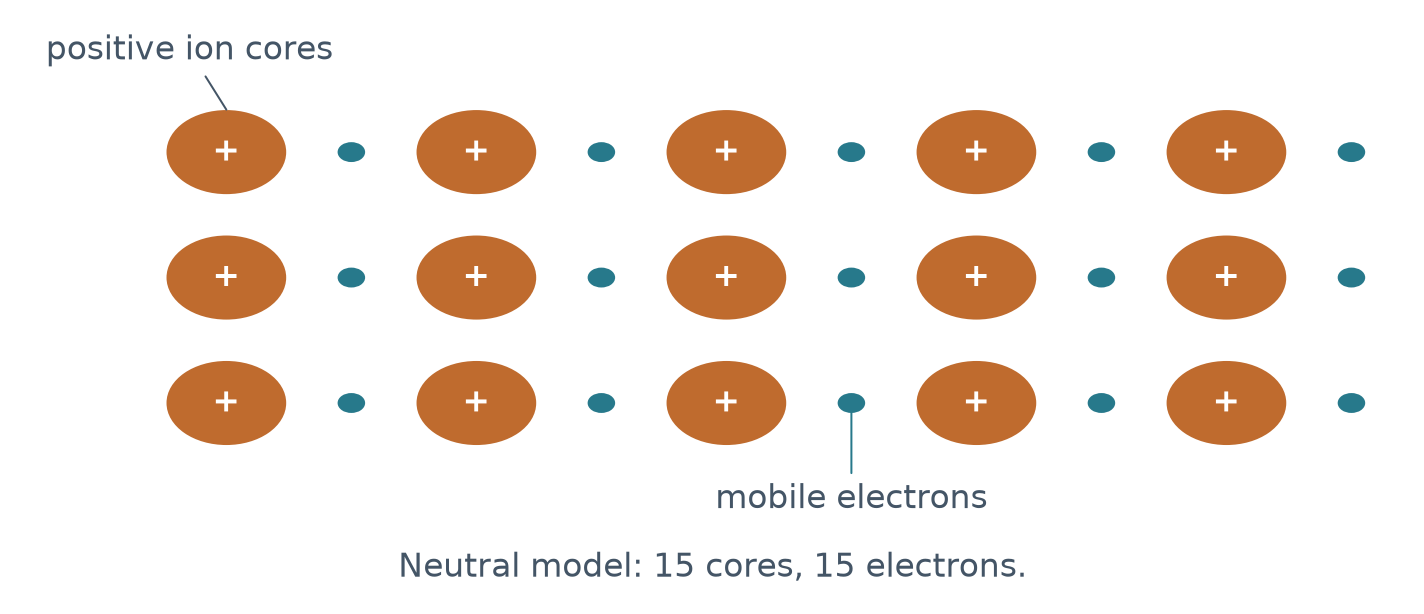
How many electrons balance ten +2 cores in a neutral model?
Dificultad 1/5 · 100 monedas + un pequeño bono en el primer intento de hoy
Ten cores at +2 each contribute total charge +20 in elementary-charge units. Neutrality requires −20, supplied by twenty electrons of charge −1 each.
How many electrons balance ten +2 cores in a neutral simple metallic model?
Dificultad 2/5 · 140 monedas + un pequeño bono en el primer intento de hoy
Ten ×(+2) needs twenty electrons, each −1.
S2.3: Explain delocalization and cohesion
- Delocalized electrons are spread through the extended metal rather than assigned permanently to one atom or fixed bond. Positive cores attract this electron density throughout the structure, while repulsions also contribute to the stable arrangement.
- The simple model describes metallic attraction as non-directional 无方向性的: changing neighbours need not destroy all cohesion. It does not mean every local configuration has identical energy or that every metal is equally soft, ductile or strong.
Does non-directional bonding imply every deformation leaves exactly the same local energy?
Dificultad 1/5 · 100 monedas + un pequeño bono en el primer intento de hoy
A qualitative bonding feature is not an exact microstructural energy calculation.
S2.3: Explain conduction as net electron drift
- Mobile electronic states carry current in a metal. Without an applied field, microscopic electron motion has no sustained net drift in one direction; applying a potential difference creates the drift associated with current.
- The positive cores vibrate about their average lattice positions in a solid. They do not migrate along a wire as the main current carriers, and anions are not required. In a molten ionic salt the bulk carriers are ions instead.
Which particles mainly carry current through a solid copper wire?
Dificultad 1/5 · 100 monedas + un pequeño bono en el primer intento de hoy
Name the mobile charge carrier appropriate to the structure.
S2.3: Keep liquid metal distinct from ionic liquid
- Melting destroys long-range crystalline order but does not remove all nearby metallic interactions. A liquid metal can retain mobile electrons and therefore still conduct.
- A molten ionic compound conducts by movement of cations and anions. Both liquids can conduct, but the observation alone does not identify the same microscopic carrier. Combine solid-state behaviour and other evidence before choosing a structural model.
Do liquid magnesium and molten magnesium chloride have the same main bulk charge carriers?
Dificultad 1/5 · 100 monedas + un pequeño bono en el primer intento de hoy
State what the substance is, not merely that it is liquid.
S2.3: Connect thermal conduction to a pan base
- Mobile electrons transfer energy through a metal, and lattice vibrations also contribute. This supports the use of a conducting metal base to distribute heating across a cooking pan.
- A pan also needs suitable chemical stability, shape and a handle that limits unwanted heat transfer. High melting temperature alone does not prove high thermal conductivity 导热性, and the best material choice depends on several properties rather than one bonding slogan.
Does high melting point alone establish a good thermal conductor?
Dificultad 1/5 · 100 monedas + un pequeño bono en el primer intento de hoy
Explain each useful property with its own mechanism.
S2.3: Explain malleability 延展性 and ductility 延性
- Malleability means a material can be hammered or rolled into shape; ductility means it can be drawn into wire. Slip changes neighbouring core positions while delocalized electron density can maintain cohesive attraction.
- Real deformation involves crystal defects, grain boundaries, temperature and processing history. A sketch of sliding layers captures a model contrast with brittle ionic crystals; it is not a claim that an entire perfect row always moves at once or every metal bends without fracture.
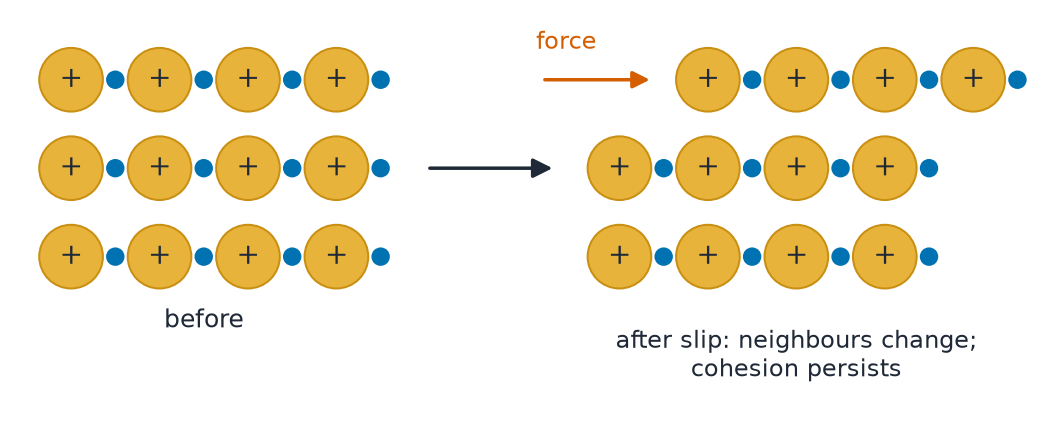
Which property specifically describes drawing a material into wire?
Dificultad 1/5 · 100 monedas + un pequeño bono en el primer intento de hoy
Use the property that corresponds to the actual forming operation.
S2.3: Compare fracture with an ionic crystal
- When an ionic lattice is displaced along a suitable plane, like charges can become adjacent and repulsion helps the crystal fracture. A metal’s mobile electron density can preserve attraction as cores change neighbours.
- Both structures involve electrostatic interactions. The difference in deformation is not that one has forces and the other has none; it concerns which particles are present and how their interactions respond to displacement.
Why is the explanation “metals bend because they have no strong bonds” inadequate?
Dificultad 1/5 · 100 monedas + un pequeño bono en el primer intento de hoy
Account for both cohesion and changed relative positions.
S2.3: Compare charge and size within a model
- For simple s- and p-block 区 comparisons, more delocalized electrons per core and a greater positive core charge can increase attraction. A smaller effective separation can also strengthen the interaction.
- This supports selected trends such as Na to Mg to Al and Li down to Cs. It is a qualitative model, not an exact melting-point equation; crystal packing, electronic structure and the entropy of melting can change the observed pattern.
Does the simple charge/radius model predict an exact melting temperature?
Dificultad 1/5 · 100 monedas + un pequeño bono en el primer intento de hoy
Keep model variables distinct from a complete thermodynamic calculation.
S2.3: Explain the Na Mg Al comparison
- The simple model counts one, two and three delocalized outer electrons per core for Na, Mg and Al, with increasing positive core charge. The effective cores also become smaller across this selected comparison.
- Supplied rounded melting temperatures are 98°C, 650°C and 660°C. The much smaller Mg–Al change does not mean their bonding is identical. Tabulated ionic radii from compounds depend on coordination and are not direct pictures of spherical aqueous ions sitting inside a pure metal.
Do nearly equal Mg and Al melting points prove identical metallic bonding?
Dificultad 1/5 · 100 monedas + un pequeño bono en el primer intento de hoy
A phase-change temperature is not a unique fingerprint of all bonding details.
S2.3: Explain a down-group trend
- Li, Na, K, Rb and Cs each contribute one outer electron per atom in the simple group-1 model. Increasing core size lowers the effective attraction for the delocalized density in this selected series.
- The supplied rounded melting temperatures fall from 181°C for Li to 28°C for Cs. Use the data to infer a trend rather than touching reactive metals or assuming every periodic group must follow the same ranking. Group membership alone does not establish every physical property.
What changes in the simple group-1 explanation while the electron contribution stays one?
Dificultad 1/5 · 100 monedas + un pequeño bono en el primer intento de hoy
Separate electron count from the size trend.
S2.3: Separate boiling from ionization
- Vaporization separates metal into vapour particles, predominantly neutral atoms in the simple model. It does not automatically create gaseous cations plus detached free electrons.
- Ionization removes electrons from gaseous atoms and requires a separate energy input. A positive core in a condensed-metal bonding model is not a prediction that aluminium vapour must consist of Al³⁺ particles after ordinary boiling.
Does boiling aluminium by itself imply Al³⁺(g) plus three free electrons per atom?
Dificultad 1/5 · 100 monedas + un pequeño bono en el primer intento de hoy
Track the final particles as well as the physical state.
S2.3: Read different chart scales honestly
- The supplied period 周期-3 and group-1 melting-point panels use different vertical scales. A visually taller bar in one panel need not mean a higher temperature than a shorter bar in the other.
- Read the labels or compare values on a common numerical scale. For example, Al 660°C is higher than Li 181°C even if a separately scaled drawing makes lithium’s bar look tall. An axis choice changes the display, not the measured temperature.
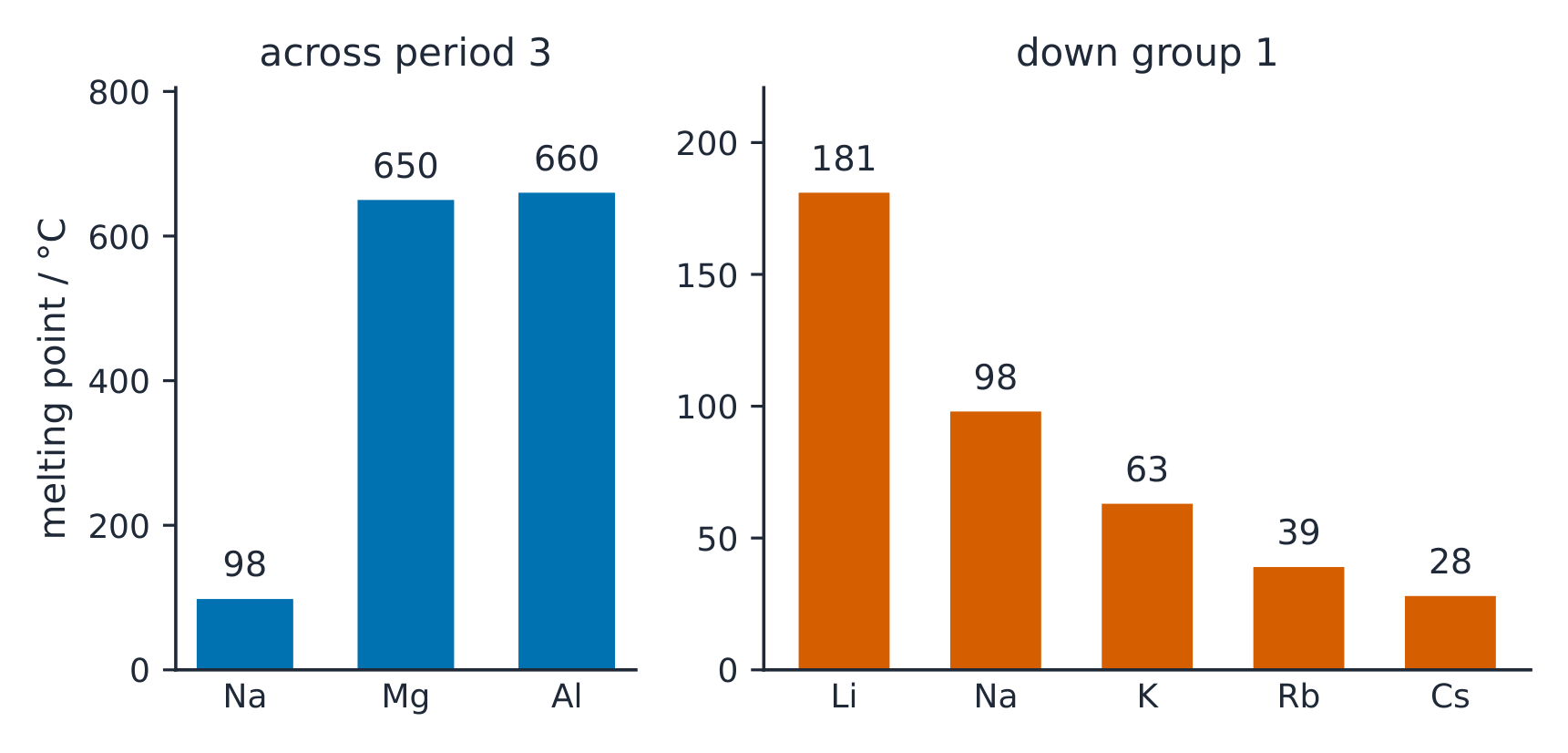
May raw bar heights from differently scaled panels be compared directly?
Dificultad 1/5 · 100 monedas + un pequeño bono en el primer intento de hoy
Inspect the axes before drawing a comparison.
S2.3: Interpret a controlled electrical measurement
- For the invented equal-size, same-temperature samples, A carries 0.30 A and B 0.15 A at 1.5 V. Using R = V/I gives 5.0 Ω for A and 10 Ω for B, so R_A/R_B = 0.50.
- A’s larger current is consistent with its lower measured resistance, but not proof of twice the conduction-electron density. Carrier mobility and scattering, contacts and geometry can affect current. The bonding model identifies electronic conduction without supplying an exact resistance formula for every wire.
Does twice the current by itself prove twice the conduction-electron density?
Dificultad 1/5 · 100 monedas + un pequeño bono en el primer intento de hoy
Interpret the measured relationship without inventing a unique microscopic cause.
At 1.5 V an invented sample carries 0.30 A. Find R=V/I in ohms.
Dificultad 2/5 · 140 monedas + un pequeño bono en el primer intento de hoy
1.5/0.30 = 5.0 Ω.
At the same voltage, samples A and B carry 0.30 A and 0.15 A. Find R_A/R_B.
Dificultad 2/5 · 140 monedas + un pequeño bono en el primer intento de hoy
R_A/R_B = I_B/I_A = 0.15/0.30 = 0.50.
S2.3: Control the comparison and justify a use
- For an approved low-voltage solid-sample comparison, control length, cross-sectional area, temperature and contacts. Rinse or clean only by the approved material protocol; avoid heating unknown substances or reactive group-1 metals.
- Copper’s electronic conduction and ductility support wire manufacture, while aluminium’s low density can matter for lightweight conductors. A design also needs suitable thickness, strength and insulation. Name a property, explain its structural origin and state a relevant constraint before judging suitability.
Why match wire length and cross-sectional area when comparing materials?
Dificultad 1/5 · 100 monedas + un pequeño bono en el primer intento de hoy
Control a factor that can imitate a material difference.
S2.4: Compare models with real materials
- Ionic, covalent and metallic bonding are useful limiting descriptions. Real materials can show mixed character: a polarizing small, highly charged cation can distort neighbouring electron density and increase covalent contribution in an otherwise ionic description.
- A model name is not a complete design specification. Composition, connectivity, phases, microstructure and processing affect bulk properties; the same broad bonding category can include materials with very different strength, stiffness or conductivity.
Does naming one bonding category determine every bulk property exactly?
Dificultad 1/5 · 100 monedas + un pequeño bono en el primer intento de hoy
Use the bonding model as one part of a structural explanation.
S2.4: Calculate both bonding triangle 键型三角形 coordinates
- For a specified binary compound, calculate the average of the two elemental electronegativities for the horizontal coordinate and their nonnegative difference for the vertical coordinate. Use the supplied diagram to interpret the position.
- With the supplied rounded Mg 1.3 and O 3.4, average = 2.35 and difference = 2.1. This supports predominantly ionic character. A boundary is approximate, and the plot is not a calculation of an exact percentage ionic character.
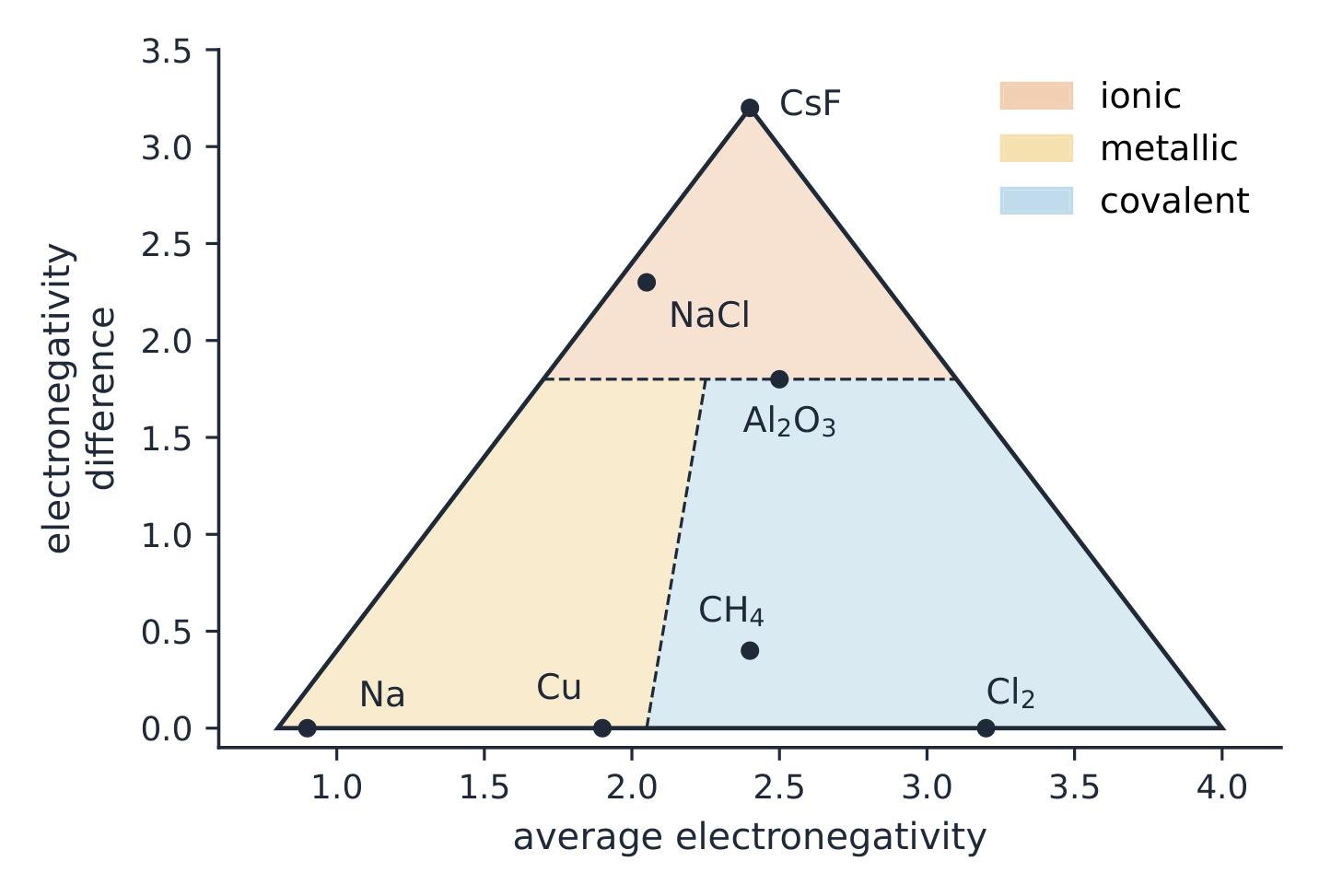
Which pair of coordinates follows from Mg 1.3 and O 3.4?
Dificultad 1/5 · 100 monedas + un pequeño bono en el primer intento de hoy
The bonding-triangle horizontal coordinate is average electronegativity: (1.3 + 3.4)/2 = 2.35. The vertical coordinate is the nonnegative difference: |3.4 − 1.3| = 2.1.
Find average electronegativity from supplied Mg 1.3 and O 3.4.
Dificultad 2/5 · 140 monedas + un pequeño bono en el primer intento de hoy
(1.3+3.4)/2 = 2.35.
Find nonnegative electronegativity difference for supplied Mg 1.3 and O 3.4.
Dificultad 2/5 · 140 monedas + un pequeño bono en el primer intento de hoy
3.4−1.3 = 2.1.
S2.4: Bound a property prediction from a region
- A position with predominantly ionic character supports an ionic-lattice model, often high melting temperature and mobile-ion conduction when molten. It does not guarantee high water solubility or specify an exact melting point.
- The covalent region can include molecular and extended-network structures. CO₂ and SiO₂ illustrate why a broad bonding label must be combined with connectivity and experimental evidence; the triangle alone cannot distinguish every molecular and network case.
Can the covalent region alone decide whether a substance has separate molecules?
Dificultad 1/5 · 100 monedas + un pequeño bono en el primer intento de hoy
Separate bonding character from the extent of the covalent structure.
S2.4: Define an alloy 合金 without inventing a molecule
- An alloy is a metallic material combining a metal with other elements. Brass is a Cu–Zn alloy with variable composition; the name does not imply a fixed collection of CuZn molecules or a universal 1:1 atom ratio.
- Some alloys contain several phases. Many are produced using molten components, but this is not the only processing route. Treat composition and microstructure as evidence to explain properties rather than converting a mixture name into a molecular formula.
Does the word brass specify a fixed CuZn molecular formula?
Dificultad 1/5 · 100 monedas + un pequeño bono en el primer intento de hoy
A metallic mixture is not a molecular compound.
S2.4: Explain alloy strengthening with limits
- Substitutional atoms of different sizes can distort a metal lattice and hinder slip. Small atoms can also occupy interstitial sites, as carbon can in iron-based structures. Steel properties additionally depend on phases and heat treatment.
- These mechanisms can raise strength or hardness, often with changes in ductility. Alloying does not automatically improve every property, and an oversized-substitution cartoon is not a literal drawing of carbon atoms in every steel.
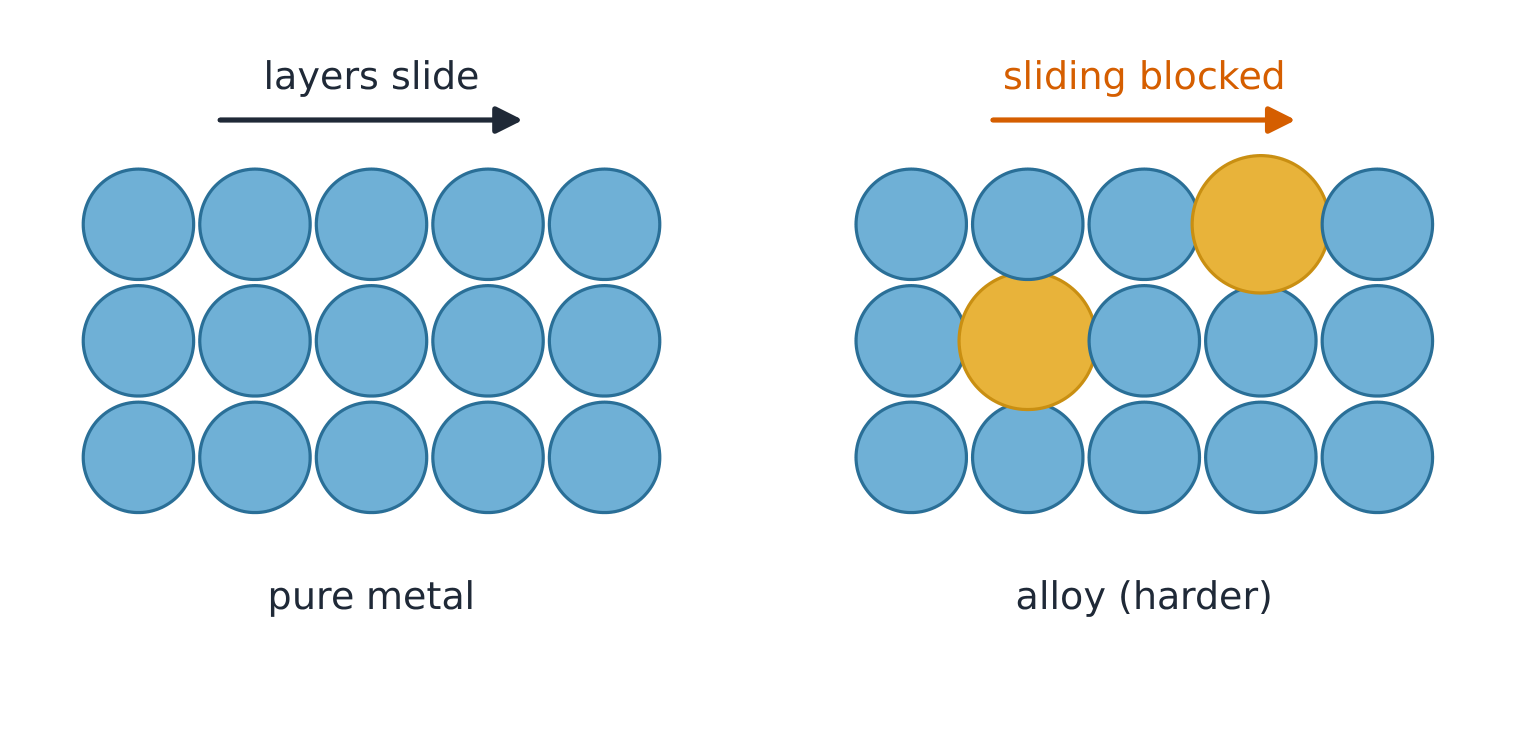
Must every alloy be harder and more ductile than its pure-metal parent?
Dificultad 1/5 · 100 monedas + un pequeño bono en el primer intento de hoy
Explain the mechanism and keep its conditions.
S2.4: Relate alloy examples to a useful property
- Brass combines copper and zinc; bronze commonly combines copper and tin. Iron–carbon steels can supply useful strength, and chromium is central to the corrosion resistance of stainless steels; many stainless grades also contain nickel.
- A protective surface layer can reduce corrosion under suitable conditions, but no alloy label guarantees immunity to every environment. Select a material by the actual property needed, composition, processing and exposure rather than memorizing that all added elements only increase hardness.
Is nickel required in every stainless-steel grade?
Dificultad 1/5 · 100 monedas + un pequeño bono en el primer intento de hoy
A family of alloys can contain different grades and compositions.
S2.4: Explain a fibre composite structurally
- Carbon-fibre reinforced polymer 聚合物 combines graphitic carbon fibres with a polymer matrix. Fibres can carry large tensile loads along their length, while the matrix transfers load and helps protect and position the fibres.
- The fibres are not simply polymer chains made of carbon. Layer orientation changes the directions in which a laminate performs well. An interface, defects and manufacturing quality matter, so a high strength per mass in one direction is not a universal superiority claim.
What is the main role of the matrix in this simplified fibre-composite model?
Dificultad 1/5 · 100 monedas + un pequeño bono en el primer intento de hoy
Relate each component to its structural role.
S2.4: Explain reinforced concrete as complementary structures
- Concrete’s matrix and aggregate provide useful compressive performance, while steel reinforcement helps carry tension and control crack opening. Load must transfer through the interface for the components to act together.
- The composite combines existing ionic/covalent components and metallic steel at a larger structural scale. It does not create one new universal composite bond, and neither strength alone nor density alone supplies a complete design decision.
Why add steel reinforcement to concrete?
Dificultad 1/5 · 100 monedas + un pequeño bono en el primer intento de hoy
Complementary properties and load transfer explain the composite.
S2.4: Calculate specific strength from stated data
- Specific strength is strength divided by density. In the explicitly invented CFRP example, 1264 MPa divided by 1.6 g/cm³ gives 790 MPa cm³/g. The chart’s other invented ratios are steel 60, aluminium alloy 150 and HDPE 30 in the same units.
- These are specified design examples, not universal material-class constants. Specific strength differs from stiffness, toughness, impact resistance and fatigue behaviour; direction of loading, grade and manufacturing affect which choice is appropriate.
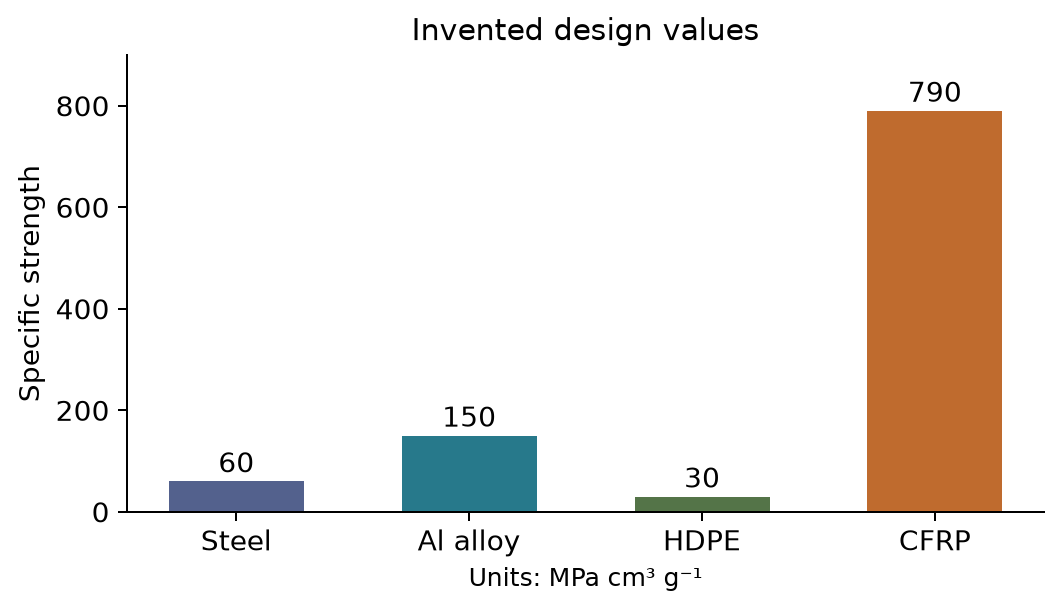
Does the invented ratio 790 prove the best material for every bicycle-frame load?
Dificultad 1/5 · 100 monedas + un pequeño bono en el primer intento de hoy
Keep a calculated metric distinct from a complete design judgement.
Using invented strength 1264 MPa and density 1.6 g/cm³, calculate their ratio in MPa cm³/g.
Dificultad 2/5 · 140 monedas + un pequeño bono en el primer intento de hoy
1264/1.6 = 790.
S2.4: Describe polymer architecture
- A polymer has macromolecules containing many repeating structural units. A monomer 单体 is a small molecule used to form the material; a repeating unit 重复单元 describes the recurring chain or network structure after reaction.
- Polymers can form linear or branched chains or cross-linked networks. Natural examples include polysaccharides, proteins and nucleic acids; many common plastics are synthetic polymers, but not every polymer is a flexible, low-melting plastic.
Must every polymer consist of a single unbranched chain?
Dificultad 1/5 · 100 monedas + un pequeño bono en el primer intento de hoy
Repeating structure can extend through chains or networks.
S2.4: Explain the HDPE LDPE comparison
- HDPE usually has relatively little branching compared with LDPE, allowing more regular packing and greater crystallinity. More branching in LDPE disrupts packing, which contributes to lower density and greater flexibility in the usual comparison.
- Intermolecular interactions, entanglement, chain length, additives and processing also affect properties. Do not assert that every HDPE chain has literally no branch or that molecular mass determines one exact melting temperature for every polymer family.
Why can the usual HDPE sample be denser than LDPE?
Dificultad 1/5 · 100 monedas + un pequeño bono en el primer intento de hoy
Structure changes density without changing the chemical identity of carbon and hydrogen.
S2.4: Distinguish thermoplastic softening and thermoset breakdown
- An uncross-linked thermoplastic can soften as segmental and chain motion becomes easier; crystalline regions can melt under suitable conditions. This can allow reshaping without breaking every backbone covalent bond.
- A heavily cross-linked thermoset remains a connected covalent network and does not simply flow as separate chains. Strong heating can decompose it. Physical softening, a melting transition and chemical degradation are different processes with different recycling implications.
Why does a thermoset not simply melt into separate mobile chains?
Dificultad 1/5 · 100 monedas + un pequeño bono en el primer intento de hoy
Identify which connections prevent independent chain motion.
S2.4: Derive an alkene addition repeating unit
- For the ideal alkene addition model, replace the C=C bond with a backbone C–C bond and retain every substituent on its original carbon. Draw continuation bonds through square brackets and place n outside.
- Ethene gives –CH₂–CH₂–; propene gives –CH₂–CH(CH₃)–. The methyl group stays off the backbone. No small molecule is lost in this propagation model; the formula of the repeat contains the same monomer atoms, while actual chain end groups involve initiation and termination details.
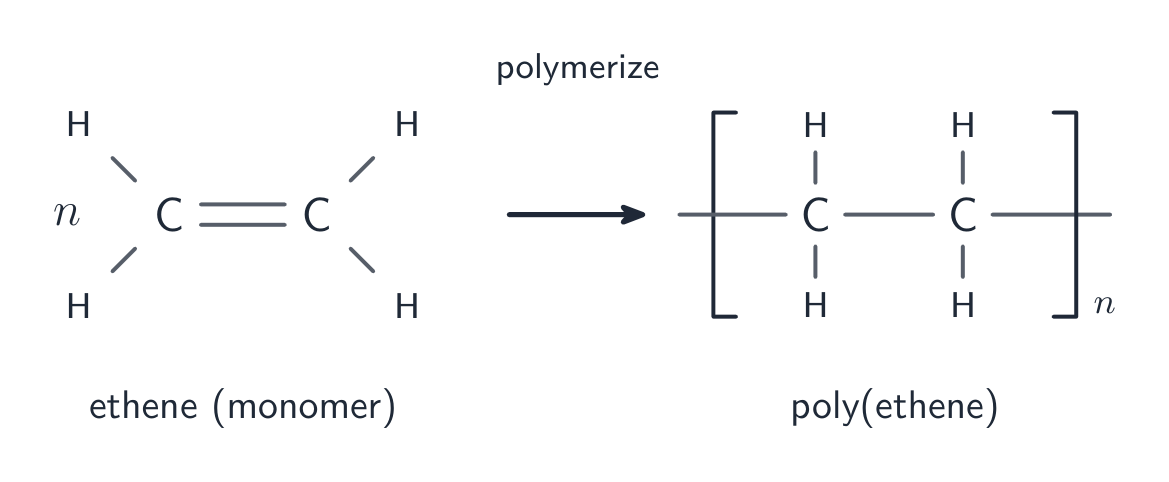
Does propene’s methyl substituent become a third backbone carbon in the usual repeat?
Dificultad 1/5 · 100 monedas + un pequeño bono en el primer intento de hoy
Preserve connectivity rather than flattening every substituent into the chain.
S2.4: Reverse a repeat to its monomer
- Identify the two backbone carbons derived from an alkene, remove their continuation bonds and restore the double bond while keeping their substituents. The repeat –CH₂–CH(CN)– gives CH₂=CHCN.
- For CH₂=CCl₂, both chlorines stay attached to the second carbon, so the repeat is –CH₂–CCl₂–. Do not remove chlorine as HCl in an ideal addition repeat: that would describe a different reaction and lose atoms incorrectly.
Does CH₂=CCl₂ lose HCl in the ideal addition-polymerization model?
Dificultad 1/5 · 100 monedas + un pequeño bono en el primer intento de hoy
Distinguish addition from a separate elimination reaction.
S2.4: Keep the atom balance in an addition model
- An ideal ethene repeat has two carbons and four hydrogens, the same as the monomer. A chain model with n such repeats has 2n backbone carbon atoms, aside from how terminal groups are represented.
- For an ideal drawing with 120 repeats, there are 240 repeat-derived backbone carbons. This counting statement is not a claim that initiator residues or end groups can always be ignored in an exact measured molecular formula or small-chain mass calculation.
How many repeat-derived backbone carbons occur in 120 ideal ethene repeats?
Dificultad 1/5 · 100 monedas + un pequeño bono en el primer intento de hoy
An ethene-derived repeat is –CH₂–CH₂– and contains two backbone carbon atoms. Thus 120 repeats contain 120 × 2 = 240 repeat-derived backbone carbons; chain end groups are outside this count.
Count repeat-derived backbone carbons in 120 ideal ethene repeats.
Dificultad 2/5 · 140 monedas + un pequeño bono en el primer intento de hoy
Each repeat has two backbone carbons: 2×120=240.
S2.4: Interpret persistence and fragmentation honestly
- Many common plastics are not readily biodegradable 可生物降解的 in ordinary disposal environments, but persistence depends on polymer, thickness, additives and conditions. Fragmenting into smaller pieces does not demonstrate complete biological conversion of the polymer.
- Combustion of carbon-containing plastic can release CO₂ and PVC can release corrosive hydrogen chloride. Do not attach one universal lifetime to all plastics or treat disappearance of a visible item as proof that no polymer fragments remain.
Does outdoor fragmentation prove complete biodegradation?
Dificultad 1/5 · 100 monedas + un pequeño bono en el primer intento de hoy
Separate physical size reduction from chemical and biological conversion.
S2.4: Evaluate a recycling claim
- A resin identification code indicates a polymer family and can help sorting. It does not guarantee that the local system collects the item, can process its additives or multilayers, or produces a useful recycled product.
- Thermoplastic reprocessing may be feasible but still needs appropriate sorting and conditions. Cross-linked networks, contamination and mixtures complicate recycling. Evaluate a claim using the actual material, local route and intended outcome rather than an identifying symbol alone.
Does a resin code guarantee local recyclability?
Dificultad 1/5 · 100 monedas + un pequeño bono en el primer intento de hoy
Identification and an available recycling process are different evidence.
S2.4: Combine evidence before choosing a material
- A justified material choice names the required loading and environment, links component structure to properties, and uses comparable measurements. Stiffness, strength, toughness, density, conductivity, cost and repair can favour different choices.
- For example, orienting fibres can improve stiffness and strength in one direction while leaving another direction more vulnerable. Alloying may improve one property while reducing another. A structural explanation should support a bounded decision, not manufacture a universal winner.
Should one high specific-strength result settle every material choice?
Dificultad 1/5 · 100 monedas + un pequeño bono en el primer intento de hoy
Use the decision’s actual requirements to choose which evidence matters.
S3.1: Read periods groups and blocks
- The modern periodic table orders elements by atomic number. A period is a horizontal row; a group is a vertical column numbered 1–18. A block identifies the characteristic s, p, d or f sublevel being filled.
- For main-group atoms, the period identifies the occupied outer principal level. The d block in period 4 fills 3d while 4s is occupied, so the sublevel’s first number alone is not the period number.
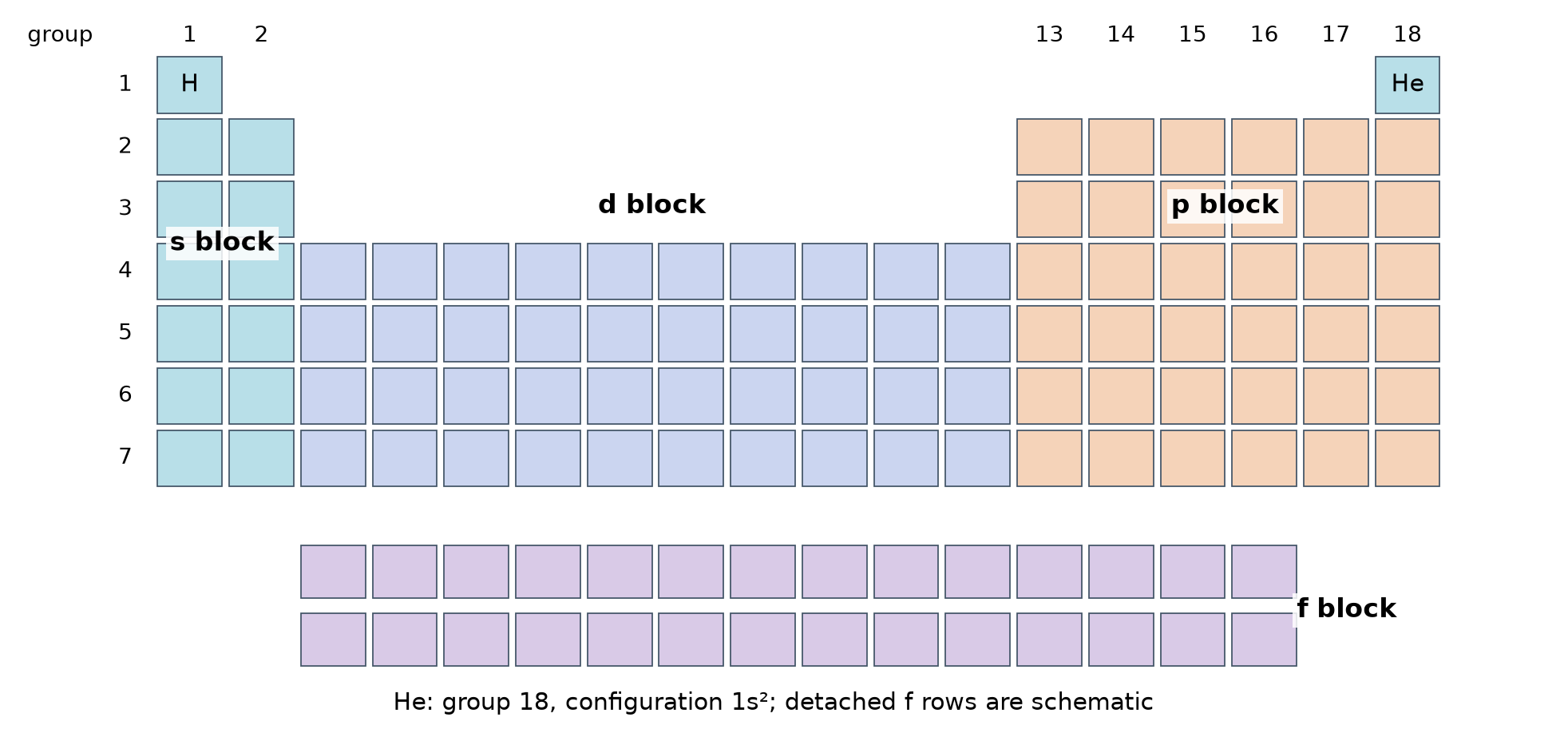
Does filling a 3d sublevel automatically place an element in period 3?
Dificultad 1/5 · 100 monedas + un pequeño bono en el primer intento de hoy
Identify the occupied outer level as well as the sublevel being filled.
S3.1: Handle helium and hydrogen explicitly
- Helium is placed in group 18 because its filled 1s² level gives noble-gas chemistry. Its configuration is s, even though the other group-18 atoms have outer p electrons. Helium has two outer electrons, not eight.
- Hydrogen is placed over group 1 but is not an alkali metal 碱金属. Main-group outer-count rules are useful with these exceptions; d-block group numbers do not translate directly into the same simple outer-electron rule.
Which description of helium is consistent?
Dificultad 1/5 · 100 monedas + un pequeño bono en el primer intento de hoy
Group placement and configuration blocks answer related but distinct questions.
S3.1: Recover a main-group configuration from position
- Bromine is in period 4, group 17. Start with [Ar], fill 3d¹⁰, then 4s²4p⁵ for the seven outer electrons. The count is 18 + 10 + 2 + 5 = 35, matching atomic number 35.
- Conversely, [Ne] 3s²3p⁴ has outer level n=3 and six outer electrons: period 3, group 16, p block. Keep known Cr and Cu exceptions when working through first-row d configurations, rather than forcing every atom into 3dⁿ4s².
What is the period and group for [Ne] 3s²3p⁴?
Dificultad 1/5 · 100 monedas + un pequeño bono en el primer intento de hoy
Use the outer principal number and total main-group outer count.
Count electrons in [Ar] 3d¹⁰4s²4p⁵.
Dificultad 2/5 · 140 monedas + un pequeño bono en el primer intento de hoy
18+10+2+5=35.
S3.1: Locate metals metalloids 准金属 and nonmetals
- Metals occupy the left and centre; nonmetals are concentrated at the upper right, with hydrogen an exception on the left. The commonly identified metalloid band includes B, Si, Ge, As, Sb and Te, although boundaries are conventional.
- A metalloid can combine properties: silicon can be shiny yet brittle and semiconducting. A position suggests chemistry and structure; it does not guarantee the exact conductivity or mechanical properties of every sample.
Does the metalloid label guarantee the same conductivity as a metal?
Dificultad 1/5 · 100 monedas + un pequeño bono en el primer intento de hoy
Use the measured property and structure alongside a broad classification.
S3.1: Explain the broad across-period radius trend
- Across a main-group period, nuclear charge increases while additional electrons enter the same main level. Similar inner shielding 屏蔽 means a stronger overall attraction for those electrons, so radius generally decreases.
- Atomic radii depend on the convention used, such as covalent or non-bonded radius. An electron cloud has no hard edge. Compare like definitions rather than mixing numbers from different tables to manufacture an exact universal size ranking.
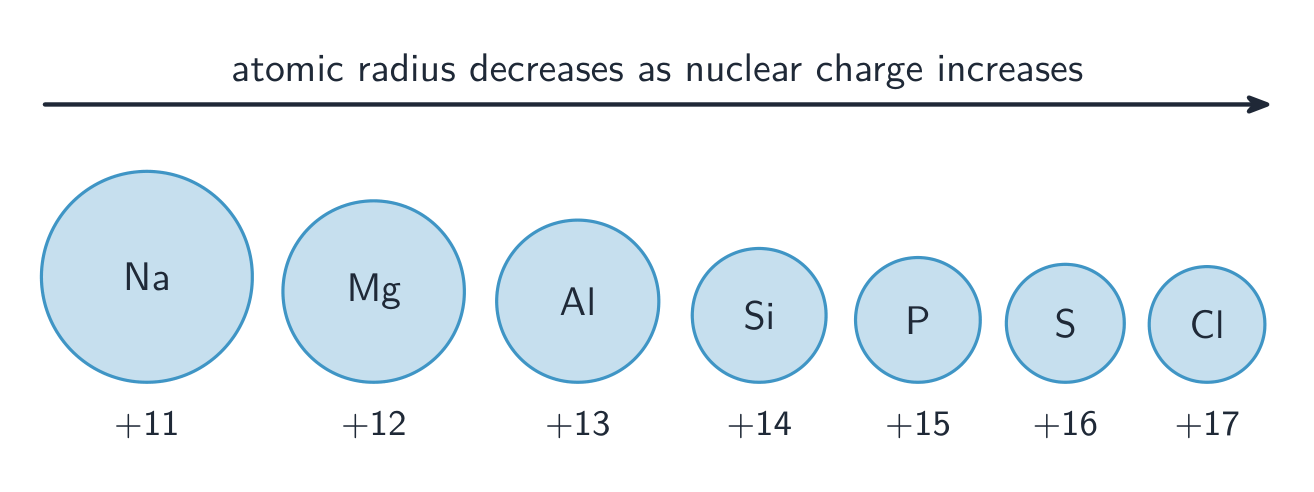
Why do period-3 atoms generally become smaller across the row?
Dificultad 1/5 · 100 monedas + un pequeño bono en el primer intento de hoy
The electron count rises across the period; contraction is not caused by shell removal.
S3.1: Explain down-group radius and electron loss
- Down a main group, the occupied outer level has a higher principal quantum number. The electron is generally farther from the nucleus and more shielded by inner electrons. Radius increases and first ionization energy generally decreases.
- Although nuclear charge also rises, distance and shielding usually dominate for the outer electron being removed. This is a broad main-group explanation, not proof of an exact monotonic value for every heavy element or every reaction rate.
Does increasing nuclear charge alone predict the radius down a group?
Dificultad 1/5 · 100 monedas + un pequeño bono en el primer intento de hoy
Compare all changing factors before deciding the overall trend.
S3.1: Compare an atom with its ion
- A cation is smaller than its corresponding atom under comparable conventions: electron loss reduces repulsion and may remove a whole outer level. Na→Na⁺ removes the n=3 occupation.
- An anion is larger than its atom because added electrons increase repulsion at the same nuclear charge. Removing a whole shell is not essential for every cation; transition-metal ion formation is a useful warning against that universal explanation.
Must forming every cation remove its entire outer electron shell?
Dificultad 1/5 · 100 monedas + un pequeño bono en el primer intento de hoy
Explain the actual configuration change, not a memorized shell-loss rule.
S3.1: Order an isoelectronic ion set
- Mg²⁺, Na⁺, F⁻ and O²⁻ each have ten electrons. Their nuclei contain 12, 11, 9 and 8 protons respectively. Greater nuclear charge attracts the same electron count more strongly.
- Thus increasing radius is Mg²⁺ < Na⁺ < F⁻ < O²⁻. Charge sign alone does not supply a universal radius ranking for unrelated ions; the shared electron configuration makes this comparison useful.
Compare O²⁻, F⁻, Na⁺ and Mg²⁺, each with ten electrons and proton counts 8, 9, 11 and 12 respectively. Which ion is largest under comparable radius conventions?
Dificultad 1/5 · 100 monedas + un pequeño bono en el primer intento de hoy
More protons contract an isoelectronic set; they do not enlarge it.
S3.1: Separate three electron properties
- First ionization energy removes an electron from an isolated gaseous ground-state atom to form a gaseous 1+ ion. Electron gain adds an electron to an isolated gaseous atom. Electronegativity describes relative attraction for shared electron density in a bond.
- Across main-group periods, first IE and electronegativity generally increase; down a group they generally decrease. Affinity has important exceptions and a sign convention to check. These properties answer different questions and should not be substituted for one another.
Which quantity explicitly describes a bonded atom attracting shared electron density?
Dificultad 1/5 · 100 monedas + un pequeño bono en el primer intento de hoy
State the species and change defining the quantity.
S3.1: State the affinity sign convention
- Here electron-gain enthalpy for X(g)+e⁻→X⁻(g) is negative if energy is released. A table headed energy released can report the same physical process as a positive number instead. Read its definition before comparing signs.
- Supplied values F −328 and Cl −349 kJ/mol mean chlorine’s gain is more exothermic by 21 kJ/mol. A positive-release table would show +328 and +349. The sign change is bookkeeping, not a reversal of which process releases more energy.
Which electron-gain value is more exothermic: −328 or −349 kJ/mol?
Dificultad 1/5 · 100 monedas + un pequeño bono en el primer intento de hoy
More negative enthalpy means greater energy release in this convention.
Find the magnitude of the difference between supplied F −328 and Cl −349 kJ/mol electron-gain enthalpies, in kJ/mol.
Dificultad 2/5 · 140 monedas + un pequeño bono en el primer intento de hoy
349−328=21 kJ/mol; Cl releases more.
S3.1: Explain the F Cl affinity exception
- Fluorine is more electronegative than chlorine on the usual Pauling scale, but chlorine’s isolated first electron gain releases more energy. The incoming electron experiences greater repulsion in fluorine’s compact 2p region.
- This interrupts a simple down-group electron-affinity 电子亲和能 trend. A halogen 卤素 molecule reacting in solution also requires bond changes and solvation; its overall oxidizing behaviour is not determined by one isolated-atom energy.
Does the F/Cl affinity exception make chlorine the more electronegative element?
Dificultad 1/5 · 100 monedas + un pequeño bono en el primer intento de hoy
Keep an isolated gaseous gain distinct from attraction in a bond.
S3.1: Link group 1 chemistry to electron loss
- Alkali metals generally become more reactive with water down group 1. The outer electron occupies a higher level, farther from the nucleus and more shielded, and is removed more readily under comparable conditions.
- For sodium, 2Na + 2H₂O → 2NaOH + H₂. The metal is oxidized and the product solution is alkaline. Sample size, surface and conditions affect observed vigour, so the trend is not a promise that every sample ignites in the same way.
Which products follow from sodium reacting with water?
Dificultad 1/5 · 100 monedas + un pequeño bono en el primer intento de hoy
Use the balanced metal–water reaction rather than a metal–oxygen reaction.
S3.1: Predict halogen displacement with conditions
- In halide formation a halogen is reduced: X₂+2e⁻→2X⁻. Ordinary aqueous displacement comparisons show chlorine oxidizing bromide or iodide, while iodine does not ordinarily oxidize chloride. Oxidizing ability generally falls down group 17.
- For example Cl₂+2I⁻→2Cl⁻+I₂ gives a brown iodine-containing solution. Fluorine reacts with water, so it should not be inserted into an ordinary aqueous test as if it were just another unchanged comparison solution.
Will iodine ordinarily displace chlorine from aqueous chloride in this test?
Dificultad 1/5 · 100 monedas + un pequeño bono en el primer intento de hoy
A displacement requires the stronger oxidizing halogen to oxidize the other halide.
S3.1: Classify oxides by reactions rather than fixed pH
- Many metal oxides are basic 碱性的 and neutralize acids. Al₂O₃ is amphoteric 两性的, reacting with acids and bases. Many nonmetal oxides are acidic 酸性的 and react with bases, but CO is neutral and SiO₂ does not react appreciably with water.
- Thus acidic oxide does not mean readily soluble acid solution, and amphoteric does not mean a guaranteed pH of exactly seven. Oxide character, solubility, amount, concentration and temperature are different parts of an explanation.
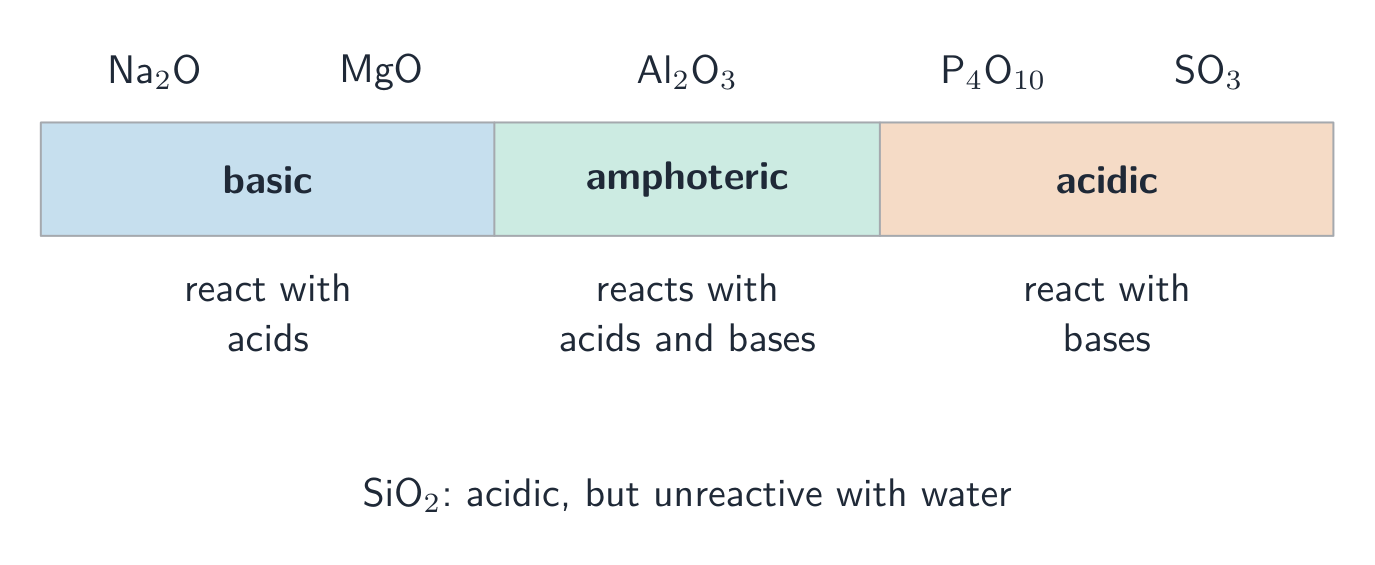
Does acidic SiO₂ have to make an acidic solution merely when placed in water?
Dificultad 1/5 · 100 monedas + un pequeño bono en el primer intento de hoy
Define the classification through reaction behaviour.
S3.1: Balance group 1 and group 2 oxide hydration
- Na₂O+H₂O→2NaOH and CaO+H₂O→Ca(OH)₂ conserve each element and form basic hydroxides under appropriate conditions. MgO reacts less readily and Mg(OH)₂ is only sparingly soluble.
- The actual pH cannot be read from the oxide formula alone. It depends on the amount reacting, water volume, solubility and conditions; neither all basic oxides nor all resulting solutions share the same pH.
Can a sodium oxide formula alone establish that the final solution has pH 14?
Dificultad 1/5 · 100 monedas + un pequeño bono en el primer intento de hoy
A qualitative acid–base classification does not specify a numerical concentration.
S3.1: Distinguish acid deposition 酸沉降 from oxide hydration alone
- SO₂ and nitrogen oxides can undergo atmospheric oxidation and reactions in droplets to form sulfuric and nitric acids. Overall 2SO₂+O₂+2H₂O→2H₂SO₄ includes oxidation; merely adding water to SO₂ does not by itself show sulfuric-acid formation.
- Acid deposition can damage limestone and affect forests and lakes. The balanced overall equations summarize chemistry, not a claim that every atmospheric process occurs as one elementary molecular collision.
What additional reactant appears in the overall SO₂-to-sulfuric-acid equation besides water?
Dificultad 1/5 · 100 monedas + un pequeño bono en el primer intento de hoy
Check atom conservation as well as the oxidation change.
S3.1: Explain ocean acidification 海洋酸化 without a pH threshold
- Dissolved CO₂ can be represented by CO₂+H₂O⇌H⁺+HCO₃⁻. Increasing H⁺ shifts carbonate towards hydrogencarbonate, reducing carbonate availability for many calcifying organisms.
- Acidification means decreasing pH. A fall within the alkaline range is still acidification: the water does not have to cross pH 7. It is the chemical change and carbonate balance, rather than the word acid alone, that supports the biological explanation.
Can seawater acidify while remaining above pH 7?
Dificultad 1/5 · 100 monedas + un pequeño bono en el primer intento de hoy
Distinguish a direction of change from a classification of the final solution.
S3.1: Assign oxidation states 氧化态 with a charge sum
- An oxidation state is a formal electron-allocation number. The states sum to zero in a neutral species and to the total charge in an ion. An uncombined element has state zero because equal sharing between identical atoms gives no net allocation change.
- For Cr₂O₇²⁻, seven O atoms at −2 contribute −14. Then 2Cr−14=−2 gives Cr +6. Roman numerals can identify the state in a name; the numeral is not the number of atoms.
What is chromium’s oxidation state in Cr₂O₇²⁻?
Dificultad 1/5 · 100 monedas + un pequeño bono en el primer intento de hoy
Divide the required total metal contribution by the number of metal atoms.
Find the oxidation state of Cr in Cr₂O₇²⁻, with oxygen −2.
Dificultad 2/5 · 140 monedas + un pequeño bono en el primer intento de hoy
Let the chromium oxidation state be x. Seven oxygen atoms contribute 7 × (−2) = −14. Charge balance gives 2x − 14 = −2, so 2x = 12 and x = +6.
S3.1: Check hydrides peroxides and fluorine
- Hydrogen is usually +1, but in NaH, sodium +1 requires hydrogen −1. In H₂O₂, hydrogen +1 requires oxygen −1. In OF₂, fluorine −1 requires oxygen +2. These exceptions still obey the charge sum.
- Fluorine is −1 in its compounds, while uncombined F₂ is zero. Do not let a usual rule override a more specific composition or the uncombined-element rule. Oxidation state is not always an actual measured charge on an atom.
What is the oxygen oxidation state in OF₂?
Dificultad 1/5 · 100 monedas + un pequeño bono en el primer intento de hoy
Two fluorines at −1 require oxygen +2 for a neutral molecule.
S3.1: Recognize average oxidation states and evidence limits
- In Na₂S₂O₃, taking one average sulfur value gives 2(+1)+2S+3(−2)=0, so average S is +2. The formula alone does not establish that both sulfur atoms have the same individual environment or state.
- A strong answer names what is inferred and what remains unresolved. The same habit applies to radius conventions, affinity signs, concentrations and observations: give the calculation and its assumptions rather than extending it beyond the evidence.
Does the average sulfur value +2 prove both sulfur atoms are equivalent?
Dificultad 1/5 · 100 monedas + un pequeño bono en el primer intento de hoy
One average equation cannot determine two inequivalent local environments.