Entropy, Gibbs energy and feasibility
Introducido| English | Significado |
|---|---|
| entropy/ˈentrəpi/ | entropía |
| Gibbs energy/ɡɪbz ˈenədʒi/ | energía de Gibbs |
What would explain this observation?
- A reaction can be endothermic and still be thermodynamically favourable. Enthalpy alone does not determine the direction favoured at a given temperature.
Build the model
- Entropy 熵 is associated with energy dispersal and the number of accessible microscopic arrangements.
- Gibbs energy 吉布斯能 combines enthalpy, entropy and absolute temperature for a process at constant temperature and pressure.
- entropy: A state property related to energy dispersal and accessible arrangements.
- Gibbs energy: A thermodynamic quantity combining enthalpy and entropy contributions.

What can remain small even when ΔG is negative?
Dificultad 1/5 · 100 monedas + un pequeño bono en el primer intento de hoy
Delta G says whether a reaction is thermodynamically favourable; it says nothing about kinetics. A high activation barrier can keep a favourable reaction immeasurably slow, as diamond shows.
Match each technical term to its precise meaning.
Dificultad 2/5 · 140 monedas + un pequeño bono en el primer intento de hoy
Use the definitions to distinguish related quantities and processes.
Choose evidence that can test it
- Use ΔG = ΔH - TΔS with consistent energy units.
- A negative Gibbs energy change indicates thermodynamic favourability for the stated conditions, not a fast rate.
- An activation barrier can make a favourable process slow.
In the lab: State whether values are standard-state quantities and record temperature in kelvin. Convert entropy from joules per kelvin per mole into kilojoules per kelvin per mole when enthalpy is in kilojoules per mole.
Which two habits make the investigation or model in this case more defensible?
Dificultad 2/5 · 140 monedas + un pequeño bono en el primer intento de hoy
Stating the conditions and assumptions lets others repeat the work exactly, and recording the supporting evidence lets them check the conclusion. Hiding disagreeing results removes the evidence that could challenge a wrong conclusion, and one measurement can never establish a wider claim.
Work from known quantities
- Known: ΔH = +20 kJ per mole, ΔS = +100 J per kelvin per mole and T = 300 K.
- Convert ΔS = 0.100 kJ per kelvin per mole. ΔG = ΔH - TΔS = 20 - 300×0.100 = -10 kJ per mole.
- The process is favourable under the stated approximation.
Your turn: ΔH=30 kJ per mole, ΔS=0.10 kJ per kelvin per mole and T=400 K. Find ΔG.
When can an endothermic process be favourable?
For ΔH = +20 kJ per mole and ΔS = +100 J per kelvin per mole, 300 K gives ΔG = −10 kJ per mole. Find the temperature where the sign changes, and compare other sign combinations.
ΔH=30 kJ per mole, ΔS=0.10 kJ per kelvin per mole and T=400 K. Find ΔG.
Dificultad 2/5 · 140 monedas + un pequeño bono en el primer intento de hoy
The result is -10 kJ/mol. Known: delta H = 30 kJ per mole; delta S = 0.10 kJ per kelvin per mole; T = 400 K. Use delta G = delta H - T x delta S. Delta G = 30 - 400 x 0.10 = -10 kJ per mole. Negative, so feasible under this approximation; note delta S was already in kJ.
Check the conclusion and its limits
- Thermodynamic favourability does not establish reaction rate.
- Celsius cannot replace kelvin in TΔS, and a unit conversion error can change the result by a factor of 1,000.
Not true: A thermodynamically favourable reaction must be fast. Feasibility and speed are different questions. Thermodynamics (delta G) says a reaction can proceed; kinetics (activation energy, rate) says how fast. Diamond to graphite is favourable yet imperceptibly slow.
- Entropy is associated with energy dispersal and the number of accessible microscopic arrangements.
- Use ΔG = ΔH - TΔS with consistent energy units.
- Watch for: thermodynamic favourability does not establish reaction rate.
Feasibility and speed are different questions.
Dificultad 1/5 · 100 monedas + un pequeño bono en el primer intento de hoy
True. Feasibility and speed are different questions. Thermodynamics (delta G) says a reaction can proceed; kinetics (activation energy, rate) says how fast. Diamond to graphite is favourable yet imperceptibly slow.
A state property related to energy dispersal and accessible arrangements: write the technical term.
Dificultad 1/5 · 100 monedas + un pequeño bono en el primer intento de hoy
entropy means A state property related to energy dispersal and accessible arrangements.
Delta H is plus 40 kJ per mole, delta S is plus 80 J per kelvin per mole, and the temperature is 400 K. What is delta G, and why does a negative value not prove the reaction is fast?
First convert entropy: ΔS = 80/1000 = 0.080 kJ/(K mol). Then TΔS = 400 × 0.080 = 32 kJ/mol, so ΔG = ΔH − TΔS = 40 − 32 = +8 kJ/mol. This positive value is unfavourable for the stated comparison. A negative value would indicate favourability, while rate would still depend on the kinetic pathway.
The written case has enthalpy change +40 kJ per mole, entropy change +80 J per kelvin per mole, and temperature 400 K. What is its Gibbs energy change?
Dificultad 1/5 · 100 monedas + un pequeño bono en el primer intento de hoy
Convert entropy to 0.080 kJ per kelvin per mole, then 40 − 400 × 0.080 = +8 kJ per mole. This uses the written case, not the earlier 30 kJ, 400 K calculation.
Write from an endothermic change and a temperature boundary
- In the original written case, enthalpy change is +40 kilojoules per mole and entropy change is +80 joules per kelvin per mole. At 400 K, first convert entropy to 0.080 kilojoules per kelvin per mole. Then $\Delta G=40-400(0.080)=+8$ kilojoules per mole. The positive entropy contribution has not yet outweighed the enthalpy term.
- This expanded route is AHL: Reactivity 1.4 is an HL-only unit with no SL copy. All new model datasets are invented. A superscript circle marks a standard-state quantity. When a calculation uses standard enthalpy and entropy, label the resulting Gibbs energy change standard too; an arbitrary mixture also needs its composition considered.
Explain entropy without giving particles intentions
- Entropy relates to accessible microscopic arrangements of matter and energy. Imagine four labelled, independently moving model particles, each allowed in either half of a box. Only one arrangement puts all four on the left. Six arrangements put two in each half, because there are six ways to choose which two occupy the left. The balanced distribution is more probable in this model because more arrangements produce it.
- “Particles want disorder” supplies neither a mechanism nor a count. For the same substance under comparable conditions, a gas generally has more accessible arrangements than its liquid, and a liquid more than its solid. Expansion at constant temperature normally increases a gas's entropy. These comparisons concern defined states, not whether an everyday scene looks untidy.
Use the coefficients in the entropy sum
- For a reaction, subtract the sum of reactant standard molar entropies from the sum for products, multiplying each by its equation coefficient. In an invented model, $\mathrm{AB(g)\rightarrow A(g)+B(g)}$ has values 220, 150 and 160 joules per kelvin per mole for AB, A and B. Its change is $(150+160)-220=+90$ in the corresponding reaction units.
- With rounded example values 192 for nitrogen, 131 for hydrogen and 193 for ammonia, $\mathrm{N_2+3H_2\rightarrow2NH_3}$ gives $2(193)-[192+3(131)]=-199$ joules per kelvin per mole of reaction as written. Reversing gives +199; halving all coefficients gives -99.5. A change in the amount of gas suggests a sign but does not replace the entropy data.
For N₂ + 3 H₂ → 2 NH₃, use rounded molar entropy values 192, 131 and 193 respectively, in joules per kelvin per mole. Find the reaction entropy change for the equation as written.
Dificultad 2/5 · 140 monedas + un pequeño bono en el primer intento de hoy
Products minus reactants, including coefficients: 2 × 193 − (192 + 3 × 131) = −199. Reversing gives +199; forming just one mole of ammonia halves the magnitude.
Do not transfer the enthalpy zero convention to entropy
- An element's standard enthalpy of formation is zero in its reference state by convention. Its standard molar entropy at room temperature is not zero. The third-law ideal zero refers to a perfect crystal at 0 K. Setting every elemental entropy to zero would therefore corrupt a reaction entropy calculation.
- A system entropy decrease does not by itself prohibit a change. The surroundings may gain sufficient entropy. For a closed system at constant temperature and pressure, with only pressure–volume work and heat exchange with surroundings at the same temperature, $\Delta S_{\mathrm{total}}=-\Delta G/T$. An exothermic system can transfer heat to the surroundings, increasing their entropy while its own accessible arrangements decrease.
Keep one energy unit throughout
- Consider invented standard values $\Delta H^\circ=+24$ kilojoules per mole and $\Delta S^\circ=+120$ joules per kelvin per mole at 300 K. Convert the latter to 0.120 kilojoules per kelvin per mole. Then $\Delta G^\circ=24-300(0.120)=-12$ kilojoules per mole. Using 120 directly alongside 24 gives a thousandfold error in the entropy term.
- Always use absolute temperature in $T\Delta S$. Celsius temperature cannot replace kelvin here. A negative Gibbs energy change identifies a thermodynamic driving force under the stated conditions; it is not a measurement of reaction speed. A barrier can leave a favourable process very slow, and a catalyst does not change the thermodynamic difference between the same initial and final states.
Invented standard data: enthalpy change +24 kJ per mole, entropy change +120 J per kelvin per mole, temperature 300 K. Find the standard Gibbs energy change.
Dificultad 2/5 · 140 monedas + un pequeño bono en el primer intento de hoy
Convert entropy to 0.120 kJ per kelvin per mole. Then 24 − 300 × 0.120 = −12 kJ per mole. The actual driving force for an arbitrary composition also needs Q.
Interpret the gradient and the crossing together
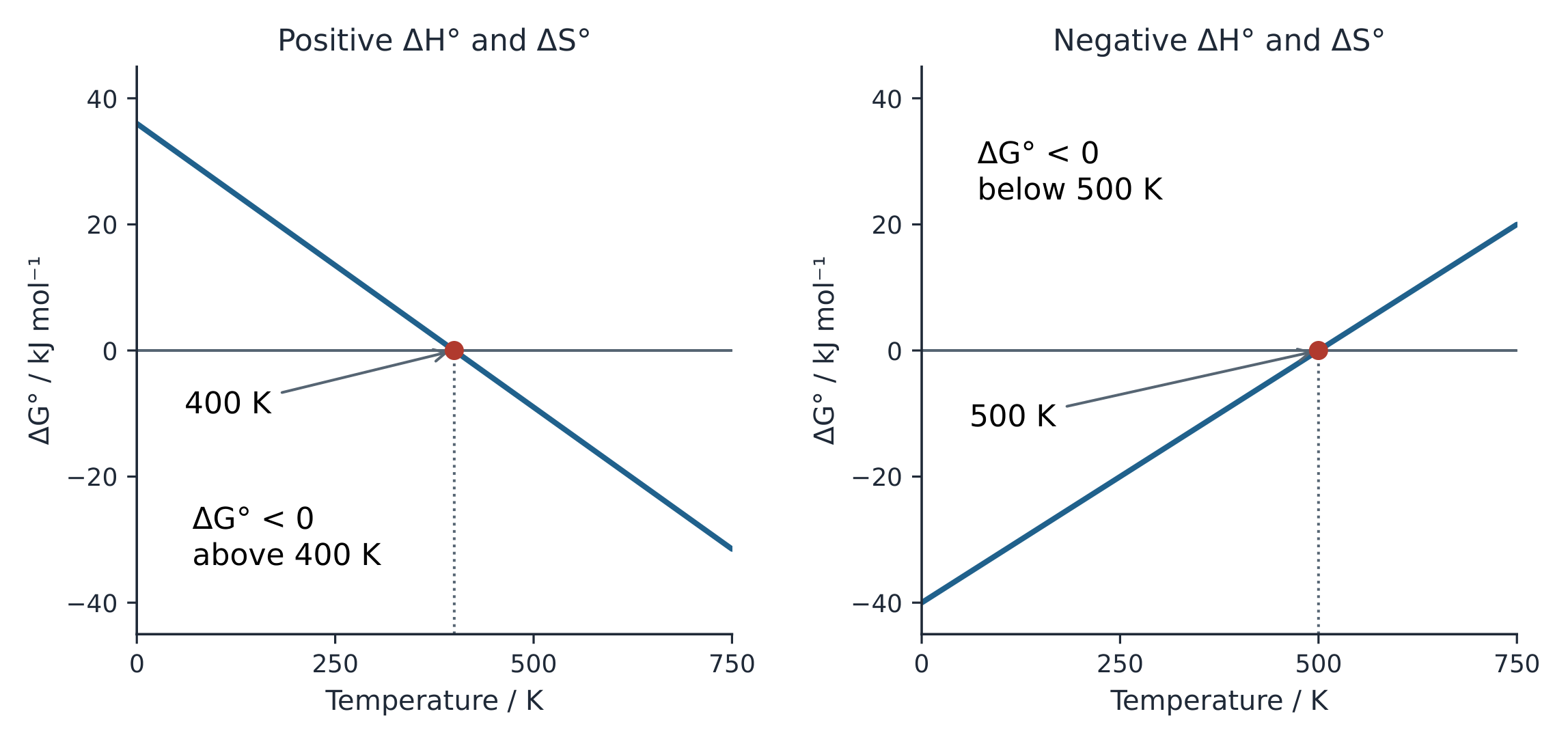
- Assuming standard enthalpy and entropy remain approximately constant, $\Delta G^\circ=\Delta H^\circ-T\Delta S^\circ$ is a straight line against temperature. Its intercept is standard enthalpy change; its gradient is the negative of standard entropy change. For +36 kilojoules per mole and +90 joules per kelvin per mole, the crossing is $36/0.090=400$ K.
- At 300 K this model gives +9 kilojoules per mole; at 500 K it gives -9. Therefore the standard Gibbs energy change is negative above 400 K, not below. Equality at 400 K is a boundary, not a negative value. A crossing calculation needs an inequality and a stated range in which the constant-value approximation and phases remain appropriate.
Reverse the temperature conclusion when entropy is negative
- For invented values $\Delta H^\circ=-40$ kilojoules per mole and $\Delta S^\circ=-80$ joules per kelvin per mole, $\Delta G^\circ=-40+0.080T$. The crossing is 500 K. Values at 300 and 600 K are -16 and +8 kilojoules per mole, so the standard value is negative below 500 K. Increasing temperature makes the negative entropy contribution less favourable.
- Negative enthalpy with positive entropy gives a negative standard Gibbs energy change at all positive temperatures in the constant-value model. Positive enthalpy with negative entropy gives a positive value at all such temperatures. These are conditional model results: phase changes and temperature-dependent enthalpy or entropy can invalidate extrapolation far beyond the stated range.
A constant-value model has standard enthalpy −40 kJ per mole and standard entropy −80 J per kelvin per mole. When is its standard Gibbs energy change negative?
Dificultad 1/5 · 100 monedas + un pequeño bono en el primer intento de hoy
Convert ΔS° = −80 J/(K mol) to −0.080 kJ/(K mol). Then ΔG° = ΔH° − TΔS° = −40 + 0.080T. Solve −40 + 0.080T < 0: T < 40/0.080 = 500 K. The value is negative below 500 K within the constant-value model; at 500 K it is zero.
Distinguish the current mixture from the standard comparison
- For the current composition, $\Delta G=\Delta G^\circ+RT\ln Q$. The reaction quotient $Q$ uses the current activities and the equation's stoichiometric powers. For an ideal A-to-B model it is the ratio of B activity to A activity. Use dimensionless activities or appropriately normalized concentration or pressure ratios; logarithms must not be applied to quantities carrying units.
- Pure solids and pure liquids have activity approximately one and do not contribute variable concentration factors in the usual school model. As products accumulate, $Q$ changes even while temperature and the standard Gibbs energy change remain fixed. The standard value alone therefore cannot establish the direction at every possible composition.
Test a positive standard value against a product-poor mixture
- Let an invented reaction have $\Delta G^\circ=+6.00$ kilojoules per mole at 300 K and $Q=0.0100$. With $R=0.008314$ in kilojoules per kelvin per mole, $RT\ln Q\approx-11.486$ kilojoules per mole. Thus the actual change is $6.00-11.486\approx-5.49$ kilojoules per mole: the forward direction is favoured at this composition.
- The logarithm is natural, not base ten. A positive standard value has not been “broken”; it answers a different question. If composition changes, recalculate the current driving force. Also do not mix $R=8.314$ in joules with a Gibbs energy in kilojoules. Both the temperature and the energy units must match the chosen gas constant.
At 300 K, standard Gibbs energy change is +6.00 kJ per mole and Q = 0.0100. Use R = 0.008314 kJ per kelvin per mole to find the actual Gibbs energy change.
Dificultad 2/5 · 140 monedas + un pequeño bono en el primer intento de hoy
Use ΔG = ΔG° + RT ln Q with consistent kJ units. The composition term is RT ln Q = 0.008314 × 300 × ln(0.0100) = −11.486215… kJ/mol. Therefore ΔG = 6.00 − 11.486215… = −5.486215… kJ/mol, about −5.49. Forward change is favoured at this composition despite the positive standard value.
Connect the equilibrium constant to the standard value
- At equilibrium, actual $\Delta G=0$ and $Q=K$. Rearranging gives $\Delta G^\circ=-RT\ln K$. A value $K>1$ corresponds to negative standard Gibbs energy; $K<1$ to positive standard Gibbs energy. Neither says that only one side is present. $K=1$ makes the standard change zero but does not generally make every species concentration equal.
- In the +6.00 kilojoules per mole model, $K=\exp[-6.00/(0.008314\times300)]\approx0.0902$. The current $Q=0.0100$ is smaller, independently confirming forward driving force. At equilibrium, the actual value is zero even though the standard value remains +6.00. Confusing these two zeros is a common explanation error.
Read direction from the ratio of quotient to constant
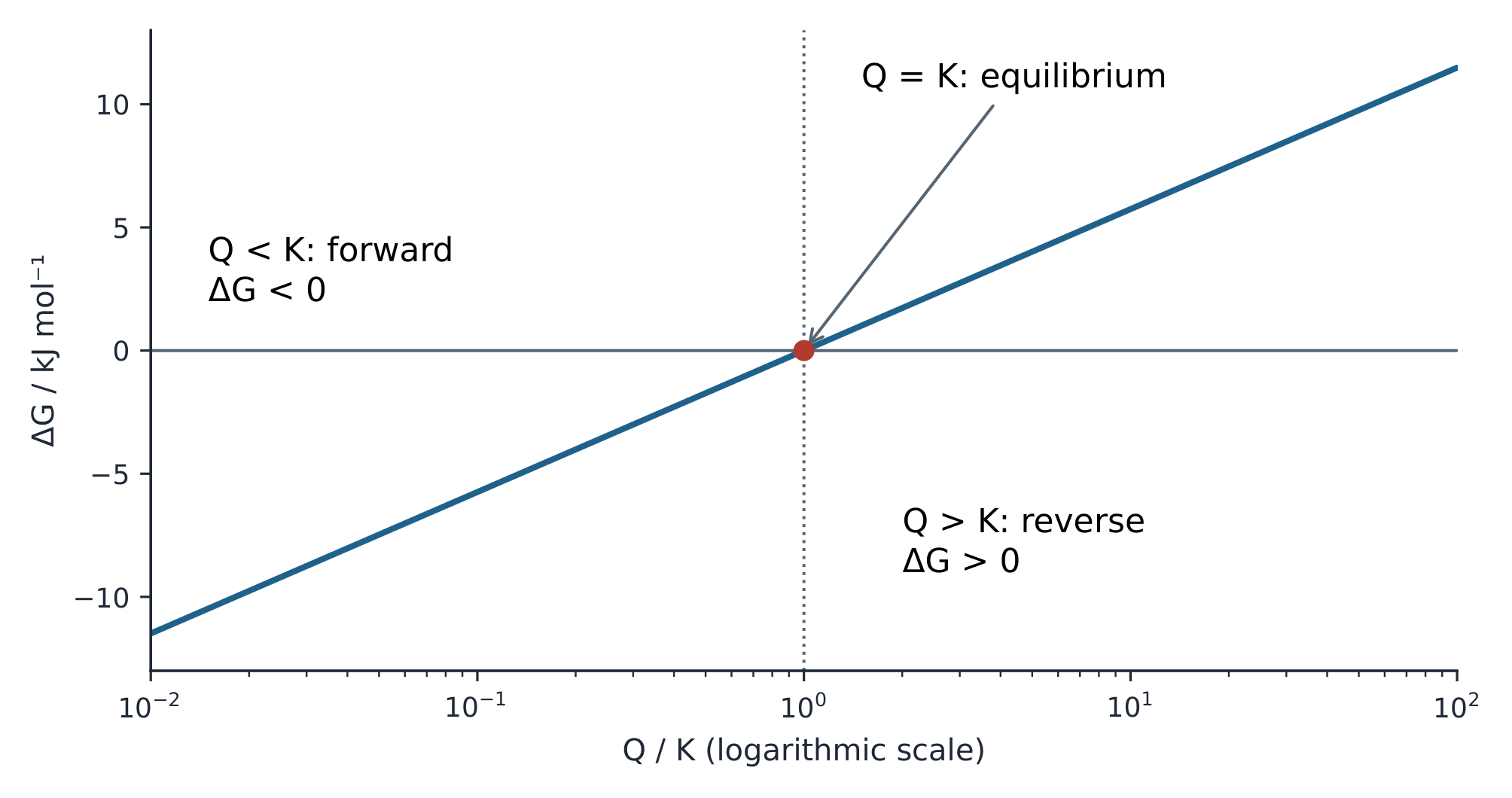
- Combining the equations gives $\Delta G=RT\ln(Q/K)$. With $K=10.0$ at 300 K, $Q=0.100$ gives approximately -11.49 kilojoules per mole, $Q=10.0$ gives zero, and $Q=100$ gives +5.743 kilojoules per mole. The favoured directions are forward, neither net direction at equilibrium, and reverse respectively.
- Thus compare $Q$ with $K$, rather than asking whether $Q$ alone exceeds one. A mixture with $Q=2$ and $K=10$ still favours forward change. A catalyst speeds approach to equilibrium but does not change $K$ at fixed temperature or reverse this thermodynamic comparison. Thermodynamic favourability also does not establish complete conversion.
Check the interpretation as well as the arithmetic
- For a fresh invented model, $\Delta H^\circ=+18$ kilojoules per mole and $\Delta G^\circ=-6$ at 300 K. Rearranging gives $\Delta S^\circ=[18-(-6)]/300=0.080$ kilojoules per kelvin per mole, or 80 joules per kelvin per mole. Keep the parentheses around the negative Gibbs value: subtraction then adds 6.
- In a final answer, state standard or actual, use consistent units, identify the temperature range and keep thermodynamics separate from kinetics. For a crossing, check both sides; for a composition problem, compare quotient and constant. Explain a model limitation specifically, such as a phase change or a constant-entropy approximation, rather than saying only that “the model is imperfect”.
The +6.00 kJ per mole standard model at 300 K reaches equilibrium with K about 0.0902. Explain which Gibbs energy change is zero, why the other need not be zero, and what a catalyst changes.
Always label standard versus actual values, then distinguish thermodynamic state differences from kinetics.