Ecological niches: resources, conditions and interactions
Introducido| English | Significado |
|---|---|
| ecological niche/ˌekəˈlɒdʒɪkl niːʃ/ | nicho ecológico |
| resource partitioning/rɪˈzɔːs pɑːˈtɪʃənɪŋ/ | partición de recursos |
What would explain this observation?
- Two species can share a habitat while using different resources or using the same resource at different times. A niche describes more than a location.
Build the model
- An ecological niche 生态位 includes how an organism uses resources, responds to conditions and interacts with other organisms.
- A fundamental niche describes potential conditions without restrictive biotic interactions in the model; a realized niche describes the conditions occupied when those interactions operate.
- Competition can restrict resource use or distribution.
- ecological niche: The resource use, conditions and interactions associated with an organism’s role.
- resource partitioning 资源分割: Differences in resource use that can reduce overlap among organisms.

What evidence concerns a niche rather than only a habitat location?
Dificultad 1/5 · 100 monedas + un pequeño bono en el primer intento de hoy
A niche is the species' role: what it eats, the conditions it tolerates and how it interacts. Recorded resource use with conditions addresses that; a map coordinate or a site name is only a location.
Match each technical term to its precise meaning.
Dificultad 2/5 · 140 monedas + un pequeño bono en el primer intento de hoy
Use the definitions to distinguish related quantities and processes.
Choose evidence that can test it
- Separate a habitat observation from a causal claim about a niche boundary.
- Absence from a site can reflect dispersal, detection, abiotic conditions or interactions.
- Resource partitioning can reduce overlap, but an observational difference alone does not prove that competition caused it.
- Compare alternative explanations and the timescale of evidence.
In the lab: Use permitted field observations or an attributed dataset. Record species identification confidence, resource category, time, abiotic conditions and sampling effort. Repeat observations at several locations rather than choosing only patches that fit the hypothesis. Non-destructive comparisons or approved models should be used instead of removing native species or introducing competitors.
Which two habits make the investigation or model in this case more defensible?
Dificultad 2/5 · 140 monedas + un pequeño bono en el primer intento de hoy
Stating the conditions and assumptions lets others repeat the work exactly, and recording the supporting evidence lets them check the conclusion. Hiding disagreeing results removes the evidence that could challenge a wrong conclusion, and one measurement can never establish a wider claim.
Work from known quantities
- Known: fictional birds A use resource categories in counts 18, 9 and 3 out of 30 observations; birds B use 3, 9 and 18.
- Their shared middle category is 30% for each, but the preferred categories differ.
- This is evidence of different observed resource use.
- It does not alone establish their full niches or demonstrate the cause of the difference.
Your turn: A species uses one resource in 12 of 40 feeding observations. Calculate the observed percentage.
Same habitat, different observed resource use
Compare bird A counts 18, 9, 3 with bird B counts 3, 9, 18. Each uses the middle category in 30% of observations, but their most-used categories differ. Doubling one sample preserves its percentages.
A species uses one resource in 12 of 40 feeding observations. Calculate the observed percentage.
Dificultad 2/5 · 140 monedas + un pequeño bono en el primer intento de hoy
The result is 30 %. Known: 12 of 40 feeding observations use the resource. Use percentage = count / total x 100. Percentage = 12/40 x 100 = 30%. Observed use in one survey does not by itself define the whole niche.
Check the conclusion and its limits
- A niche is not identical to a trophic level or a habitat.
- A realized niche is a context-dependent model, and an incomplete survey cannot establish every tolerance limit or competitive interaction.
Not true: Two species living in the same habitat necessarily have identical ecological niches. Species sharing a habitat can partition it - different foods, times or microsites - so identical location does not mean identical niches. Competition can restrict resource use or exclude a competitor; resource partitioning can support coexistence. An observed difference alone does not establish that competition caused it.
- An ecological niche includes how an organism uses resources, responds to conditions and interacts with other organisms.
- Separate a habitat observation from a causal claim about a niche boundary.
- Watch for: A niche is not identical to a trophic level or a habitat.
Species sharing a habitat can partition it - different foods, times or microsites - so identical location does not mean identical niches.
Dificultad 1/5 · 100 monedas + un pequeño bono en el primer intento de hoy
True. Species sharing a habitat can partition it - different foods, times or microsites - so identical location does not mean identical niches. Competition can restrict resource use or exclude a competitor; resource partitioning can support coexistence. An observed difference alone does not establish that competition caused it.
The resource use, conditions and interactions associated with an organism’s role: write the technical term.
Dificultad 1/5 · 100 monedas + un pequeño bono en el primer intento de hoy
ecological niche means The resource use, conditions and interactions associated with an organism’s role.
Write from 20 percent of feeding observations
- A species uses one resource in 9 of 45 feeding observations.
- Find the percentage. Sharing a habitat does not mean sharing one niche.
A species uses one resource in 9 of 45 feeding observations. What percentage is that, and why can two species share a habitat without sharing a niche?
Observed resource-use percentage = resource-use observations / all feeding observations × 100 = 9/45 × 100 = 20%. A niche includes how a species uses its habitat, not only where it is found.
In the SL written case, a species uses a resource in 9 of 45 feeding observations. What percentage is that?
Dificultad 1/5 · 100 monedas + un pequeño bono en el primer intento de hoy
9 divided by 45 is 0.20, so the share is 20 percent. Other options — 30 percent (the lesson example's result for 12 of 40 observations); 9 (the number of observations).
Describe a niche beyond its place or food label
- A habitat is the place occupied; a niche includes resources, conditions and interactions affecting survival and reproduction. For a bird, prey size, feeding height, time, nesting sites and temperature tolerance can all matter. Trophic level describes only a feeding position, not the complete niche.
- Resource partitioning means different use that can reduce overlap, such as different prey sizes or foraging times. It can support coexistence, but observations alone do not prove competition caused the differences. Resource availability, inherited preferences, season and age can change observed use; sample alternatives rather than selecting only evidence that fits one story.
Separate oxygen requirement from carbon source
- An obligate aerobe needs oxygen for sustained growth under the stated conditions. A facultative anaerobe can grow with oxygen and through suitable pathways without it. An obligate anaerobe grows without oxygen and is inhibited under sufficiently oxygenated conditions. Oxygen-independent metabolism is not the absence of all chemical reactions or necessarily the absence of every form of respiration.
- In invented matched treatments, growth increases with/without oxygen are X: 80/0, Y: 90/35 and Z: 0/70 units. These fit the three categories respectively if other requirements and viability are controlled. A single failed treatment could instead lack another resource. Heterotrophy and oxygen requirement are separate properties, so do not infer one from the other.
In invented matched treatments with other requirements met, strain Z increases by 0 units with oxygen and 70 without oxygen. Which model fits this evidence?
Dificultad 1/5 · 100 monedas + un pequeño bono en el primer intento de hoy
Growth without oxygen and inhibition with oxygen fits obligate anaerobiosis when alternative deficiencies are controlled. Oxygen requirement does not identify carbon source or every metabolic pathway.
Keep photosynthetic energy and carbon sources distinct
- Photosynthetic plants, algae and cyanobacteria use light energy to support organic synthesis from carbon dioxide. Light supplies energy, while carbon dioxide supplies carbon atoms. Water and minerals remain necessary, but a plant does not obtain most organic food carbon by swallowing soil particles or turning sunlight atoms into sugar atoms.
- Photosynthetic organisms also respire. Darkness stops light-dependent energy input rather than every metabolic process immediately. Colour alone does not establish a nutritional pathway, and an animal with photosynthetic partners still has animal feeding and metabolic requirements. Investigate the organism's actual carbon and energy transfers.
Locate digestion before interpreting an animal budget
- In holozoic nutrition, ingestion brings food in; digestion breaks it into absorbable products; absorption crosses into internal tissues or transport; assimilation incorporates material into metabolism and structures. Egestion removes unabsorbed food, whereas excretion removes metabolic waste. Saprotrophs instead secrete enzymes onto dead material and absorb soluble products after extracellular digestion.
- An invented animal ingests 100 matter units, egests 25 and later excretes 5 of the absorbed units in a specified category. Absorption is 75 and the stated remainder is 70. That remainder is not automatically new biomass: respiration, maintenance and other transfers still matter. State whether a budget tracks matter or energy before combining terms.
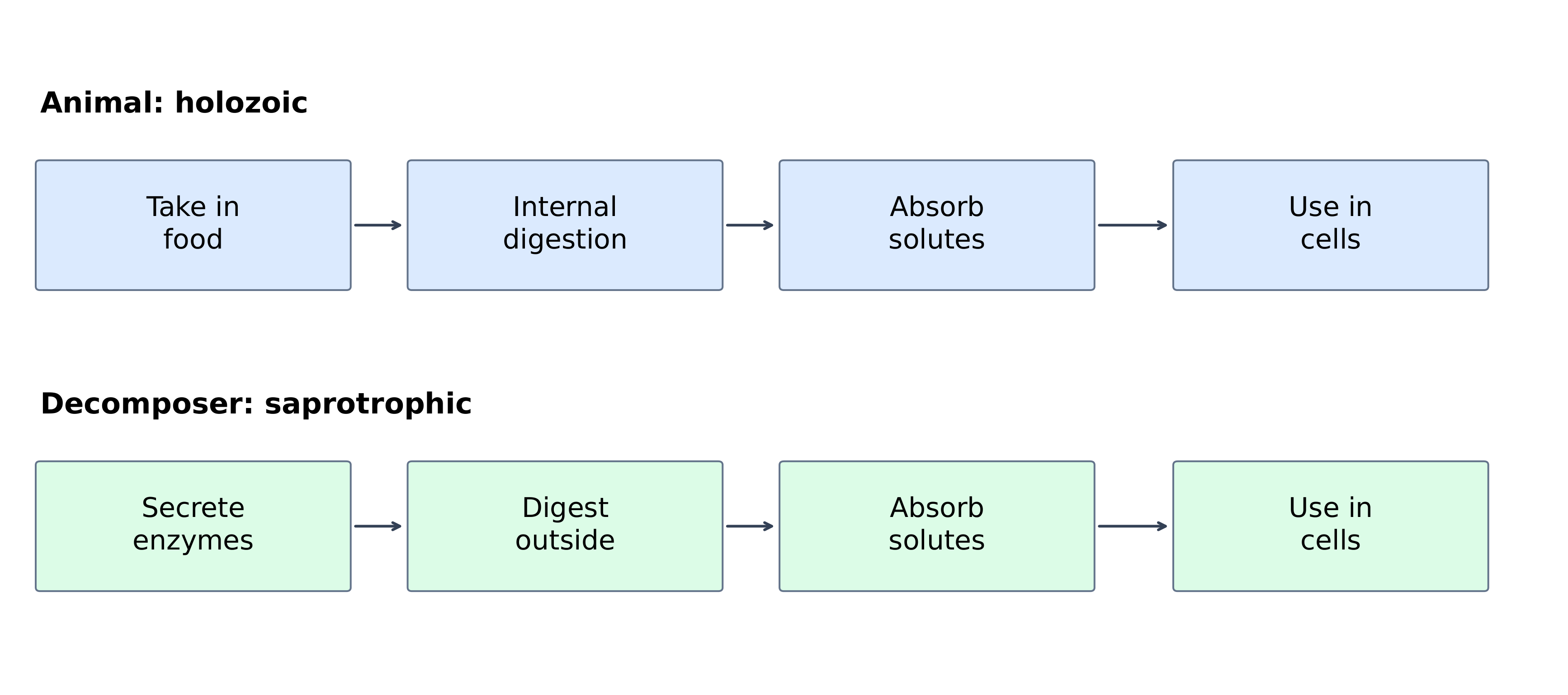
An invented animal ingests 100 matter units and egests 25 unabsorbed units. How many units are absorbed, before the later specified metabolic-waste loss?
Dificultad 2/5 · 140 monedas + un pequeño bono en el primer intento de hoy
Absorption = 100 − 25 = 75. If 5 of those later leave in the specified excreted category, 70 remain in that limited balance; neither quantity is automatically all new biomass.
Test nutritional flexibility with matched treatments
- Euglena gracilis has photosynthetic capacity and can use dissolved organic substrates under suitable conditions. Heterotrophy need not mean engulfing visible prey. A growth study compared light and organic-carbon conditions; this kind of design distinguishes contributions rather than assigning nutrition from green colour alone.
- In an invented factorial model, growth increases are light/no organic addition 20, dark/organic 15, light/organic 32 and dark/no organic 0 units. The single-source treatments support flexibility, while combined growth need not equal 35 because pathways and limitations interact. Control other nutrients, temperature and starting cells, and consider stored reserves, substrate carryover and survival before claiming indefinite growth.
Distinguish nutritional range from fixed proportions
- A facultative mixotroph can alter reliance on photosynthetic and heterotrophic contributions, including growth through one mode when conditions permit. An obligate mixotroph requires contributions from both modes under the conditions defining that dependence. “Both” does not mean exactly half its carbon comes from each route or that every mixotroph survives indefinitely in darkness.
- Archaea also have diverse energy and carbon pathways rather than one universal diet. An invented archaeon using light plus organic carbon is not thereby shown to fix carbon dioxide. Another can gain energy by oxidizing inorganic chemicals while using carbon dioxide as carbon source; a third can obtain chemical energy and carbon from organic compounds. Ask separately what supplies energy and what supplies carbon.
Infer dietary capacity without inventing meal percentages
- Hominidae includes humans and other great apes as well as extinct relatives. Human incisors bite, canines contribute tearing and cheek teeth crush and grind varied foods. The Smithsonian SK 46 account describes large cheek teeth relative to front-tooth sockets in Paranthropus robustus, supporting substantial processing of plant material.
- This does not give an exact diet percentage or prove every meal required maximal force. Canines can also serve display or defence, including in largely plant-feeding apes. Combine anatomy with wear, isotope and ecological evidence. In an invented area model, cheek/front areas 120/30 give ratio 4, while 90/45 give 2; these are tooth-area ratios, not plant-to-meat ratios.
Link feeding access to plant resistance
- Grasshopper mandibles cut and crush plant tissues; aphid stylets reach fluids such as phloem sap. Both are herbivorous access mechanisms, but the tissue affected and physical task differ. Plants can resist feeding with thorns, tough tissues or hairs and with deterrent or toxic compounds. Some herbivores detoxify particular chemicals, not every toxin at every concentration.
- In an invented matched comparison, leaves with a tested compound lose 8% area versus 20% without it: 12 percentage points less, a 60% relative reduction. Causal interpretation needs comparable age, toughness, exposure and other conditions. Defence and detoxification also cost resources, so identify trade-offs rather than assuming every additional defence is unconditionally beneficial.
Choose the denominator for each predation stage
- Predators must detect, capture and overcome prey. Sensory structures support detection, claws or webs capture, venom can help immobilize, and stealth or pursuit affects encounters. Prey can use camouflage, armour, deterrents, vigilance or escape. Each changes probabilities and can carry costs; a defence does not guarantee survival against every sensory system.
- In an invented sequence of 100 encounters, 60 lead to detection, 30 to capture and 24 to successful killing. Detection is 60%; capture conditional on detection is 50%; killing conditional on capture is 80%; overall killing is 24%. Naming the stage determines the denominator: the 80% conditional value is not overall success.
In an invented sequence, 100 encounters lead to 60 detections, 30 captures and 24 successful kills. What percentage of captures result in a kill?
Dificultad 2/5 · 140 monedas + un pequeño bono en el primer intento de hoy
The question conditions on capture, so 24/30 × 100 = 80%. Overall kills per encounter are 24%, and captures per detection are 50%; choose the denominator matching the stage.
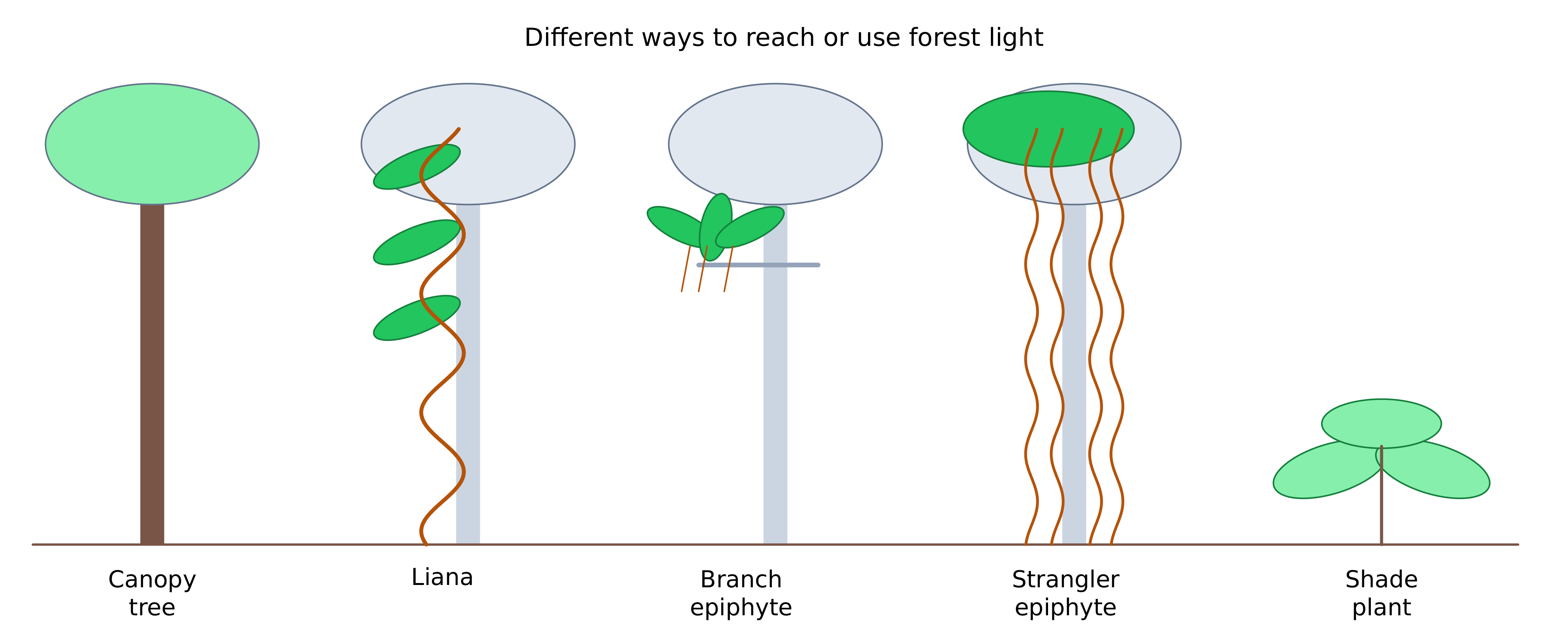
Compare forest strategies for reaching light
- Canopy trees invest in trunks raising crowns into strong light. Lianas climb supports while obtaining resources through their own roots. Epiphytes establish on branches and use hosts as support, but need their own water and nutrients rather than automatically tapping host transport tissues as parasites.
- Some strangler epiphytes send roots toward the ground and can surround hosts and compete for light and soil resources. Shade-tolerant shrubs and herbs can persist at lower light through suitable structure and physiology, not at zero energy input indefinitely. These are different strategies, not five compulsory stages in one plant's life cycle.
Treat potential and realized niches as models
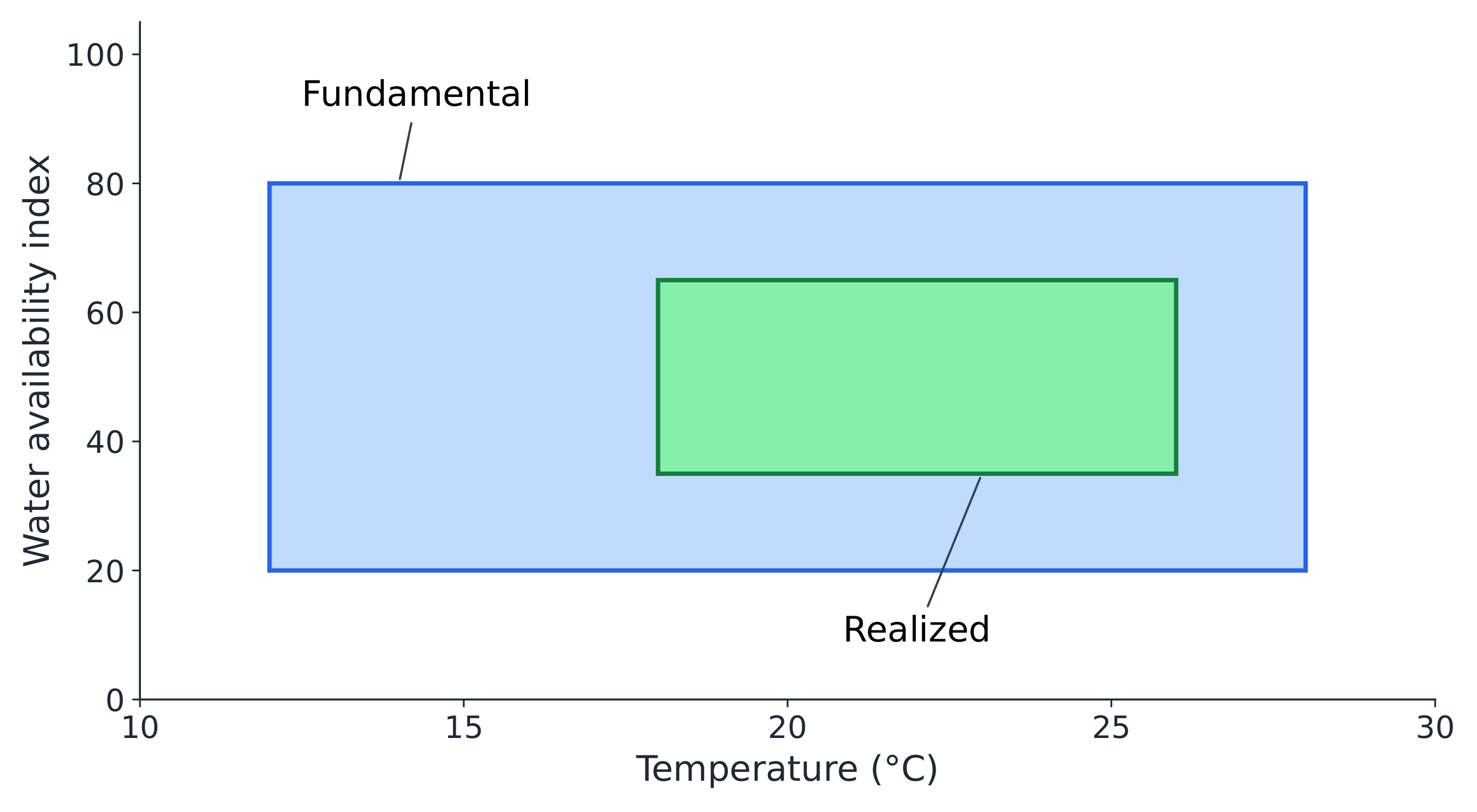
- A fundamental niche describes potential conditions and resources allowing persistence in the stated model. In a competition-focused comparison, remove restrictive competition while retaining food and essential partners. Removing every organism, including necessary symbionts, would change more than competition and could destroy the conditions required for growth.
- The realized niche describes actual occupancy or use under interactions present. Competition can restrict it, but facilitation, dispersal, history and detection also matter. A smaller realized region inside a potential region illustrates competitive restriction; it is not proof that all biological interactions are harmful or that every observed absence marks a physiological boundary.
Test competitive restriction with appropriate controls
- Use supplied simulations or an approved controlled comparison with and without a competitor, keeping abiotic conditions and resources comparable. Expansion by the focal species when competition is reduced supports a competition effect. Indirect effects and observation time still matter; one treatment does not automatically identify every interaction or establish an exact permanent boundary.
- Competitive exclusion can occur when two species rely on the same limiting resources in a stable, sufficiently uniform closed model. Unequal finite counts do not alone prove permanent elimination. Different resource use, spatial structure or changing conditions can support coexistence. Interpret a controlled model within its conditions rather than destructively adding or removing species in a field habitat.
Calculate only the overlap index actually defined
- Invented resource counts are A: 18, 9, 3 and B: 3, 9, 18. Both total 30, so proportions are 60%, 30%, 10% and 10%, 30%, 60%. All categories are shared. If the supplied index is the sum of the smaller proportional use in each category, overlap is $10+30+10=50\%$.
- This defined index summarizes observed proportions; it is not a universal measure of competition strength. One category used in 14 of 35 observations is 40%, while 5 of 50 is 10%. Neither alone identifies the narrower specialist because the remaining categories, availability, sampling and other niche dimensions are unknown.
Invented proportional resource uses are A: 60%, 30%, 10% and B: 10%, 30%, 60%. An index is defined as the sum of the smaller use in each category. Find this index.
Dificultad 2/5 · 140 monedas + un pequeño bono en el primer intento de hoy
Category-wise minima are 10%, 30% and 10%, summing to 50%. This defined observed-use index does not by itself measure causal competition, resource availability or complete niche breadth.
Build a niche explanation from several kinds of evidence
- State the carbon and energy routes, oxygen conditions, resource use and interactions relevant to the organism. Then connect a named structure to an access or defence mechanism. Distinguish what it can do from what it was observed doing; tooth shape, green colour or a shared habitat alone cannot supply the whole explanation.
- To argue competition, compare resource availability and use, population responses and controlled alternatives over an appropriate period. To argue specialization, sample multiple resource and condition dimensions consistently. Report denominators and model assumptions instead of treating one percentage, one missing record or one unequal population count as a complete ecological verdict.
Two species share a habitat but use different foods, and one has fewer observations. Evaluate a claim that competition caused the difference and permanently excluded the less common species from its fundamental niche.
Fundamental/realized niches and competitive exclusion are explanatory models requiring evidence about conditions and interactions, beyond a single count or food percentage.