Specialized cells: structure linked to function
Introducido| English | Significado |
|---|---|
| differentiation/ˌdɪfəˌrenʃɪˈeɪʃn/ | diferenciación |
| gene expression/dʒiːn ekˈspreʃn/ | expresión génica |
What would explain this observation?
- A root-hair cell and a red blood cell have different shapes because their functions impose different demands.
Build the model
- Differentiation 分化 produces specialized cells through different patterns of gene expression 基因表达.
- A root-hair extension increases exchange area.
- A mammalian red blood cell lacks a nucleus at maturity and contains haemoglobin; this is a specific adaptation, not a rule for all animal cells.
- differentiation: Development of specialized cell structure and function.
- gene expression: Use of genetic information to produce a functional product.

What best explains many differences between specialized cells?
Dificultad 1/5 · 100 monedas + un pequeño bono en el primer intento de hoy
Specialized cells share the same genome but express different gene sets, producing different proteins and therefore different structures. The genetic code is universal, and all these cells descend from the same zygote.
Match each technical term to its precise meaning.
Dificultad 2/5 · 140 monedas + un pequeño bono en el primer intento de hoy
Use the definitions to distinguish related quantities and processes.
Choose evidence that can test it
- Link a named feature to a mechanism and then to the function.
- Increased area can support exchange, but membrane proteins, gradients and metabolic demand also matter.
- Stem cells retain different degrees of developmental potential.
In the lab: Compare scaled drawings of named cells. Label the structure, state the function and explain the causal link. Use tissue-specific examples rather than saying every specialized cell has every adaptation.
Which two habits make the investigation or model in this case more defensible?
Dificultad 2/5 · 140 monedas + un pequeño bono en el primer intento de hoy
Stating the conditions and assumptions lets others repeat the work exactly, and recording the supporting evidence lets them check the conclusion. Hiding disagreeing results removes the evidence that could challenge a wrong conclusion, and one measurement can never establish a wider claim.
Work from known quantities
- Known: a spherical model cell has radius 2 units.
- Surface area/volume = 3/r = 1.5 per unit.
- A radius of 4 gives 0.75 per unit.
- Doubling radius halves this ratio, even though total area increases.
Your turn: For a sphere, surface area/volume = 3/r. Find this ratio when r = 6 units.
More surface area, but less area per unit volume
A sphere of radius 2 has area/volume 1.5 per unit. Doubling radius to 4 raises total area but halves area/volume to 0.75 per unit.
For a sphere, surface area/volume = 3/r. Find this ratio when r = 6 units.
Dificultad 2/5 · 140 monedas + un pequeño bono en el primer intento de hoy
The result is 0.5 per unit. Known: for a sphere, surface area / volume = 3/r; r = 6 units. Ratio = 3/6 = 0.5 per unit. Larger radius means a smaller surface-area-to-volume ratio, even though the total surface grows.
Check the conclusion and its limits
- Specialization does not usually require a cell to lose most of its genes.
- The spherical calculation models geometry; it does not describe every actual cell shape.
Not true: All mature animal cells lack a nucleus. Most specialized nucleated body cells retain broadly the same genome and use different combinations of genes. Specialization usually changes gene expression rather than deleting genes that are not being used. Mature mammalian red blood cells are a named exception: they lose the nucleus during development. That exception does not mean all mature animal cells lack a nucleus.
- Differentiation produces specialized cells through different patterns of gene expression.
- Link a named feature to a mechanism and then to the function.
- Watch for: specialization does not usually require a cell to lose most of its genes.
Most specialized nucleated body cells retain broadly the same genome and use different combinations of genes.
Dificultad 1/5 · 100 monedas + un pequeño bono en el primer intento de hoy
True. Most specialized nucleated body cells retain broadly the same genome and use different combinations of genes. Specialization usually changes gene expression rather than deleting genes that are not being used. Mature mammalian red blood cells are a named exception: they lose the nucleus during development. That exception does not mean all mature animal cells lack a nucleus.
Development of specialized cell structure and function: write the technical term.
Dificultad 1/5 · 100 monedas + un pequeño bono en el primer intento de hoy
differentiation means Development of specialized cell structure and function.
Write from a sphere of radius 4 units
- For a sphere, surface area over volume is 3 divided by r.
- With radius $r=4$ length units, surface area / volume = $3/4=0.75$ per length unit. Many mature animal cell types retain a nucleus.
For a sphere, surface area / volume = 3/r. What is the ratio per length unit when r = 4 length units, and do all mature animal cells lack a nucleus?
Substitute r = 4 length units into 3/r: 3/4 = 0.75 per length unit. Many mature animal cells retain a nucleus; mature mammalian red blood cells are a named exception.
A spherical model cell has radius r = 4 length units. Use surface area / volume = 3/r. Find this ratio per length unit.
Dificultad 1/5 · 100 monedas + un pequeño bono en el primer intento de hoy
For the stated sphere, surface area / volume = 3/r = 3/4 = 0.75 per length unit. At r = 6 units, the ratio would be 3/6 = 0.50 per unit. Radius and area per volume are different quantities.
Explain different cells without deleting their genes
- Differentiation produces specialized structures and functions through different patterns of gene expression. A cell carrying oxygen and a cell producing force require different combinations of proteins. Most nucleated body cells retain broadly the same genome rather than deleting every gene they are not currently using.
- Mature mammalian red blood cells are a named exception because they lose their nuclei during development. Do not turn that exception into a rule for all mature animal cells. To support a gene-expression explanation, compare appropriate functional products as well as cell shapes; appearance alone does not show which genes are active.
Interpret a developmental signal threshold precisely
- Cells in different positions can encounter different signal concentrations and activate different expression programmes. In an invented model, below 2 units gives A, from 2 to below 5 gives B, and 5 or above gives C. Exposures 1, 2, 3, 5 and 6 therefore give A, B, B, C and C.
- The exact boundary matters: 2 belongs to B and 5 to C. This model links position and signal to a response without changing the underlying DNA sequence. It is not a universal embryonic threshold. Test controlled exposures and expression measurements rather than assuming every developmental difference uses this one signal.
Separate self-renewal from differentiation
- A stem cell can produce more stem cells and specialized descendants. Self-renewal maintains the stem-cell population; developmental potency describes the range of descendants it can produce. Many divisions alone do not show broad potency, and one differentiation event does not establish long-term renewal.
- Under suitable conditions, stem cells can support repeated renewal, but not every stem cell divides continuously or survives indefinitely. Local signals and the cell's state matter. The NIH introduction explains renewal and specialized-cell production as distinct properties, rather than equating any dividing cell with a broadly potent stem cell.
State what each division actually produces
- Start with one stem cell. In an invented asymmetric model, each round leaves one continuing stem cell and adds one non-dividing specialized descendant. After four rounds, there are one stem cell and four specialized descendants: five cells total, assuming survival and no further descendant division.
- In a different model, every stem cell produces two stem cells each round, without death or differentiation. Four rounds give $2^4=16$ stem cells and no specialized descendants. Choose the model before using a power of two; the same number of rounds does not imply the same population when cell fates differ.
An invented asymmetric model begins with one stem cell. Each round leaves one continuing stem cell and adds one specialized descendant that never divides. With no death, how many cells in total are present after six rounds?
Dificultad 2/5 · 140 monedas + un pequeño bono en el primer intento de hoy
One stem cell remains and six specialized descendants accumulate, giving seven cells total. The 2⁶ = 64 model would instead require every cell to keep dividing into two under different assumptions.
Link adult niches to the tissues they maintain
- A stem-cell niche is a local environment of neighbouring cells, extracellular material and signals that influences renewal and differentiation. Bone-marrow blood-forming stem cells supply blood-cell lineages. Hair-follicle epithelial niches support relevant follicular renewal; neither normally produces every cell type in the body.
- A niche is not an empty space that automatically makes any cell pluripotent. A change in signalling can alter proliferation, survival or differentiation. Measure those separately: more marker-positive cells could arise through production, selective survival or a changed marker threshold rather than one proven developmental mechanism.
Classify potency by developmental range
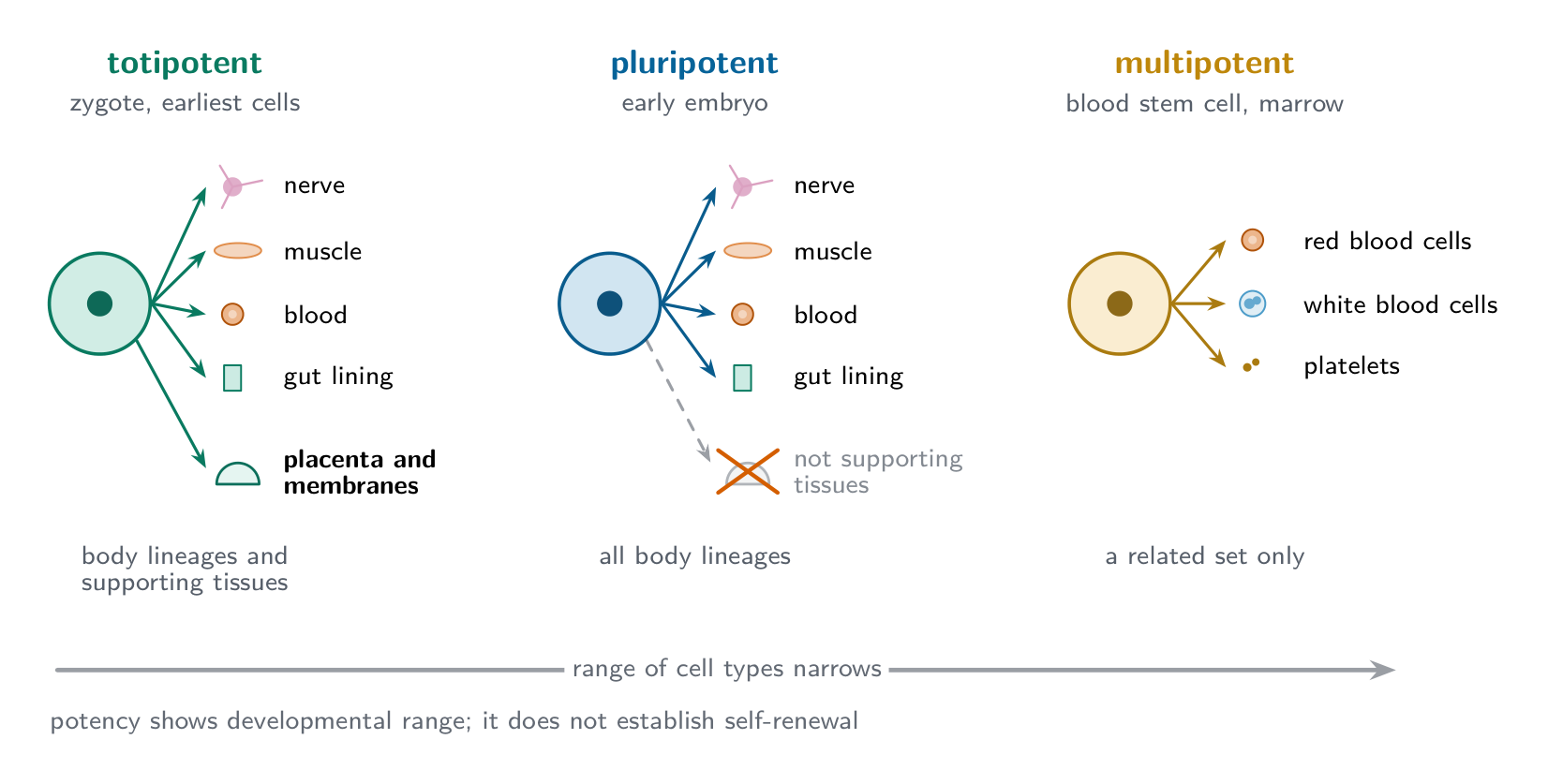
- Totipotent capacity includes body and supporting extraembryonic lineages needed for a complete conceptus, as in the zygote and certain very early cells. Pluripotent capacity includes the body's diverse lineages but does not independently supply every necessary supporting lineage. Multipotent cells produce several related types, as in blood-forming stem cells.
- Potency is not division speed or simply donor age. A blood stem cell does not become pluripotent because it makes several blood-cell types. Demonstrating a few markers is evidence about those markers, not proof of every possible functional descendant. Self-renewal remains a separate property from the range shown here. The zygote divides into embryonic cells; it does not keep producing replacement zygotes.
Compare marker proportions with viable totals
- In invented independent dishes, control marker-positive counts are 8, 10 and 12, while treated counts are 38, 40 and 42. Each dish has 100 viable cells at measurement. Mean proportions are 10% and 40%: a 30-percentage-point difference and a fourfold ratio, equivalent to a 300% relative increase.
- This supports an effect on the measured marker under those conditions, not complete functional differentiation or every signalling step. Control starting cells, medium, time and marker threshold, and measure survival. If total viable cell counts differ, calculate each proportion from its own denominator before comparing; selective death can change a proportion without making new specialized cells.
Invented marker-positive proportions average 10% in control dishes and 40% in treated dishes, each based on 100 viable cells per dish. What is the difference in percentage points?
Dificultad 2/5 · 140 monedas + un pequeño bono en el primer intento de hoy
40 − 10 = 30 percentage points. The ratio is fourfold and the relative increase is 300%, different requested quantities. Marker evidence alone does not prove full functional differentiation.
Compare the same dimension and unit
- Cell diameter, body width and total length are different measurements. An egg has a large cytoplasm supporting early development; a sperm has a small head and a longer flagellum. A neuron's long axon does not imply a spherical cell body of that diameter, and a long muscle fibre can remain narrow.
- Use scale bars or calibrated lengths and identify the dimension measured. Convert millimetres and micrometres consistently. An invented egg of diameter 0.12 mm is 120 micrometres across; compared with an invented 8 micrometre red-cell diameter, that is 15 times the diameter, not automatically 15 times the volume.
Track area and volume separately as size changes
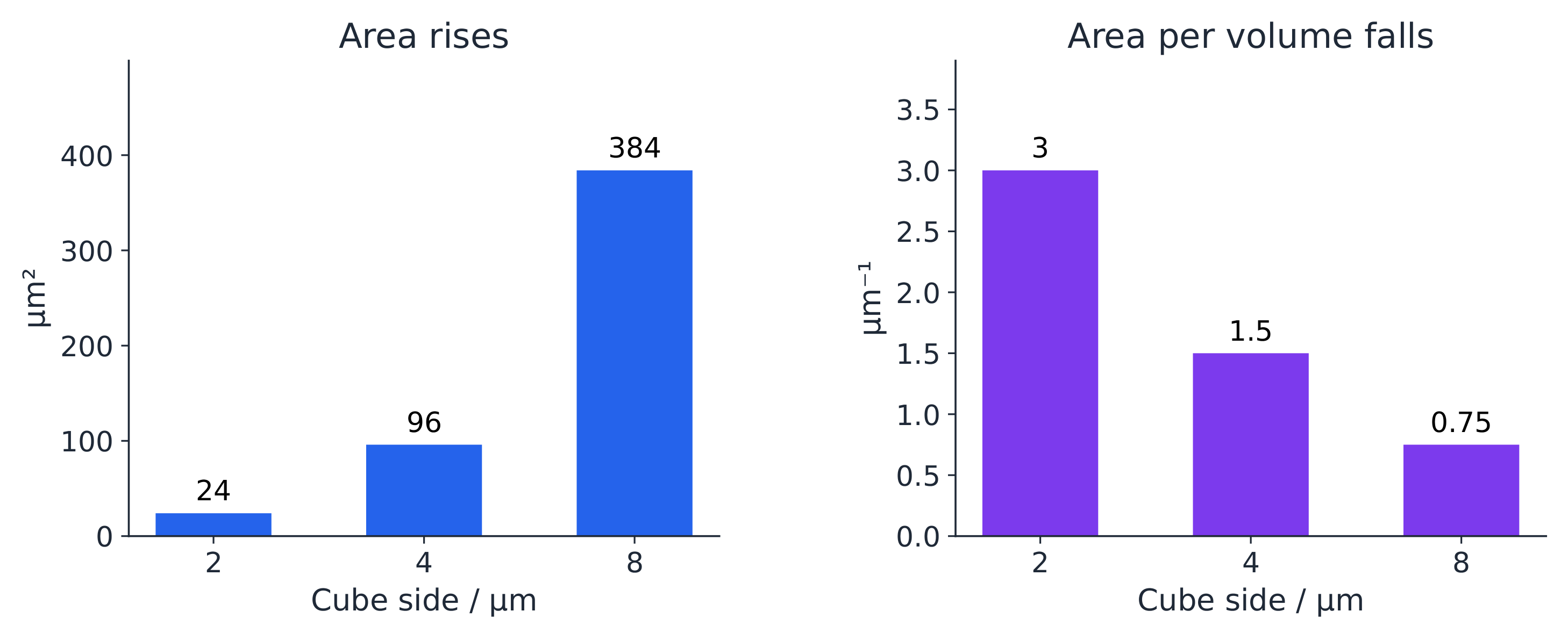
- For a cube of side $a$, area is $6a^2$ and volume is $a^3$, so area divided by volume is $6/a$. Invented sides 2, 4 and 8 micrometres give areas 24, 96 and 384 square micrometres, volumes 8, 64 and 512 cubic micrometres, and ratios 3, 1.5 and 0.75 per micrometre.
- Doubling a length multiplies area by four and volume by eight, halving the ratio. The larger cube has more total area but less area per unit volume. Exchange routes are associated with surfaces while many demands scale with volume, so report both quantities rather than saying that a growing cell's surface area shrinks.
An invented cube has side length 3 micrometres. Find surface area divided by volume, reported per micrometre.
Dificultad 2/5 · 140 monedas + un pequeño bono en el primer intento de hoy
Area = 6 × 3² = 54 square micrometres; volume = 3³ = 27 cubic micrometres. Their ratio is 54/27 = 2 per micrometre, equivalent to 6/a.
Hold total volume constant before comparing subdivision
- One 4 micrometre cube has volume 64 cubic micrometres and area 96 square micrometres. Eight separate 2 micrometre cubes have combined volume $8(8)=64$ but total area $8(24)=192$. Under the model, subdivision doubles exposed area without changing combined volume.
- The comparison assumes every face is exposed to the medium. Faces touching within a tissue may not be exchange surfaces. Cutting a real cell does not automatically create eight viable cells: each would require an intact boundary and suitable internal machinery. Geometry isolates one constraint rather than demonstrating a method of reproduction.
Distinguish a sphere's radius from its diameter
- A sphere has area-to-volume ratio $3/r$. Radii 2, 4, 6 and 10 length units give 1.5, 0.75, 0.50 and 0.30 per length unit. A diameter of 4 means radius 2 and ratio 1.5, not 0.75. State the measured dimension before substituting.
- A ratio carries an inverse-length unit: if radius is in micrometres, report the ratio per micrometre. It is not itself a surface area or a dimensionless magnification. Real cells are not necessarily spheres, so the model predicts geometric scaling without establishing a universal maximum viable cell size.
For a sphere, area divided by volume is 3/r. Its diameter is 12 micrometres. Find the ratio per micrometre.
Dificultad 2/5 · 140 monedas + un pequeño bono en el primer intento de hoy
Radius is half the diameter, so r = 6 micrometres and 3/6 = 0.50 per micrometre. Using the diameter directly would wrongly give 0.25.
Connect a feature to the function it permits
- A root-hair extension increases exchange area; a narrow neuronal process can transmit signals over distance. The mechanism must fit the named cell. More area supports exchange only with suitable permeability, transport proteins, gradients and metabolic supply; diffusion distance and internal transport matter too.
- A strong comparison uses scaled evidence, a named feature, its physical consequence and the biological task. Do not assign every specialized cell the same adaptations. Different gene expression, geometry and cell interactions can contribute together, while no single ratio or organelle count establishes complete performance.
A class compares differently shaped cells and claims that a larger surface area-to-volume ratio alone guarantees better performance. Evaluate this claim using structure, gene expression and measurement evidence.
Geometry, molecular machinery and cell function need to be interpreted together. A single ratio cannot establish complete performance.