Señalización neural: impulsos y sinapsis
Introducido| English | Significado |
|---|---|
| action potential/ˈækʃn pəˈtenʃl/ | potencial de acción |
| synapse/ˈsɪnæps/ | sinapsis |
What would explain this observation?
- A stronger stimulus can increase impulse frequency while each action potential 动作电位 remains a similar size.
Build the model
- An action potential is a brief change in membrane potential involving voltage-gated ion channels.
- Depolarization followed by repolarization propagates along a neuron.
- At a chemical synapse 突触, transmitter release can alter the next cell membrane potential.
- action potential: A brief propagating change in membrane potential.
- synapse: A junction for communication between cells.

¿Cómo puede la intensidad del estímulo afectar a un sistema de señalización todo-o-nada?
Dificultad 1/5 · 100 monedas + un pequeño bono en el primer intento de hoy
Cada potencial de acción es todo-o-nada con amplitud fija, por lo que la intensidad se codifica por la frecuencia con la que disparan los impulsos y cuántas neuronas se reclutan. La amplitud no puede aumentar, y eliminar los gradientes iónicos aboliría la señalización.
Asociar cada término técnico con su significado preciso.
Dificultad 2/5 · 140 monedas + un pequeño bono en el primer intento de hoy
Usar las definiciones para distinguir cantidades y procesos relacionados.
Choose evidence that can test it
- The all-or-none principle applies to an individual action potential.
- Stimulus information can be encoded by frequency and recruitment.
- Myelination permits saltatory conduction between nodes rather than making ions move freely through myelin.
In the lab: Interpret supplied voltage-time traces and compare time intervals. Identify threshold, rising phase and recovery before explaining ions. Use classroom models rather than electrical stimulation of people.
¿Qué dos hábitos hacen que la investigación o modelo en este caso sean más defendibles?
Dificultad 2/5 · 140 monedas + un pequeño bono en el primer intento de hoy
Enunciar las condiciones y supuestos permite que otros repitan el trabajo exactamente, y registrar la evidencia de apoyo les permite verificar la conclusión. Ocultar resultados contradictorios elimina la evidencia que podría desafiar una conclusión errónea, y una sola medición nunca puede establecer una afirmación más amplia.
Work from known quantities
- Known: 30 impulses occur in 0.50 s.
- Frequency = count/time = 30/0.50 = 60 Hz.
- This is impulse frequency, not an estimate of propagation speed.
Your turn: 24 impulses occur in 0.40 s. Find impulse frequency.
More frequent impulses, same impulse size
30 impulses in 0.50 s gives 60 Hz. Change the count and observation window while comparing equal-height event marks with a 60 Hz reference.
Ocurren 24 impulsos en 0.40 s. Calcule la frecuencia de los impulsos.
Dificultad 2/5 · 140 monedas + un pequeño bono en el primer intento de hoy
El resultado es 60 Hz. Datos: 24 impulsos en 0.40 s. Use frecuencia = conteo / tiempo. Frecuencia = 24/0.40 = 60 Hz. Esta es la frecuencia de disparo, no la velocidad de conducción a lo largo del axón.
Check the conclusion and its limits
- A neurotransmitter diffuses across the synaptic cleft; an action potential does not jump intact through the liquid gap.
- Excitatory input does not guarantee the postsynaptic cell reaches threshold.
Not true: A stronger stimulus always makes each action potential larger. Action potentials are all-or-none: once threshold is reached, the impulse has a fixed size set by the ion gradients. A stronger stimulus raises the frequency of impulses, not their amplitude.
- An action potential is a brief change in membrane potential involving voltage-gated ion channels.
- The all-or-none principle applies to an individual action potential.
- Watch for: A neurotransmitter diffuses across the synaptic cleft; an action potential does not jump intact through the liquid gap.
Un estímulo más fuerte siempre hace que cada potencial de acción sea mayor.
Dificultad 1/5 · 100 monedas + un pequeño bono en el primer intento de hoy
Los potenciales de acción son todo-o-nada: una vez alcanzado el umbral, el impulso tiene un tamaño fijo determinado por los gradientes iónicos. Un estímulo más fuerte eleva la frecuencia de los impulsos, no su amplitud.
Un cambio breve y propagado en el potencial de membrana: escribe el término técnico.
Dificultad 1/5 · 100 monedas + un pequeño bono en el primer intento de hoy
potencial de acción significa Un cambio breve propagado en el potencial de membrana.
Write from an impulse frequency of 70 per second
- 21 impulses occur in 0.30 s.
- Find the frequency. This is not the propagation speed.
Ocurren 21 impulsos en 0.30 s. ¿Cuál es la frecuencia de los impulsos y por qué no es una velocidad de propagación?
21 dividido entre 0.30 es 70. Un potencial de acción es todo o nada. El mensaje aún puede variar en frecuencia.
El caso HL escrito cuenta 21 impulsos en 0.30 segundos. Encuentre la frecuencia.
Dificultad 1/5 · 100 monedas + un pequeño bono en el primer intento de hoy
21 dividido entre 0.30 es 70 por segundo.
Connect the regions of one neuron
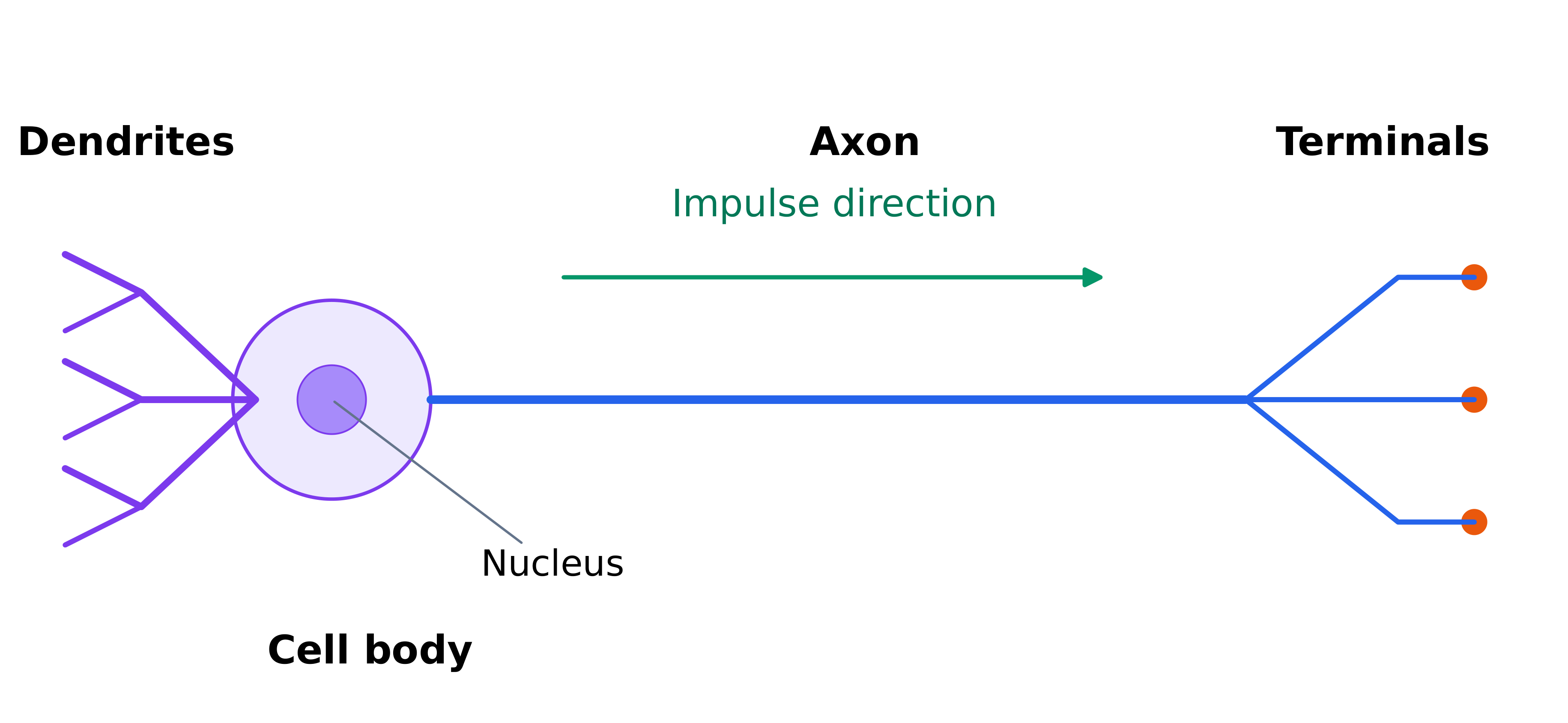
- A typical neuron has a cell body containing its nucleus, branching dendrites receiving inputs, and an axon conducting impulses towards terminal branches. These are connected regions of one cell, rather than a chain of separate cells. Shape and axon length vary between neuron types.
- Many inputs can converge on one neuron, and its branches can communicate with several targets. A nerve bundles nerve fibres with supporting tissues; it is not one large neuron. Ion movement in and across cell membranes carries the signal, rather than electrons travelling along a metal wire.
Explain a resting voltage without stopping transport
- Membrane potential compares the inside with the outside. A representative resting value of −70 mV means the interior is negative relative to the surrounding fluid, not that the cytoplasm contains only negative ions. Both bulk solutions remain close to electrically neutral, with a small charge separation near the membrane.
- ATP-dependent sodium–potassium pumping maintains high sodium outside and potassium inside. Greater resting potassium permeability permits potassium loss; electrical attraction increasingly opposes further loss. Selective permeability, gradients and trapped intracellular anions contribute to voltage. “Resting” does not mean the pump and channels have all stopped.
Count pump transfers without inventing a voltage
- The standard sodium–potassium pump exports three sodium ions and imports two potassium ions per ATP-driven cycle. Eight cycles therefore export 24 sodium, import 16 potassium and use eight ATP, moving a net eight positive charges outward.
- These counts do not calculate a particular membrane voltage: membrane area, capacitance, ion concentrations and permeability also matter. Nor does switching off a pump instantly erase every gradient. Pumps maintain conditions over time; rapid impulse phases involve changing channel currents.
En el modelo estándar de bomba, cada ciclo exportan tres iones de sodio e importan dos iones de potasio utilizando un ATP. ¿Cuántos iones de sodio se exportan en ocho ciclos?
Dificultad 2/5 · 140 monedas + un pequeño bono en el primer intento de hoy
8 × 3 = 24 sodio exportado. Los totales separados son 16 potasio importado y ocho ATP utilizados; estos conteos por sí solos no especifican un voltaje de membrana.
Keep individual impulses separate from the whole response
- For a given healthy fibre under stable conditions, reaching threshold initiates a full action potential; subthreshold stimulation does not send a smaller travelling impulse. Successive excitable regions regenerate the signal, rather than allowing it to fade continuously along a healthy axon.
- A stronger sustained stimulus can increase firing frequency or recruit more sensory neurons. A larger compound nerve recording can therefore reflect more active fibres. “All-or-none” does not require every neuron, temperature or physiological condition to produce an identical voltage trace; amplitude is not a universal constant across all conditions.
Distinguish frequency from propagation speed
- Thirty impulses counted in a defined 0.50-second window give 60 Hz, or impulses per second. An impulse travelling 0.80 m in 0.016 s instead has a speed of 50 metres per second. Counts and elapsed time give frequency; distance and travel time give speed.
- Keep the timing convention clear. Whole stimulus-to-muscle response time includes receptor, synaptic and muscle delays, so it does not isolate one axon's conduction time. For regular spikes, use peak spacing to find the period rather than dividing a peak count by an unrelated interval.
Un impulso inventado tarda 0.016 segundos en recorrer 0.80 metros a lo largo de un axón. Calcule la velocidad de conducción en metros por segundo.
Dificultad 2/5 · 140 monedas + un pequeño bono en el primer intento de hoy
0.80/0.016 = 50 metros por segundo. Esto es distancia dividida por tiempo de propagación, no la frecuencia del impulso ni la velocidad inferida a partir de todo el retraso reflejo.
Compare fibre structure under matched conditions
- Greater unmyelinated axon diameter lowers internal electrical resistance and can increase conduction speed. Giant squid axons illustrate this route. Myelin supplied by supporting cells can greatly increase speed without requiring giant diameter, so diameter alone cannot rank a mixture of myelinated and unmyelinated fibres.
- Control or record species, temperature and myelination, using independent fibres and reliable distance/timing measurements. Repeated timings of one fibre estimate its measurement variation; they do not sample variation among many fibres. Body size alone does not establish an animal's conduction speed.
Interpret a correlation coefficient before explaining a cause
- Pearson's r describes linear association from −1 to +1. A positive value indicates that larger values tend to occur together; a negative value indicates the opposite direction. A value near zero can still accompany a curved relationship, so inspect the plotted pairs.
- In a simple linear regression with an intercept, R-squared equals r squared. It describes how much sample variation the fitted linear relationship accounts for, not the fraction biologically caused by the explanatory variable. Confounding, limited ranges, outliers and small samples restrict inference.
Work through an invented diameter–speed dataset
- Four invented diameter–speed pairs are (10, 1), (20, 2), (30, 2) and (40, 5), with diameter in micrometres and speed in metres per second. Means are 25 and 2.5; the sums of paired deviation products, squared diameter deviations and squared speed deviations are 60, 500 and 9.
- Hence r is about 0.894 and R-squared is 0.80: a strong positive linear association in these four pairs. The fit accounts for 80% of sample speed variation; it does not prove that diameter causes 80% of any neuron's speed. If a different sample gives r = −0.70, its R-squared is 0.49 and the association remains negative.
Una muestra inventada tiene Pearson r = −0.60. Calcule R-cuadrado para una regresión lineal simple con intercepto; dé una proporción en lugar de un porcentaje.
Dificultad 2/5 · 140 monedas + un pequeño bono en el primer intento de hoy
(−0.60)² = 0.36, o 36% de la variabilidad de la muestra explicada por la relación lineal ajustada. La dirección permanece negativa, y el ajuste no establece causalidad.
Trace electrical arrival into chemical release
- At a chemical synapse, presynaptic depolarization opens voltage-gated calcium channels. Calcium entry down its electrochemical gradient raises cytosolic calcium, promoting vesicle fusion and neurotransmitter exocytosis. Sodium entry elsewhere in the impulse is not the same event as calcium-triggered release.
- Transmitter diffuses across the cleft and binds compatible receptors on the postsynaptic membrane. The action potential does not jump intact across the liquid gap. Release, diffusion and receptor activation introduce a delay, and the target needs the appropriate receptors to respond.
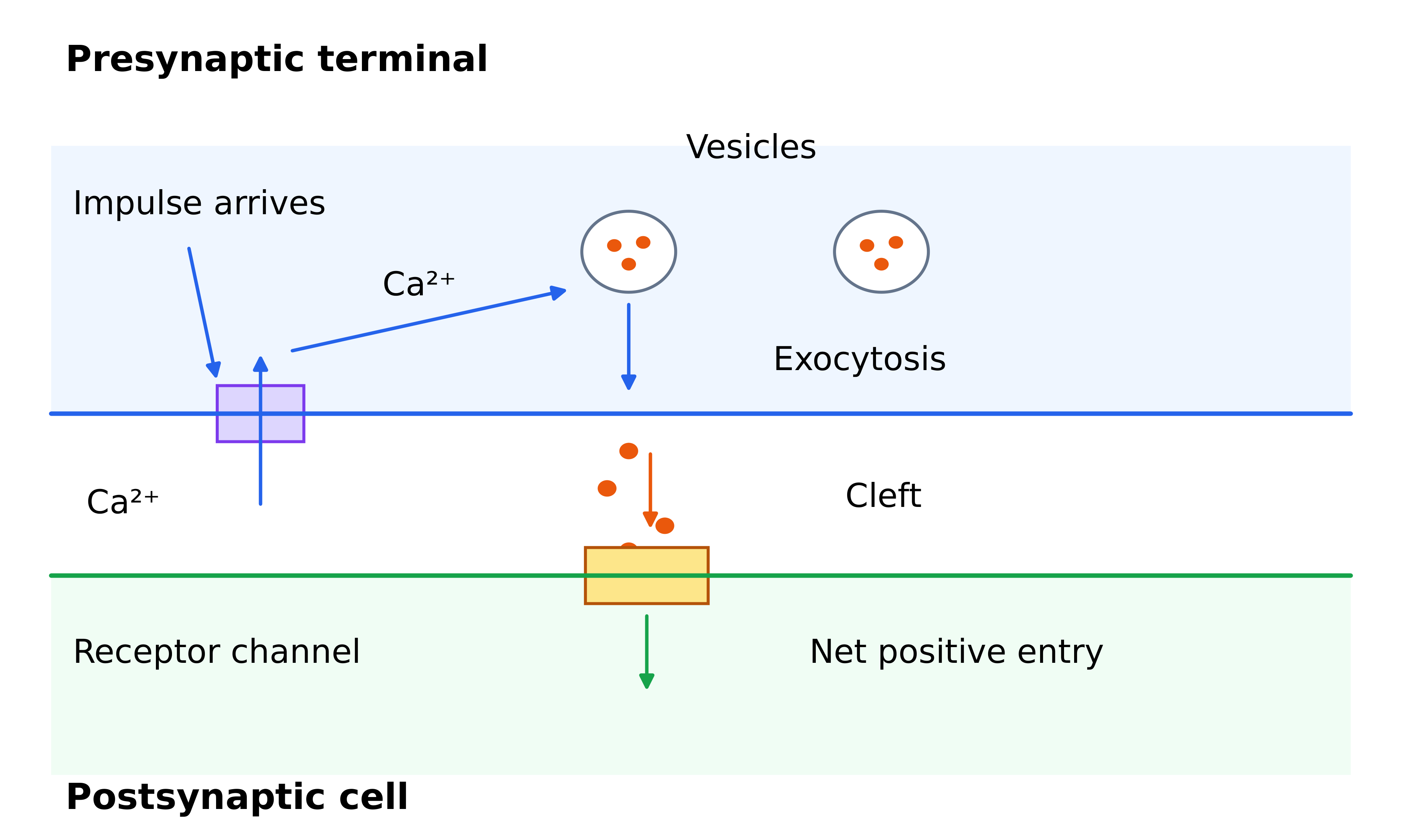
¿Qué evento vincula directamente la despolarización presináptica con la fusión de vesículas transmisoras en el modelo de sinapsis química?
Dificultad 1/5 · 100 monedas + un pequeño bono en el primer intento de hoy
La entrada de calcio desencadena la maquinaria de liberación; el neurotransmisor luego se difunde y se une a receptores diana. Los canales dependientes de voltaje presinápticos y los canales dependientes de ligando postsinápticos tienen diferentes desencadenantes y ubicaciones.
Distinguish a local excitatory response from an impulse
- At nicotinic acetylcholine receptors near resting voltage, ligand-gated cation channels allow net inward positive current, with sodium entry important. Potassium can also pass. The resulting excitatory postsynaptic potential, EPSP, is graded; it need not bring an excitable region to threshold.
- At a neuromuscular junction the target is muscle membrane, and its local response is an end-plate potential. Acetylcholinesterase hydrolyses acetylcholine into choline and acetate; choline can be taken back for reuse. This differs from removing every released acetylcholine molecule by intact reuptake, or using the same removal mechanism for all transmitters.
Explain the usual direction from synaptic structure
- A typical chemical synapse places release vesicles and their machinery on the presynaptic side and compatible target receptors on the postsynaptic side. This asymmetry organizes communication. Random molecular diffusion does not become a one-way conveyor; the release and reception sites create the functional direction.
- One arriving impulse does not guarantee one outgoing impulse in the target neuron. Inputs from several synapses can influence its voltage, and the target's state also matters. Separate transmitter release, a local voltage change and threshold crossing when explaining evidence.
Match a neural measurement to its claim
- For frequency, identify the fibre and counted time window. For speed, use conduction distance and propagation time, separating other delays. For diameter comparisons, plot independent paired observations under comparable conditions before calculating and interpreting r and R-squared.
- Explain a synaptic response through calcium entry, exocytosis, diffusion, receptor binding and target voltage change. Use supplied recordings or classroom models. Name what was measured before proposing a mechanism; a correlation or a larger compound recording alone does not identify every causal step.
Un estímulo más fuerte produce una mayor grabación nerviosa compuesta y una muestra muestra una correlación positiva entre diámetro y velocidad. Explique qué distinciones adicionales son necesarias, luego trace una respuesta sináptica química.
Especifique la señal medida y la etapa celular. Diferentes mediciones responden a distintas preguntas, aunque todas se refieran a la comunicación neuronal.
AHL: Follow channel changes through a spike
- In the model, rest is −70 mV, threshold −55 mV, peak +30 mV and undershoot −80 mV. At threshold, voltage-gated sodium-channel opening increases sodium entry and depolarization, causing further opening: positive feedback. Peak minus rest is a 100 mV change, not 30 mV.
- Sodium-channel inactivation and delayed potassium-channel opening permit repolarization through potassium exit. Continued potassium conductance contributes to undershoot. The pump maintains gradients over time; it does not create the fast falling phase by suddenly pumping all sodium back out.
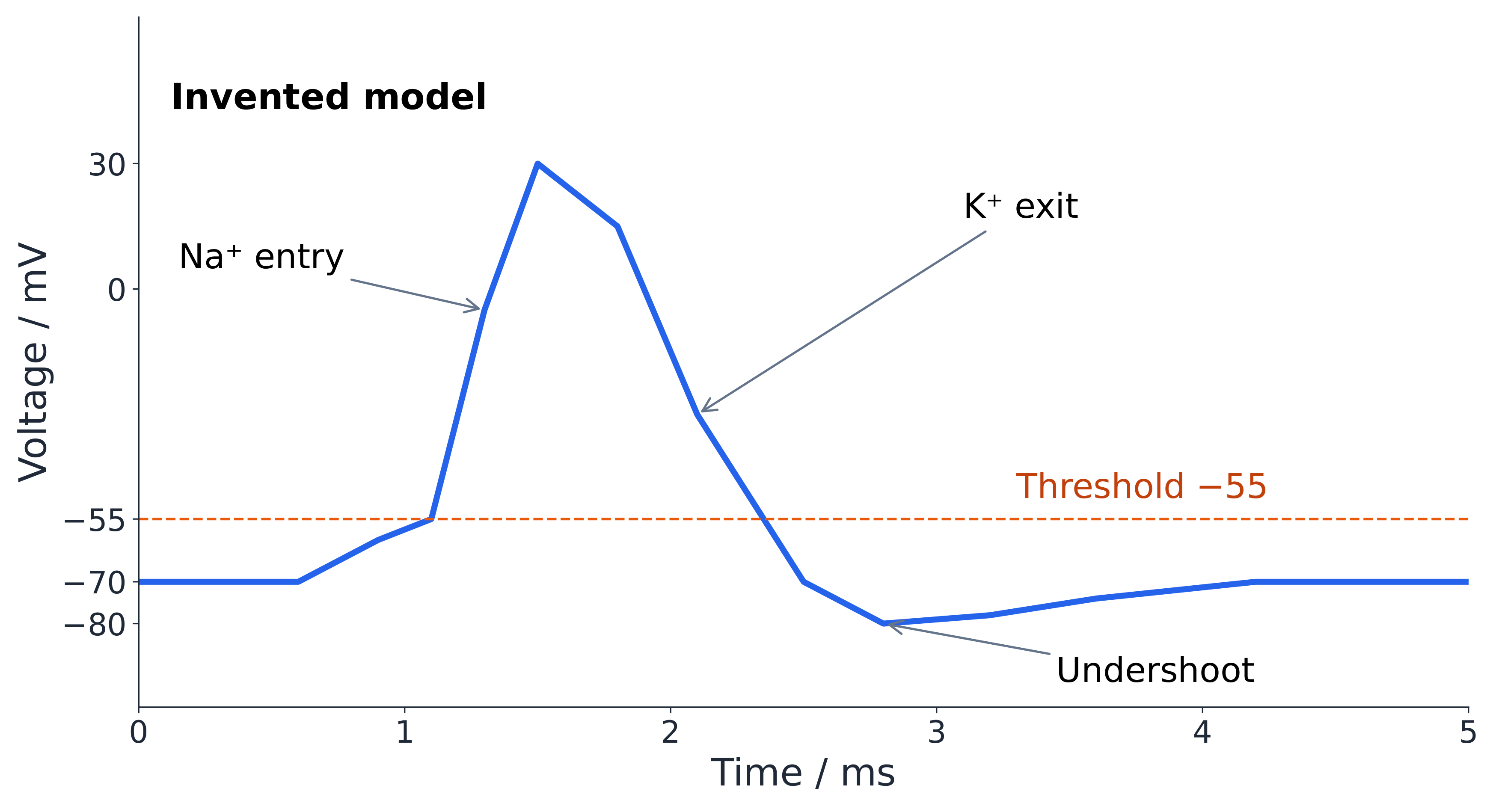
AHL: Un potencial de acción modelo sube desde −70 mV en reposo hasta +30 mV en su pico. Calcule el cambio de voltaje entre el pico y el reposo.
Dificultad 2/5 · 140 monedas + un pequeño bono en el primer intento de hoy
30 − (−70) = 100 mV. El pico relativo al exterior es +30 mV; su cambio respecto al reposo es una magnitud diferente.
AHL: Read a time scale and respect refractoriness
- If a trace uses 0.50 ms per horizontal division and regular peaks are six divisions apart, the period is 3.0 ms, or 0.0030 s. Frequency is about 333 Hz. Convert milliseconds to seconds before taking the reciprocal; a vertical voltage scale cannot supply the period.
- During absolute refractoriness, many sodium channels are inactivated and a second full action potential cannot be generated in that region. Later relative refractoriness may require stronger input because recovery is incomplete and potassium conductance remains high. These periods help constrain maximum firing frequency.
AHL: Una traza regular inventada tiene 0.50 milisegundos por división horizontal y seis divisiones entre picos. Calcule la frecuencia en hertzios.
Dificultad 2/5 · 140 monedas + un pequeño bono en el primer intento de hoy
Período = 6 × 0.50 = 3.0 ms = 0.0030 s. Frecuencia = 1/0.0030 ≈ 333 Hz, aproximadamente 330 Hz con dos cifras significativas.
AHL: Propagate a signal through local currents
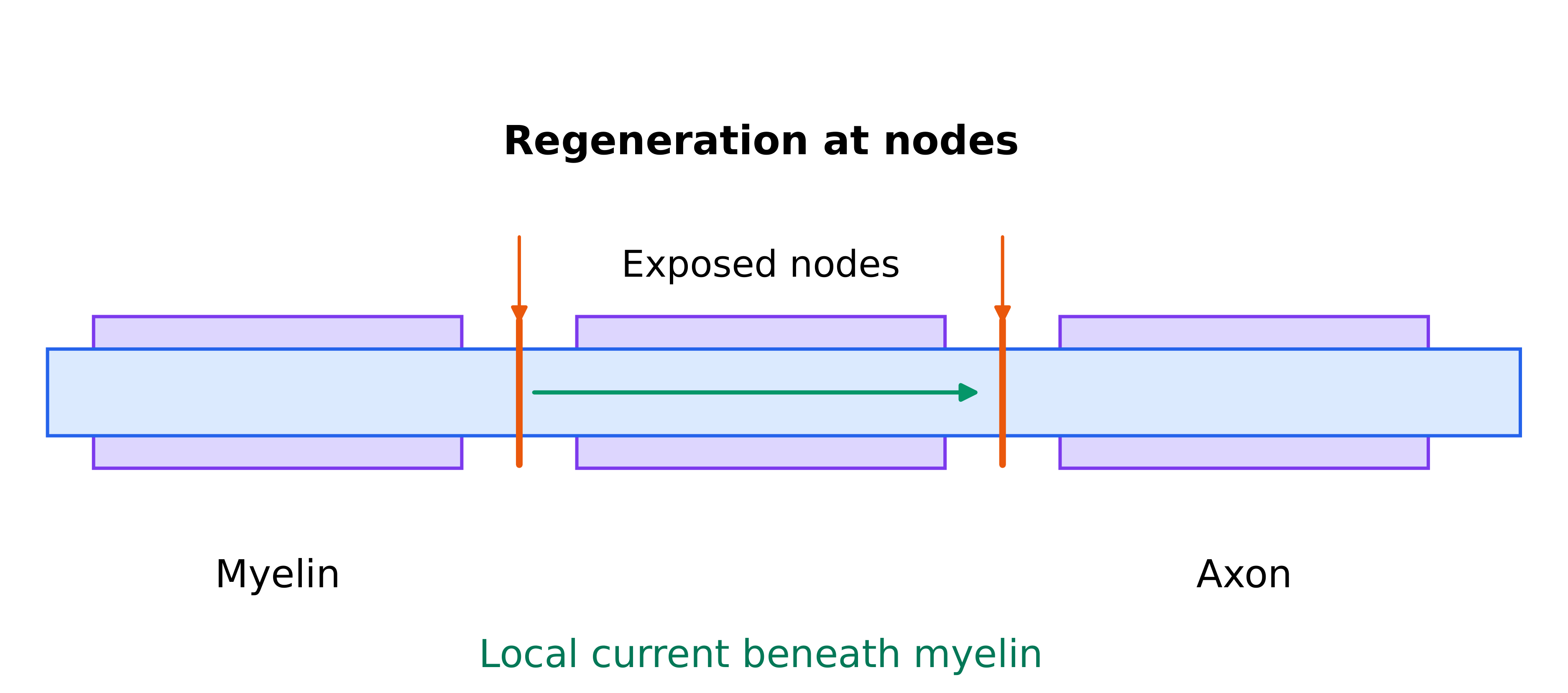
- Positive charge entering an active region produces local currents in the cytoplasm and surrounding fluid. Nearby membrane depolarizes; if it reaches threshold, its own sodium channels open. Regeneration carries the signal forward without requiring one group of sodium ions to travel from cell body to terminal.
- Recently active membrane is refractory, favouring propagation into excitable membrane ahead. Normal initiation and connections establish the functional route. Artificial stimulation in the middle of an axon can launch impulses both ways, so an axon is not physically incapable of backward propagation.
AHL: Explain what saltatory conduction actually skips
- Myelin limits current loss across internodes and reduces the membrane charging needed there. Local current spreads beneath it towards exposed nodes of Ranvier, where concentrated voltage-gated channels regenerate action potentials. This node-to-node pattern is saltatory conduction.
- “Jumping” describes the sites of regeneration. It does not mean sodium ions fly through the sheath or cross an empty gap; current spreads continuously through conducting fluids. Damaged insulation can slow or disrupt propagation, and pumps remain necessary for maintaining ion gradients.
AHL: Locate how an external chemical changes signalling
- Neonicotinoids act at insect nicotinic acetylcholine receptors; persistent activation can disrupt normal firing through sustained depolarization. Recordings from isolated honeybee brains showed depolarization block and inhibited nicotinic responses under the studied exposures. This cellular evidence alone does not quantify whole-population effects or make all compounds equivalent.
- Cocaine can inhibit dopamine-transporter-mediated reuptake, leaving dopamine available outside cells for longer. The transporter is a removal mechanism, distinct from the dopamine receptor. Research on dopamine uptake inhibition supports this target distinction; it differs from receptor agonism and acetylcholinesterase breakdown, and does not explain every cocaine effect.
AHL: Combine graded inputs before the all-or-none output
- An inhibitory input can hyperpolarize the target through chloride entry or potassium exit, depending on channels and gradients. Some inhibition instead weakens excitation through increased conductance without a large negative voltage shift. EPSPs and IPSPs are graded inputs, unlike the resulting action potential.
- In an explicitly additive model, −70 mV plus two overlapping +8 mV EPSPs gives −54 mV, beyond a −55 mV threshold. Adding a −6 mV IPSP gives −60 mV, below threshold. Temporal summation combines closely timed inputs from one source; spatial summation combines different locations. Real responses also depend on timing, location and driving forces, rather than always adding exactly.
AHL: En un modelo explícitamente aditivo, el potencial de reposo es −70 mV. Dos EPSP superpuestos añaden cada uno +8 mV y un IPSP añade −6 mV. Calcule el potencial predicho antes de determinar si se alcanza umbral de −55 mV.
Dificultad 2/5 · 140 monedas + un pequeño bono en el primer intento de hoy
−70 + 8 + 8 − 6 = −60 mV, por debajo del umbral de −55 mV. Sin la contribución inhibitoria, el modelo da −54 mV. La suma exacta es una suposición; el tiempo real, la ubicación y las conductancias son relevantes.
AHL: Trace sensory transduction without equating it with experience
- Some skin free endings contain channels responsive to high temperature, acidity or capsaicin. Positive-ion entry can depolarize an ending; threshold crossing can initiate impulses that engage pathways towards the brain. Capsaicin does not need to travel along the axon to convey the signal.
- Detection of potentially damaging stimuli and conscious pain experience are related but distinct. Brain processing and context contribute to perception. Consciousness is described as an emergent property of interacting neuronal networks; one isolated spike is not a conscious thought, and the description does not claim that every mechanism of experience is solved.