Tu plan de aprendizaje · Continuar · Revisar →
Avanzado 把 (把 + Objeto + Verbo + Resultado)
IntroducidoTu posición guardada se conserva en este navegador. Continuar no completa la lección ni responde sus preguntas.
Edición de un informe
- Tu jefe te devuelve el borrador con instrucciones.
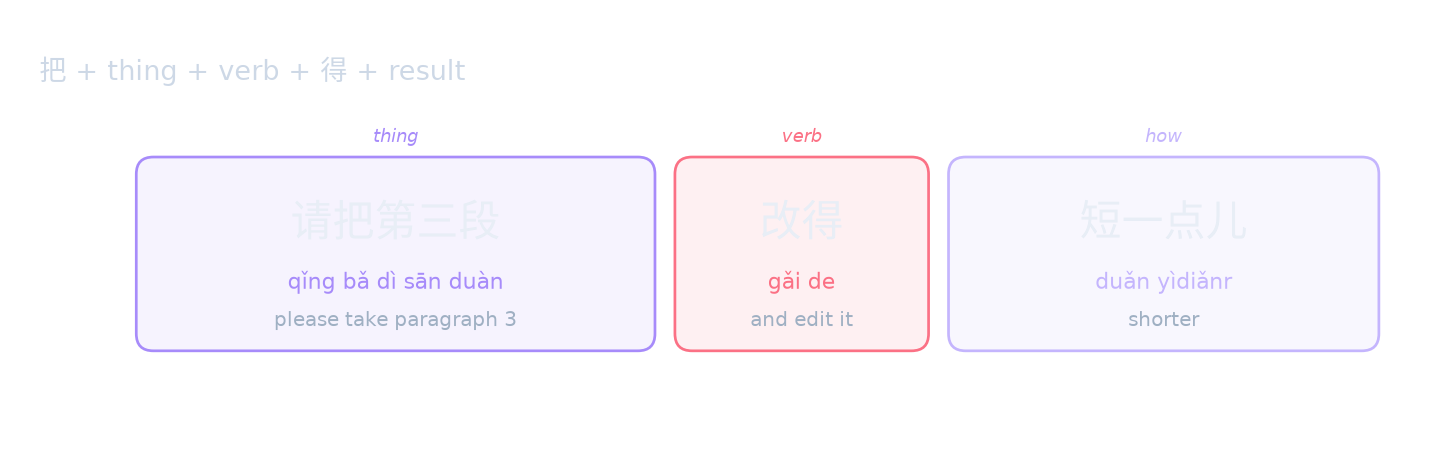
- please请(把: marks the object)把第三段to change改(degree marker)得short短erhua variant of 一点一点儿,again / then再(把: marks the object)把chart图表放到final最后。 — "Haz el tercer párrafo un poco más corto y luego mueve la gráfica al final."
Estructura: (把: marks the object)把 + Objeto + Verbo + Resultado complejo
- En HSK 5, lo que sigue al verbo puede ser un complemento (degree marker)得, un cambio into成/for为, o un lugar/dirección: to change改(degree marker)得short短erhua variant of 一点一点儿 (hacerlo más corto), translate翻译into成Chinese中文 (traducirlo al chino), 放到final最后 (ponerlo al final), to give (as a gift); to see off送to return home回家 (llevarlo a casa).
- El objeto debe ser específico y el verbo no puede estar solo.
please请把this这sentence句话translate翻译into成Chinese中文。
Complete: “Please translate this sentence into English.” 请把这句话翻译____英文。
Dificultad 1/5 · 100 monedas + un pequeño bono en el primer intento de hoy
翻译成 = translate into (a change).
Cambio, lugar, manera
- Cambio: he / him他(把: marks the object)把drawing room客厅to change into变成(completed / change)了study (room)书房。 — "Él convirtió la sala de estar en una biblioteca." / "Él transformó la sala de estar en una oficina privada."
- Manera con (degree marker)得: she她(把: marks the object)把the room房间clean打扫(degree marker)得spotless干干净净。 — "Ella limpió la habitación hasta dejarla impecable."
she她把the room房间clean打扫得spotless干干净净。
Build: “She cleaned the room spotless.”
Dificultad 3/5 · 200 monedas + un pequeño bono en el primer intento de hoy
把 + object + verb + 得 + result.
Negaciones y modales antes de (把: marks the object)把
- not / haven't没 / not不 / don't别 / can / be able to能 / want / will / need要 / should应该 van antes de (把: marks the object)把: you你should应该(把: marks the object)把question问题variant of 说说distinct清楚 (Deberías explicar el problema claramente), no you你(把: marks the object)把question问题should应该variant of 说说distinct清楚.
- Los verbos de percepción y sentimiento (to see看见, to know知道, to like喜欢) no usan (把: marks the object)把.
Which sentence is correct?
Dificultad 1/5 · 100 monedas + un pequeño bono en el primer intento de hoy
你应该把问题说清楚 is right: modal verbs and negatives (应该, 要, 不) go before 把, not between 把 and the verb.
¿Por qué usar (把: marks the object)把?
- (把: marks the object)把 pone el enfoque en lo que le sucede a un objeto específico: I我(把: marks the object)把my wallet钱包lose丢(completed / change)了 — "He perdido mi billetera."
- Sin (把: marks the object)把, la misma idea puede sonar incompleta o neutra: I我lose丢(completed / change)了my wallet钱包.
I我把my wallet钱包lose丢了。
我把他看见了 is a natural sentence.
Dificultad 1/5 · 100 monedas + un pequeño bono en el primer intento de hoy
Perception verbs like 看见 don't take 把.
Resumen
- (把: marks the object)把 + objeto específico + Verbo + resultado (complemento (degree marker)得, into成, to / arrive到 + lugar/dirección).
- Negaciones/modales antes de (把: marks the object)把; sin (把: marks the object)把 con verbos de percepción o sentimiento.
Lee la referencia completa: Gramática HSK 5 — Patrones oracionales.
Your manager hands back your draft with instructions. Close the examples. Say a Mandarin response, then write it in Chinese. Explain briefly in English what the lesson’s pattern adds. Compare with the model, then change one detail and try again.
This is supported productive practice. Compare meaning and structure; your answer need not copy the model. A partner or teacher must hear the spoken response to comment on pronunciation.