Tu plan de aprendizaje · Continuar · Revisar →
反而 vs 相反 (instead vs on the contrary)
IntroducidoTu posición guardada se conserva en este navegador. Continuar no completa la lección ni responde sus preguntas.
Lo opuesto ocurrió
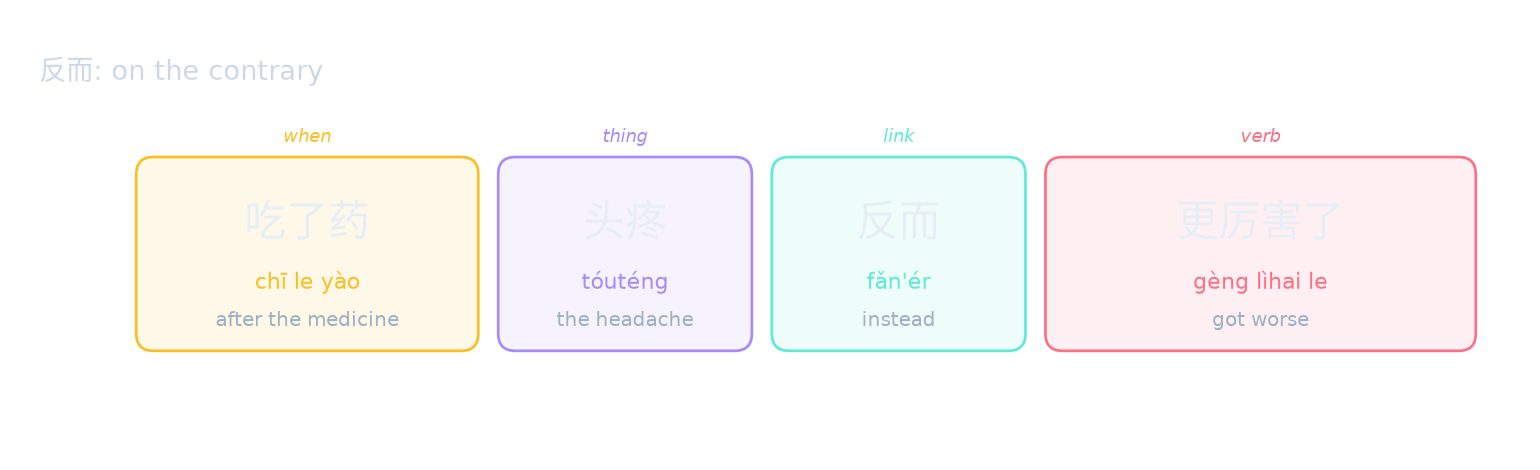
- Tomaste medicina para el dolor de cabeza, pero empeoró.
- to eat吃(completed / change)了medicine药,headache头疼instead反而more更terrible厉害(completed / change)了。 — "Después de tomar la medicina, mi dolor de cabeza en realidad empeoró."
instead反而 = al contrario, por el contrario (adverbio)
- instead反而 va después del sujeto y antes del verbo: el resultado es lo opuesto a lo esperado.
- A menudo sigue not only不但didn't没 / not only不但not不: he他not only不但didn't没get angry生气,instead反而laughed笑(completed / change)了.
he他not only不但didn't没get angry生气,instead反而laughed笑了。
Complete: “He didn't get angry; instead he laughed.” 他没生气,____笑了。
Dificultad 1/5 · 100 monedas + un pequeño bono en el primer intento de hoy
反而 before the verb = instead.
Build: “After the medicine, the headache actually got worse.”
Dificultad 3/5 · 200 monedas + un pequeño bono en el primer intento de hoy
Subject + 反而 + verb phrase.
on the contrary相反 = el opuesto (adjetivo / conector)
- on the contrary相反 describe oposición: idea意见on the contrary相反 — "opiniones opuestas"; just正好on the contrary相反 — "exactamente lo opuesto".
- on the contrary相反,… inicia una oración: "Al contrario, …": he他not不lazy懒。on the contrary相反,he他very很hard-working努力。
he他not不lazy懒。on the contrary相反,he他very很hard-working努力。
La posición decide
- Dentro de una cláusula, antes del verbo, use instead反而: illness病instead反而重了, no illness病on the contrary相反重了.
- Iniciar una nueva oración con coma, o como "opuesto", use on the contrary相反: on the contrary相反,…; direction方向on the contrary相反.
“Our opinions are exactly the opposite.” Which fits? 我们的意见正好____。
Dificultad 1/5 · 100 monedas + un pequeño bono en el primer intento de hoy
As the predicate meaning “opposite”, use 相反: 我们的意见正好相反. 反而, 却 and 倒 are adverbs that need a verb after them.
Juntos en un párrafo
- I / me我to think以为he他can / will会very很to feel sad难过,on the contrary相反,he他seemingly看起来very很relaxed轻松。 — "Pensé que estaría triste; al contrario, se veía relajado."
- O con instead反而: I / me我to think以为he他can / will会to feel sad难过,he他instead反而very很relaxed轻松.
he他instead反而very很relaxed轻松。
相反 can start a sentence followed by a comma.
Dificultad 1/5 · 100 monedas + un pequeño bono en el primer intento de hoy
True. 相反 can start a sentence, followed by a comma, to mean “on the contrary”: 他没生气,相反,他很高兴.
Resumen
- instead反而 = en cambio (adverbio, después del sujeto, antes del verbo).
- on the contrary相反 = lo opuesto / al contrario (adjetivo, o on the contrary相反,… iniciando una oración).
Lee la referencia completa: Gramática HSK 4 — Comparación de funciones similares.
You took medicine for a headache, but it got worse. Close the examples. Say a Mandarin response, then write it in Chinese. Explain briefly in English what the lesson’s pattern adds. Compare with the model, then change one detail and try again.
This is supported productive practice. Compare meaning and structure; your answer need not copy the model. A partner or teacher must hear the spoken response to comment on pronunciation.