Tu plan de aprendizaje · Continuar · Revisar →
得 (děi) (deber / tener que)
IntroducidoTu posición guardada se conserva en este navegador. Continuar no completa la lección ni responde sus preguntas.
I have to go
- It is 9 p.m. and you still have an essay due tomorrow morning.
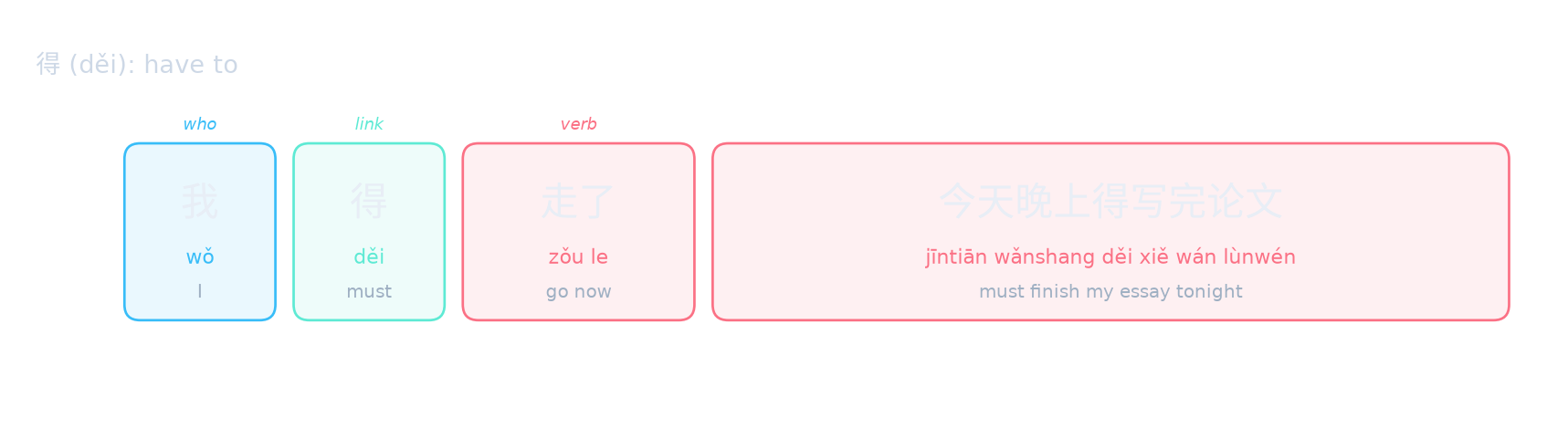
- I我have to得to walk / to leave走(completed / change)了,today今天evening晚上have to得to write写to finish完thesis; paper论文。 — "I have to go; I've got to finish my essay tonight."
- Goal: say "must / have to" in speech with have to得 (děi), and keep its sound apart from de.
have to得 (děi) + Verb = must, have to
- have to得 read děi before a verb = "must, have to", common in speech: I我have to得to walk / to leave走(completed / change)了, you你have to得earlier早点儿sleep睡 — "You have to go to bed earlier."
- It expresses necessity or obligation.
you你have to得earlier早点儿sleep睡。
Complete (spoken): “I have to go now.” 我____走了。
Dificultad 1/5 · 100 monedas + un pequeño bono en el primer intento de hoy
得 (děi) + verb = must.
Spoken necessity
- tomorrow明天there is有an exam考试,I我have to得revise复习。 — "There's an exam tomorrow; I have to revise."
- 这件matter事have to得to ask问teacher老师。 — "We'll have to ask the teacher about this."
tomorrow明天there is有an exam考试,I我have to得revise复习。
Build: “There's an exam tomorrow; I have to revise.”
Dificultad 3/5 · 200 monedas + un pequeño bono en el primer intento de hoy
Reason, then 得 + verb.
The negative is need not不用
- "Don't have to" is need not不用, never must not不得: you你not不be used to (不用来: needn't come)用来, not you你must not不得to come来.
- Read it děi only before a verb meaning "must"; after a verb (to run跑have to得fast; soon快) it is the particle de.
Which says “You don't have to come”?
Dificultad 1/5 · 100 monedas + un pequeño bono en el primer intento de hoy
The negative of 得 (must) is 不用.
In 他跑得很快, 得 is read děi.
Dificultad 1/5 · 100 monedas + un pequeño bono en el primer intento de hoy
After a verb, 得 is the particle de.
have to得 versus must必须 and want / will / need要
- must必须 is stronger and more formal: you你must必须bring带ID身份证 — "You must bring your ID card."
- want / will / need要 can mean "need to / will": I我want / will / need要to go去bank银行 ("I need to go to the bank"). have to得 is the casual "have to".
you你must必须bring带ID身份证。
Recap
- have to得 (děi) + Verb = have to, must (spoken).
- Negative = need not不用; formal = must必须. After a verb, have to得 = de (complement).
Read the full reference: HSK 4 grammar — Auxiliary verbs.
It is 9 p.m. and you still have an essay due tomorrow morning. Close the examples. Say a Mandarin response, then write it in Chinese. Explain briefly in English what the lesson’s pattern adds. Compare with the model, then change one detail and try again.
This is supported productive practice. Compare meaning and structure; your answer need not copy the model. A partner or teacher must hear the spoken response to comment on pronunciation.