Tu plan de aprendizaje · Continuar · Revisar →
可 + Adj (énfasis)
IntroducidoTu posición guardada se conserva en este navegador. Continuar no completa la lección ni responde sus preguntas.
Harbin in January
- A friend from the south asks whether Harbin in winter is really as cold as people say.
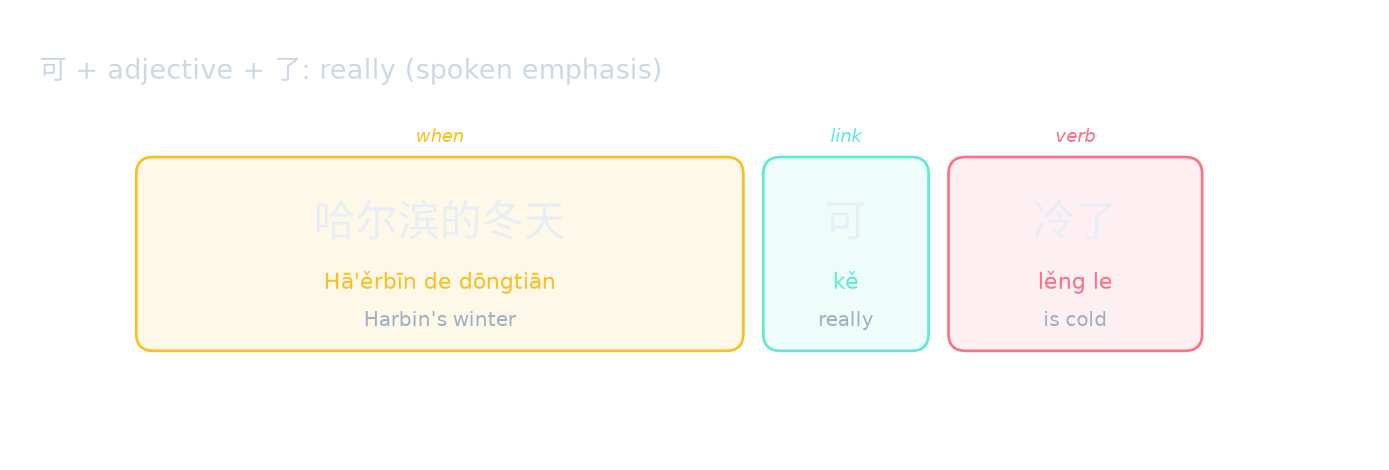
- Harbin, subprovincial city…哈尔滨(modifier / structural particle)的winter冬天really可cold冷(completed / change)了! — "Harbin winters are really cold!"
- Goal: add strong feeling to an adjective with really可 + adjective + (completed / change)了 in speech.
really可 + Adjective + (completed / change)了
- really可 + Adj (+ (completed / change)了 / (and …? / softener)呢) = "really, so" with emphasis, in speech: good or not?可好(completed / change)了, to be treasured可贵(completed / change)了, really可interesting有意思(completed / change)了 — "It is really interesting."
- It often tells someone something they may not believe or know.
this这个film电影really可interesting有意思了。
Complete: “That restaurant is really expensive!” 那家饭馆____贵了!
Dificultad 1/5 · 100 monedas + un pequeño bono en el primer intento de hoy
可 + Adj + 了 for spoken emphasis.
Build: “This film is really interesting.”
Dificultad 3/5 · 200 monedas + un pequeño bono en el primer intento de hoy
可 + Adj + 了.
Warnings and reminders
- really可 + don't别 / want / will / need要: you你really可don't别forget忘(completed / change)了! — "Don't you forget!" you你really可want / will / need要to be careful小心! — "Do be careful!"
- The really可 adds urgency to the request.
you你(do)可don't别forget忘了!
What does 你可别迟到! mean?
Dificultad 1/5 · 100 monedas + un pequeño bono en el primer intento de hoy
可 before 别 adds urgency: 你可别迟到! “Whatever you do, don't be late!” It is a strong warning, not a statement about what is possible.
Spoken emphasis
- Use really可…(completed / change)了 in conversation; in writing choose very非常 or very十分.
- really可 + Adj usually needs (completed / change)了 or (and …? / softener)呢 at the end: really可cold冷(completed / change)了, not just really可cold冷.
really可 as "but"
- At the start of a clause, really可 can be short for but可是: I我want to想go去,really可haven't没time时间 — "I'd like to go, but I don't have time."
- Before an adjective with (completed / change)了, it is the emphatic "really".
I我want to想go去,but可haven't没time时间。
In 我想去,可没时间, 可 means “but”.
Dificultad 1/5 · 100 monedas + un pequeño bono en el primer intento de hoy
At the start of a clause, 可 can be short for 可是.
Recap
- really可 + Adj + (completed / change)了 = really …! (spoken emphasis); really可don't别 / really可want / will / need要 = urgent warnings.
- At the start of a clause, really可 can mean "but".
Read the full reference: HSK 4 grammar — Adverbs.
A friend from the south asks whether Harbin in winter is really as cold as people say. Close the examples. Say a Mandarin response, then write it in Chinese. Explain briefly in English what the lesson’s pattern adds. Compare with the model, then change one detail and try again.
This is supported productive practice. Compare meaning and structure; your answer need not copy the model. A partner or teacher must hear the spoken response to comment on pronunciation.