Tu plan de aprendizaje · Continuar · Revisar →
把 sentences (do something to the object)
IntroducidoTu posición guardada se conserva en este navegador. Continuar no completa la lección ni responde sus preguntas.
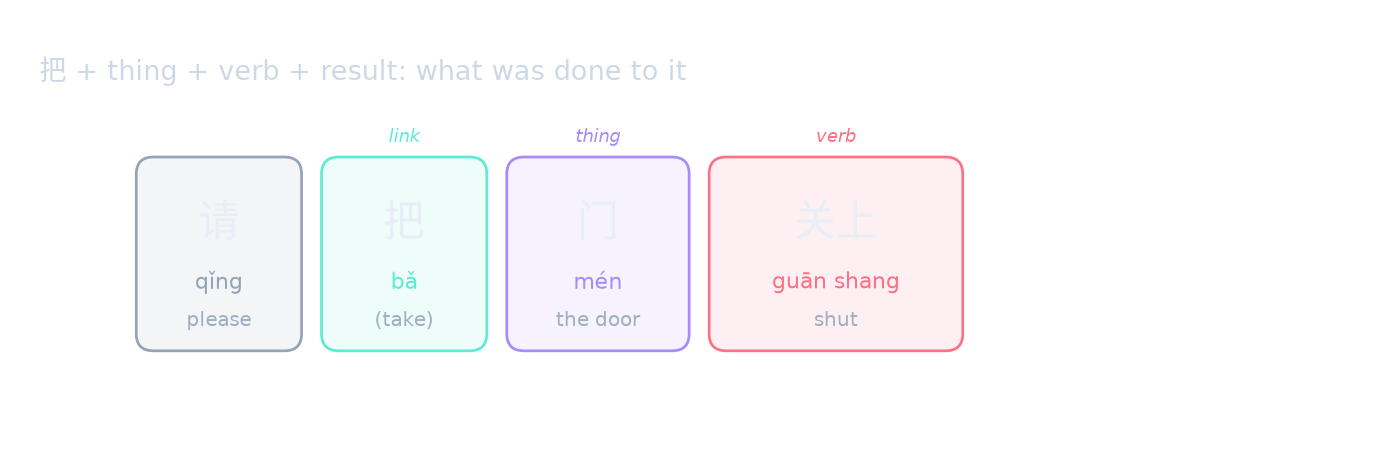
Cierra la puerta, por favor
- Hace frío y tu hermano pequeño ha dejado la puerta abierta de nuevo.
- please请to stand as a goalkeeper把门to close (a door)关上。 — "Por favor, cierra la puerta." (把: marks the object)把 coloca el objeto al principio y especifica qué sucede con él.
Sujeto + (把: marks the object)把 + Objeto + Verbo + Resultado
- (把: marks the object)把 + objeto va antes del verbo; el verbo debe llevar algo después: un resultado, una dirección, (completed / change)了 o un lugar.
- I / me我(把: marks the object)把school assignment作业to do; to make做to finish完(completed / change)了 — "He terminado la tarea." he他(把: marks the object)把the book书put放on在the table桌子(on)上 — "Él puso el libro sobre la mesa."
he他把the book书put放on在the table桌子(on)上。
Complete: “I've finished the homework.” 我____作业做完了。
Dificultad 1/5 · 100 monedas + un pequeño bono en el primer intento de hoy
把 + object + verb + result.
Mover, cambiar, terminar
- Mover algo: please请(把: marks the object)把the rubbish垃圾to take out拿出to go去。 — "Por favor, saca la basura afuera."
- Cambiar algo: I / me我(把: marks the object)把this这个sentence句子翻译成English (language)英文(completed / change)了。 — "He traducido esta oración al inglés."
please请把the rubbish垃圾take拿out出去。
Build: “Please take the rubbish out.”
Dificultad 3/5 · 200 monedas + un pequeño bono en el primer intento de hoy
把 + object + verb + direction.
El verbo no puede quedar solo
- La oración «I / me我(把: marks the object)把cooked rice饭to eat吃» está incompleta. Añada un resultado o el partícula (completed / change)了: I / me我(把: marks the object)把cooked rice饭to eat吃to finish完(completed / change)了.
- El objeto afectado suele ser identificable en la situación. Estos ejemplos usan un libro o una puerta conocida; los objetos indefinidos también pueden aparecer con un contexto apropiado.
Which sentence is complete and correct?
Dificultad 1/5 · 100 monedas + un pequeño bono en el primer intento de hoy
The verb after 把 needs a result or 了.
Negativos y don't别
- not / haven't没 / not不 / don't别 van antes de (把: marks the object)把: I / me我not / haven't没(把: marks the object)把key钥匙to bring带来。 — "No traje las llaves." don't别(把: marks the object)把your phone手机forget忘on在home家里! — "¡No dejes tu teléfono en casa!"
- Los verbos de sensación y conocimiento (to like喜欢, to know知道) no toman (把: marks the object)把.
don't别把your phone手机forget忘at在home家里!
我把钥匙没带来 is the correct word order.
Dificultad 1/5 · 100 monedas + un pequeño bono en el primer intento de hoy
没 goes before 把: 我没把钥匙带来.
Resumen
- Sujeto + (把: marks the object)把 + objeto específico + Verbo + algo (resultado, dirección, lugar, (completed / change)了).
- Las palabras negativas van antes de (把: marks the object)把. No se usan con verbos de sensación o conocimiento.
Lee la referencia completa: Gramática HSK 3 — Patrones de oración.
It is cold, and your little brother has left the door wide open again. Close the examples. Say a Mandarin response, then write it in Chinese. Explain briefly in English what the lesson’s pattern adds. Compare with the model, then change one detail and try again.
This is supported productive practice. Compare meaning and structure; your answer need not copy the model. A partner or teacher must hear the spoken response to comment on pronunciation.