Continuidad de fluidos, energía de presión y flujo viscoso
Introducido| English | Significado |
|---|---|
| viscosity/vɪˈskɒsɪti/ | viscosidad |
| continuity/kɒntɪˈnjuːɪti/ | continuidad |
| Reynolds number/ˈrenəldz ˈnʌmbə/ | número de Reynolds |
Same flow, different pressure
- Water flows from a wide pipe into a narrow one. The flow rate is the same in both, the speed rises, and the pressure drops, if the flow is ideal. Add viscosity 黏度 and the story changes.
- GRE fluids questions test continuity 连续性, hydrostatics and Pascal's principle, Bernoulli and Torricelli, Poiseuille flow and the Reynolds number 雷诺数.
Continuity and hydrostatics
- Steady incompressible flow: $Q = Av$ is constant along a pipe. Halving the radius quarters the area and quadruples the speed.
- At rest: $p = p_0 + \rho gh$ at depth $h$, whatever the container's shape. A pressure change spreads through the whole fluid (Pascal), so a hydraulic press multiplies force by the area ratio: $F_2/F_1 = A_2/A_1$.
A pipe narrows to half its radius. The flow speed becomes
Dificultad 1/5 · 100 monedas + un pequeño bono en el primer intento de hoy
Continuity keeps $Av$ constant; half the radius is a quarter of the area, so the speed becomes four times as large.
Gauge pressure 20 m below the surface of fresh water, in kPa? ($\rho = 1000$ kg/m³, $g = 9.8$ m/s²)
Dificultad 2/5 · 140 monedas + un pequeño bono en el primer intento de hoy
$\rho gh = 1000 \times 9.8 \times 20 = 196\,000$ Pa.
A hydraulic press has pistons of area 10 cm² and 500 cm². What force (N) on the small piston lifts 10 000 N on the large one?
Dificultad 2/5 · 140 monedas + un pequeño bono en el primer intento de hoy
$F_1 = F_2 A_1/A_2 = 10\,000 \times 10/500 = 200$ N.
Bernoulli and Torricelli
- Along a streamline of steady, incompressible, inviscid flow with no pump: $p + \tfrac12\rho v^2 + \rho gz =$ const. Each term is energy per volume. Faster at the same height means lower pressure.
- Water leaving a hole a depth $h$ below the open surface of a wide tank: both points are at atmospheric pressure, so $v = \sqrt{2gh}$ (Torricelli), the speed of a free fall from $h$.
Water from 4 cm² at 1 m/s into 1 cm²: $v_2 = 4$ m/s, $Q = 4\times10^{-4}$ m³/s, and $p_1 - p_2 = \tfrac12 \cdot 1000 \cdot (16 - 1) = 7500$ Pa.
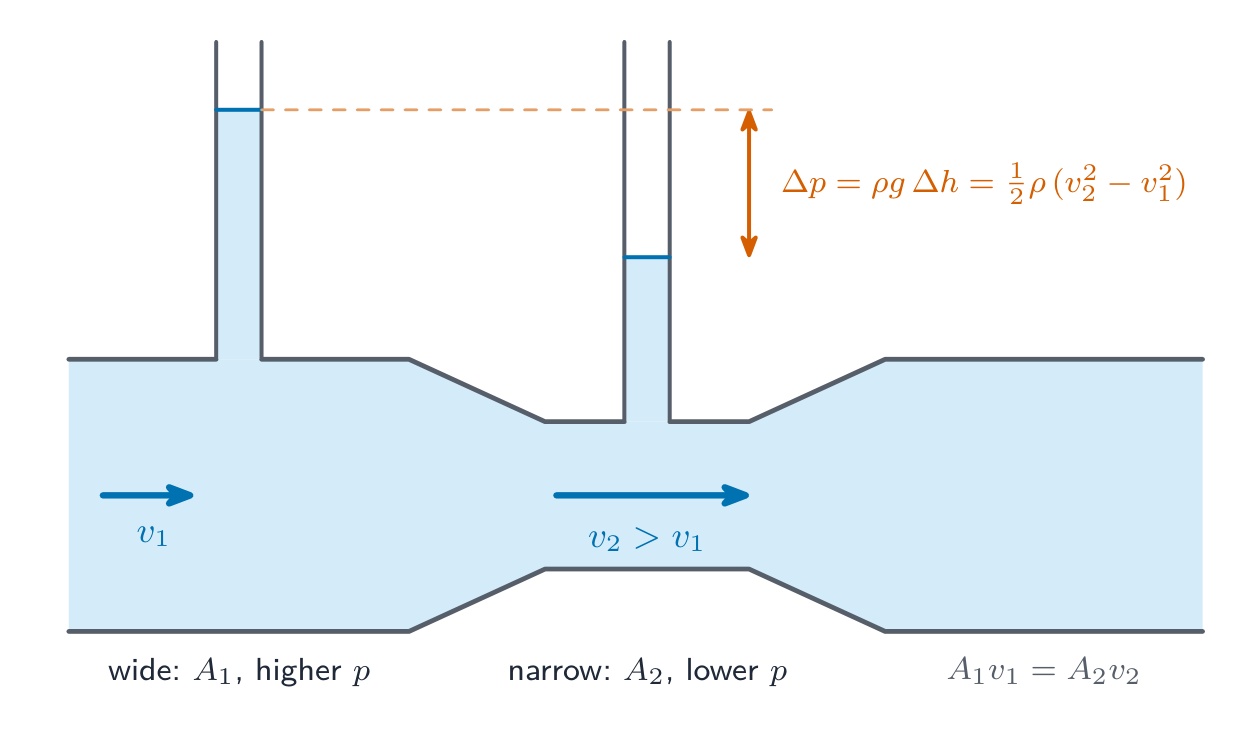
Water ($\rho = 1000$) flows horizontally from 6 cm² at 2 m/s into 2 cm². Pressure drop in Pa?
Dificultad 2/5 · 140 monedas + un pequeño bono en el primer intento de hoy
v₂ = 6 m/s; 500 × (36 − 4).
Water leaves a small hole 1.25 m below the surface of a wide open tank. Speed in m/s? ($g = 10$ m/s²)
Dificultad 2/5 · 140 monedas + un pequeño bono en el primer intento de hoy
$v = \sqrt{2gh} = \sqrt{25} = 5$ m/s.
Viscous flow: Poiseuille
- Laminar flow in a tube: $Q = \dfrac{\pi R^4\Delta p}{8\eta L}$. Doubling $R$ at fixed $\Delta p$ multiplies $Q$ by 16: a slightly narrowed artery needs a much larger pressure difference.
- This is a different comparison from continuity, which holds $Q$ fixed within one pipe. Viscous flow loses pressure along a straight pipe of constant width, which Bernoulli cannot describe.
¿Ecuación de Bernoulli o modelo de pérdidas?
Decidir si aplica la ecuación de Bernoulli sin pérdidas.
At fixed pressure drop, a tube's radius is multiplied by 1.5. Factor change in laminar $Q$ (four decimal places)?
Dificultad 2/5 · 140 monedas + un pequeño bono en el primer intento de hoy
Poiseuille's law gives $Q \propto r^4$, so $1.5^4 = 5.0625$.
Bernoulli's equation applies unchanged to viscous honey flowing slowly through a thin straw.
Dificultad 1/5 · 100 monedas + un pequeño bono en el primer intento de hoy
Viscous losses dominate; use Poiseuille.
Reynolds number
- $\text{Re} = \dfrac{\rho vD}{\eta}$ (diameter, mean speed) is dimensionless. Low Re: viscous, laminar. High Re: inertia dominates and turbulence becomes possible; the threshold depends on geometry (about 2000 for a pipe).
- Poiseuille's $R^4$ law fails once flow is turbulent.
Water ($\rho = 1000$, $\eta = 0.001$ Pa·s) at 0.5 m/s in a 2 cm diameter pipe. Reynolds number?
Dificultad 2/5 · 140 monedas + un pequeño bono en el primer intento de hoy
1000 × 0.5 × 0.02 / 0.001.
Worked GRE question: a leaking tank
A wide open tank holds water 5.0 m deep above a small hole in its side. The speed of the water leaving the hole is about ($g = 9.8$ m/s²)
- (A) 4.9 m/s
- (B) 7.0 m/s
- (C) 9.9 m/s
- (D) 14 m/s
- (E) 49 m/s
Fast route. $v = \sqrt{2gh} = \sqrt{98} \approx 9.9$ m/s. Answer (C).
Traps. (B) is $\sqrt{gh}$, dropping the 2. (E) is $gh$ with no square root. The speed does not depend on the hole's size, as long as it is small compared with the tank.
Worked GRE question: two thin pipes for one
A pipe of radius $R$ carries laminar flow. It is replaced by two pipes of radius $R/2$, with the same length and pressure difference. The total flow rate becomes
- (A) 2 times the original
- (B) the same
- (C) $\tfrac12$ of the original
- (D) $\tfrac14$ of the original
- (E) $\tfrac18$ of the original
Fast route. Each thin pipe carries $(1/2)^4 = 1/16$ of the original; two carry $\tfrac18$. Answer (E).
Traps. (C) scales flow with cross-section area ($2 \times \tfrac14$). (A) simply counts pipes. Viscous flow depends on $R^4$, so thin pipes carry very little.
Common errors
- Bernoulli for viscous or pumped flow. It holds only without losses or added energy.
- Mixing continuity and Poiseuille. Continuity: same $Q$ through one pipe. Poiseuille: $Q$ for a given $\Delta p$.
- Pressure depending on container shape. Hydrostatic pressure depends only on depth.
- Forgetting the 2 in $\sqrt{2gh}$.
Recap
- Continuity: $Av$ constant; hydrostatics $p_0 + \rho gh$; hydraulic press $F_2/F_1 = A_2/A_1$.
- Bernoulli only for lossless steady flow along a streamline; Torricelli $v = \sqrt{2gh}$.
- Poiseuille $Q \propto R^4\Delta p$ for laminar flow; check Re $= \rho vD/\eta$.
- Reynolds number: The dimensionless ratio of inertial to viscous effects in a flow.
- viscosity: A fluid's resistance to flowing, like internal friction between layers.
- continuity: The rule that the volume flow rate is the same everywhere along a pipe.