Espectros atómicos y reglas de selección
Introducido| English | Significado |
|---|---|
| selection rules/sɪˈlekʃn ruːlz/ | reglas de selección |
| reduced mass/rɪˈdjuːst mæs/ | reduced mass |
| series/ˈsɪəriːz/ | series |
| term symbol | term symbol |
| metastable/ˌmetəˈsteɪbl/ | metastable |
| fine structure/faɪn ˈstrʌktʃə/ | estructura fina |
| Zeeman effect/ˈziːmən ɪˈfekt/ | The splitting of spectral lines in a magnetic field. |
Same energy, no line
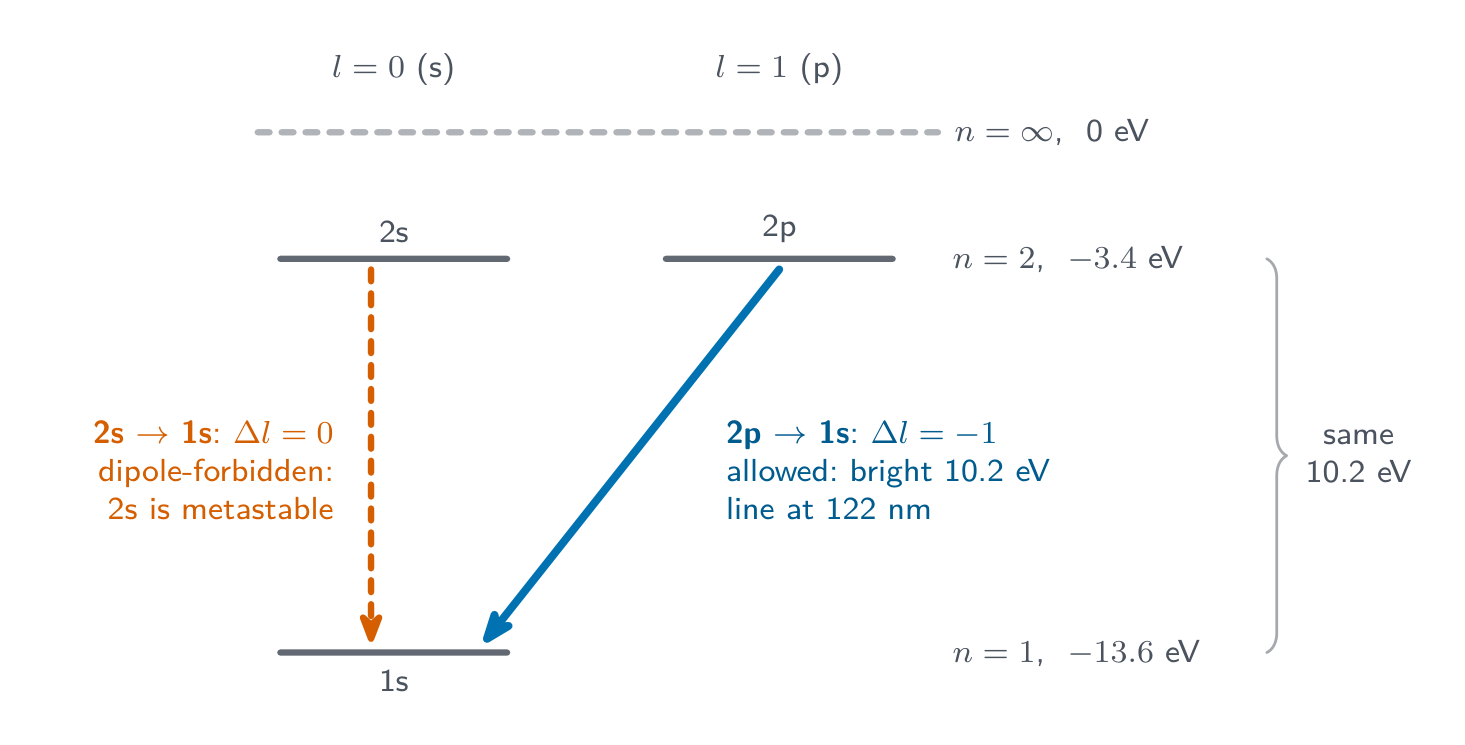
- In hydrogen, $2p \to 1s$ and $2s \to 1s$ release the same 10.2 eV. Only the first gives a strong spectral line; an atom in $2s$ can wait a tenth of a second, a million times longer than in $2p$.
- Atomic physics is about a tenth of the GRE Physics test. It asks for hydrogen-like energies and wavelengths, quantum numbers, selection rules 选择定则, and what changes when the simple model breaks down.
Hydrogen-like energies
- One electron around a nucleus of charge $Ze$: $E_n = -\dfrac{13.6\,Z^2}{n^2}$ eV. The emitted photon carries the difference, $E_\gamma = E_i - E_f$, and its wavelength is $\lambda = \dfrac{hc}{E_\gamma}$ with $hc \approx 1240$ eV·nm.
- Everything scales with $Z^2$: in He⁺ ($Z = 2$) every level is 4 times deeper, so each line has 4 times the energy and a quarter of the wavelength. The 13.6 eV also contains the electron mass (through the reduced mass 约化质量 $\mu$). In positronium (an electron bound to a positron) $\mu = m_e/2$, so every energy is half: the ground state is $-6.8$ eV.
$3 \to 2$ in hydrogen: $E_\gamma = 13.6\left(\tfrac14 - \tfrac19\right) = 1.89$ eV, $\lambda = 1240/1.89 = 656$ nm, the red H$\alpha$ line. Ionizing hydrogen from $n = 2$ takes only 3.4 eV.
Photon energy (eV) for hydrogen $n = 4 \to 2$ (the blue-green H$\beta$ line), to two decimal places?
Dificultad 2/5 · 140 monedas + un pequeño bono en el primer intento de hoy
$13.6\left(\tfrac14 - \tfrac1{16}\right) = 13.6 \times \tfrac{3}{16} = 2.55$ eV, so $\lambda = 1240/2.55 = 486$ nm.
Ground-state energy of He⁺ in eV?
Dificultad 2/5 · 140 monedas + un pequeño bono en el primer intento de hoy
Hydrogen-like energies scale as $Z^2$: $-13.6 \times 2^2 = -54.4$ eV for He⁺.
Ground-state energy of positronium (an electron bound to a positron), in eV?
Dificultad 2/5 · 140 monedas + un pequeño bono en el primer intento de hoy
The reduced mass is $m_e m_e/(m_e+m_e) = m_e/2$, and the energies are proportional to it: $-13.6/2 = -6.8$ eV.
The spectral series
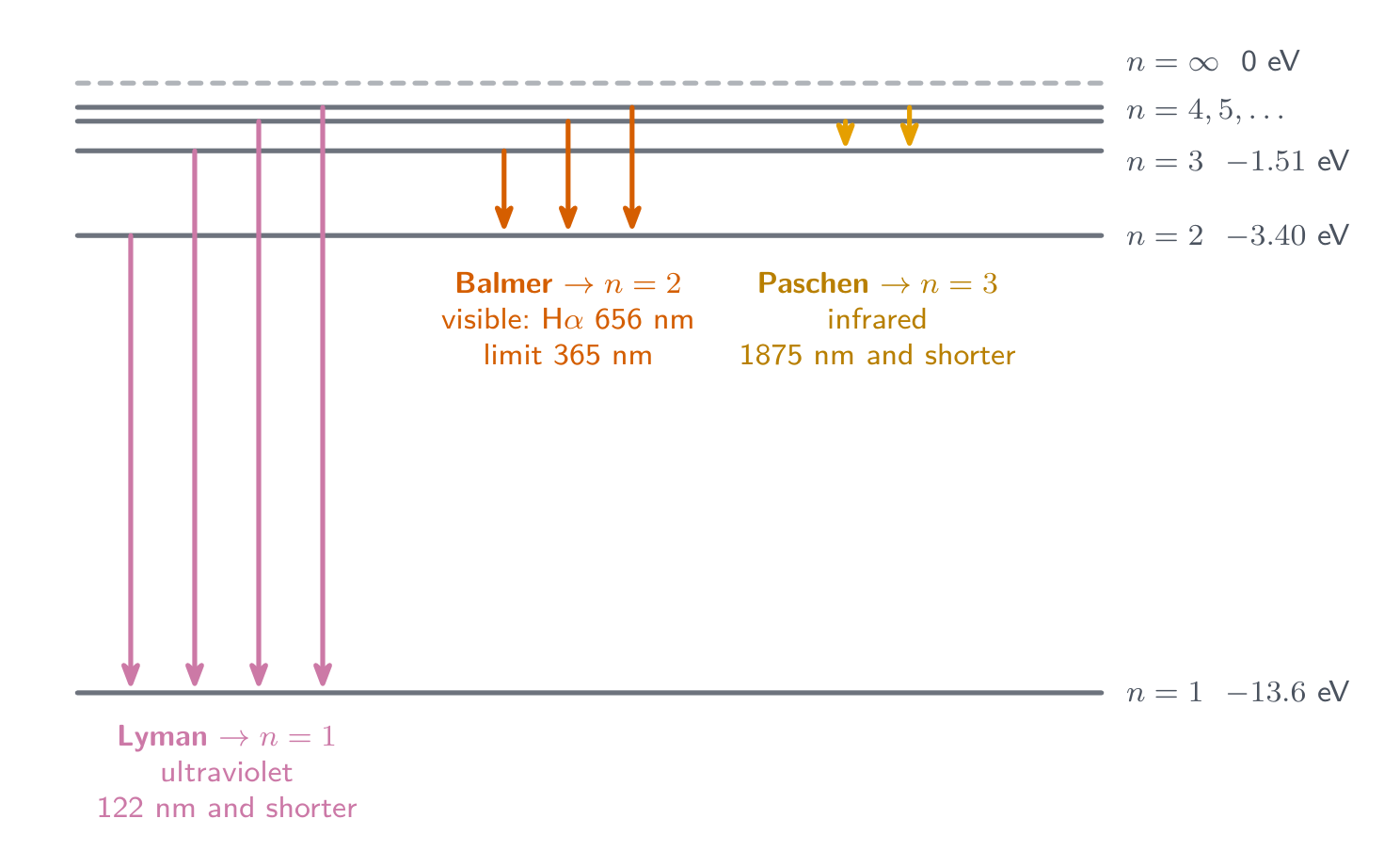
- Lines that end on the same lower level form a series 谱线系. Lyman ends on $n = 1$ (ultraviolet), Balmer on $n = 2$ (visible), Paschen on $n = 3$ (infrared).
- Each series has a series limit: the line from $n = \infty$, the shortest wavelength in the series. For Balmer, $E = 13.6/4 = 3.4$ eV, so $\lambda = 1240/3.4 = 365$ nm. The lines crowd together as they approach the limit.
Series limit of the Paschen series (lines ending on $n = 3$), in nm (nearest 10 nm)?
Dificultad 2/5 · 140 monedas + un pequeño bono en el primer intento de hoy
From $n = \infty$ hasta $n = 3$: $E = 13.6/9 = 1.51$ eV, so $\lambda = 1240/1.51 \approx 820$ nm, in the infrared.
Quantum numbers and term symbols
- $l = 0, \dots, n - 1$ (letters s, p, d, f); $m_l = -l, \dots, l$; spin $m_s = \pm\tfrac12$. Level $n$ holds $n^2$ orbital states and $2n^2$ states with spin. In pure hydrogen all of them have the same energy.
- Total angular momentum $\mathbf J = \mathbf L + \mathbf S$; one electron has $j = l \pm \tfrac12$ (only $j = \tfrac12$ when $l = 0$). A term symbol 光谱项 writes this as $^{2S+1}L_J$: hydrogen's ground state is $^2S_{1/2}$, and $2p$ splits into $^2P_{1/2}$ and $^2P_{3/2}$.
How many electron states (including spin) does the $n = 3$ level of hydrogen hold?
Dificultad 2/5 · 140 monedas + un pequeño bono en el primer intento de hoy
Level $n$ has $n^2$ orbital states, each with two spin states: $2n^2 = 18$ for $n = 3$.
Electric-dipole selection rules
- A photon carries one unit of angular momentum and the dipole operator changes parity. So an electric-dipole (E1) transition needs $\Delta l = \pm1$, $\Delta m_l = 0, \pm1$, $\Delta j = 0, \pm1$ (but not $j = 0 \to 0$), and no change of spin, $\Delta S = 0$.
- The energy can be right while the transition is still forbidden. Forbidden means forbidden for this mechanism, not impossible: such states decay slowly by weaker routes.
$2p \to 1s$: $\Delta l = -1$, allowed, lifetime about 1.6 ns. $2s \to 1s$: $\Delta l = 0$, so $2s$ is metastable 亚稳态的; it decays by emitting two photons, in about 0.12 s. $3d \to 1s$: $\Delta l = -2$, forbidden; $3d$ decays through $2p$ instead.
¿Permitido o prohibido?
Aplica la regla Δl = ±1 a las transiciones del hidrógeno.
Which transition is electric-dipole forbidden?
Dificultad 1/5 · 100 monedas + un pequeño bono en el primer intento de hoy
Electric-dipole transitions need $\Delta l = \pm1$. A $3d \to 1s$ jump changes $l$ from 2 to 0, so it is forbidden.
Beyond the simple model
- Fine structure 精细结构: spin–orbit coupling and relativity split levels with different $j$, by about $\alpha^2 \approx 10^{-4}$ of the level energy. Hyperfine structure is smaller still: the electron–proton spin flip gives the 21 cm radio line ($5.9\times10^{-6}$ eV).
- In a magnetic field $B$ each level shifts by $\mu_B B\,m_l$ (the normal Zeeman effect 塞曼效应), with $\mu_B = 5.8\times10^{-5}$ eV/T. Because $\Delta m_l = 0, \pm1$, one line splits into three, equally spaced by $\mu_B B$.
- In many-electron atoms inner electrons shield the nucleus, so $l$-levels split and you cannot use $-13.6Z^2/n^2$ for sodium's outer electron. For an inner-shell X-ray line it works with one correction: the K$\alpha$ line ($n = 2 \to 1$) sees about $Z - 1$ (Moseley's law), so $E_{K\alpha} \approx 10.2\,(Z-1)^2$ eV.
In the normal Zeeman effect, into how many lines does a single spectral line split?
Dificultad 1/5 · 100 monedas + un pequeño bono en el primer intento de hoy
Each level shifts by $\mu_B B\,m_l$, and the photon can change $m_l$ only by $0$ or $\pm1$. So there are only three different photon energies, whatever $l$ is.
Inner electrons shield most of the nuclear charge from sodium's outer electron.
Dificultad 1/5 · 100 monedas + un pequeño bono en el primer intento de hoy
True. The 10 inner electrons screen the nucleus, so the 3s electron feels an effective charge near 1–2, not 11, and its energy is about −5 eV.
Worked GRE question: scaling with Z
The $n = 2 \to 1$ line of hydrogen has wavelength 122 nm. What is the wavelength of the $n = 2 \to 1$ line of singly ionized helium, He⁺?
- (A) 30.5 nm
- (B) 61 nm
- (C) 122 nm
- (D) 244 nm
- (E) 488 nm
Fast route. He⁺ has one electron, so it is hydrogen-like with $Z = 2$. Energies scale as $Z^2 = 4$, wavelength as $1/E$: $122/4 = 30.5$ nm. Answer (A).
Traps. (B) scales with $Z$ instead of $Z^2$. (E) multiplies instead of dividing: a deeper atom gives shorter wavelengths. (C) assumes the levels are the same as hydrogen's.
Worked GRE question: an X-ray line
Approximately what is the energy of the K$\alpha$ X-ray of copper ($Z = 29$)?
- (A) 0.3 keV
- (B) 2.4 keV
- (C) 8.0 keV
- (D) 8.6 keV
- (E) 11.4 keV
Fast route. Moseley: the $n = 2$ electron sees the nucleus screened by the one remaining $1s$ electron, so $Z_{\text{eff}} \approx 28$. $E \approx 10.2 \times 28^2 = 10.2 \times 784 \approx 8.0$ keV. Answer (C). (The measured value is 8.05 keV.)
Traps. (D) uses $Z^2 = 841$ without screening. (E) makes both mistakes: $13.6 \times 29^2$ uses the ionization energy instead of the $2 \to 1$ gap, $13.6(1 - \tfrac14) = 10.2$ eV, and ignores screening. (A) scales with $Z$, not $Z^2$.
Estimate the K$\alpha$ X-ray energy of iron ($Z = 26$), in keV (one decimal place).
Dificultad 2/5 · 140 monedas + un pequeño bono en el primer intento de hoy
$E \approx 10.2(Z-1)^2 = 10.2 \times 625 = 6375$ eV $\approx 6.4$ keV (measured: 6.40 keV).
Common errors
- Scaling with $Z$ instead of $Z^2$, or forgetting that wavelength goes as $1/E$.
- Using 13.6 eV for a transition to $n = 2$: Balmer lines use $13.6(\tfrac14 - \tfrac1{n^2})$; only ionization from $n = 1$ costs 13.6 eV.
- Checking energy but not $\Delta l$. A transition can have the right energy and still be dipole-forbidden.
- Ignoring reduced mass for positronium or muonic atoms: the energies scale with $\mu$.
Recap
- $E_n = -13.6\,Z^2\mu/(m_e n^2)$ eV; photon energy is the positive level difference; $\lambda = 1240/E$ nm.
- Lyman → $n = 1$ (UV), Balmer → $n = 2$ (visible, limit 365 nm), Paschen → $n = 3$ (IR).
- $2n^2$ states per level; term symbol $^{2S+1}L_J$.
- E1 lines need $\Delta l = \pm1$, $\Delta m_l = 0, \pm1$, $\Delta S = 0$.
- Normal Zeeman effect: three lines, spacing $\mu_B B$. Moseley: $E_{K\alpha} \approx 10.2(Z-1)^2$ eV.
- selection rules: Conditions on quantum-number changes that a given transition mechanism allows.
- metastable: Long-lived because its decay route is forbidden at leading order.
- fine structure: Small splittings of atomic levels from spin-orbit and relativistic effects.
- series limit: The shortest-wavelength line of a spectral series, from the ionization limit down to its lower level.