Equivalencia de oraciones: ajuste al contexto y coincidencia de significados completos
Introducido| English | Significado |
|---|---|
| tentative/ˈtentətɪv/ | provisional |
| reticent/ˈretɪsənt/ | reticente |
Clear is not the same as short
- A guide can be easy to understand without being short. If a sentence praises instructions that a beginner can follow, clear and lucid describe the right quality; brief and concise describe a different one.
- Sentence Equivalence asks for two choices that each fit the sentence and give completed sentences alike in meaning. This lesson uses original practice examples to separate those two checks.
Choose exactly two of six
- An official Sentence Equivalence question has one sentence, one blank and six choices. Select exactly two. Both must belong to the correct pair; one correct choice does not earn partial credit.
- Do not choose one word for the first half of the sentence and another for the second half. Put each selected word into the same blank, forming two separate complete sentences, then compare them.
In sentence equivalence you must choose exactly ____ answers.
Dificultad 1/5 · 100 monedas + un pequeño bono en el primer intento de hoy
Both are needed for credit.
In an official Sentence Equivalence question, selecting one member of the correct pair earns partial credit.
Dificultad 1/5 · 100 monedas + un pequeño bono en el primer intento de hoy
The official item requires the correct two selections; it does not award partial credit for one. Individual website teaching checks are not an official GRE score.
Read the evidence before naming a pair
- Practice sentence: “The scientist's early findings were ___, treated as a working conclusion rather than settled fact, but later experiments confirmed them.” Choices: tentative 暂定的 / provisional / definitive / celebrated / erroneous / conclusive.
- “Working conclusion rather than settled fact” supports not yet final. Later confirmation supports a change from an unconfirmed result to a confirmed one; it does not mean the early result was false.
Complete the sentence twice
- Tentative and provisional both present these findings as open to further testing or revision. Read the full sentence with each: both versions describe a working conclusion that was later confirmed.
- The words need not have identical meanings in every setting. Here their shared contribution is the result's unsettled status, not hesitation in someone's voice or a temporary physical object.
“The scientist’s early findings were ___, treated as a working conclusion rather than settled fact, but later experiments confirmed them.” Select TWO.
Dificultad 2/5 · 140 monedas + un pequeño bono en el primer intento de hoy
Tentative and provisional both describe findings not yet treated as final. The explicit working-conclusion clue anchors that status. Definitive/conclusive conflicts with it, erroneous conflicts with later confirmation, and celebrated concerns praise rather than finality.
A matching pair can fail the context
- Definitive and conclusive both suggest a settled result. They form a related pair, but clash with “rather than settled fact.” Vocabulary similarity cannot repair that conflict.
- Erroneous means wrong, which conflicts with later confirmation here. Celebrated means widely praised: the passage gives no evidence about fame or public approval, and no offered partner completes that meaning.
If two choices are synonyms, they must be the answer.
Dificultad 1/5 · 100 monedas + un pequeño bono en el primer intento de hoy
The pair must also fit the sentence.
Explain why tentative / provisional fits the findings sentence and why definitive / conclusive fails, even though both are related word pairs.
Una posible explicación. Compara los vínculos de la pista con tu redacción; este modelo local no predice una puntuación GRE.
Keep the two checks separate
- First ask whether each word fits the sentence's grammar, clues and relevant sense. Then compare the complete meanings: are both versions making the same claim, with the same direction and relevant degree?
- Two words can each make a possible sentence but make different claims. “The guide is short” and “the guide is clear” can both be true, yet one concerns length and the other understanding. Possible truth is not equivalence.
Which two checks must the selected words pass?
Dificultad 1/5 · 100 monedas + un pequeño bono en el primer intento de hoy
Each word must fit the supplied sentence, and the two complete sentences must be alike in meaning. Word similarity alone tests neither requirement fully.
Work the clarity example with all six choices
- “Her explanation was ___: it showed the mechanism clearly enough for a beginner to follow.” Choices: brief / lucid / unusual / concise / clear / rare. The explanation after the colon points to easy to understand.
- Lucid and clear fit and give the same central meaning. Brief / concise is a length pair; unusual / rare is a rarity pair. Neither alternative pair is supported by the explanation of understanding.

¿Responde este par a esta oración?
Cada tarjeta incluye su pista de oración y un par propuesto. Clasifica la relación principal del par con dicha pista.
“Her explanation was ___: it showed the mechanism clearly enough for a beginner to follow.” Select TWO.
Dificultad 2/5 · 140 monedas + un pequeño bono en el primer intento de hoy
Lucid and clear match the understanding clue and give the same central meaning. Brief/concise concerns length, and unusual/rare concerns rarity; those qualities are not established here.
A quiet manner needs a clear context
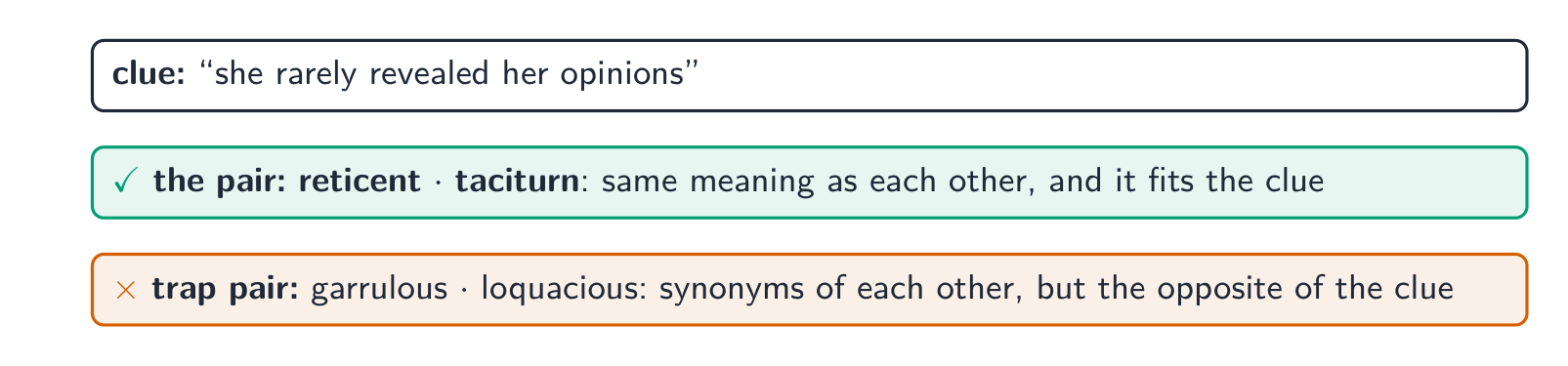
- “During the discussion she was ___, speaking only when necessary and volunteering no opinions.” Choices: garrulous / reticent 沉默寡言的 / candid / taciturn / loquacious / effusive. The sentence describes a quiet, reserved manner.
- Reticent and taciturn fit that manner here. Garrulous / loquacious describes much talking, the wrong direction. Candid means frank, and effusive means freely expressive or enthusiastic; neither matches this description as well.
“During the discussion she was ___, speaking only when necessary and volunteering no opinions.” Select TWO.
Dificultad 2/5 · 140 monedas + un pequeño bono en el primer intento de hoy
Reticent and taciturn both fit the quiet, reserved manner described here. Reticent concerns reluctance to reveal thoughts; taciturn concerns speaking little. The full context brings them together without making them interchangeable everywhere. Garrulous and loquacious describe much talking.
Related words can differ outside this sentence
- Reticent often describes unwillingness to reveal thoughts or feelings. Taciturn describes a tendency to speak little. Someone can talk at length about neutral facts while remaining reticent about a private matter.
- In the discussion example, speaking little and volunteering no opinions brings the two descriptions together. Do not learn the pair as permission to replace one with the other in every future sentence.
If reticent and taciturn fit the discussion example, they must be interchangeable in every sentence.
Dificultad 1/5 · 100 monedas + un pequeño bono en el primer intento de hoy
Reticent often concerns disclosure of thoughts or feelings; taciturn concerns speaking little. The discussion context supplies both features, but another context may separate them.
Explain why reticent / taciturn fits the discussion example without claiming that the words always mean exactly the same thing.
Una posible explicación. Compara los vínculos de la pista con tu redacción; este modelo local no predice una puntuación GRE.
Read the scope of a negative phrase
- “The fee was anything but ___: it was displayed clearly before payment.” Choices: hidden / modest / concealed / low / fixed / small. “Anything but” rejects the missing description, so the fee was not hidden.
- Hidden and concealed produce the same claim about disclosure. Modest / low / small concerns amount, which is not stated; fixed concerns whether the amount changes. A negative-looking word can be right because the sentence negates it.

“The fee was anything but ___: it was displayed clearly before payment.” Select TWO.
Dificultad 2/5 · 140 monedas + un pequeño bono en el primer intento de hoy
Anything but rejects the hidden/concealed description, agreeing with clear disclosure. The amount and whether it changes are not supplied by this sentence.
Check sense, degree and tone
- A word can have more than one sense. Lucid can describe a clear explanation; a lucid person is thinking clearly. Use the sense that fits the noun and the rest of the sentence, rather than the first meaning you remember.
- Degree also matters. Tepid praise is weak praise; enthusiastic praise is strong. Being broadly favourable does not make them equivalent. Ask what strength of judgement each completed sentence expresses.
A sentence says praise was weak and showed little enthusiasm. Which comparison correctly respects degree?
Dificultad 1/5 · 100 monedas + un pequeño bono en el primer intento de hoy
Tepid conveys weak enthusiasm. Enthusiastic expresses strong approval; broadly favourable words need not make equivalent sentences.
Use a second complete practice set
- “Despite its ornate cover, the report's prose was ___: its sentences were short and contained no unnecessary words.” Choices: verbose / concise / candid / wordy / succinct / vivid. Predict briefly expressed from the prose, not from the decorated cover.
- Concise and succinct fit; both describe economical wording here. Verbose / wordy is the wrong direction. Candid concerns frankness and vivid concerns strong impressions; the sentence supplies no such claim.
Which pair shares the relevant sense “using few words”? This is a vocabulary check, not a complete six-choice Sentence Equivalence item.
Dificultad 1/5 · 100 monedas + un pequeño bono en el primer intento de hoy
Laconic and terse both concern few words, though terse can also suggest abruptness. A real equivalence item still requires both words to fit its actual sentence and give matching complete meanings.
“Despite its ornate cover, the report’s prose was ___: its sentences were short and contained no unnecessary words.” Select TWO.
Dificultad 2/5 · 140 monedas + un pequeño bono en el primer intento de hoy
Concise and succinct both express economical wording. Verbose/wordy conflicts with short sentences and no unnecessary words. Candid and vivid concern other qualities.
When one word is unfamiliar
- Use known meanings and explicit clues to reject clear conflicts. If you find only one likely answer, reconsider your prediction and the remaining words' relevant senses; do not automatically attach the nearest-looking word.
- Word parts can suggest a meaning, but they do not establish a word's sense or tone in this sentence. For learning afterwards, record the word with a short definition and the clue that made it fit or fail.
Explain a rejection precisely
- A useful explanation names the conflict: “conclusive contradicts a working conclusion rather than settled fact,” or “concise concerns length, while this clue concerns understanding.” “It sounds wrong” gives you little to check.
- Distinguish unsupported from contradicted. A guide may in fact be short, but a clue about understanding does not establish that. A word can be rejected as the best completion without being proved false in the real world.
For the explanation sentence, compare lucid / clear with brief / concise. Explain why rejecting the length pair does not prove the explanation was long.
Una posible explicación. Compara los vínculos de la pista con tu redacción; este modelo local no predice una puntuación GRE.
Compare complete paraphrases
- Replace each candidate with a plain paraphrase and keep the rest of the sentence. If one version says “not yet final” and the other says “already proved wrong,” the claims differ. One concerns whether the result is final; the other asserts that it is false.
- Finish by checking exactly two selections, each word's contextual fit and the shared complete meaning. This is a method for practising evidence-based reading, not a guarantee that every item has an obvious synonym pair.
¿Qué movimiento de lectura se está realizando?
Cada tarjeta proporciona una razón para aceptar o rechazar opciones. Identifica el movimiento de lectura o el atajo sin fundamento.
Complete this original practice item and justify the pair: “The editor’s praise was ___: she mentioned only a minor strength and expressed little enthusiasm.” Select TWO from wholehearted / lukewarm / technical / tepid / extravagant / practical. Reject one competing description.
Una posible explicación. Compara los vínculos de la pista con tu redacción; este modelo local no predice una puntuación GRE.
Recap
- Select two words that each fit and produce completed sentences alike in meaning. Check the actual clue, relevant sense, negation and degree; isolated similarity or matching positive/negative labels is insufficient.
- If no partner fits, revisit the interpretation instead of forcing one. Explain why an alternative is unsupported or conflicts with the sentence, and reread both selected versions.
- tentative: Not yet definite or final.
- reticent: Unwilling to share thoughts or feelings.