El lenguaje de la medición
Introducido| English | Significado |
|---|---|
| accuracy/ˈækjʊrəsi/ | exactitud |
| precision/prɪˈsɪʒn/ | precisión |
| units/ˈjuːnɪts/ | unidades |
| uncertainty/ʌnˈsɜːtənti/ | incertidumbre |
| significant figures/sɪɡˈnɪfɪkənt ˈfɪɡəz/ | cifras significativas |
Close readings can share a fault
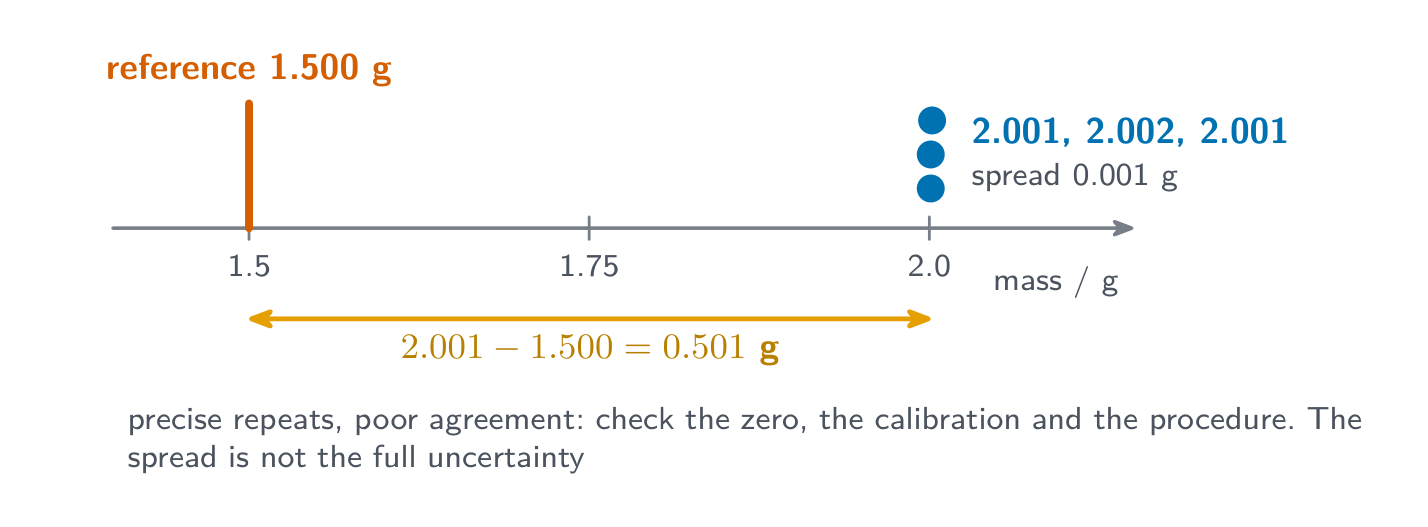
- A balance gives 2.001, 2.002 and 2.001 g for a supplied reliable 1.500 g reference mass. The readings are close to one another, but all are far above the reference.
- Repeating the unknown object alone cannot settle whether the balance has an offset. Check a suitable reference and the zero reading before trusting the result.
Distinguish accuracy from precision
- Accuracy 准确度 means closeness to a suitable reference or true value; precision 精密度 describes agreement between repeated readings under stated conditions. Precise results need not be accurate.
- These readings span only 0.001 g but exceed the reference by about 0.501 g. The pattern suggests investigating a systematic fault; it does not identify the cause by itself.
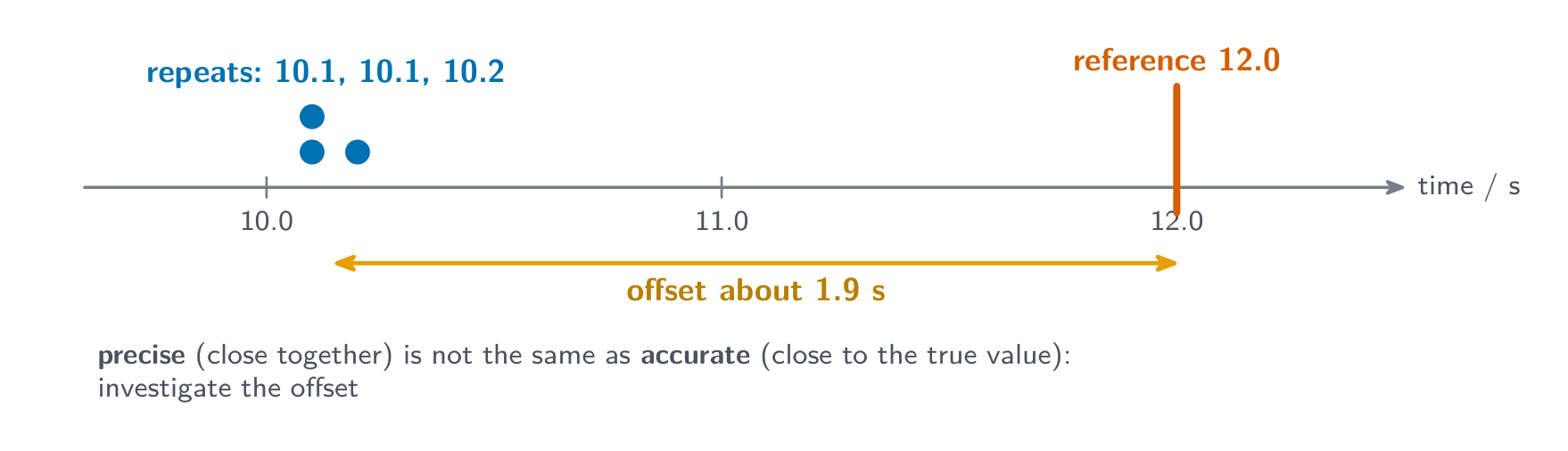
Una balanza marca 2.001, 2.002, 2.001 g para una masa conocida en 1.500 g. ¿Qué es?
Dificultad 1/5 · 100 monedas + un pequeño bono en el primer intento de hoy
Las repeticiones están próximas pero difieren de la referencia proporcionada. Un desplazamiento sistemático es una preocupación a investigar; tres lecturas solas no establecen su causa ni errores idénticos.
Convert units without changing the quantity
- Units 单位 state the scale of a physical quantity. A side of 10.0 cm is 0.100 m. For a square, $A=L^2=(0.100\ \text{m})^2=0.0100\ \text{m}^2$.
- Square the length conversion factor for area: $1\ \text{cm}^2=(0.01\ \text{m})^2=0.0001\ \text{m}^2$. Counts and ratios may be dimensionless but still need a clear definition.
El lado de un cuadrado es 10.0 cm. ¿Cuál es su área en metros cuadrados?
Dificultad 2/5 · 140 monedas + un pequeño bono en el primer intento de hoy
L = 0.100 m; A = L² = 0.0100 m². Eleva al cuadrado el factor de conversión de longitud.
State the supplied uncertainty honestly
- Uncertainty 不确定度 can include resolution, procedure and repeat variation. Significant figures 有效数字 communicate supported numerical precision. Extra calculator digits do not establish finer measurements, and half a scale division is not every measurement's full uncertainty.
- For a length supplied as 12.4 cm with uncertainty 0.05 cm, report $12.40\pm0.05\ \text{cm}$. Under the task's interval interpretation, the limits are 12.35 and 12.45 cm; no confidence level is supplied.
Match the value's decimal place to the stated uncertainty when reporting it. Do not invent an uncertainty, a confidence level or a justified exclusion to make data agree with a prediction.
Mides 12.4 cm con una regla milimétrica. ¿Por qué no escribir 12.437 cm?
Dificultad 1/5 · 100 monedas + un pequeño bono en el primer intento de hoy
Los dígitos adicionales de la calculadora no establecen mayor precisión de medición. La convención de reporte depende de los valores medidos, el procedimiento y la incertidumbre declarada.
Reporta la longitud proporcionada de 12.4 cm con una incertidumbre de 0.05 cm, alineando la posición decimal del valor con la incertidumbre.
Dificultad 1/5 · 100 monedas + un pequeño bono en el primer intento de hoy
Informe 12.40 ± 0.05 cm: valor, incertidumbre proporcionada y unidad. La tarea proporciona la incertidumbre y ningún nivel de confianza.
Usando la interpretación por intervalos del ejercicio, ¿cuál es el límite inferior de 12.40 ± 0.05 cm, en cm?
Dificultad 2/5 · 140 monedas + un pequeño bono en el primer intento de hoy
Límite inferior = 12.40 - 0.05 = 12.35 cm. No se proporciona nivel de confianza.
Choose and interpret a derived quantity
- Average speed over an interval is distance divided by elapsed time: $\bar v=d/t$. With supplied distance 3.60 m and time 48.0 s, $\bar v=3.60/48.0=0.0750\ \dfrac{\text{m}}{\text{s}}$.
- The three-significant-figure result reflects the supplied inputs. It does not tell us the speed at every moment; a car can stop and move faster during parts of the interval.
La distancia proporcionada y el tiempo transcurrido indican que el objeto se movió a exactamente 0.0750 m/s en cada instante.
Dificultad 1/5 · 100 monedas + un pequeño bono en el primer intento de hoy
Falso: distancia/tiempo da el promedio sobre el intervalo, no cada velocidad instantánea.
Check faults instead of averaging them away
- A consistent instrument offset can remain in the mean after many repeats. Compare with a suitable reference, document a suspected fault, and apply a correction only when the evidence justifies it.
- Keep the original readings and distinguish their spread from their difference from a reference. Record the units, procedure and uncertainty so the result can be interpreted.
Precision, accuracy and uncertainty answer different questions. Small repeat spread does not prove small total uncertainty or agreement with the reference.
Repetir una medición muchas veces no elimina un error sistemático.
Dificultad 1/5 · 100 monedas + un pequeño bono en el primer intento de hoy
Verdadero. Un desplazamiento consistente permanece en la media sin importar cuántas lecturas se tomen; verifique el instrumento contra una referencia adecuada.
Explica en una oración cómo detectarías un error sistemático en una balanza.
Dificultad 3/5 · 200 monedas + un pequeño bono en el primer intento de hoy
Ejemplo: "Pesa una masa patrón de calibración de 100 g y comprueba si la balanza marca 100 g."