Gerunds and infinitives · Gerundios e infinitivos
-ing or to …?
- After some verbs, use the -ing form (gerund).
- After others, use to + base verb (infinitive).
- You learn these by meeting them often.
I enjoy reading, but I keep forgetting to return the books.
-ing o to …?
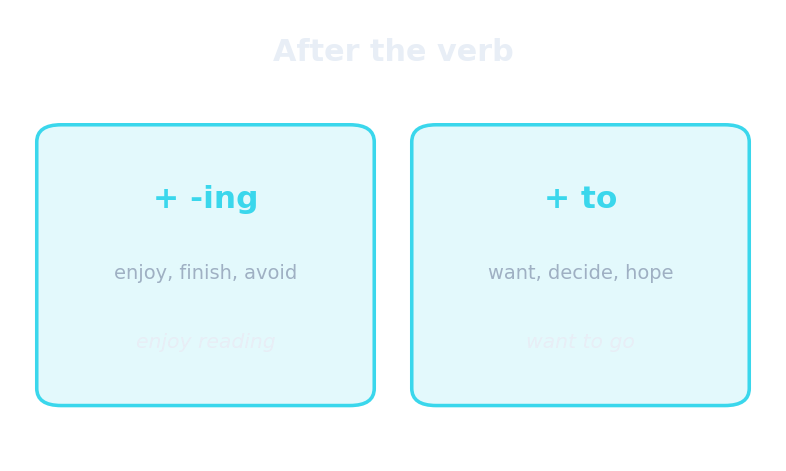
- Después de algunos verbos, usa la forma -ing (gerundio).
- Después de otros, usa to + verbo base (infinitivo).
- Los aprendes al encontrarlos con frecuencia.
Disfruto leer, pero sigo olvidando devolver los libros.
verb + -ing
- enjoy, finish, stop, mind, suggest, avoid + -ing.
- I enjoy reading. She finished doing her homework.
- The -ing form acts like a noun.
verbo + -ing
- enjoy, finish, stop, mind, suggest, avoid + -ing.
- I enjoy reading. She finished doing her homework.
- La forma -ing funciona como un sustantivo.
Choose: I enjoy ___ to music. · Elige: I enjoy ___ to music.
“enjoy” is followed by -ing: “I enjoy listening …”. · “enjoy” va seguido de -ing: “I enjoy listening …”.
verb + to-infinitive
- want, need, decide, hope, promise, learn, would like + to + base verb.
- I want to learn English. They decided to stay.
- Some verbs take either, with little change: like, love, start.
verbo + infinitivo con to
- want, need, decide, hope, promise, learn, would like + to + verbo base.
- I want to learn English. They decided to stay.
- Algunos verbos aceptan ambas formas, con poca variación: like, love, start.
After this verb — -ing or to? · Después de este verbo — -ing o to?
Some verbs take a gerund (-ing), others a to-infinitive. · Algunos verbos requieren un gerundio (-ing), otros un infinitivo con to.
Complete: They decided ___ stay. (one word before the verb) · Completa: They decided ___ stay. (una palabra antes del verbo)
“decide” is followed by a to-infinitive: “decided to stay”. · “decide” va seguido de un infinitivo con to: “decided to stay”.
Translate into English: 我想学英语。 · Traduce al inglés: 我想学英语。
“want” + to-infinitive: “I want to learn English.” · “want” + infinitivo con to: “I want to learn English.”
After prepositions → -ing
- After a preposition (at, of, about, for, in), use -ing.
- She's good at drawing. Thank you for helping.
- Never a base verb after a preposition.
Después de preposiciones → -ing
- Después de una preposición (at, of, about, for, in), usa -ing.
- She's good at drawing. Thank you for helping.
- Nunca se usa el verbo base después de una preposición.
Is this correct? “She is good at draw.” · ¿Es esto correcto? “She is good at draw.”
After a preposition (at), use -ing: “good at drawing”. · Después de una preposición (at), usa -ing: “good at drawing”.
Common mistakes
- ❌ I enjoy to read. → ✓ I enjoy reading. — enjoy only takes -ing.
- ❌ I want reading. → ✓ I want to read. — want only takes to + verb.
- ❌ I look forward to see you. → ✓ …look forward to seeing you. — this to is a preposition.
Errores comunes
- ❌ I enjoy to read. → ✓ I enjoy reading. — enjoy solo acepta -ing.
- ❌ I want reading. → ✓ I want to read. — want solo acepta to + verbo.
- ❌ I look forward to see you. → ✓ …look forward to seeing you. — este to es una preposición.
Match the verb to a correct ending. · Une el verbo con su terminación correcta.
enjoy / avoid take -ing; hope / promise take to + verb — learn verbs in these two families. · enjoy / avoid toman -ing; hope / promise toman to + verbo — aprende los verbos en estas dos familias.
The teacher came in, and the class went quiet: “Everyone stopped ___.” · La profesora entró y la clase se quedó callada: “Everyone stopped ___.”
stop + -ing = quit doing it; stop + to = pause in order to do it. · stop + -ing = dejar de hacer algo; stop + to = detenerse para hacer algo.
- Some verbs take -ing (enjoy, finish, avoid).
- Some take to + base verb (want, decide, hope).
- After a preposition, always use -ing.
- Algunos verbos requieren -ing (enjoy, finish, avoid).
- Otros requieren to + verbo base (want, decide, hope).
- Después de una preposición, siempre se usa -ing.
Write one sentence about something you enjoy doing, using a verb + -ing (a gerund). · Escribe una oración sobre algo que disfraces haciendo, usando un verbo + -ing (un gerundio).
Example: “I enjoy playing basketball with my friends.” · Ejemplo: “I enjoy playing basketball with my friends.”