Countable and uncountable nouns · Sustantivos contables e incontables
Two kinds of nouns
- Countable nouns can be counted: one book, two books.
- Uncountable nouns can't: water, music, money (no plural).
- This changes which words we use with them.
I have some homework and much optimism.
Dos tipos de sustantivos
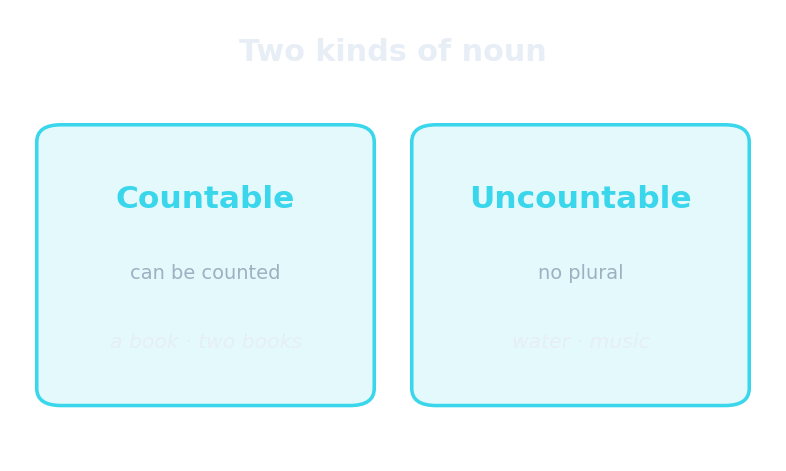
- Los sustantivos contables se pueden contar: un libro, dos libros.
- Los sustantivos incontables no: agua, música, dinero (sin plural).
- Esto cambia qué palabras usamos con ellos.
Tengo algunas tareas y mucha optimismo.
Countable vs uncountable
- Countable: a / an + singular, or a number + plural → a car, three cars.
- Uncountable: no a / an, no plural → water (not a water, not waters).
- Uncountable nouns take a singular verb: The news is good.
Contables vs incontables
- Contables: a / an + singular, o un número + plural → un coche, tres coches.
- Incontables: sin a / an, sin plural → agua (no a water, no waters).
- Los sustantivos incontables llevan verbo en singular: Las noticias son buenas.
Sort the nouns — countable or uncountable? · Clasifica los sustantivos — ¿contables o incontables?
Countable nouns can be counted and have a plural; uncountable nouns cannot. · Los sustantivos contables se pueden contar y tienen plural; los incontables no.
Which phrase is correct? · ¿Cuál frase es correcta?
“water” is uncountable — no plural and no number: “some water”. · “water” es incontable — sin plural y sin número: “some water”.
some / any
- some = a few / a little, in positive sentences: There are some eggs.
- any = in negatives and questions: There isn't any milk. Any questions?
- Use some for polite offers: Would you like some tea?
some / any
- some = unos / un poco de, en oraciones afirmativas: Hay algunos huevos.
- any = en negaciones y preguntas: No hay leche. ¿Alguna pregunta?
- Usa some para ofertas educadas: ¿Te gustaría un poco de té?
Complete the negative: There isn't ___ milk in the fridge. · Completa la negativa: There isn't ___ milk in the fridge.
Negatives use “any”: There isn't any milk. · Las negativas usan “any”: There isn't any milk.
Translate into English: 我需要一些水。 · Traduce al inglés: 我需要一些水。
Uncountable + positive → some water: “I need some water.” · Incontable + afirmativo → some water: “I need some water.”
much / many / a lot of
- many + countable plural: many people.
- much + uncountable (mostly negatives / questions): much time.
- a lot of works with both, and is best in positives: a lot of friends.
much / many / a lot of
- many + contable plural: muchas personas.
- much + incontable (mayormente negaciones / preguntas): mucho tiempo.
- a lot of funciona con ambos, y es mejor en afirmativas: muchos amigos.
Choose the correct word: There are ___ people here. · Elige la palabra correcta: There are ___ people here.
“people” is countable plural → use “many”. · “people” es plural contable → usar “many”.
Common mistakes
- ❌ informations / homeworks / advices → ✓ information / homework / advice — never plural.
- ❌ a bread → ✓ a piece of bread — count with a unit word.
- ❌ How much apples? → ✓ How many apples? — countable → many.
Errores comunes
- ❌ informations / homeworks / advices → ✓ information / homework / advice — nunca van en plural.
- ❌ a bread → ✓ a piece of bread — cuéntalos con una palabra de unidad.
- ❌ How much apples? → ✓ How many apples? — contable → many.
Match the unit to its noun. · Empareja la unidad con su sustantivo.
Uncountable nouns are counted through a unit: a slice / glass / cup / bar of … · Los sustantivos incontables se cuentan mediante una unidad: a slice / glass / cup / bar of …
Which sentence is correct? · ¿Qué oración es correcta?
information is uncountable — no plural, no a / an. · information es incontable — sin plural, sin a / an.
- Countable = can count (a car, cars); uncountable = can't (water, music).
- some (positive) / any (negatives, questions).
- many + countable, much + uncountable, a lot of + both.
- Contable = se puede contar (un coche, coches); incontable = no se puede (agua, música).
- some (afirmativo) / any (negaciones, preguntas).
- many + contable, much + incontable, a lot of + ambos.
Write one sentence about what is in your fridge, using “some” or “any” correctly. · Escribe una oración sobre lo que hay en tu nevera, usando “some” o “any” correctamente.
Example: “There are some eggs and some milk in my fridge.” · Ejemplo: “There are some eggs and some milk in my fridge.”