Comparatives and superlatives · Comparativos y superlativos
Comparing things
- Use comparatives to compare two things.
- Use superlatives for the "most" in a group of three or more.
- taller than … · the tallest
My bag is heavier than yours; the books are proud.
Comparar cosas
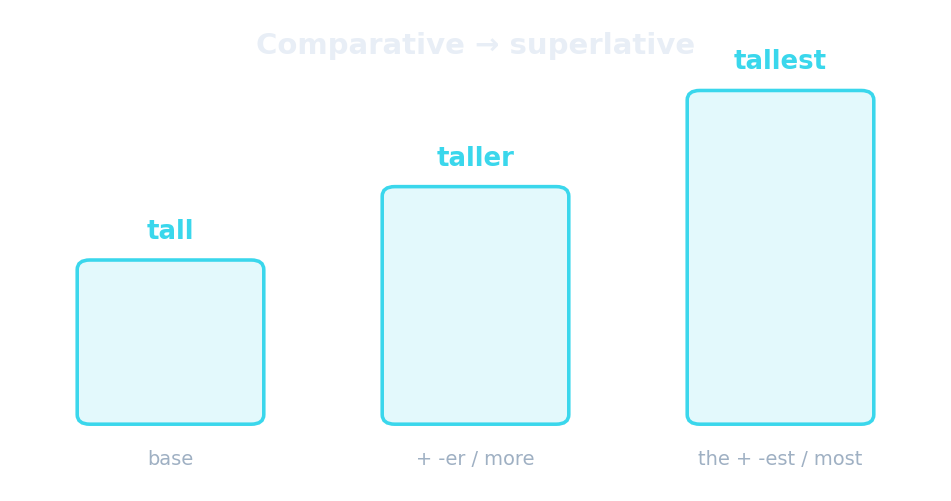
- Usa comparativos para comparar dos cosas.
- Usa superlativos para el "más" en un grupo de tres o más.
- taller than … · the tallest
My bag is heavier than yours; the books are proud.
Comparatives: -er / more … than
- Short adjectives: -er → tall → taller, big → bigger.
- Long adjectives: more … → more expensive.
- Add than to compare: My bag is bigger than yours.
- Irregular: good → better, bad → worse.
Comparativos: -er / more … than
- Adjetivos cortos: -er → tall → taller, big → bigger.
- Adjetivos largos: more … → more expensive.
- Añade than para comparar: My bag is bigger than yours.
- Irregulares: good → better, bad → worse.
Comparative: -er or more? · Comparativo: -er o más?
Short adjectives add -er; longer adjectives use 'more'. · Los adjetivos cortos añaden -er; los adjetivos largos usan 'more'.
Choose the comparative: This bag is ___ than that one. · Elige el comparativo: Esta bolsa es ___ que la otra.
Short adjective → add -er (and double the g): big → bigger. · Adjetivo corto → añadir -er (y duplicar la g): big → bigger.
Translate into English: 我的包比你的大。 · Traduce al inglés: 我的包比你的大。
Comparing two bags → comparative + than: “My bag is bigger than yours.” · Comparando dos bolsos → comparativo + than: “My bag is bigger than yours.”
Superlatives: the -est / the most
- Short: the + -est → the tallest.
- Long: the most … → the most beautiful.
- Don't forget the: He is the tallest in the class.
- Irregular: good → the best, bad → the worst.
Superlativos: the -est / the most
- Cortos: the + -est → the tallest.
- Largos: the most … → the most beautiful.
- No olvides the: He is the tallest in the class.
- Irregulares: good → the best, bad → the worst.
Complete the superlative: It is ___ film of the year. (good) · Completa el superlativo: Es ___ película del año. (good)
“good” is irregular: the best. Don't forget “the”. · “good” es irregular: the best. No olvides “the”.
as … as
- as + adjective + as = "the same as".
- She is as tall as her mother.
- Negative not as … as = "less than": Today isn't as hot as yesterday.
- Keep the adjective in its base form, not the comparative.
as … as
- as + adjetivo + as = "tan ... como".
- She is as tall as her mother.
- Negativo not as … as = "menos que": Today isn't as hot as yesterday.
- Mantén el adjetivo en su forma base, no en la comparativa.
Complete: She is as ___ as her sister. · Completa: Ella es tan ___ como su hermana.
Between as ... as, use the base adjective: “as tall as”. · Entre as ... as, usa el adjetivo base: “as tall as”.
Common mistakes
- ❌ It is more cheap. → ✓ It is cheaper. — short adjectives take -er.
- ❌ He is taller than me a lot. → ✓ He is much taller than me. — much goes before.
- ❌ bigger than your → ✓ bigger than yours.
Errores comunes
- ❌ It is more cheap. → ✓ It is cheaper. — los adjetivos cortos llevan -er.
- ❌ He is taller than me a lot. → ✓ He is much taller than me. — much va antes.
- ❌ bigger than your → ✓ bigger than yours.
Match the adjective to its comparative. · Une el adjetivo con su comparativo.
good / bad are irregular; happy → happier (y → i); long adjectives take more. · good / bad son irregulares; happy → happier (y → i); los adjetivos largos toman more.
Complete: This film is ___ interesting than that one. · Completa: Esta película es ___ interesante que la otra.
interesting is a long adjective → more interesting. · interesting es un adjetivo largo → more interesting.
- Comparative (two things): -er / more … than.
- Superlative (three or more): the -est / the most.
- as … as = the same; use the base adjective.
- Comparativo (dos cosas): -er / more … than.
- Superlativo (tres o más): the -est / the most.
- as … as = tan ... como; usa el adjetivo base.
Compare two things (two cities, two foods, two people…). Write one sentence with a comparative and “than”. · Compara dos cosas (dos ciudades, dos alimentos, dos personas...). Escribe una oración con un comparativo y “than”.
Example: “Shanghai is bigger than my hometown.” · Ejemplo: “Shanghai is bigger than my hometown.”