Present perfect — past meets now · Present perfect — el pasado se une al ahora
Linking the past to now
- The present perfect connects a past action to now.
- I have finished my homework. (so I'm free now)
- It's about experience or the recent past — not a specific time.
I have finished my homework; the sofa is delighted.
Conectar el pasado con el presente
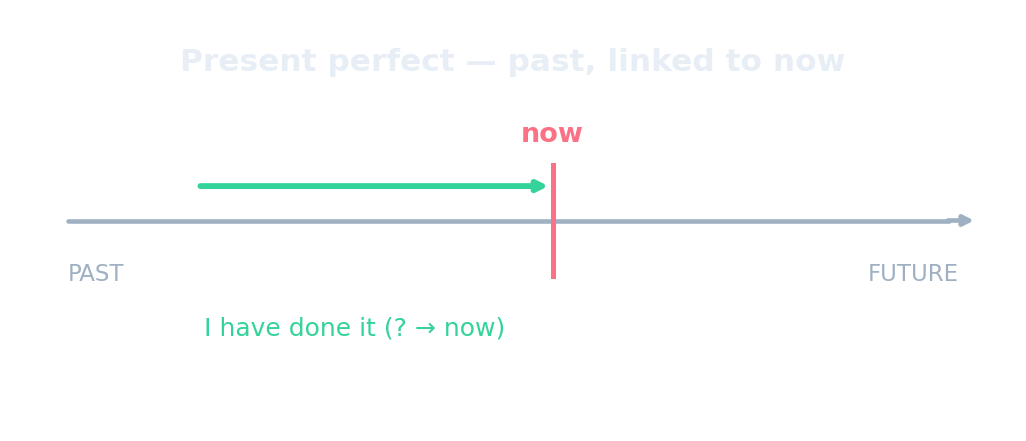
- El presente perfecto conecta una acción pasada con ahora.
- I have finished my homework. (así que ahora estoy libre).
- Se trata de experiencias o del pasado reciente, no de un momento específico.
I have finished my homework; the sofa is delighted.
Form: have / has + past participle
- have / has + past participle (he / she / it → has).
- I have seen it. She has gone home.
- Past participle: regular = -ed; irregular → do → done, see → seen, be → been.
Forma: have / has + participio pasado
- have / has + participio pasado (he / she / it → has).
- I have seen it. She has gone home.
- Participio pasado: regular = -ed; irregular → do → done, see → seen, be → been.
Which sentence is in the present perfect? · ¿Qué oración está en present perfect?
Present perfect = have/has + past participle: “has lost”. · Present perfect = have/has + participio pasado: “has lost”.
Complete: I have ___ (do) my homework. · Completa: I have ___ (do) my homework.
The past participle of “do” is “done”: I have done. · El participio pasado de “do” es “done”: I have done.
ever, never, just, already, yet
- ever (in questions) / never → experience.
- just = a moment ago; already = sooner than expected.
- yet goes at the end of negatives / questions ("so far / still not").
- Have you ever been to London? I've just eaten. He hasn't finished yet.
ever, never, just, already, yet
- ever (en preguntas) / never → experiencia.
- just = hace un momento; already = antes de lo esperado.
- yet va al final de las oraciones negativas o interrogativas ("hasta ahora / todavía no").
- Have you ever been to London? I've just eaten. He hasn't finished yet.
for and since
- for + a length of time → for three years.
- since + a starting point → since 2020.
- I have lived here for five years. We've known each other since 2018.
for y since
- for + una duración de tiempo → for three years.
- since + un punto de inicio → since 2020.
- I have lived here for five years. We've known each other since 2018.
for or since? · ¿for o since?
Use 'for' with a length of time, 'since' with a starting point. · Usa 'for' con una duración de tiempo, 'since' con un punto de inicio.
Choose the correct word: I have lived here ___ 2019. · Elige la palabra correcta: I have lived here ___ 2019.
2019 is a starting point → use “since”. Use “for” with a length of time. · 2019 es un punto de inicio → usa “since”. Usa “for” con una duración de tiempo.
Translate into English: 我在这里住了五年了。 · Traduce al inglés: 我在这里住了五年了。
Still true now → present perfect with for: “I have lived here for five years.” · Todavía es verdad ahora → present perfect con for: “I have lived here for five years.”
Common mistakes
- ❌ I have seen him yesterday. → ✓ I saw him yesterday. — an exact past time → past simple.
- ❌ I live here for ten years. → ✓ I have lived here for ten years. — still true now → present perfect.
- ❌ Have you ever went to Beijing? → ✓ Have you ever been to Beijing?
Errores comunes
- ❌ I have seen him yesterday. → ✓ I saw him yesterday. — un momento exacto en el pasado → pasado simple.
- ❌ I live here for ten years. → ✓ I have lived here for ten years. — sigue siendo verdad ahora → presente perfecto.
- ❌ Have you ever went to Beijing? → ✓ Have you ever been to Beijing?
Match the verb to its past participle (the have/has form). · Une el verbo con su participio pasado (la forma have/has).
The participle is the third form: do–did–done, see–saw–seen, eat–ate–eaten, be–was–been. · El participio es la tercera forma: do–did–done, see–saw–seen, eat–ate–eaten, be–was–been.
Tom isn't here. He has ___ to the bank.
gone = he went and is still away; been = he went and came back. · gone = fue y sigue fuera; been = fue y volvió.
- Present perfect links past → now.
- Form: have / has + past participle.
- for + a length of time; since + a starting point.
- Presente perfecto une pasado → ahora.
- Forma: have / has + participio pasado.
- for + una duración de tiempo; since + un punto de inicio.
Write one sentence about a place you have visited, using the present perfect (have/has been to ...). · Escribe una oración sobre un lugar que hayas visitado, usando el present perfect (have/has been to ...).
Example: “I have been to Shanghai.” (have + been) · Ejemplo: “I have been to Shanghai.” (have + been)