The current account and trade balance
Introducido| English | Significado |
|---|---|
| current account/ˈkʌrənt əˈkaʊnt/ | cuenta corriente |
| trade deficit/treɪd ˈdefɪsɪt/ | déficit comercial |
China's record surplus
- In 2022 China exported about 878 billion US dollars more goods than it imported — the largest trade surplus any country had recorded. Other countries, such as the US and the UK, regularly import more than they export.
- The current account records these flows.
What the current account includes
- The current account 经常账户 records trade in goods and services, plus income flows (such as profits and interest from abroad) and transfers (such as money sent home by migrants).
- Exports bring money in (+); imports send money out (−).
Which are recorded in the current account?
Dificultad 2/5 · 140 monedas + un pequeño bono en el primer intento de hoy
House prices are not a flow of money across borders.
The trade balance
- Trade balance $=$ exports $-$ imports of goods and services.
- A trade deficit 贸易逆差 means imports are bigger than exports; a surplus means exports are bigger.
Exports of goods and services are 250 billion and imports 270 billion. What is the trade balance?
Dificultad 2/5 · 140 monedas + un pequeño bono en el primer intento de hoy
250 − 270.
Match each flow to its sign on the current account.
Dificultad 2/5 · 140 monedas + un pequeño bono en el primer intento de hoy
Which way does the money flow?
Worked example: building the balance
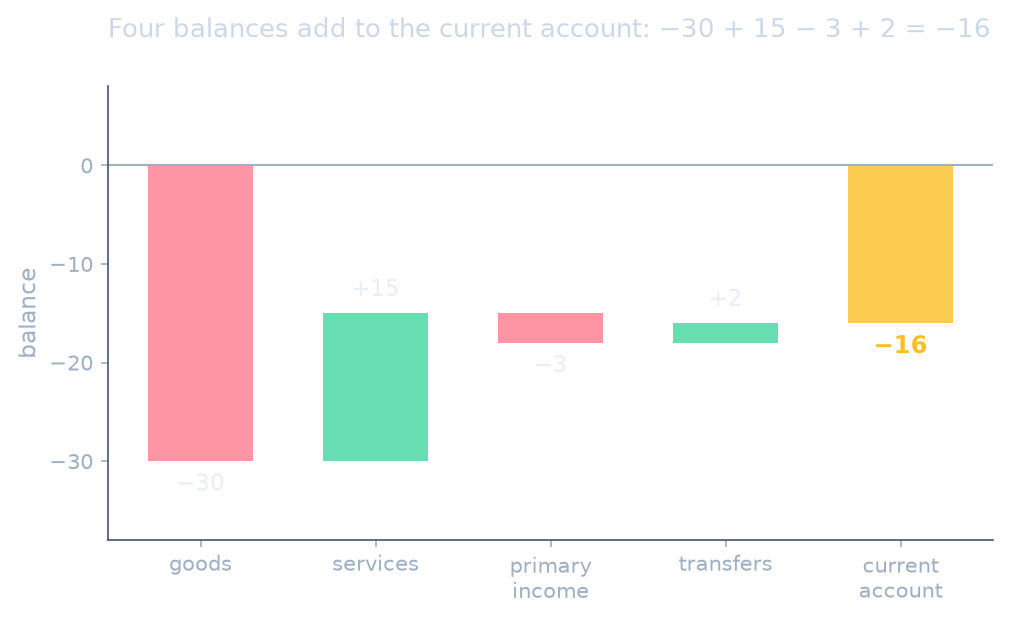
Goods exports 80, imports 110. Services exports 40, imports 25. Net primary income −3; net transfers +2 (billion dollars).
- Goods: $80 - 110 = -30$. Services: $40 - 25 = +15$.
- Trade balance: $-30 + 15 = -15$, a deficit.
- Current account: $-15 - 3 + 2 = -16$ billion dollars.
Building the current-account balance
Goods 80 − 110 = −30 and services 40 − 25 = +15 give a trade balance of −15. Add net primary income −3 and net transfers +2 and the current account is −16.
Trade balance −20, net primary income +8, net transfers −3. What is the current account balance?
Dificultad 2/5 · 140 monedas + un pequeño bono en el primer intento de hoy
−20 + 8 − 3.
Causes of a deficit
- Strong consumer spending pulls in imports; firms that are not competitive lose export sales.
- A strong exchange rate makes exports dear abroad and imports cheap at home.
Which is most likely to widen a current account deficit?
Dificultad 1/5 · 100 monedas + un pequeño bono en el primer intento de hoy
Exports dearer, imports cheaper.
Is a deficit a problem?
- A small deficit, paid for by foreign investment, may be fine. A large, lasting one must be financed by borrowing or selling assets.
- Governments may respond by improving competitiveness, not only by cutting spending.
The trade balance is not the whole current account. Here trade is −15, but income and transfers bring the current account to −16. Add every part.
The trade balance and the current account balance are always the same.
Dificultad 1/5 · 100 monedas + un pequeño bono en el primer intento de hoy
Income and transfers are also included.
The current account = trade in goods + trade in services + primary income + transfers. A deficit means more is paid out than comes in. Causes include strong demand, low competitiveness and a strong currency.
Explain why a country might have a large, lasting current account deficit, and whether it should worry.
Current account.