Concentration ratios
Introducido| English | Significado |
|---|---|
| concentration ratio/ˌkɒnsənˈtreɪʃn ˈreɪʃɪəʊ/ | coeficiente de concentración |
| market definition/ˈmɑːkɪt ˌdefɪˈnɪʃn/ | definición del mercado |
Three networks, a billion phones
- Almost every mobile phone in China runs on one of three state-owned networks: China Mobile, China Telecom or China Unicom.
- In the US, four airlines carry most domestic passengers. In both cases a few firms supply most of the market.
- The concentration ratio 集中度比率 measures this.
Concentration ratios
- A CRn is the combined market share of the n largest firms. CR3 adds the top three; CR4 the top four.
- A CR4 above about 60% usually suggests an oligopoly; a low ratio suggests many competing firms.
Shares are 35%, 20%, 18%, 12%, 10% and 5%. What is CR3?
Dificultad 2/5 · 140 monedas + un pequeño bono en el primer intento de hoy
$35 + 20 + 18 = 73\%$.
What is CR4 in that market?
Dificultad 2/5 · 140 monedas + un pequeño bono en el primer intento de hoy
$73 + 12 = 85\%$.
Worked example: CR4 and a merger
Market shares: A 30%, B 25%, C 15%, D 10%, E 8%, F 7%, G 5%.
- CR3 $= 30 + 25 + 15 = 70\%$; CR4 $= 70 + 10 = 80\%$.
- E and F merge into one firm with 15%. The four largest are now A, B, C and EF.
- New CR4 $= 30 + 25 + 15 + 15 = 85\%$ — not $80 + 3$, because the merged firm replaces D in the top four.
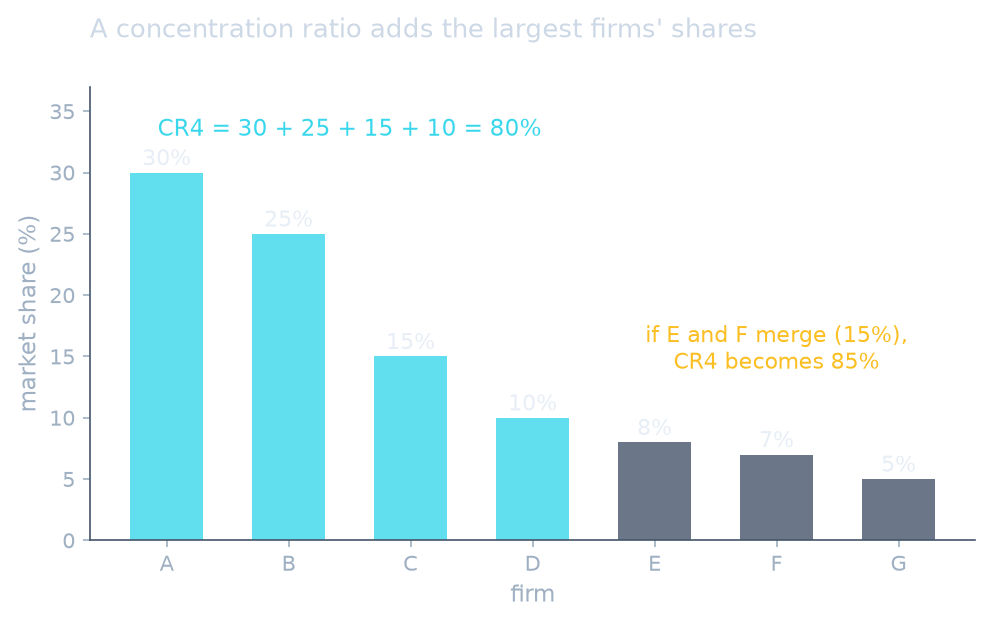
A merger can change who counts in CR4
With shares 30, 25, 15, 10, 8, 7 and 5%, CR3 = 70% and CR4 = 80%. When E (8%) and F (7%) merge, the new 15% firm joins the four largest: CR4 becomes 30 + 25 + 15 + 15 = 85%, not 83%.
The firms with 10% and 5% merge. What is the new CR4?
Dificultad 2/5 · 140 monedas + un pequeño bono en el primer intento de hoy
The top four are now 35, 20, 18, 15: $88\%$.
What is "the market"?
- Shares depend on market definition 市场界定. Is Coca-Cola's market "cola", "soft drinks" or "all drinks"? Its share is very different in each.
- A narrow definition makes concentration look higher; a wide one makes it look lower. Regulators argue about this in merger cases.
A firm's share is 60% of "instant coffee" but 8% of "hot drinks". What does this show?
Dificultad 1/5 · 100 monedas + un pequeño bono en el primer intento de hoy
Narrow definitions raise measured concentration.
What the ratio does not show
- It ignores how shares are split: CR4 of 80% could be 20% each or 77% for one firm.
- It ignores imports, potential entrants and how firms actually behave.
Two markets with the same CR4 must have the same degree of competition.
Dificultad 1/5 · 100 monedas + un pequeño bono en el primer intento de hoy
The split between firms, entry and behaviour can differ.
What does a concentration ratio NOT show?
Dificultad 2/5 · 140 monedas + un pequeño bono en el primer intento de hoy
It shows only the combined share.
A high concentration ratio does not prove that firms collude or overcharge. Four large firms can compete fiercely on price. Concentration is a warning sign, not a verdict: look at barriers to entry and conduct as well.
A concentration ratio adds the market shares of the largest firms. It depends on how the market is defined, hides the split between the top firms, and ignores entry and behaviour. A merger can raise CR4 by more than the smaller firm's share.
Explain two limitations of the concentration ratio as a measure of competition.
Market definition and hidden structure are the main limits.