Diminishing returns and short-run costs
Introducido| English | Significado |
|---|---|
| diminishing marginal returns/dɪˈmɪnɪʃɪŋ ˈmɑːdʒɪnl rɪˈtɜːnz/ | rendimientos marginales decrecientes |
| short run/ʃɔːt rʌn/ | A period in which at least one factor of production is fixed. |
| long run/lɒŋ rʌn/ | A period long enough for all factors of production to be varied. |
| marginal product/ˈmɑːdʒɪnl ˈprɒdʌkt/ | producto marginal |
| average product/ˈævrɪdʒ ˈprɒdʌkt/ | Total output divided by the quantity of the input being measured, such as output per worker. |
| fixed costs/fɪkst kɒsts/ | Costs that do not change with output over the relevant period and production range. |
| variable costs/ˈveərɪəbl kɒsts/ | Costs that change as the level of output changes. |
Too many cooks
- A restaurant kitchen has four stoves. The first few cooks raise output fast. The eighth cook spends most of the time waiting for a free stove.
- David Ricardo saw the same thing on farms in 1815: adding workers to a fixed field gives smaller and smaller harvest gains.
- This is the law of diminishing marginal returns 边际报酬递减.
The short run
- In the short run at least one input, such as machines or land, is fixed. In the long run all inputs can change.
- Total product (TP) is total output. Marginal product 边际产量 (MP) $= \dfrac{\Delta \text{TP}}{\Delta L}$; average product (AP) $= \dfrac{\text{TP}}{L}$.
Output rises from 60 to 72 when a fourth worker is hired. What is the marginal product of the fourth worker?
Dificultad 2/5 · 140 monedas + un pequeño bono en el primer intento de hoy
$72 - 60 = 12$.
Four workers produce 72 units. What is average product?
Dificultad 2/5 · 140 monedas + un pequeño bono en el primer intento de hoy
$\dfrac{72}{4} = 18$.
Worked example: product and marginal cost
A workshop with fixed machines employs 0 to 5 workers. Output: 0, 10, 25, 35, 42, 47. The wage is 30 per worker.
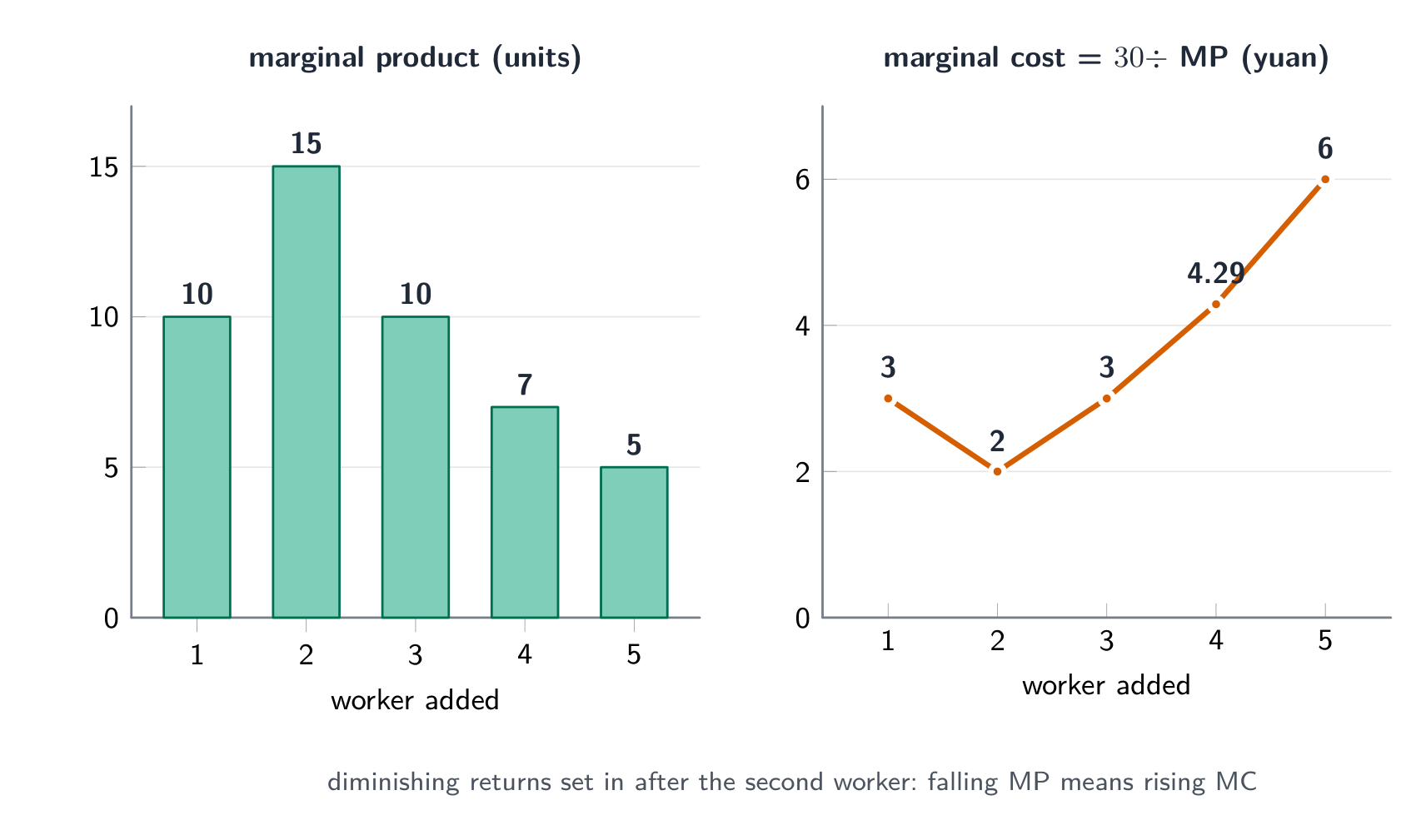
- MP: 10, 15, 10, 7, 5. Diminishing returns start after the second worker.
- MC $= \dfrac{\text{wage}}{\text{MP}}$: $\dfrac{30}{10} = 3$, $\dfrac{30}{15} = 2$, $\dfrac{30}{10} = 3$, $\dfrac{30}{7} \approx 4.29$, $\dfrac{30}{5} = 6$.
- MC is lowest where MP is highest. Falling MP means rising MC.
Marginal product sets marginal cost
$MC=\dfrac{w}{MP}$
With a wage of 30 and output 0, 10, 25, 35, 42, 47, each worker's MC is 30 ÷ MP: 3, 2, 3, about 4.29, then 6. MC is lowest where marginal product peaks.
The wage is 48 and the marginal product of a worker is 12. What is the marginal cost of a unit of output?
Dificultad 2/5 · 140 monedas + un pequeño bono en el primer intento de hoy
$\dfrac{48}{12} = 4$.
Output with 0–4 workers is 0, 8, 20, 27, 31. After which worker do diminishing returns start?
Dificultad 1/5 · 100 monedas + un pequeño bono en el primer intento de hoy
MP is 8, 12, 7, 4 — it falls after the second worker.
Falling MP, rising TP
- With 5 workers, TP still rises (42 → 47) even though MP has fallen to 5.
- Only if MP became negative would total output fall — the extra cook gets in everyone's way.
When marginal product is falling, total product must be falling.
Dificultad 1/5 · 100 monedas + un pequeño bono en el primer intento de hoy
TP falls only when MP is negative.
Costs in the short run
- Fixed costs (rent, machines) do not change with output; variable costs (wages, materials) do.
- Average variable cost $= \dfrac{\text{TVC}}{Q}$: with 5 workers, $\dfrac{150}{47} \approx 3.19$.
Fixed or variable cost?
Dificultad 2/5 · 140 monedas + un pequeño bono en el primer intento de hoy
Variable costs change with output.
Diminishing returns are a short-run idea, not the same as diseconomies of scale. They happen because one input is fixed. In the long run a firm can add machines as well as workers, and it may then enjoy economies of scale.
In the short run at least one input is fixed. Adding a variable input eventually brings diminishing marginal returns: MP falls. With a constant wage, MC = wage ÷ MP, so falling MP means rising MC. TP keeps rising until MP becomes negative.
Explain why marginal cost eventually rises in the short run.
MC = wage ÷ MP.