Productive capacity and long-run supply
Introducido| English | Significado |
|---|---|
| productive capacity/prəˈdʌktɪv kəˈpæsɪti/ | capacidad productiva |
| labour productivity/ˈleɪbə ˌprɒdəkˈtɪvɪti/ | productividad laboral |
Ten times more graduates
- In 1998 about one million students entered Chinese universities each year. By 2022 it was over ten million.
- More skilled workers, more machines and better technology raise how much an economy can produce: its productive capacity 生产能力.
- In a diagram, this shifts LRAS to the right.
Quantity and quality of resources
- Capacity grows when there are more resources: more workers (higher birth rates, migration, later retirement) or more capital.
- It also grows when resources become better: labour productivity 劳动生产率 is output per worker, and it rises with education, training, better machines and technology.
A factory of 40 workers produces 1200 units a day. What is labour productivity per worker?
Dificultad 2/5 · 140 monedas + un pequeño bono en el primer intento de hoy
$\dfrac{1200}{40} = 30$.
Worked example: two sources of growth
100 workers each produce 5 units, so potential output is $100 \times 5 = 500$.
- Training raises output per worker to 5.5: potential output $= 100 \times 5.5 = 550$, a 10% rise.
- Ten more workers at 5.5 each: potential output $= 110 \times 5.5 = 605$.
- Total rise $= \dfrac{605 - 500}{500} \times 100 = 21\%$. Two 10% rises give $1.10 \times 1.10 = 1.21$, not 20%.
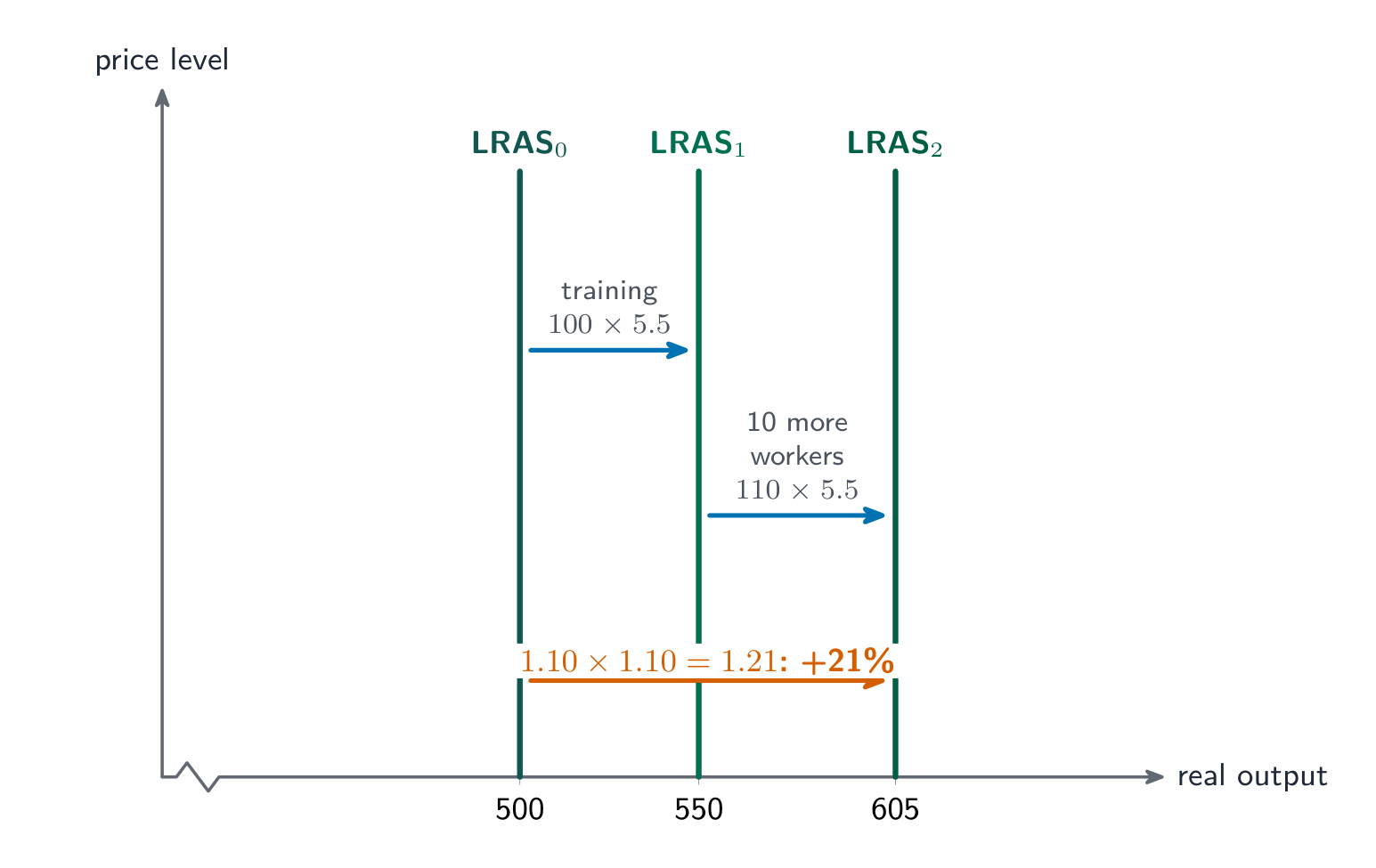
Potential output = workers × output per worker
100 workers producing 5 units each give potential output 500. Training raises output per worker to 5.5: 550. Adding 10 workers at 5.5 gives 605, a 21% rise (1.10 × 1.10), not 20%.
200 workers produce 4 units each. Productivity rises to 5 and the workforce to 220. What is the new potential output?
Dificultad 2/5 · 140 monedas + un pequeño bono en el primer intento de hoy
$220 \times 5 = 1100$.
In that example, by what percentage has potential output risen?
Dificultad 2/5 · 140 monedas + un pequeño bono en el primer intento de hoy
$\dfrac{1100 - 800}{800} \times 100 = 37.5\%$ — that is $1.25 \times 1.10$.
Supply-side causes
- Infrastructure: high-speed rail and ports cut transport costs and time.
- Competition and incentives: lower taxes on work and profit, deregulation, privatisation.
- Institutions: stable property rights and courts make firms willing to invest for the long term.
Which would shift LRAS to the right?
Dificultad 2/5 · 140 monedas + un pequeño bono en el primer intento de hoy
Confidence affects AD, not capacity.
Capacity takes time
- A new university or a new railway costs money now but raises capacity only years later.
- Some conditions limit the effect: graduates may not find jobs that use their skills, and a new machine needs trained workers.
Spending on new universities raises productive capacity in the same year.
Dificultad 1/5 · 100 monedas + un pequeño bono en el primer intento de hoy
Capacity rises only when graduates enter work years later.
More output this year is not the same as more capacity. If unemployed workers return to work, actual output rises along an existing LRAS. Capacity rises only when the quantity or quality of resources increases.
Unemployment falls from 8% to 5% with no change in resources. What has happened?
Dificultad 1/5 · 100 monedas + un pequeño bono en el primer intento de hoy
Using idle workers raises actual output, not capacity.
Productive capacity rises with more or better resources: more workers and capital, higher labour productivity, better technology and institutions. This shifts LRAS right, usually slowly. Growth rates combine by multiplying, not adding.
Explain how improved education could shift LRAS, and one reason why the effect may be limited.
Use cause → effect, then a condition.